Die längste Zugstrecke der Welt führt von Portugal nach Singapur
Ein paar Eisenbahn-Nerds haben errechnet, dass man dank der neuen Eisenbahn zwischen Laos und China nun von Portugal nach Singapur durchgehend mit dem Zug reisen kann.
Von Lagos im Süden Portugals ist es jetzt möglich, bis nach …… Singapur in Südostasien mit dem Zug zu reisen. Dauert halt ein bisschen länger.Möglich ist dieser Megatrip, weil Anfang Dezember 2021 China die erste Teilstrecke der “Neuen Seidenstraße” durch Südostasien eröffnet hatte.
18.755 Kilometer in 21 Tagen, von Südeuropa bis an die Südspitze der Malaiischen Halbinsel, alles mit dem Zug: Nach Ansicht von Experten wurde ein neuer Rekord für die längste ununterbrochene Bahnfahrt aufgestellt. Selbstverständlich handelt es sich dabei nicht um eine Direktverbindung.
Möglich ist dieser Megatrip, weil Anfang Dezember 2021 China die erste Teilstrecke der “Neuen Seidenstraße” durch Südostasien eröffnet hatte. Nach fünf Jahren Bauzeit wurde der rund 400 Kilometer lange Streckenabschnitt zwischen der laotischen Hauptstadt Vientiane und der chinesischen Stadt Kunming fertiggestellt: Über den Grenzbahnhof Boten werden Vientiane und Kunming über 242 Tunnel und Brücken durch bergiges Terrain verbunden.
Mehrere Zwischenstopps
Die Anbindung von China an Laos ermöglicht nun die wohl längste Zugverbindung der Welt, wie es Reddit-Nutzer gemeinsam mit dem britischen Eisenbahn-Enthusiasten Mark Smith ausgerechnet haben: Start der Rekordreise ist die Stadt Lagos in der Algarve im Süden Portugals. Weiter geht es über das französische Hendaye im Baskenland und über Paris nach Moskau.
Mit der berühmten Transsibirischen Eisenbahn geht’s weiter bis nach Peking. Kurzer Zwischenstopp in Kunming – der Hauptstadt der chinesischen Provinz Yunnan –, und weiter geht die Reise in die laotische Hauptstadt Vientiane. Über Bangkok und die drei malaysischen Städte Padang Besar, Penang und Kuala Lumpur erreicht man schlussendlich nach mindestens dreiwöchiger Reisedauer Singapur.
Auf der Route müssen Reisende in Lissabon, Madrid und Paris jeweils einmal und in Moskau und Peking zweimal übernachten, um die weiteren Anschlusszüge zu bekommen. Bei fünf so spannenden Hauptstädten sind diese Stopps aber wohl eher als eine Bereicherung zu sehen.
Die Kosten für eine Fahrt auf der längsten Bahnstrecke der Welt belaufen sich laut “Daily Mail” auf etwa 1.200 Euro – in eine Richtung.
A month before I boarded the plane to Cairns, Fox Studios had released The Beach (2000) into cinemas. Based on the bestselling 1996 novel by Alex Garland, and directed by Danny Boyle, the film follows Richard (played by Leonardo DiCaprio) on a backpacking journey to Thailand. After drinking some snake blood, he finds his way to a secret island, where an idyllic community lives beside a pristine island lagoon. There he finds joy and love to the ambient strains of Moby’s ‘Porcelain’ (2000), then fucks it all up, and goes insane.
I’d watched the film in a bar in Bali. In those days, backpacker bars throughout Southeast Asia would often show flickering, pirated copies of the latest cinema releases. But I didn’t pay much heed to its allegorical warnings about the dangers of surrendering to serendipity, or its blunt moral that paradise could only ever be ephemeral. I was 19 years old, and preoccupied with finding my own.
‘Mine is the generation that travels the globe and searches for something we haven’t tried before,’ says Richard. ‘So never refuse an invitation, never resist the unfamiliar, never fail to be polite and never outstay the welcome. Just keep your mind open and suck in the experience.’
New experiences have a mnemonic quality – they create a more lasting imprint in the brain
At the end of my own first brush with this zeitgeist, I came home armed with what amounted to a Proustian epiphany: I had come to realise, with a certainty that brooked no contradiction, that fresh experiences emblazoned themselves in the mind at a higher definition, palpably lengthening time. If memories of home-life often seemed diffuse, its events overlapping and abbreviated by familiarity, the ones I carried back from Bangkok were pin-sharp.
Would it make sense if I told you that I can conjure every hump and hollow of that Thailand beach? I can tell you the sand was the colour of bleached coral, that it was fringed with a tangle of low-slung mangroves. I remember that we had just descended from that boulder when it began to rain, and that we hopscotched around washed-up flotsam, drenched to the skin. I can recount how the frothing ebb tide had left dozens of jellyfish stranded every few yards, some of which we attempted to flick back into the surf with a stick, an act which I now realise probably looked thuggish to any bystanders, though I promise it was charitably intended. Later that day, we sat on the beach and watched lightning fork across the sky, except on the horizon, where the dusk broke through in a fan of sunbeams, making silhouettes of the container ships far out to sea.
Possible explanations for the pellucid nature of such recollections are not confined to the philosophical. In recent years, neuroscientists have discerned a clear correlation between novelty and memory, and between memory and fulfilment. Their findings suggest that new experiences have a mnemonic quality – they create a more lasting imprint in the brain. It didn’t seem an unreasonable leap of logic to assume that this might come to be seen as retrospective proof of a person’s rich and happy life.
I recently happened across a multinational study, undertaken in 2016, which investigated the link between novel experiences and the potency of memory. The authors set up an experiment in which mice were introduced to a controlled space and trained to find a morsel of food concealed in mounds of sand. Under normal conditions, researchers found that the mice were able to remember where the food was hidden for around one hour. However, if the environment was altered – in this case, the mice were placed in a box with a new floor material – they could still find the food up to 24 hours later. The introduction of new conditions appeared to magnify the creatures’ power of recall.
Employing a technique known as optogenetics, the study attributed this phenomenon to activity within the locus coeruleus, a region of the mammalian brain that releases dopamine into the hippocampus. Novel experiences, the results seemed to indicate, trigger happy chemicals, which in turn help to produce more indelible engrams, the biochemical traces of memory.
It was with an intuitive version of this self-knowledge that I forged out into the world: a mouse forever in search of a new floor. I spent the years after university shaping my ambitions around overseas adventures, and the months in between desperately saving for the next. Travel writing seemed an obvious alibi, a means of camouflaging my experiential hunger with a veil of purpose. But, in reality, I was engaged in a personal mission to see everything, and I was in a hurry.
My travelling assumed a frantic cadence, as if movement between map pins was a competitive sport. I would travel to the limits of my courage and energy, crisscrossing remote hinterlands, clambering from one clapped-out bus to another, often on no sleep. If I had any particular travelling sensibility it approximated Robert Louis Stevenson’s epigram: ‘I travel not to go anywhere, but to go. I travel for travel’s sake. The great affair is to move.’ It was never my intent to check off a list of sights and animals; this wasn’t some Instagrammer-style process of acquisition and display, at least not explicitly so. More, it was born of a will to reset the view, like an impatient child hitting the lever on a 1980s View-Master, desperate to change the slides.
Ironically, this often placed me in harm’s way. In the Brazilian Amazon, for instance, I was almost killed by a four-year-old child. A hunter had left a loaded shotgun in a dugout canoe, its muzzle resting on the bow, only for his daughter to mistake it for a plaything and pull the trigger. I can still remember the sensation of the buckshot wafting past my abdomen, and wondering out loud, minutes later, how far it might have been to the nearest hospital. (‘Eight hours by outboard motor,’ our teenage guide replied gravely.)
In 2010, I contracted typhoid, dengue fever and bilharzia, in the space of six months. The last of these, a parasitic disease endemic to the Great Lakes region of central Africa, didn’t make itself known until four years later, when streaks of blood in my urine betrayed the Malawian stealth invaders that had been loitering and multiplying in my bladder all that time.
But the perils inherent in my reckless movement always receded after the fact. Often, the close shaves themselves became rose-tinted in the retelling, as if every misadventure was further evidence of my enviable, halcyon life. The perils burnished the story I was writing. It was all part and parcel of the experientialist’s covenant. Again, from Richard in The Beach: ‘If it hurts, you know what? It’s probably worth it.’
As travel democratised, a consensus grew that a storied life must necessarily be a well-travelled one
My symptoms may have been specific and acute, but my choice of remedy for existential anguish was by no means mine alone. In hindsight, I realise I was merely a fanatical disciple of a widespread impulse. For me and many other cynical agnostics, novelty had become the stuff of life. As organised religion waned and we turned away from metaphysical modes of being, experience presented itself as a surrogate for enchantment.
The Western democracies were set on their trajectory: more consumption, more capitalism, more privatisation, which for most people seemed to promise a half-life on a treadmill of work, anxiety and inflexible social norms. But the outside world offered a way out. Only by fleeing the geographical constraints of that staid order was it possible to apprehend its shortcomings – to discover the ways that our own status quo, in its hubristic embrace of what we deemed progress, might have been haemorrhaging precious truths. The Western traveller’s existential epiphany – that pastoralists in the foothills of some impoverished Asian hinterland seemed more at peace with the world than whole avenues of London millionaires – may have been hackneyed and condescending. But to a 20-something in the early 2000s it felt profound. And so we came to see a full passport as a testament, not just to a life well lived, but to some essential insights into the human condition.
Of course, the travel itself had become so easy. The proliferation of new long-haul airlines, often subsidised by vain Middle Eastern plutocrats with bottomless pockets, ensured that transcontinental fares got lower by the year. The no-frills revolution, pioneered by the likes of Easy Jet and Ryanair, transformed the once fraught and expensive decision of whether to go abroad into a momentary whimsy. A weekend in Paris? Rome? Vilnius? Now $60 return.
For my generation, this revolution of affordability and convenience was providential, coinciding with a time in life when we had the paltry wages and an absence of domestic responsibility to exploit it. The collapse of the old Eastern bloc, and its constituent nations’ subsequent tilt towards consumer capitalism, opened up the half of my continent where the beaches weren’t yet overcrowded and the beers still cost a dollar. In the meantime, the communications revolution meant that organising such trips had never been more straightforward. One spring, I arranged for a few friends to climb a Moroccan mountain over a long weekend. We flew to Marrakesh on the predawn flight from Stansted Airport in London, where a dozen stag dos, bound to exact a very British carnage on Europe’s sybaritic capitals, were sculling tequila shots at 5am. Twelve hours later, we were 10,000 feet up in the High Atlas, readying ourselves for a 1am summit assault of Jebel Toubkal. I remember lying in the base-camp dormitory, giggling at the music of our farts brought on by the rapid change of air pressure, in a state of exultation. This kind of instant adventure, unimaginable just a decade earlier, was now just a couple of days’ wages and a few mouse clicks away.
As travel democratised, and became a component of millions more lives, a consensus grew that a storied life must necessarily be a well-travelled one. Holidays were no longer an occasional luxury, but a baseline source of intellectual and emotional succour. This idea of travel as axiomatic – as a universal human right – was a monument to an individualist culture in which the success or otherwise of our lives had become commensurate to the experiences we accrue.
And I was there, an embodiment of this new sacrament, and its amanuensis. In the proudest version of my self-image, I was a swashbuckling, bestubbled wayfarer, notebook in hand. ‘The mass of men lead lives of quiet desperation,’ wrote Henry David Thoreau. Not me, no sir. Because I was a man who had been to 100 countries. Who knew what wonder was, and where to find it.
A decade or so ago, when I was approaching my 30th birthday, I went on a writing assignment to the Indian Himalayas, where I trekked for two weeks through the most beautiful countryside I have seen, before or since. I had a guide, a gentle man called Biru, and we spent most of the days walking in each other’s bootprints, chatting about the geography, the culture of the Bhotia people we encountered in the foothills, and the contrasts between our disparate lives. But one afternoon, on the approach to a 14,000-foot saddle called the Kuari Pass, I felt buoyed by some hitherto untappable energy, and I left Biru far behind.
As I ran, zigzagging up the mule trails, I suddenly became gripped with an extraordinary lucidity. It felt as if only now, with the last vestiges of civilisation 12 miles down the mountainside, did I have the solitude with which to grasp the true splendour of my surroundings. As I clambered from joy into reverie, a vision kept entering my consciousness – of a broad-shouldered man, beckoning me forward.
He sat on the pass, back propped against a hump of tussock grasses. He was just as the most precious family photos recalled him: the same age I was now, lean and smiling, in faded jeans and the threadbare grey T-shirt he wore on a sunny day in a south London park before he fell ill. He looked strong – not ghostly, but corporeal – and I remember being struck that he could look so beatific up there, seemingly inured to the brittle wind whipping up from the valleys below. I had a vague sense that if only I could get there, to the pass, we could stand shoulder to shoulder, and all the secret knowledge I had been denied – of how to live the life of a good man, of how to live unafraid – would flow from him into me.
At dusk, encamped at the base of the final approach to the pass, I felt hollowed out, bereft. After we pitched our tents, I walked a mile back down the trail and found a peaceful spot in a glade of tall deodar cedars, where I wept about my dad for the first time in years.
My most distressing childhood memories were, in fact, lurid dramatisations of events I’d never witnessed
In his book The Interpretation of Dreams (1899), Sigmund Freud described the death of a father as ‘the most important event, the most poignant loss in a man’s life’. I don’t know if that’s true. But I think I have always known that the first waymarker on my trip around the physical world was the same moment that upended my private one. According to the death certificate, that was at 10:30pm on 13 March 1985, when my father succumbed to non-Hodgkin’s lymphoma in a London hospital, at the age of 32. Right from the start, the trauma of this event corrupted the way I processed and recalled experiences. Henceforward, my hippocampus would be a faulty and elastic device. I was four years old at the time of my father’s death. But I have no concrete memories between then and the age of eight.
The author, aged three, with his father on Loch Lomond in 1984
Only in more recent years, in conversations with my mum, would I come to realise that my most distressing childhood memories – that is to say, those of my dad’s actual demise – were, in fact, recurring nightmares, lurid dramatisations of events I’d never witnessed. In the most indelible, I walk into a room of starkest white, my childish rendition of a hospital. Over in a corner, he lies dead and shrunken on a plinth. He has big purple welts over his eyes, like a melancholic clown. I can conjure this image with crystal clarity, yet my mum insists I was never exposed to his diminishment at the end, let alone his body when the fight was done.
Of the man as he was in life there is next to nothing. Just a sonorous voice, impossibly deep, my recollection of which is tactile as much as aural: a muscle memory of a reverberation I felt as I clung to his knees. What image I have stored has always been a spare composite, moulded around the gauzy recollections of those who loved him best. His friends and relatives would tell me: ‘Everyone adored Peter.’ And: ‘You are the spitting image of him,’ though this last wasn’t entirely true for, while I am tallish, he was a giant: 6 foot, 6 inches and broad, with feet so large he had to go to a specialist shop to buy his shoes. He was a sportsman, though one too laconic to take sports that seriously, and he was a talented artist, given to scrawling note-perfect caricatures on request. A self-possessed man, he had rebelled against the austere mores of a disciplinarian Maltese household, growing up to be kind, generous, egalitarian and wise. Oh, and he was also handsome, smart and preternaturally charming. An early death does not lend itself to balanced valediction, you see. Nonetheless, I was convinced of his perfection. Remember your dad: the fallen god.
This tendency to deify the absent parent – hyperidealisation – had left a haunting question unanswered: if the god was so mighty yet still succumbed, what hope was there for me? By all accounts, my perfect father had wanted nothing more than to live. It was fate, not choice, which had denied him that wish, and so I couldn’t trust fate at all.
I was in my mid-20s when I became convinced of the imminence of my death.
It would be too neat a story to suggest that I was always conscious of a direct causation between this dark fatalism and my early bereavement. As a child, fatherlessness was just the way of things, an ineluctable state of being which I accepted with the outward stoicism of one who knew no different.
However, as I neared the age he was when he died, I became transfixed by the expectation that my father’s destiny was mine as well. Just as I had internalised my relatives’ exhortations to step into his shoes – to be ‘man of the house’, custodian of my surviving family – I also expected to emulate his attenuated life-curve.
My days became backtracked by a hum of worry. I never saw anyone about it, and seldom if ever mentioned it to friends or loved ones. But reading around the edges, I suppose it resembled post-traumatic stress disorder, a miasma of intrusive thoughts, and vivid, almost hallucinatory, anxieties. At my most vulnerable, I felt hunted. Somewhere on the near horizon was a sickness, something to expose the weakness invisible to everyone but myself. I wasn’t sure what shape this chimera would adopt (probably cancer, in keeping with family tradition). But I knew it would be something enervating and rapid – a desperate withering. And I knew that I would make no peace with it, that I would endure every downward step in terror and the keenest fury at the injustice of it all.
Denied my precious years of formative complacency, knowing that it is all anguish and heartbreak in the end, I’d lit out to engrave my brain with random people and places, as if this alone were a barometer of self-worth. I might have kidded myself that it was just the pursuit of happiness. But, in reality, what I was embarking on was a project of temporal elongation, forestalling my death by bleeding each hour of moments. It just seemed like the best compensation for the years I was predestined to lose.
For the time that I lived in thrall to this self-inflicted prophecy, my overseas journeys provided respite for my restless mind. But the theatre of travel was changing, fast.
The paradigm shift made itself known in a new idiom: the ‘selfie’, bringing with it a disconcerting atmosphere of self-absorption to every tourist attraction and viewpoint in the world. ‘Digital nomadism’ debuted as an aspirational ideal, marketing the promise of professional success unconstrained by the geographical manacles of conventional, office-based work. The influencers hashtagged their way to fame and fortune. But somehow the transparency of their narcissism embarrassed whatever countercultural affect people like me were trying to cultivate. The retiree’s humble dream of saving for a ‘holiday of a lifetime’ had evolved into a ‘bucket list’, a life’s worth of checkable, brag-worthy aspirations. A poll in 2017 found that the most important factor for British 18- to 33-year-olds in deciding where to go on holiday was a destination’s ‘Instagrammability’.
Youth hostels that had once seemed like entrepôts of cultural exchange had instead come to feel like solipsistic hives, inhabited by people cocooned in the electric glow of phone and laptop screens. Travel had become egocentric, performative and memeified.
This new vulgarity appeared in tandem with travel’s exponential growth. The globalisation of English as a lingua franca was removing the enriching incentive to learn the local language. Smartphone maps meant you no longer had to ask strangers for directions. Sparking the locus coeruleus – triggering that synaptic lightning storm invoked by new experiences – had always been contingent on surprise. But now a glut of foreknowledge and the ease of forward planning was acting like a circuit breaker. What once seemed impossibly remote and enigmatic had been demystified. Pleasure cruises plied the Northwest Passage.
These reductive trends, both technological and cultural, were conspiring to dull the joy of visiting other places. The planet’s riches, which I’d once thought inexhaustible, seemed diminished, whittled down to a list of marquee sights, natural and human-made. Everything was too goddam navigable. Hell, perhaps I had just coloured in too much of the map.
It is perhaps indicative of my reluctance to plumb the origins of my travel addiction that it was only recently – while searching for some way to frame this idea of accumulating experience to fill a void – that I came across the work of Daniel Kahneman. An Israeli psychologist and Nobel laureate, Kahneman is renowned as the father of behavioural economics. The writer Michael Lewis calls him a ‘connoisseur of human error’. Some of his most intriguing theories have been in the field of hedonic psychology, the study of happiness.
Over decades of research and experimentation, Kahneman identified a schism in the way people experience wellbeing. In his bestselling memoir, Thinking, Fast and Slow (2011), he articulates this dichotomy in terms of the ‘experiencing self’ and the ‘remembering self’. The experiencing self describes our cognition as it exists in the ‘psychological present’. That present, Kahneman estimates, lasts for around three seconds, meaning an average human life comprises around 600 million of such fragments. How we feel in this three-second window denotes our level of happiness in any given moment.
The remembering self, by contrast, describes how the mind metabolises all of those moments in the rear-view mirror. The sensation resulting from this second metric would be best described, not as happiness, but rather ‘life satisfaction’.
Kahneman’s crucial observation was that the way we recall events is invariably divorced from the experience itself. One might expect the memory of, say, witnessing the Northern Lights to directly correlate with our feelings at the time – to comprise an aggregation of the experiencing self’s emotional responses to sensory stimuli. Instead, the remembering self is susceptible to all kinds of ‘cognitive illusions’. In its urge to weave discrete experiences into a desirable narrative, the memory will edit and elide, embellish and deceive. The actual sensations, and, by extension, our true sense of how we felt, are lost forever. We are left with only an adulterated residue. ‘This is the tyranny of the remembering self,’ Kahneman wrote.
The narcissistic atmosphere of the selfie age had exposed the solipsism of my own quest
This revelation held import for all manner of human experience. (Kahneman’s most famous illustration of the divergence was an experiment involving colonoscopies, which I will refrain from describing.) But it seemed to have particular implications for the valence of holidaymaking, and the travel-oriented ambitions I and others had opted to pursue.
For years, I’d been convinced that the mnemonic quality of novel experiences presented a route to happiness. The philosophy that I had come to live by – that chasing new horizons produced a more colourful tapestry in the mind, and that this could be cashed in for contentment – had seemed self-evident. But, according to Kahneman’s hypothesis, the calculus was at least partly illusory. Was experientialism a legitimate route to wellbeing? Or was it just a function of my storytelling impulse, my urge to portray my life as a battle to outrun a prophecy, and thereby prone to novelistic biases that I was helpless to regulate?
In the meantime, I knew, other important sources of happiness had been neglected. I had let friendships lapse. I had scorned any inclination to sustain a sense of belonging at home. I had driven my partner, Lucy, to distraction with my pathological need to shape the calendar, not to my mention my mood, around coming foreign capers. Yet I was no longer sure that I had been honest with myself about how necessary it had all been. I suspected that one of the reasons I was so disconcerted by the narcissistic atmosphere of the selfie age was that it had exposed the solipsism of my own quest. For while I balked at ‘influencer’ superficiality, I also appreciated that my travel writing was just a more sophisticated version of the same tendency. I wondered how many other people might have been using travel in a similar, medicinal way – to curate a narrative, sometimes at the expense of subjective joy.
It didn’t help that tourism was assuming more ethical freight. Renewed calls to decolonise the Western mind called into question the rich world’s entitlement to tramp through poorer lands. The relationship between travel and ecological destruction solidified. Air travel, in particular, dwarfed almost every other activity in terms of individual carbon emissions. Suddenly, there seemed to be an irreconcilable hypocrisy about someone who yearned to see the world, but whose actions contributed to its devastation.
By the time COVID-19 interrupted the trajectory, it was no longer possible to sustain the masquerade that travel was, by definition, an ennobling endeavour. The traveller had mutated from a Romantic ideal of human curiosity into something tawdrier: a selfish creature pursuing cheap gratification at the cost of everything. A mammal that fondled the coral reefs while driving the ocean acidification that could wipe them out. The desire to see foreign places had come to seem like just another insatiable and destructive human appetite, its most feverish practitioners a dilettante horde, pilgrim poseurs at the end of time.
There was no way to avoid a reckoning with the egotistical underpinnings of my own itinerancy. After all, what was I if not the archetype of the vainglorious traveller, a moment collector for whom learning and pleasure were incidental to my quest for affirmation? And, of course, I was an agent of the demystification and cultural homogenisation I deplored, writing about places that might have been better off left alone. (By this time, the Thai island where they filmed The Beach, a magnet for tourists after the film’s release, had been closed to visitors, a scene of ruin.) Journeys that once felt carefree were now tainted with remorse, as I realised that my dromomania could so easily be reframed as a kind of consumerist greed.
‘Every time I did these things, a question arose about the propriety of doing what I was doing,’ wrote Barry Lopez in Horizon (2019), his recent meditation on travel and natural communion. ‘Shouldn’t I have just allowed this healing land to heal? Was my infatuation with my speculations, my own agenda, more important? Was there no end to the going and the seeing?’
There seems no way of divining what will become of our compulsion to wander
Of course, there was an end, or at least a pause. A pandemic saw to that. The coronavirus lockdown, which came into force in my home country of England on 26 March 2020, precipitated the most static period of my adult life. But by then, truth be told, my manic period of travelling was already behind me.
If death had been the poisonous kernel of my fatalism, new life would provide a cure. My daughter, Lily, was born in 2012; a son, Ben, followed three years later. It is counterintuitive, I suppose, that the rise in stakes that attends a child’s dependence should have pulled me clear of anxiety. But then, too, parenthood brought with it an obligation to prioritise other lives over my quixotic search for self-validation. These years, during which I surpassed the age my father had been at the time of his death, provided milestones of a more meaningful escape.
Travel became less essential. I began to revisit places I loved and reconciled myself to the idea that there were places I would never see. I no longer slept with an envelope of travel documents – passport, bank notes, immunisation certificate – at my bedside. In this way, lockdown was a coda to a process of divorce already underway.
The urge to move still lingers. Even as personal choice and external circumstance steer me towards domesticity, some fragment of my character will always be that scared mouse, a novelty junkie struggling to replicate the circumstances of my early highs, forever burdened with the unfortunate knowing of someone who has seen his first everything. But the imperative has lost its desperate edge. In the wake of a pandemic, which torpedoed the various overseas assignments I had on the slate, this has transpired to be no small relief.
For the time being, there seems no way of divining what will become of our compulsion to wander, no clear indication of whether this pause represents an eclipse or an extinguishment of travel as it was before. If there is any lesson to glean from my journey, it is that a fixation on experience is like so many other addictions: gratifying, intermittently euphoric, but ultimately forlorn. Travelling is wonderful, don’t get me wrong. But it is not the same as contentment.
This Reebok shoebox, I think, as I place the miscellany back inside it, is a treasure chest of an innocence that may never be recaptured. And that may not be the worst thing for the planet, or the priorities of the people who cherish it.
Trzeba się dużo nachodzić po mieście, żeby odnaleźć i zobaczyć wszystkie architektoniczne ślady Wernera Düttmanna, jednego z najbardziej znaczących architektów powojennego modernizmu w Berlinie Zachodnim. Dla mnie poszukiwanie jego śladów zaczęło się na Kreuzbergu, przy Alexandrinenstraße . Gdyby adminka nie zwróciła swojej i mojej uwagi na betonową wieżę i gdyby w pobliżu nie mieszkała Krysia (Krystyna Koziewicz), nigdy nie poznałabym architektonicznych pomysłów Wernera Düttmanna.
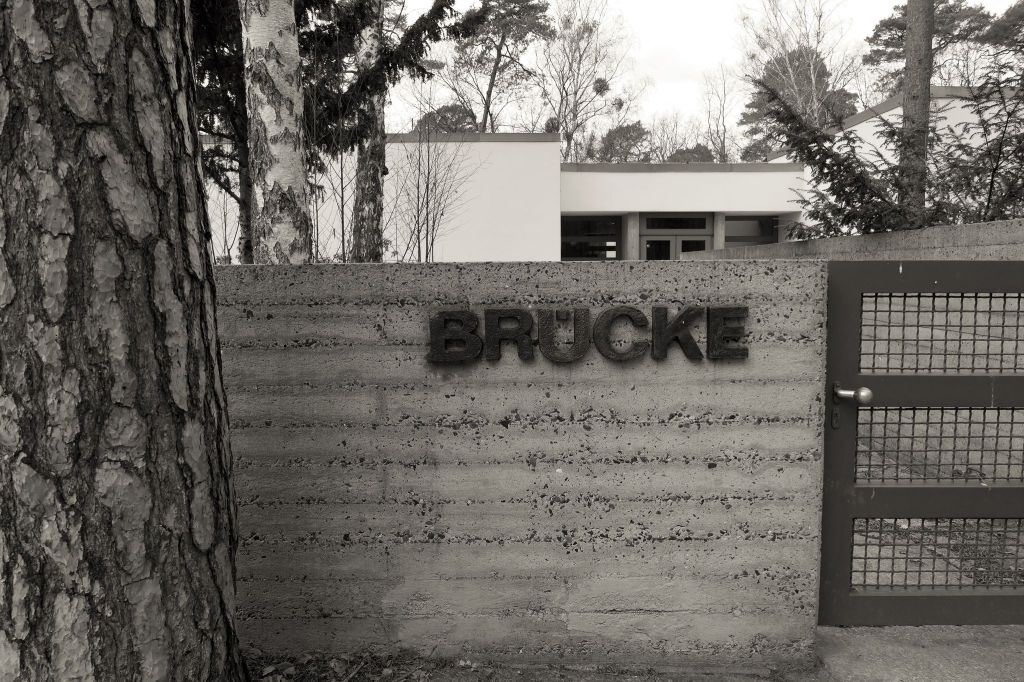
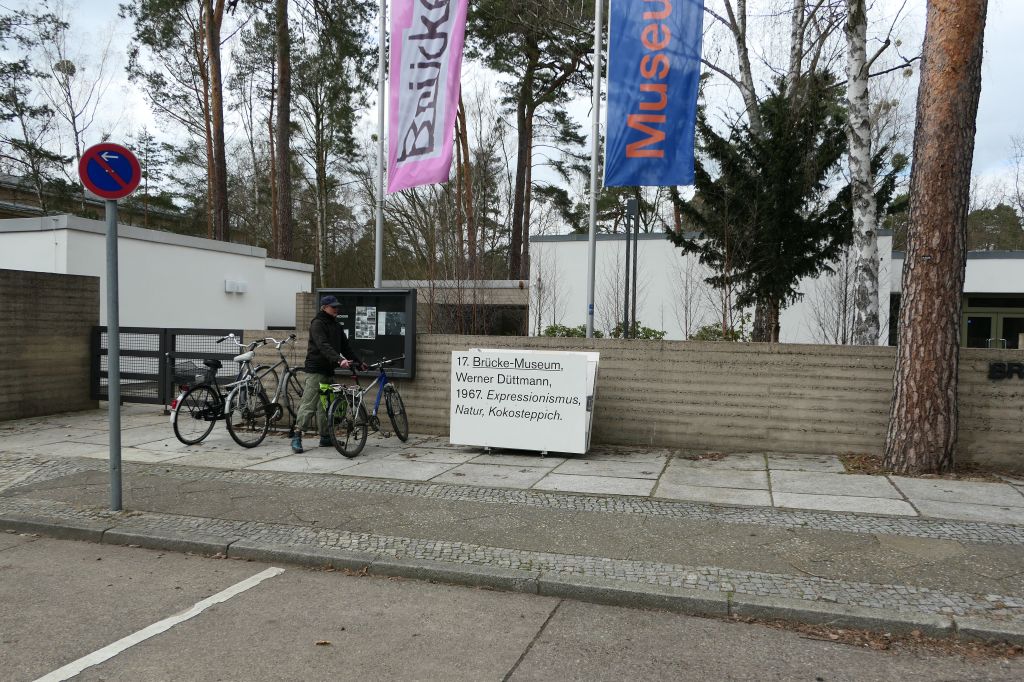
Werner Düttmann (1921– 1983) urodził się sto lat temu w Berlinie. Miasto uczciło jego jubileusz wystawą Werner Düttmann. Berlin. Bau. Werk. w budynku, który sam zaprojektował, w Brücke-Museum w Berlinie i w wielu innych częściach miasta, po jego zachodniej stronie. Białe tablice, na których można było przeczytać o budynku, projekcie i architekcie stały porozrzucane w mieście. Nie do wszystkich dotarłam, do niektórych przypadkowo.
Gdyby nie adminka, o której już wspomniałam i 100. rocznica urodzin Düttmanna, prawdopodobnie bym nigdy się o nim nie dowiedziała i nadal przechodziła obojętnie obok budynków przez niego zaprojektowanych. Werner Düttmmann był reprezentantem betonowego stylu w architekturze, zwanego brutalizmem, nie wzbudzającego u mnie ani trochę zachwytu. Zainteresowanie natomiast wzbudził ogromne. Przechodząc dzisiaj obok podobnych budowli, myślę sobie: „O, Düttmann”, choć to wcale nie Düttmann, może jakiś jego naśladowca, następca.
Alexandrinenstraße, Kreuzberg
Budynek przy Alexandrinenstraße na Kreuzbergu w Berlinie, zaprojektowany przez Düttmanna, był planowany i przez 40 lat kościołem katolickim pod wezwaniem świętej Agnieszki. Powstał w późnych latach 60. Jest typowym przykładem architektonicznego brutalizmu. W 2005 roku poddano go desakralizacji, a w 2011 powstała tu galeria, KÖNIG GALERIE. Krystyna Koziewicz odwiedzała ten budynek jeszcze jako kościół, chyba tak samo często jak później, gdy w roku 2011 stał się już galerią. „Kościół nie miał stać na uboczu”, jak mówił Düttmann, „miał stać na drodze”. Do dzisiaj stoi.
„Powinien on wyróżniać się na tle budynków, które nad nim górują, a jednocześnie, jako dom wspólnotowy, witać ludzi z otwartymi ramionami. Powinien łączyć świecką gościnność z tym, co odrębne, święte, uświęcone”
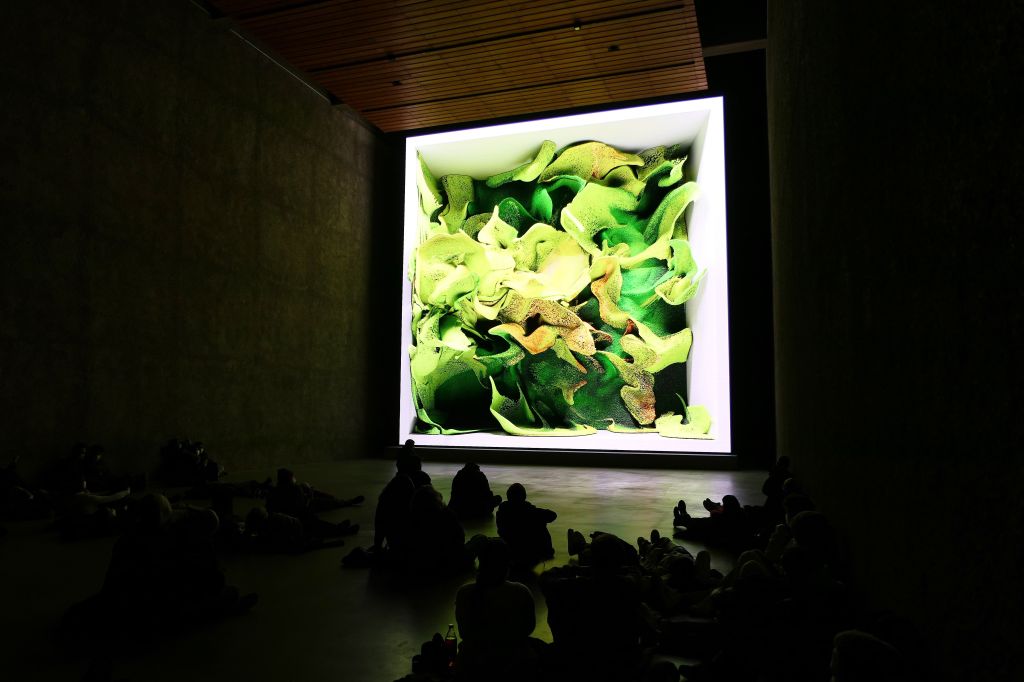
Tak jest do dzisiaj. Ostatnia wystawa Refika Anadola opanowała cały kościół. Siedzieliśmy wszyscy przed ołtarzem sztuki, modląc się do Boga lub sztucznej inteligencji, a wieża kościelna zamiast dzwonów rozbrzmiewała wszystkimi kolorami tęczy.
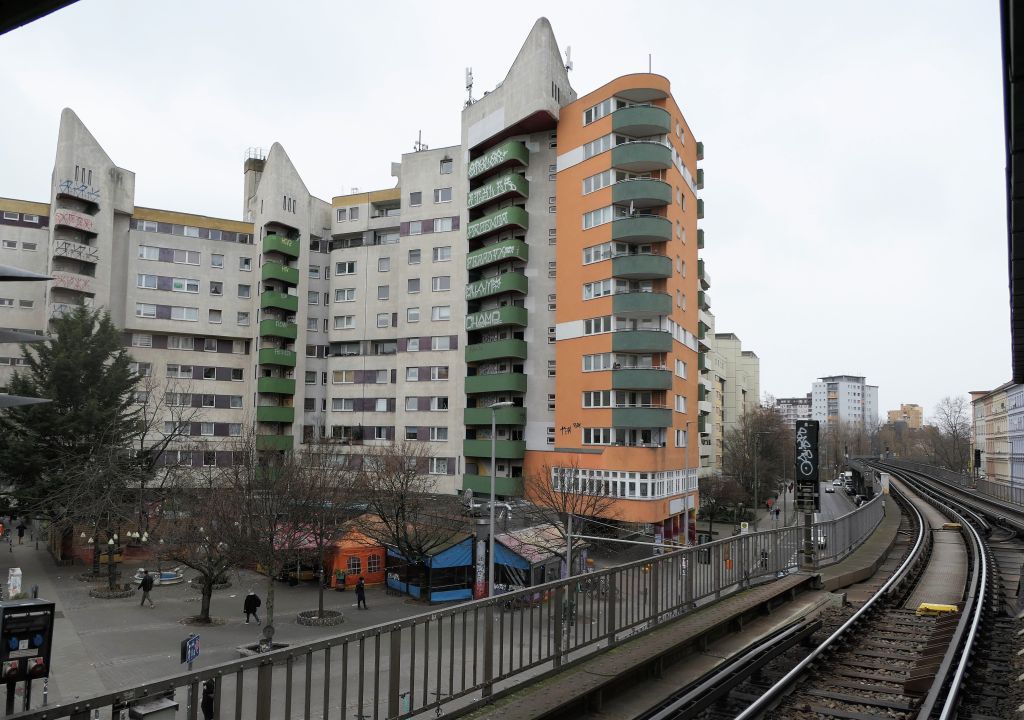
Wieżowce na Kreuzbergu
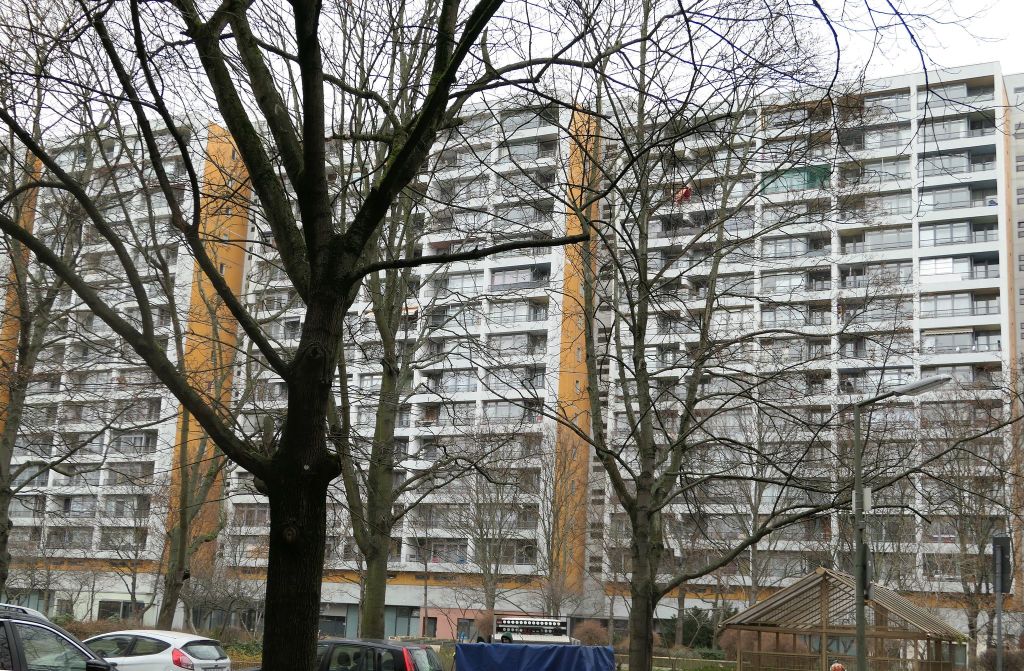
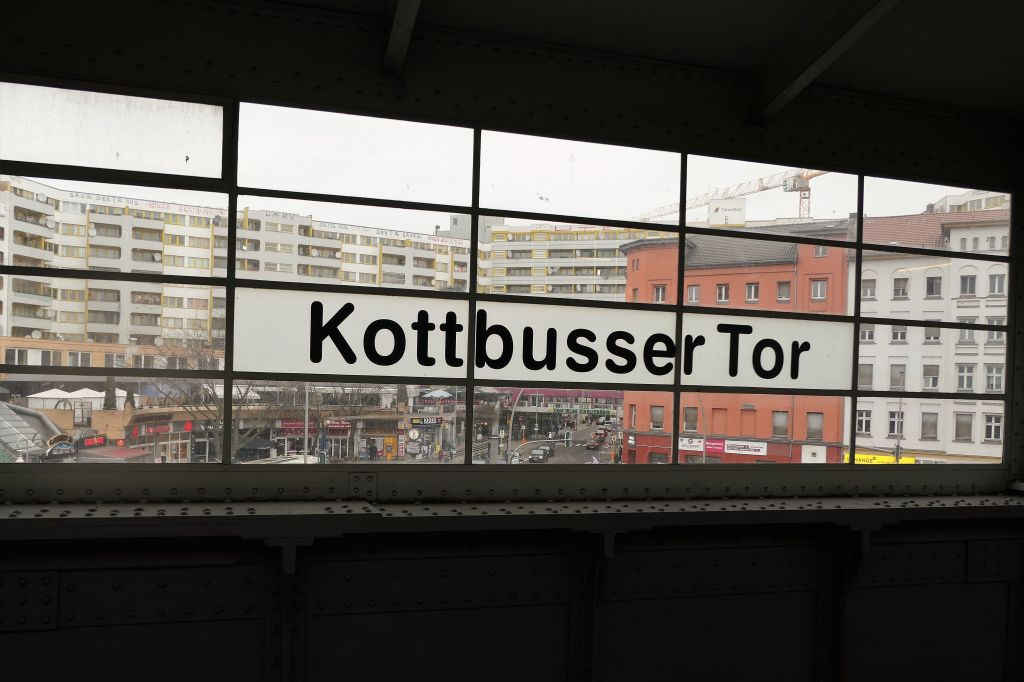
Werner Düttmann przebudowywał, rozbudowywał, planował nie tylko na Kreuzbergu (Mehringplatz, wieżowce przy Wassertorplatz i przy Kottbusser Tor, bloki przy Hedemannstraße), dając zgodę na wyburzanie tysięcy przedwojennych kamienic i zmuszając mieszkańców do przymusowych przeprowadzek do nowo powstałych blokowisk na nowo powstałych osiedlach.
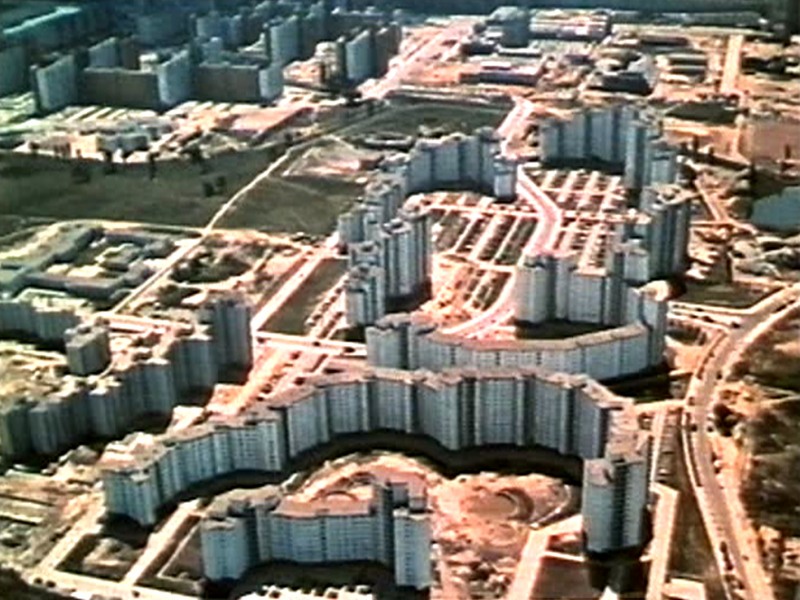
Jedno z tych osiedli, Märkisches Viertel też jest jego dziełem, z dala od centrum, w latach 60., gdy powstawało, było na peryferiach Berlina Zachodniego.
Wśród bloków stoi kościół Düttmanna, bardzo podobny do kościoła z Kreuzbergu. Jest jeszcze jest kościołem, katolickim pod wezwaniem św. Martina. Sam Düttmann tak o nim pisał: “inna przestrzeń, przestrzeń ciszy, refleksji, pusta przestrzeń, w którą można wejść wchodząc ze zgiełku, by spotkać to, czego nie można spotkać na zewnątrz, co można łatwo pominąć w hałasie miasta, przestrzeń, w której można pobyć kilka chwil ze samym sobą”.
Märkisches Viertel (zdjęcie po lewej Autorka, dwa zdjęcia obok – z sieci)
Werner Düttmann, syn rzeźbiarza, pierwsze nauki rzeźby i rysunku pobierał u swojego ojca w jego pracowni. Architekturę zaczął studiować w roku 1939 na Wyższej Szkole Technicznej w Berlinie (dzisiaj TU, Uniwersytet Techniczny), przerwane studia skończył po wojnie. W latach 50. ubiegłego wieku pracował jako niezależny architekt, został też rządowym doradcą budowlanym. W tych latach realizowane są jego pierwsze projekty, a on zaczyna piąć się po szczeblach zawodowej kariery.
Na początku lat 50. powstaje Dom Seniora przy Schulstraße 97 na Weddingu. To jeszcze nie brutalizm, ale dzisiaj musi ustąpić innym planom urbanistycznym miasta. Być może, że kilka elementów, lub w najlepszym razie niektóre budynki nie zostaną wyburzone, o co walczy syn Düttmanna. Budynki stoją puste od 2018 roku, niszczeją.
Akademie der Künste / Hansabücherei
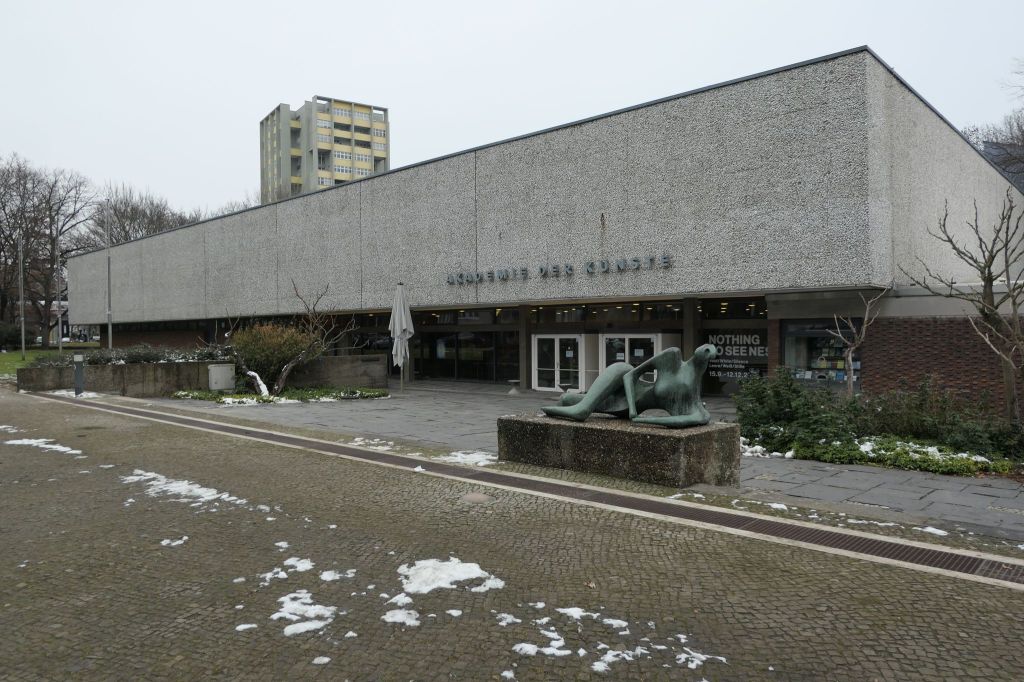
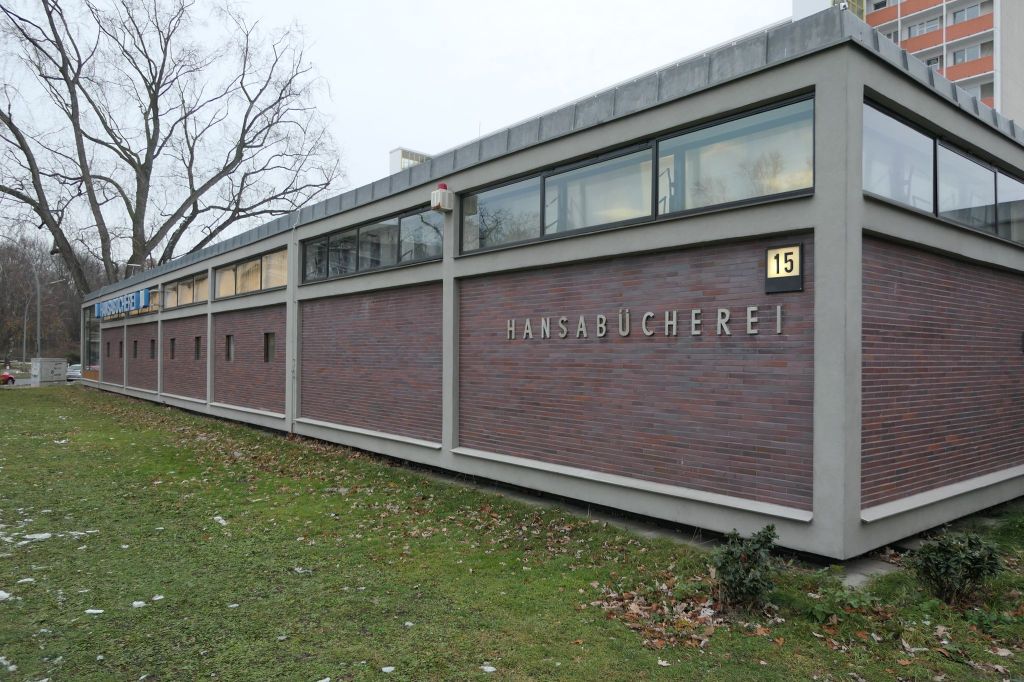
W ramach Międzynarodowej Wystawy Budownictwa Interbau 1957 Werner Düttmann zaprojektował bibliotekę, która miała stać się centrum kulturalnym odbudowywanej właśnie dzielnicy Hansaviertel. Tym centrum jest do dziś. Przy Hanseatenweg, niedaleko biblioteki w roku 1960 powstają budynki zachodnio-berlińskiej Akademii Sztuki (Die Akademie der Künste). Düttmann zostaje dyrektorem wydziału architektury Akademii Sztuki, a od 1971 roku do śmierci w 1983 roku był jej rektorem.
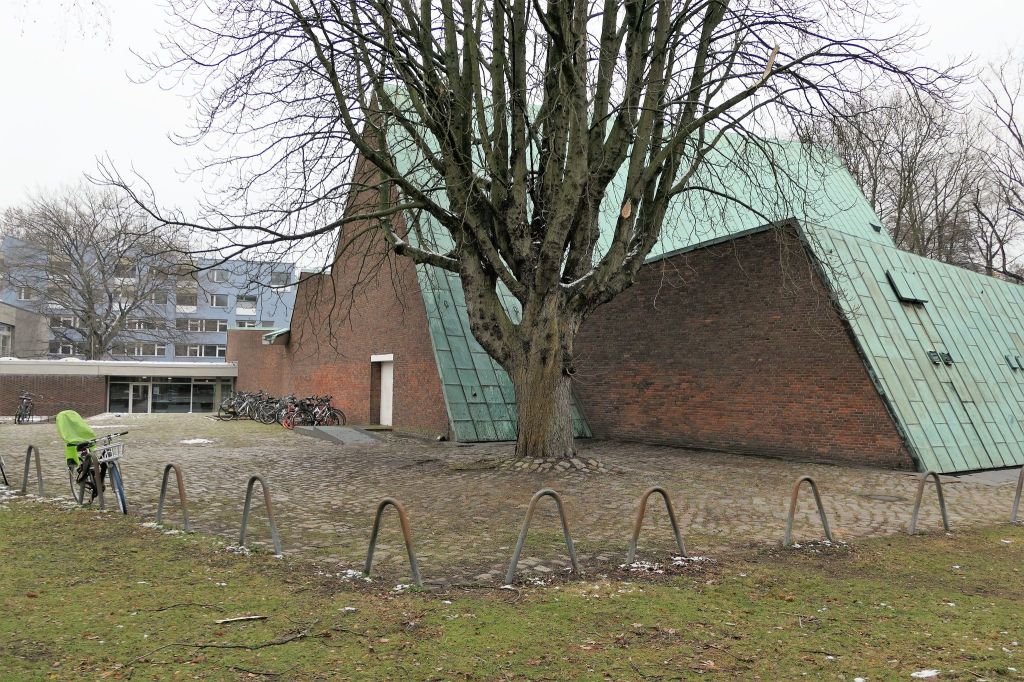
Zachodnia Akademia Sztuki składa się z trzech bardzo różnych budynków. Główny budynek z centralnym wejściem jest w formie prostopadłościanu, tzw. Studio znajduje się pod sięgającym do ziemi geometrycznie powyginanym dachem z patynowanej miedzi, w Niebieskim Domu mieszczą się pracownie i pomieszczenia administracyjne.
Brücke Museum (Muzeum grupy malarzy modernistycznych Die Brücke)
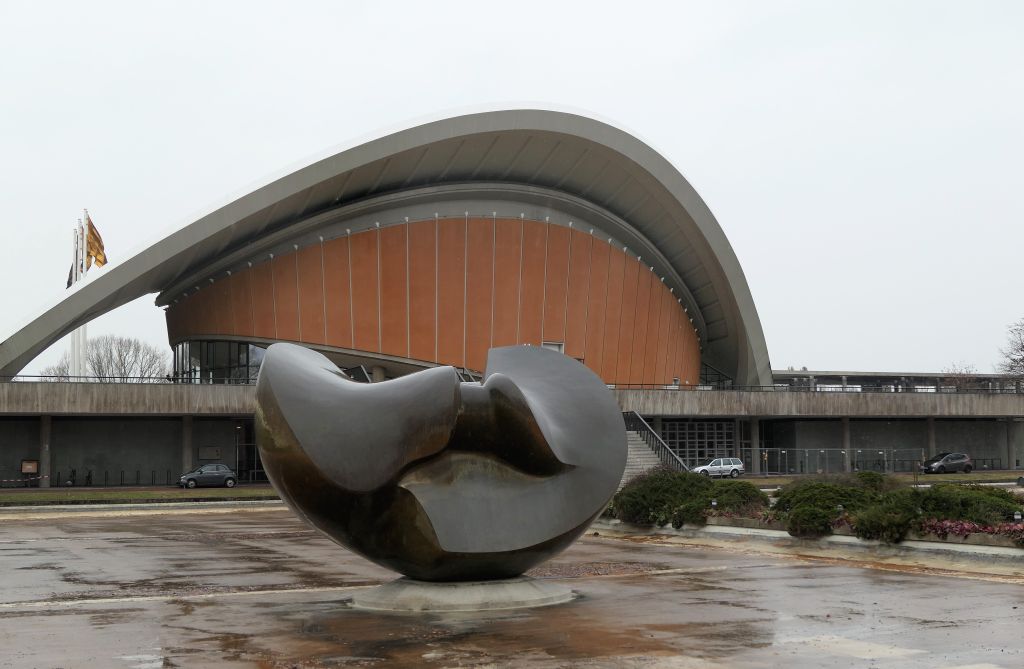
Obok Brücke Museum, Akademie der Künste najbardziej ważnym, znanym i rozpoznawalnym budynkiem, przy którego realizacji pracował Werner Düttmann, jest berlińska Sala Kongresowa, obecnie Dom Kultur Świata (Haus der Kulturen der Welt). Autorem projektu był amerykański architekt Hugh Stubbins. Werner Düttmann i Franz Mocken byli odpowiedzialni za jego wykonanie w Berlinie.
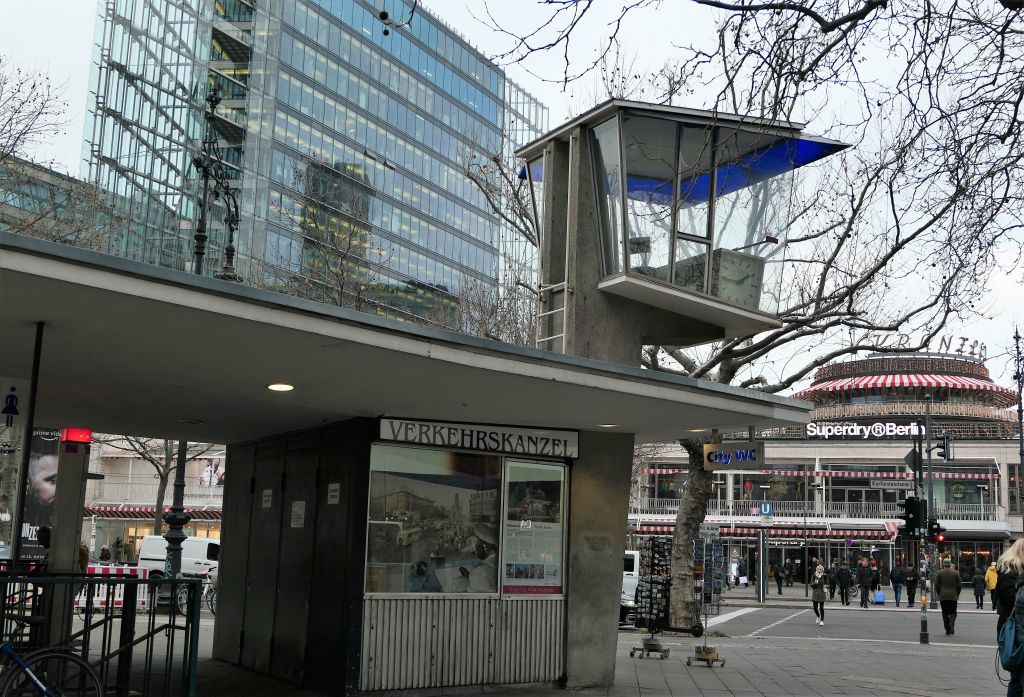
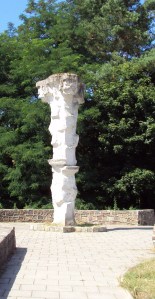
Moja ulubiona budowla Düttmanna, którą pamiętam, a może jednak nie pamiętam, stoi w centrum Berlina Zachodniego. Prawie wszyscy nadal przechodzą obok niej obojętnie, nie zastanawiając się, czym była w latach 60. ubiegłego wieku. Nie wiem jak brzmi poprawna polska nazwa, być może, że właśnie tak: ambona do kierowania ruchem drogowym, po niemiecku Verkehrskanzel. Jest ostatnią zachowaną w Berlinie amboną drogową.
Wieża kierowania ruchem na Kudammie (głównej ulicy dawnego Berlina Zachodniego)
Podesty, ambony, wieże do kierowania ruchem drogowym miały swój początek w Londynie, później, pod koniec XIX wieku budowano je w Nowym Jorku. W 1924 roku przy Potsdamer Platz w Berlinie pojawiła się pierwsza berlińska wieża do kierowania ruchem drogowym, w roku 1937 została zdemontowana, w roku 1997 zrekonstruowana ponownie.
Dzieło Düttmanna znajduje się na skrzyżowaniu Kurfürstendamm i Joachimsthaler Straße w dzielnicy Charlottenburg. Ambona w kształcie oszklonej skrzynki umieszczona jest na wysokości ok. 4,5 m na betonowym słupie, który został architektonicznie zintegrowany z kioskiem handlowym, podziemnym wejściem do stacji metra Kurfürstendamm i toaletą publiczną. Oprócz ambony wszystkie inne obiekty spełniają nadal swoje pierwotne funkcje.
Po zjednoczeniu Niemiec w 1990 r. powojenny modernizm określono jako “drugie zniszczenie miasta”. Nie tylko budynki Düttmanna wyburzano. Większość jednak została, czasem szpeci, czasem zadziwia, rzadziej zachwyca.
Zanim znikną z mapy miasta, by ustąpić miejsca innym, nowocześniejszym, warto na nie spojrzeć i zapamiętać je jako przedstawicieli kolejnego okresu w architekturze i urbanistyce miasta.
Reuter Platz (zdj. 1 i 2) / Zdjęcie 3: Haus der Kulturen der Welt (Dom Kultur Świata; budynek zwany w dawnym Berlinie Zachodnim “Ostryga w ciąży”) – wszystkie zdjęcia, chyba że zaznaczyłam inaczej – Autorka.
Mam kapelusz po czeskiej stronie. To nie jest mój kapelusz. Ten kapelusz kładzie się cieniem na stosunki polsko-czeskie, co się wyraża konfliktem o kopalnię Turów. Rozwiązanie problemu kopalni Turów trzeba zacząć od kapelusza.
Historia jest taka. Byłem kiedyś na odsłonięciu pomnika przewodników sudeckich. Po uroczystości było przyjęcie, na którym poznałem Czecha. Miał piękny czarny kapelusz z srebrnym łańcuszkiem dookoła, nawet przy stole go nie zdejmował. Gdy po przyjęciu wyszliśmy na dwór okazało się, że zostawiłem czapkę. Wchodząc do budynku spotkałem tego Czecha w tym pięknym kapeluszu. Poprosiłem go, by mi na chwilę pożyczył ten kapelusz. Chciałem się pokazać i ukłonić żonie. Takie tam nasze zaszłości. A tu facet mi mówi, że jest kowbojem a dla kowboja kapelusz to świętość i nie może go pożyczać. Ja jednak nalegałem. Pochylił się i powiedział – weź. Nie ze mną te numery. Powiedziałem – ty jesteś kowbojem, ja nie wezmę tego kapelusz chyba, że sam mi go podasz. Rozprostował pięść uśmiechnął się i podał mi kapelusz. Prawdziwy cygan zawsze dogada się z prawdziwym kowbojem. Wyszedłem z budynku w jego kapeluszu i ukłoniłem się żonie, ku radości znajomych z którymi stała. Kapelusz oddałem Czechowi. Zawiązała się między nami nić porozumienia. Długo jeszcze rozmawialiśmy. Okazało się, że ma ranczo i hoduje konie. Zapraszał mnie do siebie.
Dopiero po jakimś czasie, po lekturze Myśl – studium logiczne Gottloba Fege uświadomiłem sobie błąd. Nie powinienem oddawać mu tego kapelusza, powinienem się nachylić, a on miał zdjąć go z mojej głowy, zaznaczając tym swoje prawa do tego kapelusza. A ja postąpiłem tak, jak bym to ja był jego właścicielem. Ja mu go nie oddałem, ja mu go przekazałem na przechowanie. To trzeba wyprostować. Bez tego nasze relacje z Czechami mogą być napięte i sprawa Turowa może się ciągnąć w nieskończoność. Zwrot tego kapelusza trzeba powtórzyć z zachowaniem procedur obowiązujących między cywilizowanymi ludźmi. Gottlob Frege w artykule Myśl – studium logiczne w zbiorze pt. Pisma semantyczne, przekonuje, że myśli nie wytwarzamy w naszych głowach, one istnieją niezależnie od nas, a my je tylko ujmujemy i w ten sposób nadajemy sens rzeczom, zdarzeniom, sytuacjom. Oprócz Matrixa 44 musi istnieć coś jeszcze – jakiś rezerwuar myśli i zdolność naszego umysłu do sięgania do tego rezerwuaru. Nazwijmy go Katedra Poetyki.
Matrix 44 i Katedra Poetyki to dwa byty odpowiedzialne za nasze wrażenia. A świat, który nam się wydaje, że istnieje, jest iluzją. To „maja” jak mówią hindusi, albo mniemanie jak pisał Parmenides dwa i pół tysiąca lat temu. Nasze porozumienie nie opiera się słowach a na wspólnym ujmowaniu myśli, słowa w tym tylko pośredniczą, nie zawsze skutecznie. Sprawiedliwość to nie jest zgodność z przepisami prawa . Sprawiedliwość to myśl, na którą trzeba naprowadzić.
Zostałem zatrzymany podczas przechodzenia na czerwonym świetle. Odmówiłem zapłacenia mandatu i policja przekazała sprawę do sądu, a ten wydał nakaz zapłaty. Odwołałem się bo ten mandat naruszał moje poczucie sprawiedliwości. By na tę myśl naprowadzić sąd, użyłem moich sąsiadów. Napisałem tak: „Jak pokazałem ten wyrok moim sąsiadom u mnie na wsi i powiedziałem, że zdarzenie miało miejsce o drugiej w nocy i że nic nie jechało, to moi sąsiedzi pukali się po głowie i śmiali się z Wysokiego Sądu, a ja na to nie mogę pozwolić. Proszę zatem o zmianę wyroku.” I sąd anulował mi mandat, a przecież przepisy prawa były po jego stronie.
Kiedyś syn bezskutecznie biegał do banku po jakieś zaświadczenie, ciągle nie było gotowe. Jak już zbliżał się termin, gdy było potrzebne, poprosił mnie o pomoc. Wziąłem pismo, z którego wynikało, że za dwa dni mija termin złożenia tego zaświadczenia, wsadziłem do plecaka i poszliśmy. W banku znów się okazało, że jeszcze go nie ma, że mamy się zgłosić za dwa dni. Wtedy sięgnąłem do plecaka a syn półgębkiem mówi do mnie – tato, zostaw, nie wyciągaj. Pani poprosiła byśmy poczekali na korytarzu i po piętnastu minutach przyniosła nieszczęsne zaświadczenie. Nie wiem, co ta kobieta myślała, że mam w tym plecaku ale sens ujęła bezbłędnie.
Nie dajmy sobie wmówić, że rzeczywistość rzeczywiście istnieje, a w niej obiektywne fakty. Zdajmy się na Matrix 44 i Katedrę Poetyki, a życie będzie poezją.
Poezja w czasach automatycznej korekty i inne wiersze
mija nowy rok mam napisać wiersz i choć wiem mimo to zapominam że mową naszą powszednią rządzi Wielki Korektor który mi wszystko poprawi monday na madonnę monady mondaminy macondo na mannę lub mcdonalda ale mantykorę zna i nie poprawia jej na manię a marihuany nie zamienia w mszę ma władzę wszystko wie lepiej.
Przyszedł tomik wierszy od poetki. Znam poetkę od dziecka. Pierwszy raz przyjechała do Berlina, gdy miała 14 lat. Miała brać udział w warsztatach translatorskich wraz gromadą studentów z Polski i Berlina. Do Berlina przyjechała z mamą, a jej wiersze były tak dojrzałe, że niektórzy młodzi zawistni poeci myśleli, że to mama jej te wiersze napisała. Potem już wiedzieli lepiej.
Czytam te wiersze w styczniową noc. Trzeciego stycznia o trzeciej nad ranem.
Człowiek z papierosem na balkonie widział światło w moim uchylonym oknie w styczniu o trzeciej nad ranem
To, co sprawia, że czytam ten akurat wiersz trzeciego stycznia o trzeciej nad ranem nie może być ani intuicją ani telepatią. Nic nie wiem. Nic nie mogę wiedzieć lepiej. Ona też nie. Choć wszystko sprawdza i przymierza. Może być Hekate albo siostrą Tanatosa. Zna wszystkie wiodące w zaświaty istoty Może wybierać jak chce.
Wybiera Niefrasobliwą.
W tej przydrożnej kapliczce będzie Ci jak w domu, uszyję Ci sukienkę, wykarmię dzieciątko, a kiedyś może jeszcze zacznę od początku gdy Syn Twój już wyrośnie z mojego pokłonu.
Sprzątnęłam Wasz ogródek w którym krzyże zwiędły, a w czasie odpoczynku tłumaczyłam sobie – on nie chce być strażakiem, tylko Panem Bogiem, przecież każdy w dzieciństwie chciał być niepojęty.
Madonno, możesz tańczyć, wszak już zbawiony świat i chyba przyznasz sama, że wyszedł na ludzi Twój Syn, co o miłości tak wiecznie marudził.
Wam wszystkim świętym zawsze pomyślny wieje wiatr w oczy, co im głód nieba na sucho uchodzi. A mnie wciąż zbyt grzesznie i ciągle nie tak.
Dziwię się tym słowom, poukładanym tak, żeby się sobie dziwiły. Które sprawiają, że można zjeżdżać na sankach z Golgoty.
*** Nasza łódź jest z bambusa będziemy dobrze brzmieć pośród wód przynoszonych we wiadrach
jesień okadza nasz dom zapachem jabłek świętość na półeczce obok utartej bazylii
twarda pięta zna tajemnicę
ze zmarzliny glina nasze drzewa bujają w doniczce
Mały świat, w którym świętość stoi na półeczce obok utartej bazylii.
To odważne tak pisać wiersze żeby się nie bać że Wielki Korektor poprawi nam pietę na piętę lub piętę na pietę
Wiecie o co chodzi bo w każdym bądź razie plany napięte czy róża w życie upięta nie jest na żarty?
Mały świat, w którym ktoś chce dokapać się własnej kałuży szczęścia.
Wielki Korektor nie chce dokapać się możemy okapać dokazać okazać dokopać i pokopać mały świat
Pieta
Tyle lat pięknych i przegadanych jak przegadane i piękne są niektóre frazy
Zamiast zbierać kwiaty pisałam o kwiatach
To odważne tak pisać wiersze żeby się nie bać że on poprawi nam pietę na piętę lub piętę na pietę a młodą poetkę na starą kobietę
***
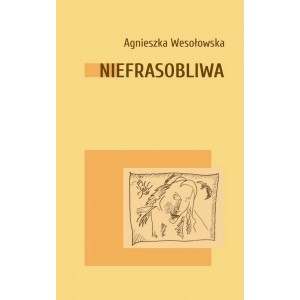
Agnieszka Wesołowska, Niefrasobliwa
Wydawnictwo: Stowarzyszenie Pisarzy Polskich Oddział Warszawa
Opinie tych, którzy wiedzą lepiej niż ja:
Piotr Müldner-Nieckowski: Takich wierszy nie da się zaplanować. Kiedy autorce się zdarzały, były zapewne odkładane i czekały, aż zdecyduje się na nie jakaś szczególna książka. Okazały się traktatem o pewnym stanie psychiki, o niefrasobliwości. Ale nie beztrosce. Są czymś w rodzaju studium wolności
Krzysztof Bielecki: Ani to konstrukcja, ani dekonstrukcja świata. Agnieszkę Wesołowską pociąga świat rozproszony. Człowiek rozproszony. Ulegający baśni. Złudzeniu. Czemukolwiek, co mogłoby istnieć. W poetyckim rozmarzeniu nawet istnieć powinno, ale… nie istnieje.
Agnieszka Wesołowska urodziła się w 1984 roku. Związana była z pismem literackim Łabuź, wydawanym w Łobzie na Pomorzu Zachodnim. Tam też mieszkała od urodzenia, potem przez jakiś czas w Szczecinie, Krakowie i Poznaniu. Ukończyła Uniwersytet Pedagogiczny im. KEN w Krakowie, Wydział Pedagogiczny. Od kilku lat znowu mieszka w Łobzie. Autorka arkuszy i książek poetyckich, m.in. Ars vitae. Listy do nieszczęśliwych (Oficyna Wydawnicza Atut, Wrocław 2008); Dwuznaczny (Książnica Pomorska, Szczecin 2000; wyróżnienie im. K. Iłłakowiczówny za książkowy poetycki debiut roku); Zgubić pytania (Żebracza Inicjatywa Wydawnicza Klubu Literackiego Łabuź, Łobez 1999). Współpracowała z Polsko-Niemieckim Towarzystwem Literackim (Verein zur Förderung der Deutsch-Polnischen Literatur) WIR. Publikowała w różnych czasopismach (m.in. w „Pograniczach”, „Zeszytach Literackich”, „Dekadzie Literackiej”). Należy do Stowarzyszenia Pisarzy Polskich.
Pisała też czasem u mnie na blogu. Ale nie tu. Dawno. Nieprawda. Na mitycznym blogu, zwanym Kura…
Uwaga – niebieskie fragmenty wpisu to wiersze i cytaty z tomiku Niefrasobliwa Agnieszki Wesołowskiej
Sen Trzech króli, 1120-30, fragment kapitelu z Katedry Saint-Lazare, Autun, Francja
Uwaga – wpis obrazoburczy. Czytacie na własną odpowiedzialność.
Ewa Maria Slaska
Mędrcy świata, monarchowie, gdzie śpiesznie dążycie? Powiedzcież nam Trzej Królowie, chcecie widzieć Dziecię? Ono w żłobie nie ma tronu, i berła nie dzierży, a proroctwo jego zgonu, już się w świecie szerzy.
Mędrcy świata, złość okrutna, Dziecię prześladuje, wieść okropna, wieść to smutna, Herod spiski knuje. Nic monarchów nie odstrasza, do Betlejem spieszą, gwiazda zbawcę im ogłasza, nadzieją się cieszą.
Przed Maryją stoją społem, Niosą Panu dary. Przed Jezusem biją czołem, składają ofiary. Trzykroć szczęśliwi królowie, Któż wam nie zazdrości? Cóż my damy, kto nam powie, pałając z miłości.
Oczywiście wszyscy wiemy, że Trzej Królowie to pozostałość po starożytnych triadach bogiń i bogów. W trójcy bogiń były zawsze Dziewica, Nimfa, czyli Matka i Starucha, Pani Piekieł. Trójca męskich bogów naśladowała triady kobiece i składała się z Boga Początku, Boga Życia i Boga Śmierci. Byli to trzej osobni bogowie. Dopiero chrześcijańska Trójca Święta, ta, którą dobrze znamy, a która składa się z Ojca, Syna i Ducha Świętego, uważa te trzy elementy triady za emanacje tej samej Istoty. W gruncie rzeczy ta stosunkowo niedawna interpretacja starożytnego prototypu, tylko nieznacznie przesuwa akcenty – najważniejszy staje się Bóg Ojciec, który i daje życie, i go pilnuje i może je odebrać. Syn i Duch są tylko pobocznym uzupełnieniem, ale teologowie nic na to nie mogą poradzić, że my, ludzie z jaskiń, wciąż jeszcze potrzebujemy trzech pradawnych bogów – Boga Piorunów, Boga Polowań i Boga Śmierci. I że, jak głębiej pogrzebiemy w naszych lękach i magicznych zabiegach, to okaże się, że są to starsze od Trzech Bogów Trzy Boginie – Kora, Potnia i Hekate.
Trzy księżniczki baktryjskie
Jedyną (chyba) religią, która konsekwentnie zlikwidowała starożytne triady był ustanowiony przez faraona rebelianta – Echnatona kult Jedynego Atona, przejęty przez Mojżesza i “wyprowadzony” z Egiptu do Ziemi Obiecanej. Echnaton rządził zbyt krótko, by jego koncepcja Boga Jedynego zdążyła się ugruntować i przetrwać. Ale Żydzi mieli dość czasu i to tam właśnie, w Ziemi Obiecanej, utrwaliła się religia oparta na KONCEPCJI boga, który był jedyny i którego Prawo zostało zapisane w Księdze.
Izraelici czcili więc wymyślonego jednego Boga, jednoosobowego i jedynego, o którym mówili Jahwe, który był Obcy, Daleki, Bezimienny. Był on surowy i chyba nie mógł inaczej, musiał karać za odstępstwo, bo odstępstwo było łatwe, znajome, naturalne. Trzy Boginie lub Trzej Bogowie byli zawsze, Ten Jeden Bóg był Nieznany i Obcy, co gorsza jego pierwszą wersję ich przodkowie poznali w Egipcie, Kraju Niewoli. Ten Obcy Bóg groził karami za czczenie bogów okolicznych narodów.
Ja jestem Jahwe, Twój Bóg, który cię wywiódł z ziemi egipskiej, z domu niewoli.
Nie będziesz miał innych bogów obok mnie.
Nie będziesz czynił żadnej rzeźby ani żadnego obrazu tego, co jest na niebie wysoko, ani tego, co jest na ziemi nisko, ani tego, co jest w wodach pod ziemią!
Nie będziesz oddawał im pokłonu i nie będziesz im służył, ponieważ Ja Jahwe, twój Bóg, jestem Bogiem zazdrosnym, który karze występek ojców na synach do trzeciego i czwartego pokolenia względem tych, którzy Mnie nienawidzą.
Okazuję zaś łaskę aż do tysiącznego pokolenia tym, którzy Mnie miłują i przestrzegają moich przykazań.
Nie będziesz wzywał imienia Boga twego, Jahwe, do czczych rzeczy, gdyż Jahwe nie pozostawi bezkarnie tego, który wzywa Jego imienia do czczych rzeczy.
My to znamy na pamięć w wersji uproszczonej do nierozpoznania: Nie będziesz miał bogów cudzych przede mną. Ci cudzy bogowie często pojawiali się jako triady, trójce bogów.
Rzym: Trójca Kapitolińska Jowisz, Junona i Minerwa
Hinduizm: Brahma (Kriszna), Wisznu, Sziwa
Chiny: Fu Lu Shou (trójca bóstw gwiezdnych) Fuxing bóg szczęścia, Shouxing bóg długowieczności i Luxing bóg kariery
Niektóre triady zrastały się w jedną trójosobową postać, jak potrójna Hekate albo trójca prasłowiańska tzw. „Trzygłów” (Triglav)
Hekate Potrójna i Trzygław, rzeźba współczesna z Parku Słowiańskiego na Wolinie.
Chrześcijaństwo przywróciło więc tylko starożytną trójcę, tracąc tym samym cechę podstawową religii monoteistycznej – Jedynego Boga. I choćbyśmy się nie wiem jak zaklinali i bożyli, że jak “bonie dydy”, wierzymy w Jednego Boga, to przypomnijmy sobie Wyznanie Wiary, czyli Credo:
Wierzę w jednego Boga, Ojca Wszechmogącego, Stworzyciela nieba i ziemi, wszystkich rzeczy widzialnych i niewidzialnych. I w jednego Pana Jezusa Chrystusa, Syna Bożego Jednorodzonego, który z Ojca jest zrodzony przed wszystkimi wiekami. Bóg z Boga, Światłość ze Światłości, Bóg prawdziwy z Boga prawdziwego. Zrodzony a nie stworzony, współistotny Ojcu, a przez Niego wszystko się stało. On to dla nas ludzi i dla naszego zbawienia zstąpił z nieba. I za sprawą Ducha Świętego przyjął ciało z Maryi Dziewicy i stał się człowiekiem. Ukrzyżowany również za nas, pod Poncjuszem Piłatem został umęczony i pogrzebany. I zmartwychwstał dnia trzeciego, jak oznajmia Pismo. I wstąpił do nieba; siedzi po prawicy Ojca. I powtórnie przyjdzie w chwale sądzić żywych i umarłych, a Królestwu Jego nie będzie końca. Wierzę w Ducha Świętego, Pana i Ożywiciela, który od Ojca i Syna pochodzi. Który z Ojcem i Synem wspólnie odbiera uwielbienie i chwałę który mówił przez Proroków. Wierzę w jeden, Święty, powszechny i apostolski Kościół. Wyznaję jeden chrzest na odpuszczenie grzechów. I oczekuję wskrzeszenia umarłych. I życia wiecznego w przyszłym świecie. Amen.
C.b.d.o.
***
We Włoszech z kolei… ale to niech już opisze znawca Włoch, czyli cytowany już tu wielokrotnie Jacek Pałasiński:
Jesteście, P.T. Czytelnicy gotowi? Nie? No to hajże po skarpetę! Dzisiejszej nocy odwiedzi Was pewna brzydka starucha. Upewni się, czy śpicie i wedrze się do waszego domu, a jak się okaże, że głosowaliście na szajkę (tak autor określa tych, co u władzy – przyp. EMS), to do skarpety nawrzuca wam węgla. Rosyjskiego, oczywiście, z Donbasu, oczywiście, bo szajka zasiarczony węgiel z Ludowych Republik Ługańskiej i Donieckiej przedkłada ponad inne. A jeśli byliście grzeczni, chodziliście na manifestacje, dezawuowaliście przestępstwa, machlojki i oszustwa szajki, to może starucha wrzuci wam do zawieszonej na kominku skarpety cukierka. Starucha ma na imię Befana. A „Befana”, to takie włoskie, ludowe przekoślawienie oryginału, czyli ἐπιφάνια, epifania, a epifania to objawienie. W tym wypadku objawienie boskiej natury dzieciątka Jeszua trzem mędrcom ze Wschodu, który, śledząc „gwiazdę” (Mt 2,1-12.16), przynieśli boskiemu Dziecięciu dary: złoto, kadzidło i mirrę, a kto nie wie do dziś, co zacz mirra, niech podłubie w źródłach. W suku w Damaszku straganiarze oferowali mirrę i D.O. oczywiście kupił, ale gdzieś mu się w licznych przeprowadzkach zadziała. Giotto przedstawił „gwiazdę” jako kometę, prowadzącą Trzech Mędrców (zupełnie niepoprawnie zwanych „królami”) do stajenki w Bet Lehem, co po hebrajsku oznacza dosłownie „Dom Chleba”, czyli po prostu piekarnię. No bo Giotto był w 1301 r. świadkiem „przebiegu” po nieboskłonie komety Haleya i tak mu się skojarzyło. Ale od tego czasu nikt inaczej owej „gwiazdy” betlejemskiej inaczej nie przedstawiał, jak tylko kometę, co jest bez sensu, bo gwiazda i kometa to są dwa zupełnie odmienne ciała niebieskie. Do dziś mędrcy (choć nie tamci trzej, ze Wschodu) zachodzą w głowę, cóż to mogło być za światło, które Trzech Mędrców prowadziło, bo, jakby tu powiedzieć, „gwiazda” na pewno nie. Może jakieś małe UFO? „Epifania” to termin, używany przez Kościoły zachodnie, te wschodnie, nieco mniej od zachodnich heretyckie, na objawienie boskiej natury Jeszuy, używają bardziej precyzyjnego terminu „Teofania”. Z kolei muzułmanie używają terminu „epifania” na pojawienie się na końcu czasów ludzi wezwanych przez Allaha, którzy położą kres niesprawiedliwościom i niedoskonałościom gatunku ludzkiego. Drodzy muzułmanie, co, wy gazet nie czytacie? Tacy ludzie już się objawili, nazywają się „szajka”, a jak nie wierzycie, to obejrzyjcie wiadomości w kurwizji (https://tvn24.pl/…/afera-mailowa-nowa-odslona-mail-z…). W każdym razie we Włoszech z „epifanii” najpierw zrobili „bifanię”, a potem „befanię”, skąd już tylko krok do Befany. Befana ma źródła mało chrześcijańskie, dlatego w Kościele łatwego życia nie miała. Wywodzi się z hellenistycznej odmiany mitraizmu, dla którego 12 dni po równonocy zimowej, w Saturnaliach jako Diem Natalis Solis Invicti, obchodzono w Cesarstwie Rzymskim równocześnie, jako święto śmierci oraz święto odrodzenia Matki Natury. Rzymianie wierzyli, że przez te 12 dni (a raczej nocy) kobiety latają nad polami, by dodać im siły rozrodczej. 12 dnia umierały dla Rzymian zeszłoroczne plony, a te, przygotowane pod wiosenny zasiew, nabierały ducha, który sprawi, że w ziemi się odrodzą i rozmnożą. I właśnie Befana była jedną z tych kobiet, latających nad polami, by dać im płodność. Bogiem a prawdą to zastąpiła Dianę, która wcześniej dokonywała tych nalotów. Befana odpoczywała w ludzkich domach i osądzała ich mieszkańców: dobrych nagradzała, złych karała. Aha: ten 6 stycznia, w którym mędrcy mieli dotrzeć do betlejemskiej stajenki, to nie jest wynalazek wczesnochrześcijański; datę tę zaproponował pod koniec IV w. święty Epifaniusz z Salaminy, przez Kościoły wschodnie uważany za ojca Kościoła. Dzisiaj by sprawiał mnóstwo kłopotów, bo energicznie przeciwstawiał się kultowi Maryi i równie energicznie zwalczał kult obrazów. (D.O. nieodmiennie namawia do przeczytania w Wikipedii hasła „Dekalog” i odbycia refleksji, jak też to się stało, że Kościoły chrześcijańskie, zwłaszcza zachodni, spokojnie wyeliminowały sobie Drugie Przykazanie Boże i, żeby się liczba zgadzała, podzieliły na dwa Przykazanie Dziewiąte, każąc wiernym wierzyć, że Pan Bóg zstąpił na Ziemię, by dać rodzajowi ludzkiemu Przykazanie o treści „ani żadnej rzeczy, która jego jest”). Ufff… No, dobrze, możesz, Czytelniku, zapomnieć o skarpecie dla Befany, ale nie zapominaj, żeby się przyzwoicie zachowywać i nie sprzedawać ojczyzny za 500 srebrników.
***
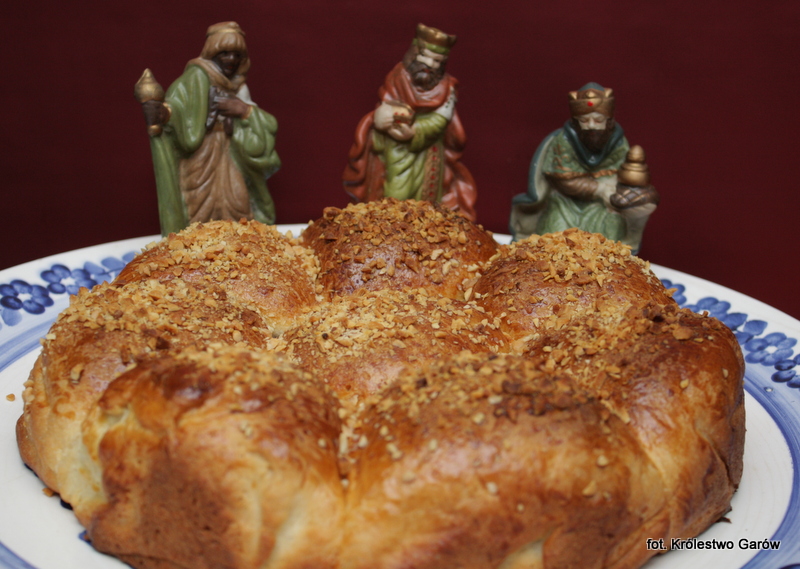
O!, poważnie się zrobiło. Oczywiście nie sprzedamy. Obyśmy jednak nie zapomnieli, że święto to jednak święto, przypomnę tu dwa królewskie wypieki pieczone z okazji święta Trzech Króli – Ciasto Królewskie i Szczodraki:
Ten wypiek nieco przypomina rogale marcińskie – jest to ciasto francuskie nadziewane masą migdałową. Z kolei szczodraki to drożdżowe ciastka nadziewane kapustą, czyli coś w rodzaju kulebiaczków, albo czymś na słodko, np. dżemem albo masą sernikową. Czyli też jakaś odmiana rogali marcińskich.
I w szczodrakach i w cieście królewskim coś się zapieka – figurkę, migdał, ziarnko fasoli. Osoba, która znajdzie zapieczonego fanta, zostaje królem, fasolowym, migdałowym, karnawałowym. Królem. A ten król to wzór postaci Sancho Pansy i jego nadziei na gubernatorstwo wyspy. Pisałam już o tym kilkakrotnie (np. TU), ale nigdy nie zawadzi przypomnieć.
Jakob Jordaens, Fasolowy Król (1640 – 1645)
Pewien młody człowiek poinformował swoją mamę, a ona mnie, że obecnie w Berlinie pojawił się od dawna znany w Niemczech północnych nowy sposób wybierania króla karnawału: kupuje się pączki w cukierni i je się tak długo, aż się trafi na pączek nadziany musztardą. Tak się zostaje Musztardowym Królem.
***
Dodatki od Czytelniczek i Czytelników nadesłane w ciągu dnia:
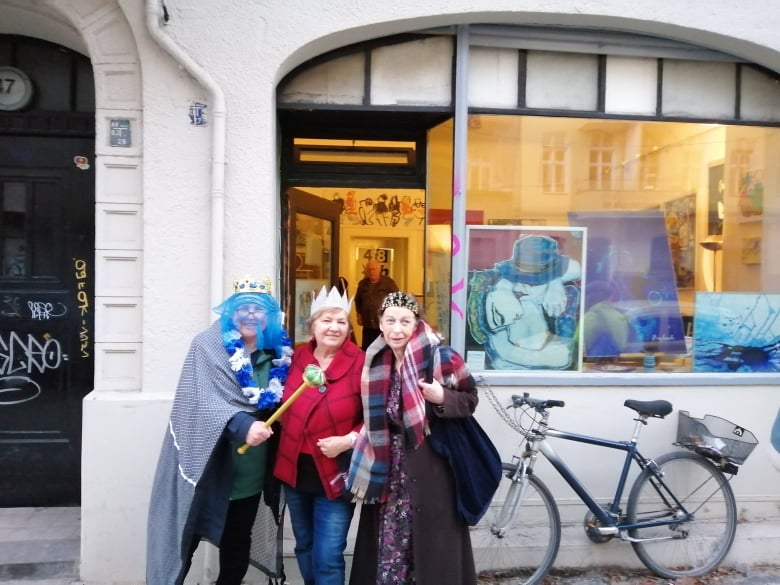
Ela Kargol o naszej dzisiejszej wyprawie do malarza, Wiesława Fiszbacha – ma nas trzy sportretować, a my się postanowiłyśmy pokazać w naszej prawdziwej postaci:
Powiedzcież nam trzy królowe, gdzie spiesznie dążycie? do artysty, het na Neukölln umilić mu życie!!!
(Dodatek od Adminki: poszłyśmy do Wiesława Fiszbacha, a o nim będzie na samym dole)
ElaEwaKrysia
Mietek Węglewicz
Trzech Króli (kolęda)
Idą mędrcy wschodu, przez calutki świat dookoła globu dwa tysiące lat Czy pustynia, czy oaza mróz, czy żar się leje Kacper, Melchior i Baltazar idą do Betlejem Baltazara boli kostka Kacper łapie dech Melchior mówi ,,łaska boska że nie sam, we trzech” Idą trzej królowie, dwa tysiące lat i dziękują Bogu za ten piękny świat
Ewa Maria Slaska upiekła szczodraki, a Ela Kargol przypomniała poprzednie świętowania Trzech Króli
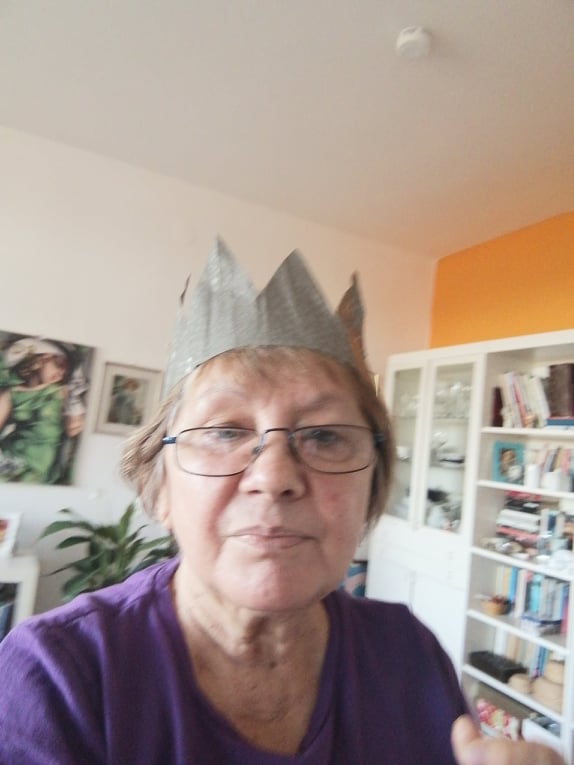
To jeszcze ja, Adminka: W szczodrakach zapiekłam słodkie nadzienie z makiem, orzechami i migdałami, po to by nam się dobrze wiodło. Był też jeden cały orzech. Królową Orzechową została Krysia!
*** Trzej Królowie to nie tylko koniec okresu świątecznego w chrześcijaństwie, ale praktycznie rzecz biorąc w każdej religii na świecie, która raczyła zauważyć zjawiska na niebie i ziemi, takie jak przesilenie zimowe, czy przybywanie dnia “na barani skok”. W tradycji słowiańskiej okres ten nazywał się Szczodre Gody. Stąd szczodraki. Niech się nam wszystkim szczodrze wiedzie! ***
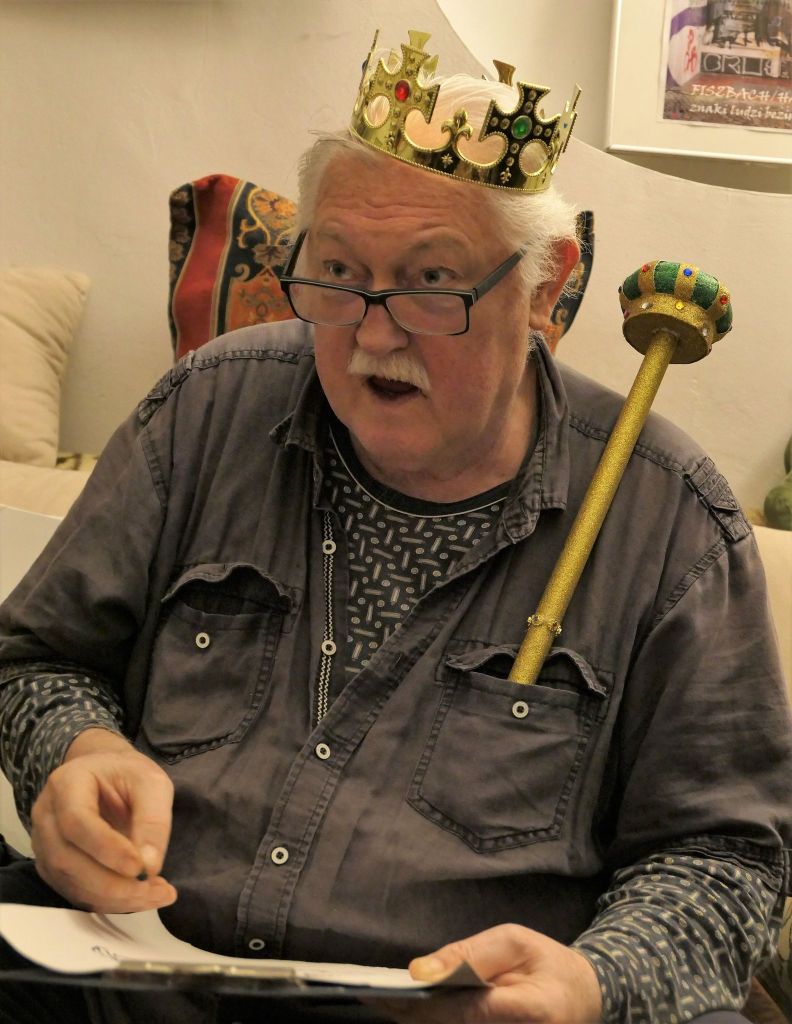
A to nasz wczorajszy Karnawałowy Król, Wielki Gubernator Baratarii w Berlinie, artysta Wiesław Fiszbach:
Die Wurzeln der Fotografiegeschichte liegen weiter zurück, als wir annehmen: Bereits im 4. Jahrhundert vor Christus beschrieb Aristoteles die Camera Obscura. Hierbei wird ein Bild in das Innere der Lochkamera projiziert. Durch eine kleine Öffnung sieht man die auf dem Kopf stehende Projektion der Außenwelt. Die Camera Obscura gilt als Urstein fotografischer Verfahren – sie ebnete den Weg für weitere revolutionäre Erfindungen.
Wer erfand die Fotografie?
Joseph Nicéphore Niépce (auch Nièpce oder Niepce) und Louis Daguerre gelten als die Erfinder der Fotografie:
1826 gelang es JosephNicéphore Niépce, das erste beständige Bild aufzunehmen. Dafür belichtete er eine mit Asphalt beschichtete Zinnplatte – und das 8 Stunden lang! Nièpce wählte ein naheliegendes Motiv: den Ausblick aus seinem Arbeitszimmer im französischen Saint-Loup-de-Varennes.
Der Maler Louis Jacques Mandé Daguerre war so begeistert von der Errungenschaft, dass er Nièpces Partner wurde. Er tüftelte weiter an der Technik und entwickelte ein Verfahren mit Kupferplatten und Quecksilberdämpfen, welches eine deutlich kürzere Belichtungszeit ermöglichte.
Damit fand Daguerre 1839 mit der nach ihm benannten Daguerreotypie einen Weg, Fotografie erstmals kommerziell für Portraits zu nutzen. Hier begann die bahnbrechende Erfolgsgeschichte der Fotografie.
William Henry Fox Talbot entwickelte wenige Jahre später das Negativ-Positiv-Verfahren. Mit seiner Hilfe konnten Fotografen nun ihre Bilder durch Negativabzüge vervielfältigen.
Fotografie Geschichte damals wie heute: Selfies und „sex sells“
Bevor Fotografie zur eigenständigen Kunstgattung aufstieg, dominierte insbesondere Malerei die Kunstszene. Noch im 19. und Anfang des 20. Jahrhunderts wurden Fotografen von Künstlern als minderwertige Rivalen angesehen. Traditionell ließ man sich zu dieser Zeit von Malern porträtieren, die nun um ihre Daseinsberechtigung fürchteten. Dennoch integrierten die ersten Künstler Fotografie in ihren Arbeitsprozess.
Das erste “Selfie” der Geschichte nahm 1839 der amerikanische Lampenhersteller und Fotografie-Enthusiast Robert Cornelius auf: mit Hilfe der Daguerreotypie. Geschäftstüchtige Fotografen erkannten sofort den kommerziellen Mehrwert der Reproduzierbarkeit der Bilder.
Aktfotografen wie Alexis Gouin oder Bruno Braquehais produzierten in den 1850er Jahren mit ihren erotischen Darstellungen die Vorläufer klassischer Pin-up-Fotos. Diese fanden reißenden Absatz, was nicht verwunderlich ist: „Sex sells“ – daran hat sich auch heute nichts geändert. Nach wie vor gehören Aktbilder zum festen Repertoire vieler Fotografen, doch nur wenige finden den schmalen Grat zwischen Ästhetik und Erotik.
______________
Aber es ist alles nicht so eine simple story, wie man sie hier, im rebblogten Text und beigefügten Film(chen) darstellt, weil eben die Camera Obscura schon in der Antike bekannt war und den findigen und pfiffigen Künstler dies zu tun ermöglichte, was von der Welt als schier Unmögliches, ergo – Wunder, ergo – Schwarz Magie, klasifiziert wurde. Eine solche Geschichte erzählt ein deutscher Schriftsteller, Mathias Gatza in seinem faszinierendem Roman Der Augentäuscher (siehe oben). Ich werde Euch nicht erzählen, worum es in diesem Buch geht. Es ist so lustig, ironisch, gesellschaftskritisch und interessant, dass Ihr es einfach lesen musst.
Vor Jahren, als ich ganz kurz im Polnischen Kulturinstitut die Spalte: Kultur, Politik, Literatur leitete, habe ich u.a. Andrzej Stasiuk zu einer literarischen Soiree eingeladen. Schon damals fiel mir auf, wie gutaussehend und erzählbegabt der Schriftsteller war, ein Typ mit Esprit, mit Lebens- und Durchsetzungskraft. Bei dem Abend war auch sein Übersetzer Olaf Kühn anwesend, das Gespräch stützte sich vor allem auf die Erzählungen aus dem Leben des Schriftstellers, das für mehrere Romane den Stoff liefern könnte; er gab auch etwas später das Buch Jak zostałem pisarzem [Wie ich Schriftsteller wurde. Versuch einer intellektuellen Autobiographie] heraus. Irgendwie erinnerte mich seine Erzählweise und der Versuch sich selbst zu positionieren an Lessico famigliare [Mein Familien-Lexikon], 1965, und die kurze Erzählung Il mio mestiere aus Le piccole virtú von Natalia Ginzburg. Ob er ihr Werk kannte, scheint mir eher unwahrscheinlich. Damals habe ich ihn nicht danach gefragt. Stasiuk selbst beruft sich in einem Gespräch auf seine Vorbilder wie Thomas Dylan, Joseph Brodsky oder Czesław Miłosz. Es sind also eher Dichter als Prosautoren, die ihn inspirieren. Das Poetische bleibt also ein Markenzeichen in der Stasiuks Prosa erhalten.
Andrzej Stasiuk reiht sich für viele Polen in eine Figur des gepflegten Außenseiters, der gegen vieles rebelliert und sich dem „normalen“ Leben eines Intellektuellen Schriftstellers entzieht. Schon sein Lebenslauf mit der abgebrochenen Schulbildung, einem Aufenthalt im Gefängnis wegen der Rebellion gegen den Drill und unmenschliche Behandlung während des Militärdienstes, dann der Wohnortwechsel aufs noch tiefere Land (damals noch völlig unüblich…) in das Dorf Czarne in den Niederen Beskiden klingen nach einem extravaganten, selbstbestimmten Leben, das er wie ich neulich erfahren habe, fortsetzt. Später heiratete er Monika Sznajderman und zusammen gründen sie den Verlag Czarne, der bis heute existiert und sehr gute Literatur (vor allem die aus dem sog. Mittelosteuropa und Reiseliteratur) herausbringt.
Natürlich denkt man bei Stasiuk an seine wunderschön herausgegebenen Bücher wie Dukla schon im Verlag Czarne [Die Welt hinter Dukla] in der schönen Übersetzung von Olaf Kühn, oder Kruk [Der weiße Rabe]. Später folgen viele Titel, viele gute Romane, fast jedes Jahr einer, die sehr oft weiterhin von Olaf Kühn ins Deutsche übertragen werden. Er schrieb auch über seine Lesereise in Deutschland das Buch unter dem Titel Dojczland, das mit demselben Titel in Suhrkamp 2008 erschienen war. Irgendwann wurden seine Bücher eher von Renate Schmidgall übersetzt. Der letzte Titel, der mir in Erinnerung geblieben ist, hieß Wschód [Der Osten]. Stasiuk schien sehr viel zu reisen, schien auf einem poetischen, Selbstfindungsweg zu sein. Der Osten, weite Steppen, die Wüste, menschenleere Räume, unberührt und manchmal doch grausam, die Ukraine faszinierten ihn; da suchte er seine Wurzeln und sein Verständnis der Ereignisse. Er entzog sich weiterhin dem „modernen“ Leben, benutzte kein Handy, war in keinen Netzwerken unterwegs.
Fast nebenbei, oder doch erst später fing er auch an, sich für Musik, für Jazz zu interessieren und dieses Interesse verfolgt er bis heute. Schon 2007 gab er zusammen mit Mikołaj Trzaska und anderen Musikern einen Album Kantry heraus, in dem er von der Reise über das ehemalige Jugoslawien berichtet. Bei langsamen Klängen, jazzartig werden die Szenen untermalt, kommen die Erlebnisse der Reise noch besser zur Geltung; z.B. die Stücke Istrianna und Sarajewska. Zugegeben Stasiuk verfügt über eine sehr angenehme, tiefe, melodische Stimme, fast priesterliche, ohne belehrend zu klingen.
2020 erschienen weitere zwei CD mit Trzaska Grochów głosem [Grochow (Stadtviertel von Warschau) mit der Stimme] liest Stasiuk seine frühen Texte über die Gegend (die auch teilweise in Tygodnik Powszechny veröffentlicht wurden) und wird wiederholt von den Musikern begleitet. Für die Fans dieser rechtsseitigen Weichsel Warschau ein Muss. Er beschreibt noch die erhaltenen Holzhäuser und das ärmliche, meistens Arbeiterleben und den Stolz der Bewohner, die für ihren Viertel zwar leidend doch gradestehen. Die Musik ist wirklich minimalistisch, so dass die Texte gut hörbar und nachvollziehbar sind. Dabei kommt es sehr gut heraus, worum es Stasiuk wie auch in seinen Prosawerken geht, mit vielen Beschreibungen der Natur hebt er das Poetische, Erlebte, die Landschaften, Orte nach oben; er erlebt das sehr intensiv und hautnah, dadurch wirkt alles sehr authentisch und keineswegs snobistisch und überzogen.
Später gibt es noch eine CD mit der Gruppe Haydamaken, eine sogar schon 2018 unter dem Titel: Mogiły Haremu und jetzt 2021 eine neue, in der er die Gedichte von Mickiewicz vorträgt.
Der eigentliche Anlass, warum ich über Stasiuk jetzt gerade schreibe, ist sein neues Album Opla Stasiuk Trzaska. Es ist eine Improvisation um die polnische Religiosität und Gewalttätigkeit. Stasiuk selbst hebt die Musik hervor, seine Rezitation beschränkt sich hier aufs Beten, das Beten an die heilige Maria, das Gemurmel. Das Album wurde mit großer Aufmerksamkeit in den polnischen Medien aufgenommen, es gab viele Interviews mit dem Schriftsteller; in einem sagt er sehr deutlich und unverblümt, worum es ihm geht: „Ich sage: ‘jetzt wird es über Polen und die Heilige Maria gehen’ und die Zuschauer und Zuhörer flüstern: ‘jetzt wird er PIS und die Religion mit Scheiße bewerfen.’ Wie groß war dann die Überraschung, dass ich einfach ein Gebet gesprochen hatte“. Stasiuk berührt schon interessante Seite der polnischen Religiosität, er spricht von einem fast heidnischen Kult der Maria und dazu kommt von der Musikerseite der Rhythmus von Oberek. Oberek ist ein polnischer Drehtanz, in dem sehr bewegten und raschen Tanzschritten drehen sich die Paare, immer schneller und immer wieder, man denkt fast an die Derwische, an ihre Drehfiguren und das Magische, Mystische, das dabei entsteht. Das findet auch Stasiuk, Oberek symbolisiert für ihn gut polnische Wirklichkeit, es drehe sich alles im Kreis ständig und wiederholt, und irgendwann versuche man sich loszureißen, manchmal per Zufall scheint es, als würde es für eine Weile gelingen und dann gleich danach kommt die Bauchlandung. So bleibt nach einem Fest, nach einer Hochzeit nur Kater. Die Gruppe hat diese Musik, die ganze CD den Sommer über probiert, aufgenommen, auch immer wieder aufs Neue versucht, die richtige Stimmung, den richtigen Rhythmus zu treffen.
Das, was mir bei Stasiuk gefällt, er bleibt sich selbst treu, läuft nicht mit, kritisiert auch gezielt, immer seinen Standpunkt bewahrend.
Inzwischen ist auch ein neuer Roman Przewóz [Flussfähre, Flussüberfahrt] von ihm erschienen, ein Buch über die Normalität des Krieges, das Alltagsleben unter widrigen Umständen, mit Gerüchen, Stimmungen und Atmosphäre.
Auf jeden Fall ein Schriftsteller, den man beobachten soll.
I am a clown … and I collect moments. – Heinrich Böll, The Clown (1963)
The first thing I linger over, when I upturn the box onto my bedsheet, is an overexposed photograph of two skinny boys. It depicts me, aged 19, with a collegial arm slung over the shoulders of Ed, an old friend from school. The pair of us are crouched on a boulder on a beach in western Thailand, in the ungainly repose of people who have just hurried into position after setting a camera timer. The image is shot at an angle from below, and the purplish sky overhead prefigures a gathering storm. The rapturous look on my face suggests that I was either unbothered or that I hadn’t noticed. Whatever the case, I was having a good day.
The photo is one of a thousand odds and ends inside a box – specifically, a Reebok shoebox – that long ago became a reliquary for the stash of mementoes I brought home from my first independent trip abroad. It was the sort of journey that was a rite of passage for kids of a certain milieu at the turn of the 20th century, when Gap Year culture was the rage. I’m not sure what propelled me and the two friends I travelled with, beyond some vague cultural determinism; this was just what a lot of British teens did in the hiatus between school and university. Other than the starting point, Cairns, and the return flight from Bangkok, I had little idea of where we were going, or what we could expect to find when we got there.
When I arrived home – 30 pounds lighter, with a penchant for wearing baggy trousers emblazoned with a Chinese dragon, and no doubt insufferable – I transferred the trove of knick-knacks I’d accumulated in my rucksack into a plastic carrier bag from a Bangkok 7-Eleven. Then I crammed it into this shoebox and shoved it in the attic. It’s taken me 20 years to revisit the contents.
It’s anodyne stuff, mostly. There are a few banknotes and coins; street maps of obscure Vietnamese and Cambodian towns; a dozen flyers for backpackers’ bars. Emptied onto a bed, it looks like anyone else’s trash. But to me it memorialises a graduation. By the time I stashed away this box, I think I already knew that I had found an obsession, and a counteragent, potentially, for the fidgety discontent I’d carried through school.
Home, increasingly, had begun to feel like a malaise; away seemed like an instant antidote. It was the escape hatch I’d been searching for.
Sitting at a desk in London 20 years on, those rudderless months in Australia and Southeast Asia belong to an expired world.
I guess it was inevitable, as the pandemic dragged on, that many of us would be plunged into nostalgia for the journeys we took in the past. For while it may be glib to bemoan a lack of adventure in a period of global bereavement and anxiety, the drastic contraction of international movement is likely to be one of COVID-19’s most momentous cultural and economic ramifications. The old way it was practised, at vast scale, and across increasingly porous borders, has begun to look like it might be a terminal casualty. At the time of writing, there are only memories, and the work of reorienting ourselves to a more inert and less hospitable world.
The author in Chilean Patagonia in 2004
I began travelling independently with that trip in 2000, and in the period since I’ve travelled a lot, certainly more than is usual. In hindsight, the best word to describe my compulsion to move isn’t wanderlust but dromomania, because the second word better hints at its obsessive dimensions. It wouldn’t be unfair to think of it as an addiction. A consuming fixation, unthinkable for the vast span of human history, that even today, after months of immobility, I struggle to imagine living without.
Recalling those travels now, it is tempting to view them as having straddled travel’s golden age. In the first 20 years of the millennium, international tourism arrivals more than doubled, from 700 million in 2000 to almost 1.5 billion in 2019. Over that period, travel, for those of us lucky enough to enjoy it, has become synonymous with wellbeing, a vital adjunct of a fulfilling life.
As I determined to write an elegy to this era, however, I was surprised to find myself feeling not just nostalgia but also ambivalence – at once reeling from the cessation of global travel and quietly resigned to the idea that the breakneck experientialism of the pre-COVID world had to be derailed. Why, for me and others, did the desire to experience other places – to feel the joy animating my face in that old photo – evolve into such a burning need? Was there more at play than simply the decadent joy-seeking of a generation who could? Or was it merely a selfish moment in time, one that we now see, in the stark light of a pandemic’s recalibration of our priorities, for the indulgence it always was?
It seems hard to credit, in a society so utterly reconfigured by the digital revolution that was to come, but, for curious kids growing up in the late 1980s and early ’90s, the world still seemed a depthless prospect. Borders were impermeable; the nations they concealed were incomprehensibly varied and vast. It was a world that could only be glimpsed and never surveyed, in which encyclopaedias and atlases hinted at a planet still rife with mystery.
In elementary school, my favourite books were the Adventure series by Willard Price. Published between 1949 and 1980, the 14 slim novels followed the exploits of two brothers, Hal and Roger Hunt, as they travelled the globe collecting rare animals for their father’s Long Island zoo.
Hal, the elder, was the archetypal travelling hero: 17 years old, adept, absurdly brave, ‘as tall and strong as his father’. But I identified more with the younger brother, Roger, who was eager, but green and accident-prone. The stories were surreal in their eventfulness, each chapter opening on another shoot-out or dangerous animal encounter, as the boys careened from one escapade to the next. In Amazon Adventure (1949), the first book in the series, shy and rare jungle creatures – tapirs, anacondas, jaguars – materialise at their feet each time they step ashore. Together, the boys wrestle this temperamental fauna into submission and stuff it aboard a boat they anoint The Ark, upon which they drift down South America’s great river, pursued all the while by the bullets and arrows of psychopathic rivals and head-hunting ‘Indians’.
Reading it back now, it’s tempting to laugh at the narrative’s unlikelihood. We can only wonder at the rationale of the boys’ father, John Hunt, a man of presumably lunatic irresponsibility and questionable ethics, as he dispatches two teenage sons to pilfer endangered species from the four corners of the world.
However, for all their far-fetched plotlines, it occurs to me in hindsight that the books encapsulated much about the life that I, a fatherless kid, easily bored, would grow to covet. The cinematic, event-filled life. The mythic, shadow father. Hal, the surrogate, surmounting every challenge. The boy, feigning courage. It was a pulp fiction allegory for my state of mind. On page 84 of Amazon Adventure: ‘The truth is the kid was scared to death.’
For the time being, my own adventures, and indeed the mainstreaming of adventurous travel, were far in the future. During childhood, I went overseas a handful of times. But we never left Europe, and whatever happiness I found in those trips was transitory, overshadowed as they often were by my mum’s melancholy. It was on such occasions, when convention ordained that life should be at its most pleasurable, that she most felt her solitude. More often, we camped in Devon, or stayed in Welsh caravan parks. And I cajoled my mum into letting me bring friends along, so that we could spend the week sneaking off to smoke cigarettes and weed, and persuading sympathetic hippies to buy us flagons of potent West Country cider.
The truth was that foreign travel as it would grow to be enjoyed was yet to make its full debut. My parents’ generation had Interrailed around Europe. Since the early 1960s, when the first charter flights unlocked the Mediterranean’s mass tourism market, a growing cohort of British holidaymakers had started to venture south for an annual summer vacation. The bourgeoisie had discovered the joys of Alpine skiing. But as far as most Brits were concerned, the far-off places beyond western Europe could stay that way. The geopolitical volatility of the late Cold War, which presented the countries of Africa, Asia and Latin America as theatres of conflict, famine and totalitarianism, didn’t suit the brochures.
Bouncing from bus to border post, I felt restored because I also felt autonomous
Nevertheless, the seeds of my own itinerancy were germinating. It’s interesting to note that, in the argot of the time, a compulsion to travel was often described in chronic terms. A person who loved to go overseas was said to have contracted ‘the travel bug’. A person stuck at home, dreaming of foreign climes, had ‘itchy feet’. What would, within two short decades, grow into a universal pursuit was once analogous to a fungal infection. In my case, the allusion would be fitting, because my compulsion to travel was forged in pathology, even if, in the euphoria of my earliest journeys, I was enjoying myself too much to notice.
Long before it appeared in passport stamps, my itch manifested in a maudlin temper, and a deep-seated dissatisfaction with life at home. In my teenage years, I often found myself gripped by a crushing cynicism that seemed all the more unshakeable as the 21st century arrived with its oil wars, dumb politics and global warming. I had a beatnik disdain for the status quo and often felt stifled by its orthodoxies. Why aim for Oxbridge, start a pension, consider a long-term career path? In some inchoate way, I was convinced I would never harvest the spoils.
Initially, these nihilistic tendencies manifested in typical adolescent misbehaviour, in petty crime, and bongs, and street-corner booze. However, arguably the most peculiar symptom, and perhaps its most consequential, was what I can only describe as an allergy to the familiar, a reluctance to retrace intellectual or physical ground I’d covered before. Anything that was reminiscent of chapters I had already closed – driving past my old school, for instance, or bumping into an old acquaintance I’d once called a friend – made me feel stuck and panicky. After university, as I fell sideways into temporary office jobs of limited utility, sliding my knees under a desk felt like an act of submission. For a spell, walking down to the shops from my mum’s house became a source of despair.
One unfortunate offshoot of this unease was that I often felt ill. All manner of psychosomatic symptoms – that is, the physical presentation of psychological pain – afflicted me throughout my 20s. I’d already become prone to exaggerating the severity of bugs and viruses, wallowing in hypochondriac self-pity with the onset of whatever small malady. But now even minor health complaints would transmute into blue-light medical emergencies: each headache, a brain tumour; each off-colour piss, a harbinger of diabetes; each aching limb, the leading edge of some autoimmune degeneration. Still other ailments were entirely imagined.
The link between emotional anxiety and physical wellbeing was often embarrassingly explicit. I was once working in an office where a colleague related a weekend horror story about her boyfriend having to rush to Accident and Emergency with an ‘impacted testicle’. Two days later, I limped pathetically into the doctor’s office, pleading for someone to investigate an imaginary pang in my own bollock, thinking all the while that I was losing my mind.
It sounds absurdly self-aggrandising to speculate that a few months in Southeast Asia might have presented itself as a cure for this emotional maelstrom. All I can tell you is that, on the move, miraculously, the aches and anxieties would disappear.
Bouncing from bus to border post, I felt restored because I also felt autonomous. The enemy was futility, and my vulnerability was tied to it epidemiologically, like vector and disease. Only by going away, and in so doing defying society’s stifling expectations, could I evade the predestiny clawing at my back. Immobility was a capitulation, a figurative death. So I sought to be untethered.
At home, now, as I pick through the relics of that first, naive journey at the turn of the millennium, each item triggers floods of reminiscence. There’s a cut-out scrawl of a dolphin, drawn by my six-year-old sister, which she handed to me bawling as I shouldered my backpack to leave. A piece of plastic brake handle, which snapped off a hired moped when I lost control of it in a Malaysian alleyway. A page on ‘post-holiday blues’, rudely torn from a discarded Lonely Planet guidebook, which I read in a Khao San Road flophouse on the day we flew home: ‘Life on the road is challenging, exciting and fulfilling while life back home can appear bleak, boring and dreadfully lacking in meaning…’
In many ways, I had stumbled into the arena of international travel at a pivotal moment, just as the New Age backpacker culture that had lured hippies east on a cloud of mysticism and hashish smoke was being fully co-opted by the mainstream.
To be continued in one week
***
Henry Wismayer is a writer based in London. His essays and features have appeared a.o. in The New York Times Magazine, The Atlantic, The Washington Post Magazine, The Guardian and The Wall Street Journal.
Lucy i księżyc Pewnego wieczoru, gdy Lucy siedziała na ganku, wzszedł księżyc i zalśnił tak jasno, jak nigdy. – Oho! – pomyślała wielka mistrzyni – czy jestem już oświecona? Ale szybko przegoniła tę myśl, jako zbyt przemądrzałą. Lucy zastanawiała się długo, ale nie potrafiła znaleźć przyczyny tej niezwykłej jasności i rozejrzała się bezradnie dookoła, aż jej wzrok padł na małe, kaczątko pod korzeniem kasztana, napuszone w obronie przed nocnym chłodem. – Ha! – roześmiała się Lucy – dziękuje ci księżycu! Podniosła zagubione pisklę i zaniosła je do kaczej matki w kaczej chatce na podwórku, podczas gdy księżyc rozgościł się na białej chmurce.
Vollmond
Lucy i reinkarnacja
Podczas gdy Lucy krzątała się w sadzie przy jabłoniach, odwiedził ją słynny uczony (a podobno bliski oświecenia) mistrz i powiedział: – Jestem pewien, że szlachetna pani mistrzyni posiada tak wysoki stopień wiedzy, iż jest w stanie przepowiedzieć, gdzie po śmierci dojdzie do pani kolejnej reinkarnacji? – Trudno mi to przewidzieć – odpowiedziała Lucy, zrywając dorodne jabłko – co się ze mną po śmierci stanie, ale w każdym razie nie miałabym nic przeciwko temu, aby narodzić się robakiem w tym smacznym owocu z mojego ogrodu.
Vogelgrippe
Dziennik Lucy
Zapytana, dlaczego nie prowadzi dziennika, w którym zapisywałaby swoje przemyślenia, Lucy odpowiedziała: – Moje mądre kaczki kwaczą nieustannie, natomiast ja staram się każdego dnia pożegnać z myślami i pozostawić za sobą rzeczy niepotrzebne, to odróżnia mędrca od głupka, bo mądrość jest wśród myśli tak samo rzadka jak diament na żwirowisku.
Lucy, moja Muza…
urodziła się 80 lat temu, pracowała jako nauczycielka w szkole dla dzieci niepełnosprawnych; jest matką trojga dzieci i babcią sześciorga szczęśliwych wnuków.