Reblog(s) and more: women lib and smoking

Well…
That pic was posted in Facebook, with funny and cute and awesome text underneath: Rosa Luxemburg, Simone de Beauvoir, and Emma Goldman on the beach, smoking pipes (1930’s.)
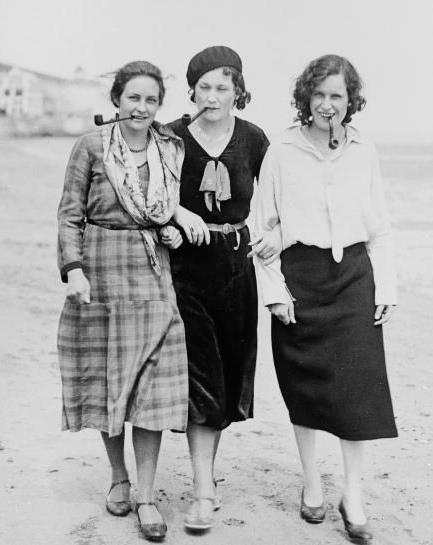
I shared it on my FB wall and my dear friend Esther Schulz-Goldstein wrote as a comment: Ungefähr 30 Jahre später, habe ich als junge Frau im Museumsrestaurant in Tübingen Zigarre geraucht und da zischte ein für mich damals alter Herr am Nebentisch, “eine deutsche Frau raucht nicht”. Ich zischte zurück, “deutsche Männer hätten lieber nicht soviele Menschen umgebracht”.

I was so taken over by this beautiful foto, that I did not notice, it could be a fake and in fact it is, what my two Polish friends – Ula Ptak and Elżbieta Jagiełło – immediately noticed. Sure it is a fake. The authors do not even try to say you it is not. Just look at it:
Emma Goldman 1869-1940
Rosa Luxemburg 1871-1919
Simone de Beauvoir 1908-1986

But obviously I am not alone in my being mistaked. Somebody found out, that that foto with it’s purposely false caption was shared 13,268 times. Well, so… I was the 13,269th one…

But I found the true story about that pic, it was so called WOPS in Mexico:

The Womens’ Pipe Smoking Group affectionately known as the WOPS or Borkum Riffs because of the sweet smells that trail behind them. They meet every early morning of the week and stroll along Olas Altas smoking and discussing shag tobacco. This wonderfully relaxed group sometime mix a blend of prime Moroccan hashish with their fine Borkum Riff fine cut shag from the Netherlands.

There is a waiting list to join these women of the below the knee dress wearing persuasion who want to become involved in this sedate pursuit of strolling and chatting and puffing away on their smooth Calabash Meerschaum pipes like steam locomotives struggling up a hill. The youthful countenances of this group suggest tobacco smoke is good for the complexion and has general health benefits.

Searching for the text above I found another two interesting texts about women and smoking and pipes and now I am rebbloging them for you: 

Women and Pipes

By Beth Maxwell Boyle

‘The guitar player’ by David Rijckaert III

By 1615 in England, the first consignments of Virginia tobacco for pipe smoking had arrived and some 7,000 shops in London sold tobacco .

Women Pipe smokers are rare today but female smoking was very popular in the 17th and 18th centuries. Respectable women were commonly seen smoking pipes in public. Many famous paintings exist of noble women of the period drinking in the smoke from a clay pipe. The middle classes were eager to enjoy this new pastime as well. In the Elizabethan times clays were quite delicate with graceful thin bowls and long stems. The Dutch redesigned these clays by enlarging the bowl and lengthened the stem.
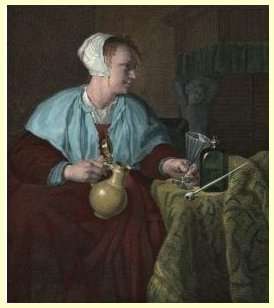
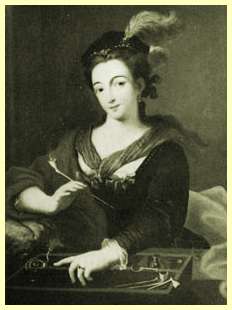
Dutch, French and English women all enjoyed the “Indian Weed”. For centuries the favorite way of enjoying tobacco was to smoke it in clay pipes. As early as about 1575 pipes were being made in England, but by the 17th century Holland had become the dominant center for the manufacture of clay pipes. Clays were made in many other European countries at this time, as well. Such pipes were usually white, with small bowls and long stems. They were extremely fragile and did not last long. However, by the 1850s, when pipe smoking in general became associated with the working class, female smoking began to decline, at least in public. The acceptance of female smokers seemed to vary between regions at this time. It is believed that many women kept their old habits. It is more than likely it was done in secret while they outwardly treated the act as a disgrace.’
Marquise de Pompadour, the favorite mistress of Louis XV, was a passionate smoker and owned more than three hundred pipes!

In rural areas such as the Highlands of Scotland and in Ireland the women smoked without shame. Women in the Hebrides smoked well into the 1930s due to the cultural isolation just as Appalachian women in the US did. It was seen as a very crude and backwards habit by most of polite society but little changes in any society without contact with urban centers. Today a women smoking a pipe draws immediate notice and sometimes ridicule.
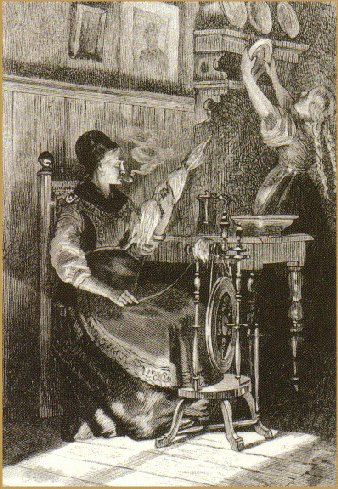
For more women pipes look HERE


And another text I just have to reblog:

I think I need to start smoking: or how to be an artist without a Gauloises hanging from your mouth.

Posted by Lisa Thatcher on January 19, 2012

Simone de Beauvoir – avec Gauloises.

I was rather disturbed to find out recently that some folk I admire are giving up smoking.

I was startled to say the least. No matter what anyone says, smoking remains the hallmark of cool. It’s as synonymous with art as booze, and as chic as any Euro fantasy.

Besides my obvious initial concerns (the loss of revenue for large faceless corporations and a drop in “cool” for those I admire) which are the same I think we all have when a dear one suggests they want to give up smoking, I had some broader concerns after giving the issue some thought.

Clarice Lispector. Smoking.

What about the health care professionals who are kept in a job because they have to care for the ill as a result of smoking all their life? (approx 48 billion a year is spent in smoking related health problems – approximately $11.00 of the cost of your cigarettes goes to health care professionals and their industries). The local tabac merchant, and all the other smaller stores that make the bulk of their revenue from cigarette sales. What of the poor governments loss of revenue (approximately $4 per pack) the drop of approximately 12.4 billion dollars from the advertising industry in the US alone (I think they’d notice this decrease, don’t you?) not to mention the drop in work for the legal industry. Tobacco is grown in 21 states of the United States, a leading producer of tobacco along with China and India. Think of all those farms and farmers, all those small communities kept alive – schools, libraries and hospitals because the local farmers grow tobacco.

Margurite Duras and Michelangelo Antonioni. Both Smoking.

And finally, the most poignant argument of all – almost everyone in Paris smokes.

Or is that all just bullshit?

If existence precedes essence, then I need to smoke in order to ‘be’ the writer I want to be. I know how the writer I want to be appears, because it has been determined (in essence preceding existence) by the writers I most want to emulate. Above you can see images of them smoking in the years before I took to the passion of writing. If I am determined by what surrounds me (according to Spinoza) the pressure to give up smoking is in direct confrontation with my experience of free will. It is in the world being a mirror of my free will that I am obliged to react. To overtake myself. The question here, is what self am I overtaking? Am I oppressed by my desire to give up cigarettes or my desire to smoke them in the first place?

Like Sartre’s waiter, I need to ‘play’ at being a writer until whatever (mysterious) criterion has been fulfilled that will have my inner self belive I am a writer. Scoff if you will, but this is a small charade that works for me. I had a blissful afternoon of writing today, in an atmosphere conducive to writing. Sometimes it is my desk and sometimes I will go mad if I have to look at my desk any longer and sometimes I need to play at being a writer just to feel its direction on my skin for the smallest while. Existence is defined by my concrete interactions with the world. Is it completely absurd that writers usually drink and smoke to excess? Of course it is – but again (if you adhere to the tenants of existentialism) that absurdism gives the action more meaning and puts us in touch with the basic humanity of existence.

Then, of course, we get into the nature of the cigarette itself. Should we roll our own? Can I still be an artist if the Gauloises are replaced by B & H extra mild?

And here comes the unpalatable truth. I have actually tried to smoke at several points in my life, and always given up in bitter disappointment, because I just can’t do it. I tend to be a very healthy person. The slightest upset in health regime sits poorly with me. I’ve never been able to smoke properly. I get too sick. For the most part, I’ve had to hang out with artists who do smoke, drinking in the second-hand, and wishing my little healthy body could tolerate it a little more hard-core.

And perhaps at the end of the day that is the source of my disappointment. Those around me giving up smoking results in me giving up the possibility of smoking. If I don’t see it, I wont remember it and horror of all horrors – I wont’ miss it. Perhaps my primal cry is more about the final shedding of the connection I have with the old artist image that fed me for so long. Just as I know the day of the depressed artist is over, perhaps the day of the drinking, smoking artist is over also.

Reblog: 100 years of Polish Avantgard

The text was published on 15th of March 2018 on the blog 20th century Typographers; the idea of that post was proposed to me by our Avant-Garde specialist, our author doctor Lidia Głuchowska.

PS. Written on Mai 2025 – unfortunately after years are all pictures gone.

Steven Heller

Stamp Of Approval For Polish Avant Garde

On November 11, 2018, Poland marks the 100th anniversary of the Second Polish Republic and independence from foreign domination upon signing the armistice that ended World War I (until the Nazis and Soviets carved it up again in 1939 prior to the start of World War II).

As a contribution to the celebration, Dr. Piotr Rypson, Polish design historian and deputy director for research at the National Museum in Warsaw, conceived a project that commemorates the 100th anniversary of the first Polish avant-garde exhibition of Polish Formists-Expressionists on October 27, 1917. The result is four postage stamps with illustrative and typographic work represented by Poland’s leading progressive artists.

The series was designed by Agata Tobolczyk, together with the date stamp and commemorative envelopes featuring constructivist sculpture by Katarzyna Kobro and a functionalist Warsaw villa by architect duo Lachert & Szanajca. The edition of 120,000 is sold by the Polish Post Office.

Below are stamps with covers of three avant-garde periodicals in the Formist (akin to the Constructivist) style and a theater program in an Expressionist manner.


Z archiwów Andrzeja Rejmana

Andrzej Rejman

Petersburski łącznik cz. II

Otrzymałem niedawno list od Andreja Frołowa, o którego zainteresowaniach pisałem już raz na tym blogu. Jako że stanowi on uzupełnienie wpisu sprzed dwóch lat, a odnosi się do prezentowanych zdjęć Petersburga sprzed ponad stu lat – publikuję go z małymi skrótami.

Andrej pisze:

“…Members of our group are still discussing your wonderful photos – we all admire them, without exaggeration. Some depicted locations were newly determined. So, we have amended our first suggestion that the picture

“Hrebnicki 3_Institutskiy shopping mall” (photo 1) had been taken on Malaja Spasskaja street. Instead,it was Institutskiy Prospekt, clearly visible signboards of various stores led us to this conclusion – all the stores are listed in the phone books of that time (they have been recently scanned by our Russian National Library website). At least one food store is still existing on this place:


HERE

The depicted shopping mall was very close to Institutskiy Pereulok (not Prospekt, these are two different streetnames), where the family of your grandfather probably used to live. You’ve sent two pictures that allow the suggestion about the photographer’s special relationship to the house with the current adress Institutskiy Pereulok 5-9. One of these photos was probably the view from the flat window of Institutskiy Pereulok in the south direction (fot. 2 ). The other photo depicts the house itself (fot 3). There is also a general view of Institutskiy Pereulok in the north direction (fot 4 ). Another picture (fot 5) shows how does it look like right now (was taken on 17th February 2018). The current general view of Institutskiy lane (south direction) should not be missed (fot 6).


The view from the photo “Kemeri_Villa Mitau” (fot 8 ) is not belonging to our neighborhood, it has been taken in the Latvian resort Kemeri (or Kemmern) near Jurmala. One member of our community managed to find an other photo of this marvellous building in the Internet (fot 7).

Oryginalne zdjęcie Hrebnickiego

The next photo (fot 9 ) grants us a rare view of the villa with an informal name “Three wells”. It was located approximately here:

HERE


Thank you very much again for the photos! It was a huge step forward for the local history of our district Lesnoy. I hope our correspondence will continue and I could provide you with the news about depicted locations. …”

Andrej Frolov, St. Petersburg

***
I ja dziękuję Andrejowi za szczegółowe opisy i pasję w kultywowaniu pamięci o jego mieście, które było też miastem młodości moich przodków…

Barataria 56 Island on dry land (Reblog)

THE HISTORY OF LOUISIANA, OR OF THE WESTERN PARTS OF VIRGINIA AND CAROLINA
Containing a DESCRIPTION of the Countries that lie on both Sides of the River Missisippi. With an ACCOUNT of the SETTLEMENTS, INHABITANTS, SOIL, CLIMATE, AND PRODUCTS.

Translated from the FRENCH Of M. LE PAGE Du PRATZ;
With some Notes and Observations relating to our Colonies.

Supposedly is Benjamin Smith Bartonan owner of Le Page`s book.

Reblog, p. 145

Let us return to Manchac, where I quitted the Missisippi; which I shall cross, in order to visit the west side, as I have already done the east. I shall begin with the west coast, which resembles that to the east; but is still more dry and barren on the shore. On quitting that coast of white and crystal sand, in order to go northward, we meet five or six lakes, which communicate with one another, and which are, doubtless, remains of the sea. Between these lakes and the Missisippi, is an earth accumulated on the sand, and formed by the ooze of that river, as I said; between these lakes there is nothing but sand, on which there is so little earth, that the sand-bottom appears to view; so that we find there but little pasture, which some strayed buffaloes come to eat; and no trees, if we except a hill on the banks of one of these lakes, which is all covered with ever-green oaks, fit for ship-building. This spot may be a league in length by half a league in breadth; and was called Barataria, because enclosed by these lakes and their outlets, to form almost an island on dry land.


One league means 5556 meters or 5,5 kilometer.


Fort Bute or Manchac Post was established on a board between Florida and Louisiana in 1763 at the junction of Iberville River (Bayou Manchac) with the Mississippi River. It was an important military and trading post in British West Florida until captured by Spanish forces on 1779, during what became known as Battle of Fort Bute of the American Revolutionary War. Manchac was one of the originally-planned stations along the railroad, which were generally at ten-mile intervals. It was a part of the Canadian National Railway system.

Canadian! In Luisiana!

The name “Manchac” derives from a Choctaw expression for “rear entrance” and really – it was a sort or rear entrance to Lake Pontchartrain, a lake we know already – Halfway House Jazz Orchestra was playing its New Orlans Jazz 1925 – 1936 in a Halfway House what was build on a half way from New Orleans to that lake.

So if we see that sober, the Barataria Jazz have been somewhat similiar to the situation of  giving a title Chelsea for a Jazz composition made in a studio located in Chelsea. Or something like that.


M. LE PAGE Du PRATZ was an interesting personality.

Antoine Simon Le Page Du Pratz was a Dutchman, as his birth in Holland about 1695 apparently proves. He died in 1775, just where available records do not tell us, but the probabilities are that he died in France, for it is said he entered the French Army, serving with the Dragoons, and saw service in Germany. While there is some speculation about all the foregoing, there can be no speculation about the statement that on May 25, 1718 he left La Rochelle, France, in one of three ships bound for a place called Louisiana.

For M. Le Page tells us about this in a three-volume work he wrote called, Histoire de la Louisiane, recognized as the authority to be consulted by all who have written on the early history of New Orleans and the Louisiana province.

Le Page, who arrived in Louisiana August 25, 1718, three months after leaving La Rochelle, spent four months at Dauphin Island before he and his men made their way to Bayou St. John where he set up a plantation. He had at last reached New Orleans, which he correctly states, “existed only in name,” and had to occupy an old lodge once used by an Acolapissa Indian. The young settler, he was only about 23 at the time, after arranging his shelter tells us: “A few days afterwards I purchased from a neighbour a native female slave, so as to have a woman to cook for us. My slave and I could not speak each other’s language; but I made myself understood by means of signs.” This slave, a girl of the Chitimacha tribe, remained with Le Page for years, and one draws the inference that she was possessed of a vigorous personality, and was not devoid of charm or bravery. Le Page writes that when frightened by an alligator approaching his camp fire, he ran to the lodge for his gun. However, the Indian girl calmly picked up a stick and hammered the ‘gator so lustily on its nose that it retreated. As Le Page arrived with his gun, ready to shoot “the monster,” he tells us: “She began to smile, and said many things which I did not comprehend, but she made me understand by signs, that there was no occasion for a gun to kill such a beast.”

It is unfortunate, for the purpose of sociological study, that this Indian girl appears so infrequently in the many accounts Le Page has left us in his highly interesting studies of early Louisiana and its original inhabitants. He does not even tell us the Indian girl’s name.

We are told that after living on the banks of Bayou St. John for about two years, he left for the bluff lands of the Natchez country. His Indian girl decided she would go with him, as she had relatives there. Hearing of her plan, her old father offered to buy her back from Le Page. The Chitimacha girl, however, refused to leave her master, whereupon, the Indian father performed a rite of his tribe, which made her the ward of the white man—a simple ceremony of joining hands.

Le Page spent eight years among the Natchez and what he wrote about them—their lives, their customs, their ceremonials—has been acknowledged to be the best and most accurate accounts we have of these original inhabitants of Louisiana. He has left us, in his splendid history, much information on the other Indian tribes of the lower Mississippi River country.

Antoine Simon Le Page Du Pratz tells us he spent sixteen years in Louisiana before returning to France in 1734. They were years well spent—to judge by what he wrote.

As it was written and published in the French language, Le Page’s history proved in many instances to be a tantalizing casket of historical treasure that could not be opened by those who had not mastered French. The original edition, published in Paris in 1758, a score of years after the author landed in New Orleans, was followed in 1763 by a two-volume edition in English, and eleven years later in 1774, by a one-volume edition in English, entitled: “The History of Louisiana, or of the Western Parts of Virginia and Carolina.” The texts in the English editions are identical.

Fortunately, early historians who could not read the French edition, were now able to read M. Le Page’s accounts of his adventures in the New World. Unfortunately, especially for present day historians, the English editions have become increasingly rare—many libraries do not have them on their shelves. Therefore, the present re-publication fills a long-felt want.

STANLEY CLISBY ARTHUR

(Mr. Arthur is a naturalist, historian and writer, and executive-director of the Louisiana State Museum.— J. S. W. Harmanson, Publisher.)


In Manchac went the young colonist from th Mississipi river, going either east or west. An here fe found Barataria. It s for him no place of resemblance on Don Quijote or Cervantes or Sancho Pans, but only a word meaning an an island on dry land, exactly as the place Sancho Pansa got als his Governement. It is exatly one hundred years after publishing a second part of Don Quijote, where Barataria was described. The name is already existing, given to the place for sure some years or maybe even some decades before.

I try modestly to put here my simple question:

Was the word Baratria invented by Cervantes which (VERY QUICKLY!!!) became synonyme to an island on dry land? (Was he word inventor? Or quotations author?) When it became proverbial?

Or was it always the description for it and Cervantes picked it as all writers do with words?

Valentine Day and Ash Wednesday

This year’s Valentine Day coincides with Ash Wednesday – what a contradiction.
Let me share with you a memory of a very strange Valentine Day.

Polish version HERE.

Lech Milewski

At the beginning of February 1999 I flew from hot summer in Melbourne, Australia, to cold and wintry Minneapolis. My intention was to compete in a ski marathon – American Vasaloppet in Mora, Minnesota.
The winter was poor in snow, but I managed to have decent skiing in few parks in Minneapolis. On Thursday evening, 3 days before the race, I heard on the radio, that the race has been cancelled due to the lack of snow.

It was a shock! Next morning I rang the race office. They confirmed the bad news – sorry, the race is cancelled.
– That’s impossible! I came here all the way from Australia! It cannot be!
– We are very sorry, but it is cancelled.
– But there is quite good snow in parks in Minneapolis.
– We also have good snow in the forest. But the race is run in the open area and there is no snow there.
– So shift it to the forest!
– That’s impossible, we have around 4,000 participants, we cannot squeeze them on narrow tracks. Anyway, the decision is FINAL, there is NO RACE!

I tried the last chance – please connect me with the club secretary.
I had Valerie Brown on the other end of the wire and I laid down my proposal:
I understand that you are unable to run the regular race. But on the other hand there is still quite good snow in the forest. And on another hand, I came here all the long way from Australia. Why not to put these two hands together and let me do a solo race in the forest?
There was a moment of silence and then… – come to Mora, we’ll see what we can do for you.
I heard smile in Valerie’s Brown voice.

Dalarna

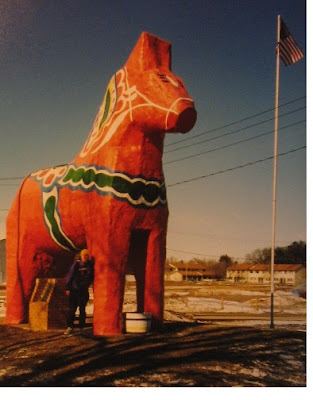
I came to Mora on Saturday morning. It was sunny, cold and snowless. The big, red Dalarna Horse reminded me my race in Sweden 3 years earlier.

In states Minnesota and Wisconsin there is quite large Scandinavian population, no wonder they introduced cross country skiing and copied traditional ski races of their countries.

Vasaloppet is most famous of them. It commemorates a historical event from year 1521. At that time Sweden was under Danish occupation and Swedish nobility assembled in a little town Mora decided to organize an uprising to liberate their country. As a leader they chose certain Gustav Vasa. He was hiding from Danes close to Norwegian border. Messengers were sent to him to convey the message. Gustav fastened his skis and skied 90 km from Sälen to Mora.

The uprising was a success, Gustav Vasa was elected a king and established a Vasa dynasty.
In year 1922 a ski race has been organized on the historical course – Sälen to Mora – 90 km – CLICK.

I went directly to the race office. It was the saddest place in the world. Thousands of race bags and bunches of medals for finishers. I took one of them in my hand….

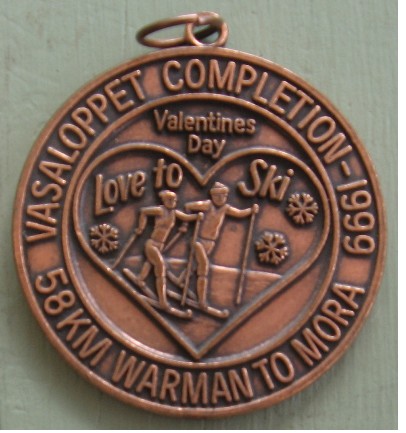
Medal

Valentine Day? Yes, of course! It will be Valentine Day tomorrow (14/2/1999)!
A heart, two skiers inside, Love to ski .
– What are you going to do with them?
– They all will be scrapped.
– O, no! You must let me to race for this medal!

We studied maps of ski trails in the forest. Valerie showed me the ones where the snow should be OK. I did simple arithmetic.
– Valerie, so if I will ski around these loops until 1 clock over 58 km, will you give me such a medal?
– Find his racing bag – she said.

A couple of club members drove me to the forest to see how it looks. I found it in much better condition than expected. After return to the town, I still managed to participate in sled races with some locals of Swedish origin and eventually went to sleep as the happiest person in Mora.

StartFinish

9 o’clock Sunday morning, blue skies, light frost, no wind. In the Log Cabin I left a bag with warm clothes and some food and drinks. I put on my red racing suit with kangaroos on the back and on the leg. Race number 503, START!!!

For a long time I was the only person on the trails. Later some people arrived, whole families for a relaxing session of skiing in the sun. Some of them were quite shocked when out of sudden a crazy racer appeared…
– Go away from the track – shouted parents to the children – thousand skiers will be here in a moment!
– But they said , that the race is cancelled?
I left them in such puzzled state and skied on and on – 5 times around The Point Trail, 4 times Beaver Dam Trail and every possible trail between and around.

Eventually my log showed more than 60 km, it was almost 3 pm. I skied back to the Log Cabin where some club members waited for me with the medal of my dreams.

Back from home, I wrote a detailed report of my effort, it showed almost 65 km. What a surprise it was when few weeks later I received mail from Valerie Brown. She sent me a special diploma.

Diploma

…and another medal. Valerie explained, that some of “Love to Ski” medals have been given to sponsors and volunteers so for me she sent a special one – Winners’s Time + 50%, Year 1999.

Medal 2

And there is only ONE such medal in the world.

Winter meetings with Olympians

Dziś rozpoczynają się Zimowe Igrzyska Olimpijskie 2018.
Die XXIII. Olympischen Winterspiele finden vom 9. bis 25. Februar 2018 in der südkoreanischen Stadt Pyeongchang statt.
2018 Winter Olympics!

Link do wersji polskiej

Lech Milewski

Once upon a time… when I reached noble age of 50, I spent my birthday in the mountains.

It was end of July, winter in Australia, I planned to have downhill skiing holidays.
Next day after my arrival a very strong wind came, so they had to close the ski lifts. I went to the store to return hired skis.
– Maybe you would try touring skis? – they suggested.
– Touring skis? And where can I ski on them?
– Everywhere.

I skied into the forest, wandered in a deep snow for hours. Returned to a ski lodge a different person.

Couple of days later the wind stopped, sun returned, my family arrived, we celebrated my birthday in familiar downhill skiing atmosphere, still the spell remained.

Soon my children did not need my assistance in their school duties and then the final message received in a ski hire store happened to be prophetic – I went… everywhere

Ski touring in Australia and cross-country ski marathons, over 40 of them, in 17 countries.
Ski marathons, these were so called “citizen races”, that means amateurs although sometimes elite skiers joined us. In secret I will tell you that twice I beat gold Olympic medalists – they did not finish the races.

Today, when the Winter Olympic Games start in PyeangChang, I return to my winter memories. My meetings with people, old time Olympians.

Estonia.

February 1996 – Tartu (known also as Dorpat).

Tartu 1996

On the eve of the Tartu Maraton there was a big opening ceremony in the main stadium. Some official speeches and ski sprints, a show of Estonian folk dances, skiers in traditional dresses.
I could not stand long in one place, it was so cold (-28C), that every few minutes I had to run to the top of the stadium to warm up at one of large bonfires.

During one of such visits a very big man looked at me curiously
– Where from are you? – he asked recognizing from my improper clothes, that I must be a foreigner.
– Melbourne, Australia.
– Melbourne! – he shouted – are you really from Melbourne?
– Yes, certainly I am.
– Melbourne! This is most beautiful city in the world! – he exclaimed squeezing my hand.
– Have you been to Melbourne?
– Yes, yes, in 1956, at the Olympic Games.
– O, you participated in the 1956 Olympic Games?
– Yes, I played basketball.

Basketball at Melbourne Olympic Games… I retrieved my memory for a while – oh yes, Soviet Union won a silver medal.
– Yes, Soviet Union – he frowned – but I played for Estonia! For Estonia! Do you understand? – he squeezed my hand even stronger.
– Yes I understand – I answered.

I saw tears freezing on his cheeks and felt ice on my cheeks too.

Slovakia

I arrived in Stary Smokovec by bus from Zakopane. There was a long climb of many steps leading from the bus stop to the town. I bent under my heavy load and walked up slowly.

– Mister Pollack, I have an accommodation for you – some voice croaked into my ear and I felt a smell of alcohol.
I looked up. A middle aged woman stood in front of me. She repeated her offer.
I had known this place from my ski trips in old times and expected to find accommodation in the central office located in the main street.
– Thank you but I already have booked accommodation – I lied.
– And where is your accommodation Mister Polak? – the woman did not give up and blocked my way.
– I got it arranged by accommodation office – I answered and tried to force my way up.
– Mr Polak, there is no longer any accommodation office! – cried triumphantly the woman. – And I have an accommodation for you!
– Stefan! Stefan! – she shouted. Two big men arrived at the top of the stairs.
– Stefan, I have a Polak for you!

I bent my head in resignation. The only escape was to run back to the bus stop. I decided that having my throat cut will be less shameful. I went up.
– Welcome Mister Polak – greeted me Stefan.
I have to explain that he spoke Slovakian, I spoke Polish, and we understood each other perfectly. Next to Stefan, a waiter stood with a tray with glasses of Becherovka.
We drank. Stefan grabbed my ski bag.
– Why are these skis so light? – he asked.
– These are cross country skis – I replied.
– Cross country skis? – you are the first Pole who came here with cross country skis.

I got large and comfortable room. In the evening there was a knocking to my door. Stefan came carrying some bag.
– Lech, do you know such name – Sixten Jernberg? – he asked.
– Sixten Jernberg! Of course! King of skis! Gold medals in Cortina, Innsbruck, Squaw Valley!
– Now I believe you are a cross country skier.

Stefan opened his bag and put on the table few bottles of Smadny Mnich.
– And do you know Lech, that I competed againts Sixten Jernberg in Innsbruck in 1964?
We both took a long sip of beer, sat comfortably and Stefan started his story…

Lech, you know how it was in communist system. They put all this rubbish into our heads.
So when I was selected to the Olympic ski team, we had these long instructions from some political officers – how bad capitalist system is, how many dangers are there. That we will be approached by some spies and provocateurs, so better not to speak to anyone. That we may be even kidnapped!
We came to Innsbruck. I was in fantastic shape. And I drew excellent start number, just three minutes before Sixten Jernberg.
– Listen Stefan – said my coach – go fast and strong. And watch Jernberg. If he will not catch you then you will get a place in the first six and maybe even a medal.
The race started. I felt so good. And my skis were waxed so well. I remembered what my coach said and went fast and strong. Distance 50 km. I passed 20 km, 30 km, 40 km and there was no sign of Jernberg. And then I heard a helicopter noise behind my back.
What was it? I remembered this stupid story that we might be kidnapped and froze.
And at that very moment Sixten Jernberg passed me. The helicopter was a TV crew covering his race.
I was so confused and frustrated that I stiffened, lost my rhythm. I finished 22nd.
And I could have finished in first six… or maybe even I could have won a medal.
– Medal, medal for sure – I confirmed eagerly.

We both took long sips of beer.

Next three days I had beautiful weather and excellent skiing. And every evening Stefan visited me and we talked about beauty of skiing.

At that time Slovakia made a bid to organize Winter Olympic Games 2006, below an occasional billboard.

Smokovec

Barataria 51 Halfway House Orchestra

Jazz Barataria

Recorded in New Orleans on 22 January 1925 by the Okeh Company’s mobile recording unit, Barataria is a fine example of the Halfway House Orchestra’s wonderfully relaxed playing style.

Okeh made a number of “field trips” to New Orleans and recorded many tunes by several bands but Barataria remains one of the best and most important examples of early New Orleans jazzmusic.

On YouTube where I found that wonderfull piece of wonderfull jazz of twenties wrote sombody with the nick Nick Ade: My grandfather, Leo Adde, co-wrote Barataria. That’s him on drums in the photo. Thanks for posting this. Isn’t it wonderfull?
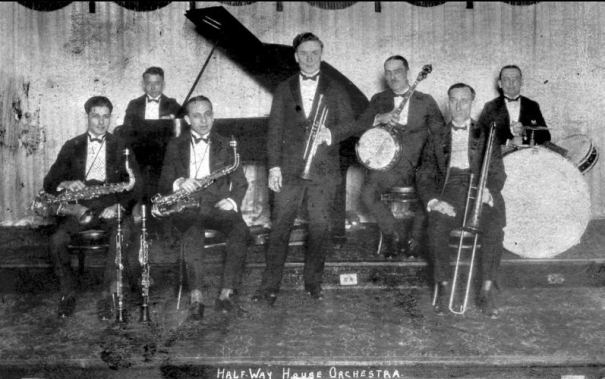

Abbie Brunies’ Halfway House Orchestra with l-r: Charlie Cordella, Mickey Marcour, Leon Roppolo, Abbie, Bill Eastwood, Joe Loyacano and Leo Adde. A different version of this photo was first published in 1939, where Roppolo’s socks hade made black, which better suited his tuxedo.

The piece on you tube is beautifully cleaned up, wrote one another listener to Barataria. (Un-cleaned version you will find HERE).
Another lisstener – jrogers71 – asked: I wonder what was going on in Barataria in 1925?

The Halfway House Orchestra was an USA jazzband, one of the first ones of New Orleans Jazz. It existed from 1919 till 1928, so it is a very propper time to wrote about it  hundred years later. In that time it was still rare to take the records and The Halfway House Orchestra was one of the first doing it, with one of the first labels – Okeh Records. And Barataria was a first record of the band.
The band was grounded by a cornetto player Albert “Abbie” Brunies (1900–1978), member of a very famous jazz family of  New Orlean. Also Georg Brunies, Charlie Cordella, Mickey Marcour, Leon Rappolo, Bill Eastwood, Joe Loyacano and Leo Adde played in the group.
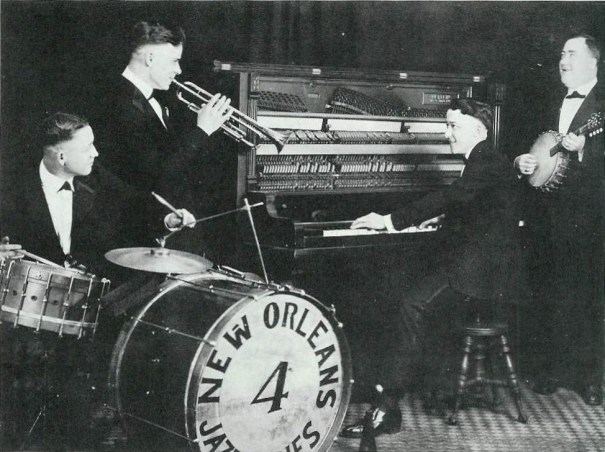

Four New Orleans Jazz Babies at Halfway House, ca. 1920. L-R: Emmett “ Buck” Rogers, Abbie Brunies, Mickey Marcour and Stalebread Lacoume. The photo was taken at the Halfway House and it may have been the first group that Abbie had there. Abbie would stay for many years at the Halfway House and the combination was to become famous among collectors of early jazz.


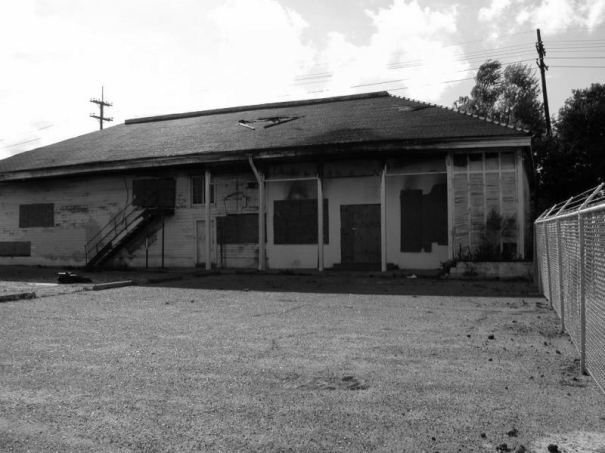
Above: Abbie leaning against the Halfway House, which was a music place and dance hall on a half way between the City of New Orleans and Lake Pontchartrain (Please notice the Budweiser-Ad on the roof). It opened around 1915 and was run by the brothers Chris, Gus and Oscar Rabinsteiner. Beneath: The house stays empty now and is badly in need of repair but, despite the ravages of time and fire, the Halfway House still stands. Its official address is 102 City Park Avenue.

Barataria on record

In March 1924 the OKeh company made its first field trip down to New Orleans. It recorded the bands of Johnny Bayersdorffer, Johnny DeDroit and Fate Marable, as well as some singers. The next year, in January 1925 OKeh came back and again recorded a mix of black and white artists. Among the white groups was the Halfway House Orchestra. On Thursday, January 22, 1925, Abbie’s band recorded Pussy Cat Rag and Barataria. Pussy Cat Rag was a composition of Abbie Brunies together with two of his band members, reed player Charlie Cordella and pianist Mickie Marcour. It features Leon Roppolo in a fine solo on alto saxophone. On Barataria, by the band’s banjoist Bill Eastwood and drummer Leo Adde, Roppolo solos on clarinet. Okeh’s publicity blurb said:

There’s no need to talk about the Halfway House Orchestra. Their music speaks for itself, for it’s a shoulder shaking rhythm that only Half-Way House Orchestra can play. Watch your feet misbehave when the carefree strains of “Pussy Cat Rag” and “Barataria” are in the air. You can get both of them on one Okeh record right now.

So, their music speaks for itself: HERE!

Super blue blood moon

The event may sound like a complicated tongue twister, but it’s really just the confluence of three celestial occurrences.

A blue moon is the second full moon of a month — in January, there will be a full moon on New Year’s Day and on Jan. 31 — while a supermoon is when the full moon appears larger and brighter to the naked eye.

These two events will coincide with a total lunar eclipse, or blood moon, on Jan. 31.

Most days the moon is nearly 238,855 miles from Earth, but during the supermoon it will be approximately 223,068 miles away, according to NASA. During a supermoon, the moon can appear up to 14 percent larger and 30 percent brighter than usual.

A total lunar eclipse occurs when a full moon passes into Earth’s shadow, making the moon appear red — hence the nickname blood moon.

Altogether, the three events — a blue moon, a supermoon and a blood moon — will make for a spectacular show the last night of January. (Or day! In Berlin since 16:58)

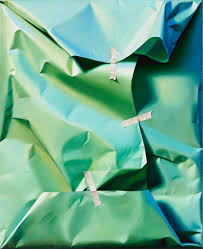
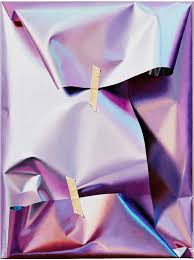
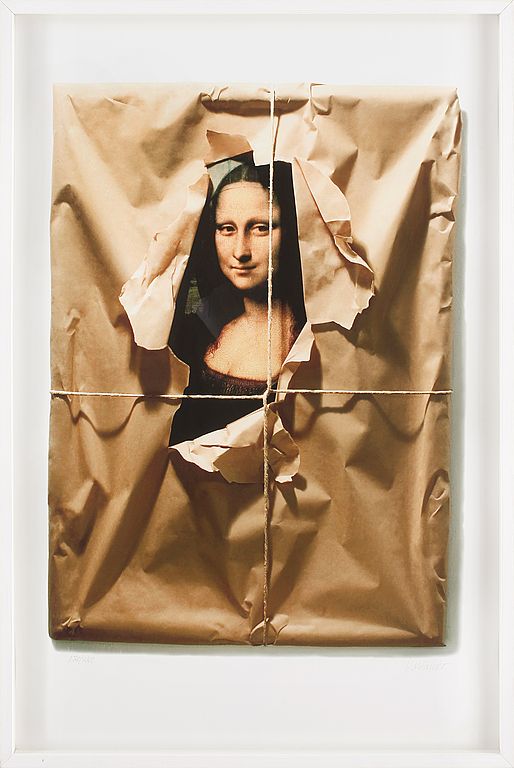
Zagadka / Riddle / Rätsel

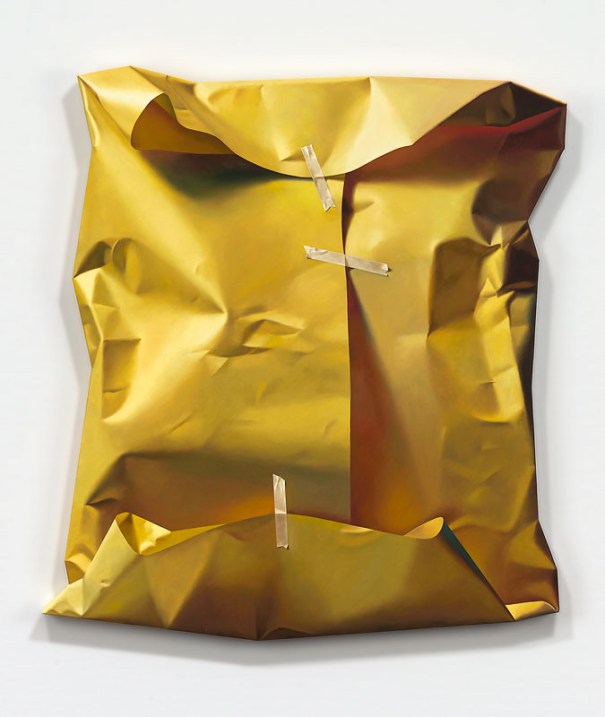
Co ja paczę? No, co to jest? / Was ist das? / What is that???


Na? And? I co?
Paczki świąteczne, co? Xmas Packages maybe? Ich glaub, Pakete. Weihnachtsgeschenke?

Aha!

Look! Schau! To popatrz.

Sztuka! Kunst! Art!!!!! And the Artist. A to artysta. Der Künstler!

Yrjö Edelmann (1941-2016)

Wiki auf Deutsch

artnet in English

a po polsku niestety jakiś dziwny portal, gdzie obraz olejny nazywa się “obraz olejowy” 😦
womanadvice.pl