Post in English
Post in English
Barataria 119. O bzach i poezji
Ewa Maria Slaska
Takie zdjęcie przysłane na messengera. A w nim warstwy znaczeń, aluzji, przypomnień. Ale nie wszystkie widać od razu. Pierwsza, najprostsza – zasuszone wielopłatkowe kwiatki bzu, a w tekście – powracający motyw bzu…
Dla A

When Lilacs Last in the Dooryard Bloom’d
By Walt Whitman
1
When lilacs last in the dooryard bloom’d,
And the great star early droop’d in the western sky in the night,
I mourn’d, and yet shall mourn with ever-returning spring.
Ever-returning spring, trinity sure to me you bring,
Lilac blooming perennial and drooping star in the west,
And thought of him I love.
2
O powerful western fallen star!
O shades of night—O moody, tearful night!
O great star disappear’d—O the black murk that hides the star!
O cruel hands that hold me powerless—O helpless soul of me!
O harsh surrounding cloud that will not free my soul.
3
In the dooryard fronting an old farm-house near the white-wash’d palings,
Stands the lilac-bush tall-growing with heart-shaped leaves of rich green,
With many a pointed blossom rising delicate, with the perfume strong I love,
With every leaf a miracle—and from this bush in the dooryard,
With delicate-color’d blossoms and heart-shaped leaves of rich green,
A sprig with its flower I break.
4
In the swamp in secluded recesses,
A shy and hidden bird is warbling a song.
Solitary the thrush,
The hermit withdrawn to himself, avoiding the settlements,
Sings by himself a song.
Song of the bleeding throat,
Death’s outlet song of life, (for well dear brother I know,
If thou wast not granted to sing thou would’st surely die.)
5
Over the breast of the spring, the land, amid cities,
Amid lanes and through old woods, where lately the violets peep’d from the ground, spotting the gray debris,
Amid the grass in the fields each side of the lanes, passing the endless grass,
Passing the yellow-spear’d wheat, every grain from its shroud in the dark-brown fields uprisen,
Passing the apple-tree blows of white and pink in the orchards,
Carrying a corpse to where it shall rest in the grave,
Night and day journeys a coffin.
6
Coffin that passes through lanes and streets,
Through day and night with the great cloud darkening the land,
With the pomp of the inloop’d flags with the cities draped in black,
With the show of the States themselves as of crape-veil’d women standing,
With processions long and winding and the flambeaus of the night,
With the countless torches lit, with the silent sea of faces and the unbared heads,
With the waiting depot, the arriving coffin, and the sombre faces,
With dirges through the night, with the thousand voices rising strong and solemn,
With all the mournful voices of the dirges pour’d around the coffin,
The dim-lit churches and the shuddering organs—where amid these you journey,
With the tolling tolling bells’ perpetual clang,
Here, coffin that slowly passes,
I give you my sprig of lilac.
7
(Nor for you, for one alone,
Blossoms and branches green to coffins all I bring,
For fresh as the morning, thus would I chant a song for you O sane and sacred death.
All over bouquets of roses,
O death, I cover you over with roses and early lilies,
But mostly and now the lilac that blooms the first,
Copious I break, I break the sprigs from the bushes,
With loaded arms I come, pouring for you,
For you and the coffins all of you O death.)
8
O western orb sailing the heaven,
Now I know what you must have meant as a month since I walk’d,
As I walk’d in silence the transparent shadowy night,
As I saw you had something to tell as you bent to me night after night,
As you droop’d from the sky low down as if to my side, (while the other stars all look’d on,)
As we wander’d together the solemn night, (for something I know not what kept me from sleep,)
As the night advanced, and I saw on the rim of the west how full you were of woe,
As I stood on the rising ground in the breeze in the cool transparent night,
As I watch’d where you pass’d and was lost in the netherward black of the night,
As my soul in its trouble dissatisfied sank, as where you sad orb,
Concluded, dropt in the night, and was gone.
9
Sing on there in the swamp,
O singer bashful and tender, I hear your notes, I hear your call,
I hear, I come presently, I understand you,
But a moment I linger, for the lustrous star has detain’d me,
The star my departing comrade holds and detains me.
10
O how shall I warble myself for the dead one there I loved?
And how shall I deck my song for the large sweet soul that has gone?
And what shall my perfume be for the grave of him I love?
Sea-winds blown from east and west,
Blown from the Eastern sea and blown from the Western sea, till there on the prairies meeting,
These and with these and the breath of my chant,
I’ll perfume the grave of him I love.
11
O what shall I hang on the chamber walls?
And what shall the pictures be that I hang on the walls,
To adorn the burial-house of him I love?
Pictures of growing spring and farms and homes,
With the Fourth-month eve at sundown, and the gray smoke lucid and bright,
With floods of the yellow gold of the gorgeous, indolent, sinking sun, burning, expanding the air,
With the fresh sweet herbage under foot, and the pale green leaves of the trees prolific,
In the distance the flowing glaze, the breast of the river, with a wind-dapple here and there,
With ranging hills on the banks, with many a line against the sky, and shadows,
And the city at hand with dwellings so dense, and stacks of chimneys,
And all the scenes of life and the workshops, and the workmen homeward returning.
12
Lo, body and soul—this land,
My own Manhattan with spires, and the sparkling and hurrying tides, and the ships,
The varied and ample land, the South and the North in the light, Ohio’s shores and flashing Missouri,
And ever the far-spreading prairies cover’d with grass and corn.
Lo, the most excellent sun so calm and haughty,
The violet and purple morn with just-felt breezes,
The gentle soft-born measureless light,
The miracle spreading bathing all, the fulfill’d noon,
The coming eve delicious, the welcome night and the stars,
Over my cities shining all, enveloping man and land.
13
Sing on, sing on you gray-brown bird,
Sing from the swamps, the recesses, pour your chant from the bushes,
Limitless out of the dusk, out of the cedars and pines.
Sing on dearest brother, warble your reedy song,
Loud human song, with voice of uttermost woe.
O liquid and free and tender!
O wild and loose to my soul—O wondrous singer!
You only I hear—yet the star holds me, (but will soon depart,)
Yet the lilac with mastering odor holds me.
14
Now while I sat in the day and look’d forth,
In the close of the day with its light and the fields of spring, and the farmers preparing their crops,
In the large unconscious scenery of my land with its lakes and forests,
In the heavenly aerial beauty, (after the perturb’d winds and the storms,)
Under the arching heavens of the afternoon swift passing, and the voices of children and women,
The many-moving sea-tides, and I saw the ships how they sail’d,
And the summer approaching with richness, and the fields all busy with labor,
And the infinite separate houses, how they all went on, each with its meals and minutia of daily usages,
And the streets how their throbbings throbb’d, and the cities pent—lo, then and there,
Falling upon them all and among them all, enveloping me with the rest,
Appear’d the cloud, appear’d the long black trail,
And I knew death, its thought, and the sacred knowledge of death.
Then with the knowledge of death as walking one side of me,
And the thought of death close-walking the other side of me,
And I in the middle as with companions, and as holding the hands of companions,
I fled forth to the hiding receiving night that talks not,
Down to the shores of the water, the path by the swamp in the dimness,
To the solemn shadowy cedars and ghostly pines so still.
And the singer so shy to the rest receiv’d me,
The gray-brown bird I know receiv’d us comrades three,
And he sang the carol of death, and a verse for him I love.
From deep secluded recesses,
From the fragrant cedars and the ghostly pines so still,
Came the carol of the bird.
And the charm of the carol rapt me,
As I held as if by their hands my comrades in the night,
And the voice of my spirit tallied the song of the bird.
Come lovely and soothing death,
Undulate round the world, serenely arriving, arriving,
In the day, in the night, to all, to each,
Sooner or later delicate death.
Prais’d be the fathomless universe,
For life and joy, and for objects and knowledge curious,
And for love, sweet love—but praise! praise! praise!
For the sure-enwinding arms of cool-enfolding death.
Dark mother always gliding near with soft feet,
Have none chanted for thee a chant of fullest welcome?
Then I chant it for thee, I glorify thee above all,
I bring thee a song that when thou must indeed come, come unfalteringly.
Approach strong deliveress,
When it is so, when thou hast taken them I joyously sing the dead,
Lost in the loving floating ocean of thee,
Laved in the flood of thy bliss O death.
From me to thee glad serenades,
Dances for thee I propose saluting thee, adornments and feastings for thee,
And the sights of the open landscape and the high-spread sky are fitting,
And life and the fields, and the huge and thoughtful night.
The night in silence under many a star,
The ocean shore and the husky whispering wave whose voice I know,
And the soul turning to thee O vast and well-veil’d death,
And the body gratefully nestling close to thee.
Over the tree-tops I float thee a song,
Over the rising and sinking waves, over the myriad fields and the prairies wide,
Over the dense-pack’d cities all and the teeming wharves and ways,
I float this carol with joy, with joy to thee O death.
15
To the tally of my soul,
Loud and strong kept up the gray-brown bird,
With pure deliberate notes spreading filling the night.
Loud in the pines and cedars dim,
Clear in the freshness moist and the swamp-perfume,
And I with my comrades there in the night.
While my sight that was bound in my eyes unclosed,
As to long panoramas of visions.
And I saw askant the armies,
I saw as in noiseless dreams hundreds of battle-flags,
Borne through the smoke of the battles and pierc’d with missiles I saw them,
And carried hither and yon through the smoke, and torn and bloody,
And at last but a few shreds left on the staffs, (and all in silence,)
And the staffs all splinter’d and broken.
I saw battle-corpses, myriads of them,
And the white skeletons of young men, I saw them,
I saw the debris and debris of all the slain soldiers of the war,
But I saw they were not as was thought,
They themselves were fully at rest, they suffer’d not,
The living remain’d and suffer’d, the mother suffer’d,
And the wife and the child and the musing comrade suffer’d,
And the armies that remain’d suffer’d.
16
Passing the visions, passing the night,
Passing, unloosing the hold of my comrades’ hands,
Passing the song of the hermit bird and the tallying song of my soul,
Victorious song, death’s outlet song, yet varying ever-altering song,
As low and wailing, yet clear the notes, rising and falling, flooding the night,
Sadly sinking and fainting, as warning and warning, and yet again bursting with joy,
Covering the earth and filling the spread of the heaven,
As that powerful psalm in the night I heard from recesses,
Passing, I leave thee lilac with heart-shaped leaves,
I leave thee there in the door-yard, blooming, returning with spring.
I cease from my song for thee,
From my gaze on thee in the west, fronting the west, communing with thee,
O comrade lustrous with silver face in the night.
Yet each to keep and all, retrievements out of the night,
The song, the wondrous chant of the gray-brown bird,
And the tallying chant, the echo arous’d in my soul,
With the lustrous and drooping star with the countenance full of woe,
With the holders holding my hand nearing the call of the bird,
Comrades mine and I in the midst, and their memory ever to keep, for the dead I loved so well,
For the sweetest, wisest soul of all my days and lands—and this for his dear sake,
Lilac and star and bird twined with the chant of my soul,
There in the fragrant pines and the cedars dusk and dim.
Autora wiersza rozpoznaję jednak wcale nie po bzie, lecz po… słowie “kapitan”, które pojawi się w tytule następnego wiersza na tej samej stronie.
O Captain! My Captain
O Captain! my Captain! our fearful trip is done;
The ship has weather’d every rack, the prize we sought is won;
The port is near, the bells I hear, the people all exulting,
While follow eyes the steady keel, the vessel grim and daring:
But O heart! heart! heart!
O the bleeding drops of red,
Where on the deck my Captain lies,
Fallen cold and dead.
O Captain! my Captain! rise up and hear the bells;
Rise up—for you the flag is flung—for you the bugle trills;
For you bouquets and ribbon’d wreaths—for you the shores a-crowding;
For you they call, the swaying mass, their eager faces turning;
Here Captain! dear father!
This arm beneath your head;
It is some dream that on the deck,
You’ve fallen cold and dead.
My Captain does not answer, his lips are pale and still;
My father does not feel my arm, he has no pulse nor will;
The ship is anchor’d safe and sound, its voyage closed and done;
From fearful trip, the victor ship, comes in with object won;
Exult, O shores, and ring, O bells!
But I, with mournful tread,
Walk the deck my Captain lies,
Fallen cold and dead.
Oba wiersze są lamentem na cześć Abrahama Lincolna, zamordowanego 14 kwietnia 1865 roku, w porze kiedy kwitną bzy. Piszę do A, że podoba mi się słowo “kapitan”, ale nie piszę, że jest dla mnie ważne. Nawet nie wiem, czy on wie, dlaczego jest ważne – że to mój Ojciec, i że tak jak o Mamie wszyscy mówili Artist lub Artysta, tak o Ojcu – Kapitan lub Captain. O Captain! My Captain! A właśnie o nim pisałam…
W odpowiedzi dowiaduję się, że owszem, jestem uważną czytelniczką, a jakbym zauważyła coś jeszcze, to żebym dała znać. Nie zawracam sobie tym głowy. Takie sobie komplementy. Wszyscy, my, którzy zajmujemy się książkami, jesteśmy uważnymi ich czytelnikami. Zresztą, o czym tu pisać? Oczywiście zauważyłam zasuszone kwiatki bzu, oczywiście je pamiętam, bo miesiąc temu A pokazał mi je świeżo zerwane, być może w jednym z ogrodów na mojej wiecznie kwitnącej ulicy. Mamy tu kwiaty, które kwitną jeszcze w grudniu i takie, które już w grudniu zakwitają.
Dopiero po kilku godzinach pojawią się następne skojarzenia. Walt Whitman! Wiersze po angielsku! Oczywiście!
15 kwietnia. Wczoraj A, który zebrał i zasuszył fioletowe kwiatki i włożył je do zielonej książki, tam, gdzie Whitman pisze o bzie, miał urodziny. Nie było mnie jednak.
15 kwietnia zostanę więc zaproszona na ciasto urodzinowe, upieczone przez solenizanta. Prezent dałam mu już przed wyjazdem – wiersze Lorki w tłumaczeniu Mamy, zakupione przez moją siostrę i sprowadzone w skomplikowany sposób z Gdańska do Berlina. Ale jednak jak się idzie na urodziny, to nie można iść z pustymi rękoma. Rozglądam się po mieszkaniu
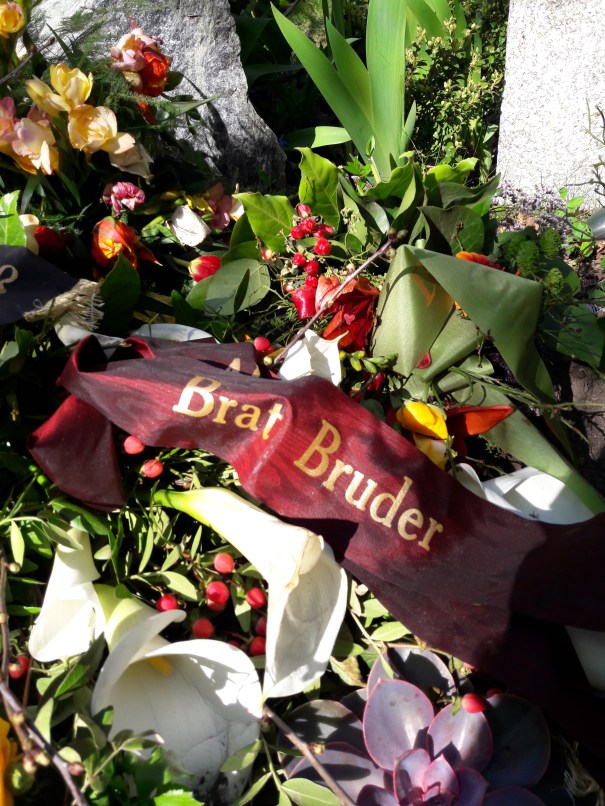
i widzę zieloną książkę. Nie powinno jej tu być, ale jest. Nie została odłożona na półkę przez kolegę, który wczoraj dokonał dorocznego i dogłębnego odkurzania książek. Whitman nie wrócił tam, skąd się pojawił – na półkę, gdzie stoją książki po angielsku ze zbiorów Mamy. I już nie wróci, bo zabieram go zamiast prezentu. Lorca Mamy, Whitman Mamy, kwiatki bzu. Nawet śmierć obecna w obu wierszach Whitmana towarzyszyła nam, żywym, tego dnia, bo po herbacie i cieście z lodami poszliśmy na cmentarz, na grób zmarłego przed miesiącem kolegi dziennikarza.
A gdy już to wszystko napiszę, to nagle dojrzę misterną, baratarystyczną sieć pułapek, jaką na mnie zarzucił A. Bo tego dnia rano (jest 21 maja), przy dzbanku herbaty na balkonie, rozmawiamy o Don Kichocie. Już jakiś czas temu A zapytał mnie, dlaczego właściwie tak mnie interesuje Don Kichot? Odpowiedziałam wtedy, że nie wiem, że tak się zdarzyło i że jest to zapewne zasłużona kara za to, iż przez wiele lat nie lubiłam tej książki i nie chciało mi się jej czytać. Teraz wracam do tego pytania i mówię, że lubię rozmyślać o wędrówkach motywów w kulturze – w końcu jestem archeolożką i etnolożką, a to zawody, które tym się zajmują. A poza tym lubię, jak rzeczywistość przeplata się z kulturą – lubię usłyszeć w autobusie, od przypadkowo siedzącego obok mnie pasażera, odpowiedź na pytanie, które zadał sobie i mnie bohater czytanej wczoraj powieści.

Tym razem, rzecz się jeszcze komplikuje, bo tę powieść, po raz kolejny oczywiście, czytał A. I wieczorem przysłał mi nie tylko wiersz Whitmana, ale i tę karteczkę. Właśnie skończył lekturę.
– Po cóż iść za tropem tego, co się już skończyło?
– Bo tak, odpowiedział mi dziś żebrak w metrze.
Berlin, 22 maja 2019
PS 1. znaleziony tego dnia na FB u Danusi:
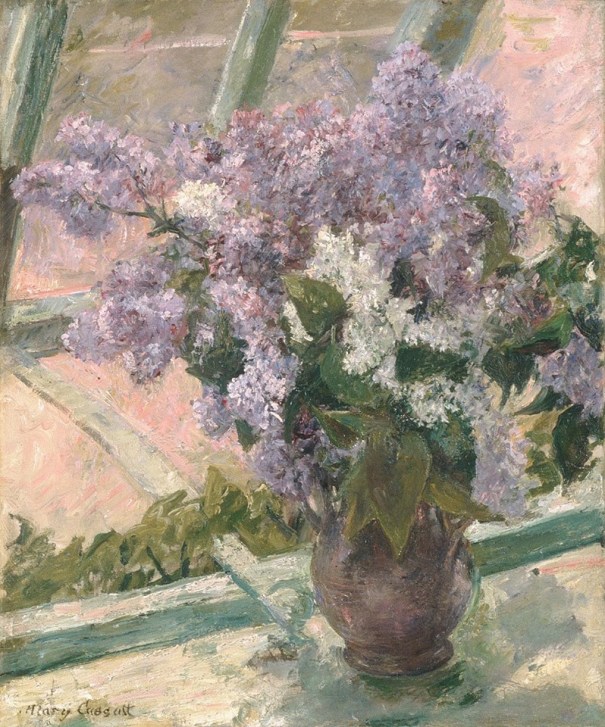
Ponieważ “To był maj / pachniała Saska Kępa / szalonym, zielonym bzem”… ponieważ 175 lat temu, 22 maja, urodziła się Mary Cassatt, amerykańska malarka i graficzka tworząca we Francji, impresjonistka, autorka wielu obrazów inspirowanych prozą Henry’ego Jamesa… “Lilacs in a Window” (Bez w oknie), 1879 r., Metropolitan Museum of Art (The Met), Nowy Jork:
PS 2. Pisałam ten wpis przez kilka tygodni. W międzyczasie, 31 maja, minęła dwusetna rocznica urodzin poety. Z tej okazji różne instytucje przypominają jego wiersze. Np berliński festiwal poezji, który 19 czerwca zaprasza do Kulturbrauerei na rozmowy o whitmanowskich źdźbłach trawy. Wszystko się łączy ze wszystkim.
Und es ist gut so!
From my spams
I already published here a weird text I got send to me every day in a river of spams every blog administrator got evere day. It is a never ending procedure which, happily enough, are stopped by akismet, ein defence programm against spam. Once upon a time among all that money slots and girl porn wchich build a main of tha avalanche of spams, there was even a religious story about two small twin brothers of seven which were discovering Jesus in a playing with they parents. It was send to me in parts and it took about three weeks to complete the story.
Now I find etwas, which would be a coming-of-age story with music in America. Maybe it will have the following parts. I’ll let you know. Interesant, the sender of that is download frank casino ep
gera-mebel.ru/bitrix/rk.php?goto=http%3A%2F%2Freg…x
AntonMorice71@gold.intained.com
162.244.150.228
Casino is juts normal sender of spam; gera-mebel.ru suggest something from the East Europe – Russland, Rumenia, but no, Rumenia is RO, Russland is RUS, and RU is… Burundi. But gera-mebel.ru is exactly, what you erwartes, a Hompepage of furniture magazin in Moscow near to Andropov Prospect. Online and in Russian. Anton Morice, about whom I hoped, he coud be our searched author, is only one to find in net: Anton Morice Cerda Henriquez, living in Chile. And not a writer. An intergraltrainer, whatever it means… Online portal Stop Forum Spam writes: gold.intained.com erscheint in unserer Datenbank 470 mal. OK spam, no way.
The last try: BG, initials beginnig both capitels of that story. On the Wikipedia-List of BGs all over the world I find: Boris Grebenschtschikow (* 1953), Russian Poet and Musician. Let’s hope it’s him and my blog get him so long wanted fame :-). Bat I do not think he needs fame like that. Wikipedia writes: he is widely considered the “founding fathers” of Russian rock music. Due as much to his personal contribution as to the undisputed and lasting success of his main effort, the band Aquarium (active since 1972 until today), he is a household name in Russia and much of the former Soviet Union. Grebenshchikov is colloquially known as BG after his initials.

Maybe it is him. I mean – his text… Anyway it is dealing with facts. All links from me.
BG: Spur of the moment, but this half a freestyle, and half an old verse I never put on a track. It was years ago so I was more than likely high out of my mind. Could certainly tell by lengthy hair and “stop snitching’ shirt Experienced been wearing. I love those guys absolutely no one will ever do that together again!
The school will provide you with an ugg. The money that you spend on that Art Carved Class Ring is the better devoted to a beautiful wooden frame for that diploma. You’ll never be embarrassed any diploma for a wall, and never tuck it away in a desk cabinet. And besides, even after finding the frame, personal cash loan have plenty of money make moves meaningful – like taking a weekend day at Cabo.
During that time period, albums included “The Dirt Band”, and “An American Wish.” The band also performed on “Saturday id test game live 22” and provided backing for Steve Martin on his million selling novelty tune, “King Tut.” They released several more pop albums adverse reactions . time, getting around the country music roots they started that has.
I came into this world in 1973. Saturday Night Live first hit the air in October of that year. One time i was young and sneaking associated with your my bed. I’d sit in the hall way and listen to my father laughing at the show. I could not wait till I was old enough to watch it.
BG: Aren’t getting me wrong, if it weren’t for hard drugs, my parents record collection wouldn’t be half as big as it must be. Though in my case, undertake it! say, “yo, I smoked the best weed and wrote this dope song”, but for me, using a level and clear head helps me be more creative than any drug could ever make my vision.
Mussachio, a complete time guidance counselor, searching for to position himself for their big fight and a win over Thompson could land him one. Mussachio rebounded from a tough loss to world rated Garrett Wilson, a fight which was very close when he was stopped in the 12th round, to defeat Billy Bailey in May of 2012. With a career plagued by inactivity & with father time catching up, Mussachio must looked to impressively dispatch from the the tough Thompson.
Letters to Juliet is an unabashed chick flick. This may be a good selection for a date at home this year. It’s a love story about beautiful folks beautiful settings, plus there’s the added Shakespeare/Romeo & Juliet element. Instrument chick flicks, if really want some easy viewing, if you’d like a snuggle on the couch type movie, rent Letters to Juliet.
Overall, having been impressed and happy to relive my concert memories while listening to Beautiful Mess-Live on Earth, and I felt motivated and inspired by Mraz’s lyrics. The DVD includes extras because “Fall Through Glass,” and videos of Mraz on tour from summer. The DVD forces you to laugh once you watch Mraz and his friends amusing themselves on tour, you will also achieve inside look from Mraz and his video director as they determine what songs perform most optimally with what visuals for music movie clips.
Even if it is most possible, the author is an American, I still remember the Russian conection of tha mail adresse from which this text was sen to me. So let’s belive it is that Russian BG. Today in a London club Under The Bridge you can go to concert of BG. So go, if you are in London. The guy is really good.
Борис Гребенщиков и группа “Аквариум”
“Песни и танцы Гипербореи” (Pieśni i tańce Hiperborejów)
(Старое, новое и политически некорректное)
17, 18 и 19 мая 2019 года в лондонском клубе Under The Bridge пройдут концерты Бориса Гребенщикова и группы «Аквариум». Это первые за последние 5 лет выступления “посла рок-н-ролла в неритмичной стране” вместе с группой в полном составе в городе, где «каждый камень Леннона знает».
Целые поколения выросли под “Аквариум”. Их подпольные записи слушали в СССР на бобинах и кассетах, из текстов песен узнавали о «сансаре и нирване». Каждый их новый альбом становился событием, под их песни люди влюблялись, взрослели…
В этом году легендарная группа отпразднует свой 47-й день рождения, но «Аквариум» решительно отказывается почивать на лаврах: музыканты постоянно ищут новый звук, экспериментируют со стилями и жанрами.
Каждый концерт “Аквариума” – настоящий праздник для его поклонников, который редко заканчивается раньше полуночи. Гребенщиков всегда стремится найти идеальную гармонию между местом, временем и способом исполнения своих песен. Программа предстоящих концертов, как всегда, держится в строжайшем секрете, но будет отличается от той, которую лондонцы слышали на акустическом концерте Гребенщикова в 2017 году. Будут и совсем новые, еще не записанные песни, и классика «Аквариума».
«Аквариум» выступит в полном составе:
Борис Гребенщиков (вокал, гитара), Александр Титов (бас-гитара), Алексей Зубарев (электрическая гитара), Андрей Суротдинов (скрипка), Брайан Финнеган (свисток, флейта), Лиам Брэдли ( ударные), Глеб Гребенщиков (перкуссия), Игорь Тимофеев ( саксофон, банджо), Константин Туманов (клавишные, аккордеон),
По словам Гребенщикова, “Аквариум – это сияющий зверь. Он приносит вам лекарство. То, чего вам не хватало, а вы сами этого не знали.”
Двери открываются в 19-00, концерт начинается в 20-00.
Kyrgyz Republic. The Tulip Revolution of March 2005 – its causes and consequences
Tomorrow, 14 years ago
Franz Eichinger
The Tulip Revolution of March 25, 2005 was the turning point of my two-year stint in the Kyrgyz Republic. I have, therefore, made it the point of reference for my assessment of the events and developments in that period.
* Deceptive Calm
A Good Start
After receiving a proper introduction in Germany, I came with a very positive attitude to Kyrgyzstan. Right from independence, German interest in Kyrgyzstan had been raised by the substantial German minority in the country. This, combined with a very promising democratic and economic take-off after independence, soon made Kyrgyzstan a high-priority country for German development assistance. Kyrgyzstan was regarded as a basically stable country with certain dangers looming: Islamic terrorism, organized crime, drug-trafficking and minority problems. The foreign policy record was exemplary: balanced between the great powers of the region: Europe acted as an important partner and model for regional integration, and eventual WTO member status.
My first impressions of the country were encouraging. The cultural atmosphere was liberal and the press seemed to be remarkably lively. I found receptive interlocutors in the Government and the opposition, and I liked the often ironic or even critical way officials talked to me about the situation. My first meeting with President Akayev was during the ceremony of handing over of my credentials, an impressive experience. He took his time, was very friendly and humble and knew every detail about cooperation with Germany.
Disenchantment
After a while I could not avoid a certain disenchantment. I learnt about the all-pervasive and, partly, well-organised corruption, including the Presidents family, the flaws in the democratic façade and – for outsiders most difficult to understand – clan, tribal and regional rivalries. Particularly annoying for many people was the discrepancy between talk and reality. Akayev‘s rhetoric on democracy and free market economy was immaculate but his rule had become more and more autocratic. The economy was in the grips of his family and a small minority around them. Mechanisms of repression were mostly geared to avoid open violation of human rights but nonetheless effective, e.g. taking unwanted opponents or journalists to court for offenses which they either had not committed or which were only punishable for people who had no Government protection.
Economy and Development
The economic situation was characterized by widespread poverty, great regional disparities and few prospects for tangible improvement. There was a strong “official” commitment to a good investment climate and support for foreign investors. In reality, investors were frightened away by red tape, corruption and the absence of the rule of law. It was especially discouraging to see the frustration of young, capable businesspeople who were deprived of opportunities by the system.
Development aid was highly appreciated and there were many very capable counterparts but they soon became part of the corrupted system when expatriate control was relieved.
I had the impression that the country – as a result of its long-time status as an assistance recipient – had developed a kind of recipient mentality with sophisticated ways to court donors and to raise aid money, sometimes at the expense of their own efforts. Even during Soviet times some 80% of the Kyrgyz budget was covered by Moscow.
From my contacts with the Opposition, I generally got the impression that they were strong in criticism of the Akayev regime but weak on ideas and vision of their own. Apart from some NGOs, I could not find much of it convincing democratic concept. This was, in fact, confirmed at a dinner with Bakiyev which friends of mine had arranged for me when he grew to be probably the most important opposition figure.
Minorities
When I came to Kyrgyzstan, the German minority had already been decimated by emigration to Germany and was not playing any significant role in the country’s economy and politics. But dealing with them drew my attention to the minority question. I raised it in every conversation with important politicians. Throughout, they expressed either pretended or genuine nonchalance. On the other hand, mirtorities were well aware of the general exclusion from core politics and big business. I came to the conclusion that the actual minority policy was at least an impediment to the country’s economic development if not a stability risk.
Conflict Potential
lt took me some time before I realized that the situation was potentially explosive. Most of the people appeared to be fed up with the regime. Some opposition members sounded quite militant and many people explained to me that based on nomadic tradition, Kyrgyz people were unruly and rebellious.
In the complex tribal, clan and regional structure, the North-South divide started to dominate the other rifts. It was epitomized by Akayev himself and his rival Kulov (by that time still in prison) who both were Northeners. Bakiyev, Beknazarov, Madumarov and Tekebayev were soon as the main representatives of the South. I felt that, with the Southerners becoming more important, a Kyrgyz nationalistic touch had been added to political life.
It soon became clear that with the forthcoming elections – municipal elections in October 2004, district, provincial and national parliamentary elections in February-March 2005, and presidential elections in the middle of 2005 – the country was moving towards a critical phase as no one thought that the regime could win elections without fraud. The unrest in the South after the arrest of popular opposition MP Beknazarov in the Aksy district during 2002 when five demonstrators were shot dead was still very much on the minds of everyone. The situation was exacerbated by the establishment of Alga Kyrgyzstan, a new party which in emulation of Putin’s United Russia, was meant to secure a two-thirds majority in Parliament for the Akayev regime. The strong person behind the party was Bermet Akayeva, the elder daughter of Akayev. It was telling of the popularity of Akayev and the elite around him that the party did not take off. In the end, a number of candidates from Alga Kyrgyzstan chose to run on a personal ticket instead of an Alga ticket. There were a number of other parties but their importance was limited because parties could only nominate 18% of the candidates. The rest was determined by direct vote, when often local issues were in the foreground.
The political discussion was dominated by Akayev’s succession. He had on several occasions declared that he would not seek re-election at the upcoming presidential elections, but people did not trust him. They thought that he might either tamper with the Constitution to secure continuing influence or renege on his commitment because “people had urged him to continue.”
Foreign influence on the political process was an important issue in the discussions. Against the background of OSCE‘s wide membership – US, Canada, Western Europe and CIS countries – OSCE representatives in Bishkek were working toward a dialogue between the regime and the opposition. It managed to maintain a high standing with both sides up until the last minute. The US Ambassador publicly urged Akayev to unequivocally renounce another term of presidency. I did not support him because I did not want to give a reason for denouncing the opposition as foreign-supported and did not want to interfere with a matter which was entirely up to the Kyrgyz people to deal with. I preferred to urge the Government to ensure fair elections.
The first results of the election campaign observation did not augur well for the elections. The media coverage was unfair for the opposition candidates. In many constituencies, wealthy businessmen were encouraged to stand against opposition candidates because they were in a better position to buy votes. As the technical conditions for correct elections had improved through donor help, the regime tried to make sure that unwanted opposition candidates were not registered or deregistered on flimsy grounds before the elections. Others were harassed or impeded in their election campaign while their opponents loyal to the regime got massive administrative support. As a result, before the elections even began people went into the streets in some constituencies.
Days of uncertainty and fear
It got worse after the first round of elections on February 27. Especially in the South, there were a number of places where mainly peaceful demonstrations against election results took place. They reached a first climax when a brother of Bakiyev, with his people, occupied the administrative building in the provincial capital of Jalal-Abad and the Government was unable to stop him. After the second election round on March 13, the situation escalated. Special Government forces only intermittently managed to win back the administration buildings in Jalal-Abad and Osh from the demonstrators.
In Bishkek, the situation had been relatively calm with small opposition rallies. But rumor had it that there would be a showdown between Government and opposition on March 25, though no one expected a decisive outcome. Everybody was shocked when the White House fell so quickly. Apart from various security forces which disappeared, after at while the Government had put up “sportsmen” to fight insurgents. I stayed in the Embassy longer that day, and when I drove home I saw the looters carrying goods away from the shops. In the middle of the night, the OSCE Ambassador called me and told me that there was systematic looting on Sovietskaya and that it seemed to be well organized. The next morning at nine, Rosa Otunbayeva called some ambassadors to a meeting in the Hyatt to brief them on the latest developments. I do not remember the details, but I was struck by remarks with Kyrgyz nationalistic overtone.
The question whether the events of March 25 were a revolution or just a coup d‘état is controversial. What happened in Bishkek was a mobilization of supporters by different opposition politicians. But the developments which led to it had traits of a popular uprising, especially in the South. So it is with this in mind when I talk about Revolution.
The days after the Revolution were tough in terms of work and my own personal situation. Nobody knew where the looting mob would move. Nobody knew what the security forces – who had virtually disappeared from the scene with their arms – would do. Thinking of the terrible things marauding soldiers had done in other places of the world, I was impressed by the relative discipline which ruled in that situation in Kyrgyzstan. At work, there was a great need for sound information, in particular, in regard to the decision whether to evacuate German citizens. The pressure to evacuate mounted when the UN, Turkey and OSCE started to fly out people or bring them to Almaty. In close connection with friendly missions, American and French in particular, we decided not to evacuate. Luckily, the situation became more relaxed ater Kulov, a rival of Akayev who had been arrested and sent to prison in connection with the presidential election in 2000, was freed from prison and managed to stop the looting and restore some fragile order after several days.
On the private side, the situation became complicated because our three grown-up children had come to Bishkek for the Easter holidays which started the day after the riots. My youngest son who was the last to arrive via Istanbul, met Turkish citizens there who were happy to have escaped the riots in Kyrgyzstan. Ater two boring (and costly) days in the Hyatt hotel, which was regarded the only safe place to go to, my family got fed up and set of to Issyk-kul, at their own risk. The Embassy had strongly discouraged German citizens from leaving Bishkek at this time of turmoil. After some calm had returned, attention was directed more to the political issues again. Most of the observers were puzzled
– that the regime had fallen so quickly and easily
– that Akayev had immediately let the country and did not or could not muster more resistance
– and that it could not be cleared up who organized the support of the looters in Bishkek. All that indicated how tenuous the state was in general.
*Restoring fragile stability
Political Developments
It seems that the decision by the opposition, now in power, not to dissolve the new Parliament and to have it confirm Bakiyev as Prime Minister and Acting President was a wise one. New parliamentary elections could have led to further turmoil and the quick formation of a government sent an important signal to the worried population and possible troublemakers. By all accounts, Bakiyev was the strongest opposition leader. But it was also clear that his new office would give him an additional headstart in the impending presidential elections.
The new Government appointed by Bakiyev did not indicate much change. The opposition members of it, including Bakiyev himself, represented the old guard who had already made an important part of their career either under the Communist regime or under Akayev. According to a familiar pattern, the new Ministers appointed old, trusted allies and relatives to key positions. One could argue that the situation called for experienced, reliable people but it was the first damper on the high hopes many people associated with the Revolution. The people remained unruly and did not hesitate to go out into the streets or to erect road blocks when their demands were not fulfilled. At district and municipal levels many new leaders appointed themselves or were appointed by the people without following legal procedures.
Right from the beginning the situation was overshadowed by the forthcoming presidential elections. The discussion continued to focus on the North-South divide. This favored Bakiyev as a heavyweight from the South. His only serious competitor at the time was Kulov, a former security chief, who had reaffirmed his reputation as a hands-on law and order man in the days after the Revolution. His main drawbacks were that he originated from the North, that he did not seem to be well rooted in clan and tribal structures, and – as an important formal point – that he had problems to meet the constitutional requirement for presidential candidates to speak Kyrgyz. So when Bakiyev and Kulov announced that they had agreed to run in tandem in the presidential elections scheduled for July 10, 2005 most of the people were happy that a North-South confrontation had been avoided. There was little doubt that Bakiyev would come out as President from the elections. The agreement provided that Bakiyev would then choose Kulov as his Prime Minister.
Under these circumstances the presidential elections were unspectacular. It did not, however, bode well for the future that in spite of Bakiyev’s strength and virtually certain victory, the elections were heavily rigged in his favor. After the elections a tug of war between Bakiyev and Kulov started in which Bakijev more and more seemed to get an upper hand, not least due to the strong position of the President in the Constitution.
In parallel to the events on the ground, a lively discussion of constitutional amendments with a view to reduce the powers of the President had started. There seemed to be general agreement that the constitutional changes initiated under Akayev had vested the President with excessive powers. However, it became clear right from the beginning that Bakiyev who was close to winning the Presidency was trying to prevent such a change, though he could not stop the dscussion.
Frustration with Bakiyev’s rule, in particular, the involvement of his family in politics and business and the perceived overweight of Southeners in positions of power, soon led to the formation of a new opposition to the Government which managed to stage important demonstrations in Bishkek in the second quarter of 2006 and forced Bakiyev to exchange some of the stalwarts of his regime.
Property and Land
The redistribution of illegally acquired property by the Akayev family and its cronies was a priority of the new Government. But there was no independent investigation, and it soon became clear that the new holders of power were not interested in a just solution but in manipulating the redistribution in their favor. Property issues became a pronounced source of instability as local leaders and criminal groups tried to solve disputes by force and violence.
Since independence, land had been a touchy issue in Kyrgyzstan, and it was no surprise that this issue flared up after the Revolution. The situation became especially critical around Bishkek where thousands of squatters from the South who had supported the Revolution were pitched against the landowners and local authorities. The fact that land speculators and criminal elements tried to benefit from the situation made a solution even more difficult. The Government temporarily managed to diffuse the conflict but it kept simmering on.
Economy
More important for the development of the Country and business, donor, and popular support for the new Government were economic reforms. There was no serious new effort to tackle the endemic deficiencies of the Kyrgyz economy: corruption, lack of rule of law, bureaucracy, lack of a consistent economic development policy and the ensuing bad investment climate. Sporadic crackdowns on corruption and the introduction of new bureaucratic control mechanisms as well as the announcement of big industrial projects evoked memories more of Soviet thinking than of a new market economy approach. Lip service to donor’s requirements continued but was less eloquent than before.
Security
A few days after the Revolution, having seen superficial calm restored, Kulov resigned from his job as coordinator of the security forces. There were, however, clear indications that the Government was not in control of the situation. The Revolution had left security forces feeling very insecure. Apart from loyalty conflicts that any change of regime raises, the police and other security forces had been exposed to a moral dilemma when asked to act against protesters. At the local level, the security forces were subject to the same pressures and actions by self-appointed leaders as other parts of the administration. At the some time, illegal arms were flooding the country and organized crime that under Akayev had mainly acted underground, raised its head and came out into the open. The police were doomed to stand aside when competing criminal groupings struggled for regional influence, new rackets were organized, and close connections between important politicians and organized crime became obvious. The situation reached a height when a leading criminal authority organized public meetings against PM Kulov in Bishkek’s central square and the police could do nothing but look on.
Human Rights
On the positive side, there was a new feeling of freedom in the media scene and less pressure on critical NGOs after the Revolution. However, it was not yet clear whether this reflected a new policy or whether the Government had just not yet managed to assert itself. The facts were difficult to establish because the new Government, like the old Govemment, preferred informal means of influence over formal ones. It took some time before it became apparent that the regime was tightening the screws again. Bakiyev’s rhetoric on democracy and human rights betrayed more old thinking than Akayev’s. His handling of the presidential elections and constitutional reforms also raised concerns, and there were no efforts to guarantee new freedoms by law.
Ethnic Minorities
Illegal actions in the aftermath of the Revolution, like looting, illegal property acquisition and land occupation, often had ethnic connotations. Members of minority groups were harder hit than others. As a consequence, many of those who were able to, left the country, especially Russians. For Kyrgyzstan this meant a loss of brains and expertise. At the same time, the Government did not pursue a reassuring minority policy. It had abolished the Akayev concept of the Common House of Kyrgyzstan with a place for all nationalities. The Assembly of Nations of Kyrgyzstan became invisible. When I asked members of the Government about this I was told that it was just a change in rhetoric but not in substance. Even if this was right it sent out negative signals. Minorities always told me that they felt the climate had changed for the worse for them.
Foreign Policy
The more or less autocratic neighbors of the Kyrgyz Republic had a skeptical attitude towards the Kyrgyz Revolution. The complicated relationship with Uzbekistan soured even more after the uprising in Andijan in Uzbekistan on June 4, 2005 where many people were killed and about 400 fled to Kyrgyzstan. Uzbekistan demanded the refugees to be sent back and Western countries and the UN High Commissioner for Refugees put pressure on the Government not to send them back in accordance with international law. The local Kyrgyz population was hostile to the refugees. In the end the Kyrgyz authorities sent back four refugees while the rest were able to travel to Romania.
The Bakiyev Government seemed to follow the same balanced policy towards the great powers in the region as its predecessor. The US was allowed to maintain its airbase at Bishkek Manas Airport which had become even more important for the operations in Afghanistan after the US was forced to leave its base in Uzbekistan. Soon after the Revolution, however, the Government demanded a renegotiation of the contract. The base had become an important factor in the Kyrgyz economy in terms of money and jobs. It is another point altogether, though, whether this “easy money“ meaningfully contributed to the development of the country.
In terms of mentality, Bakiyev seemed to be closer to his Russian partners. The Russians had very early on declared their willingness to cooperate with the new Government. They promised to strengthen the airbase in Kant and offered large investments in power stations. There were always rumors that Bakiyev was getting advice from Russian experts on “polit-technology“ for the consolidation of his power.
Conclusion
When we left Kyrgyzstan in June 2006, it was still difficult to assess the long-term effects of the Tulip Revolution which had created new dynamics in the evolution of the country. In the short run, the results were disappointing but not surprising. In a country without a democratic tradition, where power was more or less taken over by members of the old elite, it would have been overoptimistic to expect a significant change towards a more efficient democratic system. Most of the people were fed up with the Akayev regime because of their difficult living conditions, the perceived economic stagnation in the country, and a feeling of being unterprivileged as a result of corruption as well as tribal and clan politics. Above all, they blamed the people in charge, but not so much the system, for their misery. The opposition seemed to advocate democracy, rule of law and human rights only as long as it supported their claim to power. When they castigated corruption, it was mainly the corruption of others they were admonishing. I am sure there were exceptions to this rule and I would like to apologize to this minority for lumping them with the mainstream.
We can only hope that the Tulip Revolution was an irnportant step towards the realization of lasting stability and progress. They can only be achieved with new people and a more democratic and transparent system, with media that are free and capable of reporting on the deficiencies in the Government and in the country. Donors can help in this process with support to those parts of the civil society who credibly promote the above mentioned ideals in their work. Careful targeting and conditioning of aid money is more important than the amount.
As always in such a situation, my wife and I left Kyrgyzstan with mixed feelings. We were pessimistic about the chance of a rapid, thorough change to the better, but we had met many people whose professional ethics, creativity and dedication to high ideals made us optimistic about the long-term prospective of the country.
***
Published in: „20 years of Indenpendence seen from inside and outside“, The Times of Central Asia, Bishkek 2011
Franz Eichinger was German Ambassador to the Kyrgyz Republic in 2004-2006
From Wikipedia:
Kyrgyzstan, officially the Kyrgyz Republic and also known as Kirghizia, is a country in Central Asia. Kyrgyzstan is a landlocked country with mountainous terrain. It is bordered by Kazakhstan to the north, Uzbekistan to the west and southwest, Tajikistan to the southwest and China to the east. Its capital and largest city is Bishkek.
Kyrgyzstan’s recorded history spans over 2,000 years, encompassing a variety of cultures and empires. Although geographically isolated by its highly mountainous terrain, which has helped preserve its ancient culture, Kyrgyzstan has been at the crossroads of several great civilizations as part of the Silk Road. Though long inhabited by a succession of independent tribes and clans, Kyrgyzstan has periodically fallen under foreign domination and attained sovereignty as a nation-state only after the breakup of the Soviet Union in August 1991.
In October 1991, Askar Akayev ran unopposed and was elected president of the new independent Republic by direct ballot, receiving 95 percent of the votes cast. Together with the representatives of seven other Republics that same month, he signed the Treaty of the New Economic Community. Finally, on 21 December 1991, Kyrgyzstan joined with the other four Central Asian Republics to formally enter the new Commonwealth of Independent States. Kyrgyzstan gained full independence a few days later on 25 December 1991. The following day, on 26 December 1991, the Soviet Union ceased to exist. In 1992, Kyrgyzstan joined the United Nations and the Organization for Security and Co-operation in Europe (OSCE). On 5 May 1993, the official name changed from the Republic of Kyrgyzstan to the Kyrgyz Republic.
In 2005, a popular uprising known as the “Tulip Revolution”, took place after the parliamentary elections in March 2005, forced President Askar Akayev’s resignation on 4 April 2005. The revolutionaries alleged corruption and authoritarianism by Akayev, his family and supporters. Opposition leaders formed a coalition, and a new government was formed under President Kurmanbek Bakiyev and Prime Minister Feliks Kulov. The nation’s capital was looted during the protests. Askar Akayev fled to Kazakhstan and then to Russia. On April 4, 2005, at the Kyrgyz embassy in Moscow, Akayev signed his resignation statement in the presence of a Kyrgyz parliamentary delegation. The resignation was ratified by the Kyrgyz interim parliament on April 11, 2005 and it was the end of the “Tulip Revolution”.
Cat’s museums

Hair Salon Painting – Barber Shop With Cats And Apes, circa 1655, oil on canvas by Abraham Teniers [Belgium 1629-1670]
Ewa Maria Slaska
Cat’s Museum
Some days ago I get that link on Facebook, a BBC story about cat’s museum in Amsterdam.
Felines have fascinated and inspired artists for centuries; worshipped in Ancient Egypt and made Instagram famous in the 21st Century. For many, the cat has been a companion worthy of immortalising in art.
Bob Meijer founded Amsterdam’s KattenKabinet (Cat Cabinet) in memory of his beloved pet John Pierpont Morgan, which he owned as a student. The museum features depictions of cats in film, posters, photography, sculptures and music. It’s also home to two young cats, who are popular with the visitors.
“The character of artists and cats are very close to each other because a cat is a very independent creature, he doesn’t listen to his master. An artist is also very independent, and that is why most artists love cats and not dogs,” says Meijer.
Watch the video above to find out more.
I did. And I found, BBC sent it as one of world’s strangest museums.
And I thought, oh jeemine, IT IS NOT TRUE!
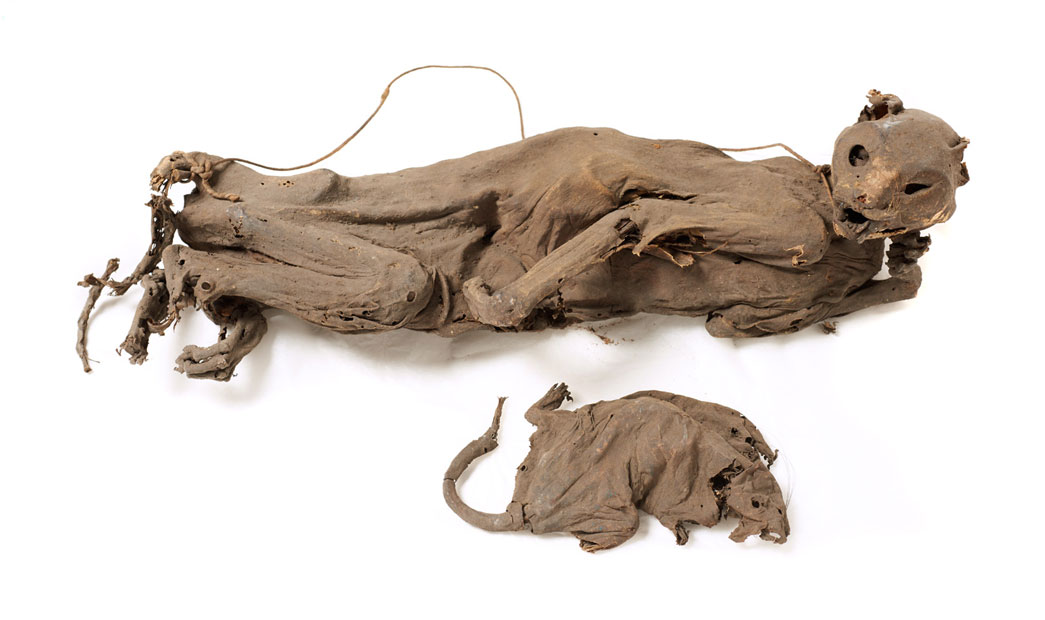
I do not make any research, I just write about cats, because (everybody knows it) I like them. But I am sure, there are many cat’s museums in the world. I myself wrote already twice about cat’s museums – one in Berlin and one in Moscow. The Berlin Museum has even similar story as the Amsterdam’s one – it goes back to that what the owner did (had) as a young boy. I translate from my post:
Helmut Glantz, a very nice older man, collects since 40 years all about cats – figurines, pictures, china, everyday items and selected objects for collectors. Mass products and precious uniques. Everything started with a small white china cat, which he bought for some marks being the pupil… Now all that cats got over the whole flat, the owner and his family (nowadays the wife only, the children growned up and moved away) and, of course, cats are living in another flat in the same house. Here is no place for living beings, here rule the reificated cat.
And HERE. Nine cat’s museums in the whole world – the Amsterdam one is on the list, my two – even not. On the list below there are some further museums.

HERE the link to Cat’s Museum in Warsaw and HERE – in San Francisco. And so on, and so on…
Really BBC, please, some modesty! Katten Kabinet in Amsterdam is a very fine thing, but it is NOT one of the strangest museums in a world! Only because you do not have cat’s museum in London you must not decide such a museum is strange… Two years ago there was a special cat exibition in Museum of London. And see, what was showed there:

Guess, what it is? A mummified rat and cat, late 19th century; found together in a London sugar warehouse.
Isn’t it nice?
Mantegna & Bellini
Ewa Maria Slaska
Dla Danusi
Deutsch & English in Text

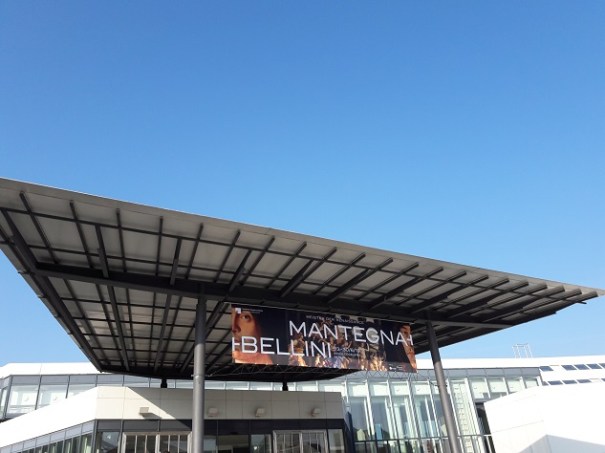
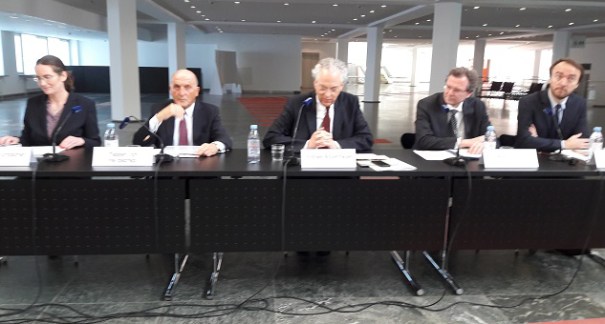
1 marca otwarta została w Berlinie wystawa superlatyw. Podczas konferencji prasowej nazwano ją wprawdzie tylko wystawą roku, ale czuło się, że mówcy, rozpływając się nad wartością wystawy, a więc tego, co przygotowali bądź opłacili, wiedzą, że mówią o wystawie dekady, a może stulecia. Jest w każdym razie spektakularna, niezwykła, nadzwyczajna, sensacyjna. To słowo pojawia się wielokrotnie i nader skutecznie, bo recenzje też piszą o sensacji.

Nota bene pan drugi z prawej, przewodniczący Towarzystwa Ubezpieczeń Od Ognia (Feuer-Sozietät) poinformował zebranych, że jego instytucja wydaje rocznie 1,5 miliarda euro na sponsorowanie popularyzacji sztuki. Och!
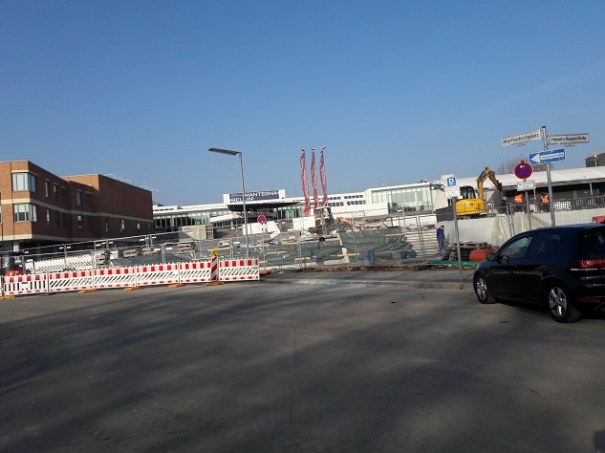
Gościa zamierzającego udać się na wystawę informuję, że zanim tam dojdzie czeka go przedostanie się przez rozległy plac budowy. Z tyłu widać już zbawcze napisy, że owszem Mantegna i Bellini, ale przed nami droga przez mękę. Na pociechę dodam, że jakoś się dojdzie. Idźcie wzdłuż płotów.

Potem już będzie coraz lepiej.

Wystawa zajęła również reprezentacyjny holl wejściowy Nowej Galerii Narodowej (Neue National Galerie) z piękną instalacją wodną Waltera de Maria, a ja słysząc to wyobrażałam sobie, że będzie nam dane doświadczać przyjemności, jakie mieli bogacze, którzy zamawiając dzieło sztuki, nie wieszali go bezdusznie na ścianie, lecz umieszczali je pomiędzy drogimi kwiatami, w otoczeniu drogocennych przedmiotów i wkomponowywali je w gry wodne i ogrody…
Dzieło Waltera de Maria zniknęło jednak całkowicie, wodę wyłączono, kamienne baseny przykryto podłogami i dywanami, jeśli w salach były kiedykolwiek jakiekolwiek okna, to wszystkie zostały pokryte gęstą, intensywnie kolorową materią spowijającą sufity, podłogi i ściany. Zielenie, szarości, czerwień. Wystawa jest zbiorem coraz mniejszych szkatułek, zamykających nas w czarodziejskim świecie. Gdy potem wyjdziemy z muzeum, ze zdumieniem stwierdzimy, że tam na zewnątrz nadal trwają prace budowlane, a niebo jest niebieskie.
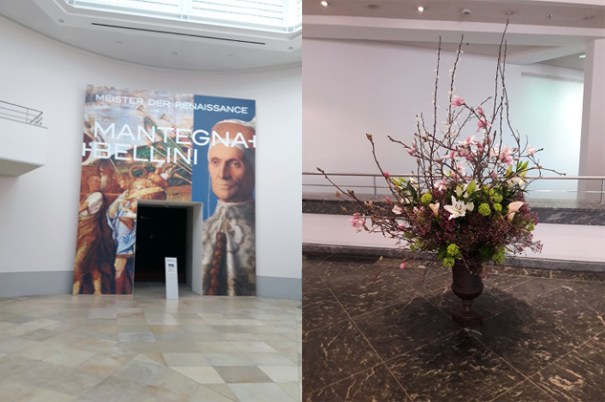
Co naprawdę wzrusza na wystawie jest maleńka informacja – Fotografujcie (przepraszam za jakość zdjęcia) i jak chcecie, to wyślijcie swoje fotografię na stronę #mantegnabellini (oczywiście jak wam się uda – mnie się nie udało, ale cóż bym ja tam miała wysyłać :-).

Podczas konferencji zostaliśmy dobitnie poinformowani, że galeria ma teraz super nowoczesną stronę, ale może jestem zbyt archaiczna, żeby odkryć jakieś jej nieopisane uroki, a zdjęcia (choćbym chciała) nie udało mi się przesłać, więc chyba wszystko jest nie dla mnie. Ale inni wstawili tam zdjęcia i filmiki, co wygląda bardzo ładnie. Poniżej filmik z wystawy w londyńskiej National Gallery, która poprzedziła tę naszą, berlińską.
Und hier (endlich) eine richtige Kritik auf Deutsch.

A ja od siebie dodam na koniec – piękna wystawa, czarodziejska, pozwala zapomnieć o stresie i zmartwieniach :-). Wielcy artyści, wielkie obrazy.
Barataria 104: Weź rdzeń młodej palmy…
Tibor Jagielski już kilkakrotnie raczył nas tu ciekawymi przepisami kulinarnymi; ten został znaleziony przez Autora podczas podróży morskiej.
Weź rdzeń młodej palmy (ok. 0,5 – 0,75 m),
owiń w liście bananowca i umieść w wysmarowanej tłuszczem brytfannie.
Obsyp orzeszkami arachidowymi (0,5 kg, najlepiej świeżo prażone),
dodaj fasolki soi (0,5 kg, najlepiej świeże, ale mogą być z puszki),
dorzuć parę papryczek chili, kilka grzybów (boczniak, shitake, ale mogą być i pieczarki),
dopraw kilkoma ząbkami czosnku i posól (do smaku – każdy ma inny, ale można znaleźć wspólną podstawę),
zalej klasycznym wywarem z warzyw (0,5 litra).
Brytfannę dobrze przykryj i wstaw do piekarnika (180°C) na 45 minut (próba widelca).
Smacznego!
Ewa Maria Slaska
Zastanawiam się, czym możnaby zastąpić rdzeń młodej palmy? Mam oczywiście trudności, bo nigdy tego nie jadłam, choć raz jadłam potrawę owiniętą w liście bananowca i powiązaną rafią na kształt paczuszki. Liści bananowca się potem nie jadło. Widzę tu pewne pole do popisu dla inwencji kulinarnej autora i postanawiam mu wysłać tych kilka zdań.
Odpowiedź przyszła enigmatyczna:
Jemy, jemy! (jak rozumiem – jemy liście bananowca). Również kwiaty bananowca jemy (nazywa się je „sercami bananów“). Wszystko jemy, a dodatkowo liście mogą służyć jako talerze lub opakowanie potraw.
Rdzeń palmy kupuje się w afroshopie.

Wpis wydaje mi się nieco za mały, postanawiam go samodzielnie uzupełnić, bo autor dosyła wprawdzie świetny przepis (wykorzystam kiedy indziej), ale na sałatkę z kwaśnej kapusty.
Sięgam jeszcze raz do książki Barataria Summer. Pisałam już o niej. To powieść naładowana wesołym swobodnym seksem (każdy śpi z każdym, a w rodzinie to już w ogóle), nie wiadomo też, czy jest to opowieść
o przemycie czy o walce z przemytem, ale na pewno wiadomo, że jest to powieść o tym, jak w ciągu jednego lata, przy pomocy rodzinnego seksu, przemytu, pływania łodziami i statkami po zatoce Barataria oraz jedzenia można z rozpieszczonego szesnastolatka z miasta zrobić świetnego faceta, a nawet (jak się okaże) – pisarza. Jego imię podczas wakacji zmienia się z Teddie na T’Eddie.
Głównym napojem bohaterów książki jest mocna gorąca kawa, ale oczywiście nie stronią też od whisky. Na łodzi żywią się kiełbaskami i chlebem. Ale już zorganizowany ad hoc posiłek, podany przez LaBelle, młodą, piękną gospodynię w chacie na wodzie będzie wyglądał lepiej:
… piliśmy kawę i jedliśmy chleb żytni, placki, tartę ze słodkich ziemniaków i pudding z chleba. Pychota.
Po przekąsce LaBelle podbiera kurom jajka, zbiera jarzyny w ogrodzie i łowi ryby kaszorkiem. Małe ryby wracają do wody, dziewczyna wybiera na obiad tylko suma. T’Eddie i LaBelle idą do kuchni. Ona ona gotuje, on obiera, sieka i zmywa to, co dziewczyna mu podsunie do obierania, siekania lub zmywania.
LaBelle podaje posiłek. Jedliśmy suma w cieście, chleb żytni, pomidory i succotash, indiańską potrawę z młodego bobu i kukurydzy. Na deser była oczywiście kawa i placek z yamem. (Jako tłumaczka mam tu pewne trudności, bo yam to pochrzyn, ale podejrzewam, że nasi bohaterowie jedli placek ze słodkimi ziemniakami; bo w Ameryce myli się yam z batatami, podobnie zresztą jak radiccio z endywią). O dziwo LaBelle opowiada wprawdzie T’Eddiemu o gumbo, które każdy południowiec musi umieć przyrządzić, ale sama wcale go nie podaje.
Polska blogerka pisze, że z gumbo jest jak z bigosem, mniej więcej wszyscy robimy go podobnie, ale każda rodzina ma swój własny przepis. Gumbo to rodzaj potrawki z mięsa lub owoców morza jarzynami i ewentualnie kiełbaskami w zagęszczonym np. zasmażką sosie. Gumbo gotuje się przez kilka godzin. Ważne jest, żeby do potrawy dodać trzy święte jarzyny kuchni z południa USA: seler naciowy, cebulę i zieloną paprykę. Zasadniczo można użyć różnych rodzajów mięsa (królik, drób, szop pracz, nutria, wiewiórka) w jednej potrawie lub różnych owoców morza, ale nie należy używać ani wieprzowiny ani wołowiny, i, poza Nowym Orleanem, nie miesza się mięsa z frutti di mare.
Przepisów na gumbo są tysiące. Tu podam przepis ze strony Barataria Spice Company.
Te spices to zestaw przypraw typowych dla kuchni z okolic Luizjany.
Tu znalazłam plus/minus składniki dobrej przyprawy do gumbo, jeśli, co przecież może się zdarzyć, akurat nie mamy pod ręką mieszanki przypraw kapitana Mike.
2 łyżeczki sosu Worcestershire
2 łyżeczki ostrego sosu chili (typu Tabasco)
3 ząbki czosnku przeciśnięte przez praskę i roztarte z 1/2 łyżeczki soli
2 łyżeczki słodkiej papryki w proszku
1/2 łyżeczki świeżo zmielonego czarnego pieprzu
1/2 łyżeczki świeżo zmielonego białego pieprzu
1 łyżeczka suszonego oregano
1/2 łyżeczki suszonego tymianku
1/8 łyżeczki pieprzu cayenne
Roux to oczywiście zasmażka, tylko wysmażona na brązowo, a tu jeszcze przepis na Pickapeppa.
- 1 łyżka posiekanego czosnku
- 1 łyżeczka sól
- 1 łyżeczka mielonego kminku
- 1 łyżeczka chili mielonego
- 2 łyżki keczupu
- 2 łyżki sos Worcester
- 1 1/2 łyżki sosu Pickapeppa
- 5 łyżek posiekane papryki jalepano
Czosnek rozetrzeć na pastę z solą. Wszystkie składniki sosu zmiksować w blnderze.
Uwaga: Sos Pickapeppa można zastąpić sosem Worcester.
Myślę, że gdyby zamiast mięsa lub owoców morza dodać podsmażone tofu, to można by wykonać wersję wegetariańską. A może rdzeń młodej palmy?
Smacznego!
Tekst, który “chodzi za mną” od prawie 30 lat
Ewa Maria Slaska i reblog
Był rok 1991. Byłam młoda, szczupła, z szopą kręconych włosów na głowie. Nosiłam obcisłe dżinsy i jedwabne podkoszulki z niewielkim dekoltem, ale wystarczającym, by koleżanki szeptały mi czasem do ucha, że podczas wieczoru auorskiego faceci w ogóle nie słuchali, co czytam, tylko gapili mi się w dekolt. To było prawie 30 lat temu. Kobiety nie pokazywały jeszcze tyle ciała, co teraz, czyli mało było więcej.
Pojechaliśmy do Ameryki, wynajęliśmy samochód w Los Angeles i jechaliśmy, aż dojechaliśmy do Nowego Jorku. Zapamiętałam z tej podróży piękną przyrodę, wspaniałe muzea w każdej byle wiosce z kilkoma milionami mieszkańców oraz nowoczesną architekturę. Właściwie nie mieliśmy żadnych kontaktów z ludźmi. Sypialiśmy na kampingach, gdzie nie było nikogo i nikt się z nami nie chciał z amerykańską wylewnością zaprzyjaźnić. Pamiętam tylko kilka osób. Czarnoskórego przystojnego urzędnika w banku z krawatem nonszalancko zarzuconym na prawe ramię. Jakąś panią na kampingu w Kosciuszko County, która mnie poinfomowała, że Kościuszko był Amerykaninem, a jego nazwisko wymawia się Coscijasko. Młodego Indianina spotkanego nocą na stacji benzynowej w drodze przez kolorowe góry Colorado. Trasy wybieraliśmy mało uczęszczane. Miał dżinsową bluzę z frędzlami i warkocze.
– Skąd jesteś? – zapytał, co jest oczywiście pierwszym pytaniem, z jakim styka się podróżnik na całym świecie.
– Z Europy.
– Skąd z Europy? Pytanie było dziwne, bo w Idaho Minnesotta jest zagranicą, ale nie zraziłam się.
– Z Polski.
– Skąd z Polski? Uznałam, że facet nieźle się upiera, ale odpowiedziałam.
– Z Gdańska.
– O, ożywił się chłopak. – Znasz Wałęsę?
– Tak.
Pokiwał głową, zadowolony, świat był dokładnie taki, jaki miał być, taki, o jakim on wiedział na swojej małej stacji benzynowej w Colorado. Wydał mi resztę, wyszłam, pojechaliśmy dalej.
Nocowaliśmy w rezerwacie, a rano pojechaliśmy do Junktion na sprawunki, bo w rezerwacie były tylko pamiątki, chipsy i cola. Junktion była rzeczywiście miejscem, w którym spotykali się Indianie z rezerwatu i biali z okolicznych wiosek i miasteczek. Turystów nie było. Na wielkim placu parkingowym stały trzy terenowe jeepy z odkrytymi platformami. Nasz biały samochód rzucał się w oczy z daleka. Był tylko jeden ogromny sklep, w którym było wszystko, od kosiarek po naklejki z supermanem. W lokalnej gazecie przy kasie na okładce było zdjęcie cielęcia z dwoma głowami. W gazecie stanowej Gorbaczow stał na czołgu i tryumfował, bo pokonał pucz komunistycznej jaczejki.
Mąż i syn gdzieś zniknęli w czeluściach sklepu, szłam z wielkim wózkiem między półkami i pakowałam chleb, mleko, brokuły i donaty. Zza regału wysunęła się strasznie blada dziewczyna w spranej sukienczynie z jakiejś bladej wzorzystej bawełny. Sukienczyna była wysmotruchana na brzuchu, a wyglądała tak, jak sukienki Ani z Zielonego Wzgórza, zanim jeszcze Mateusz zainterweniował i stroje dziewczynki zaczęły być kolorowe, bufiaste i ozdobne. Dziewczynina w sklepie miała na czole blade jak ona sama loczki, przyklejone plastrem. Uśmiechnęłam się do niej, ale ona tylko stała i patrzyła na mnie poważnym wzrokiem. Po chwili pojawiła się druga, tak samo ubrana i też młoda. Nie stały obok siebie, każda zatrzymała się tam, gdzie wyszły z przejścia między półkami. Stały i patrzyły, a ich patrzenie było nie tyle poważne co surowe i zimne. Poczułam się, jakbym miała plamę na policzku. Pojawiły się dwie następne kobiety, starsze, grubsze, siwoblond. Na sukienkach miały zawiązane fartuchy w paseczki. Były z innej epoki, z innego świata, może z jakiejś sekty jak amishe czy shakerzy. Było ich coraz więcej i przysuwały się do mnie coraz bliżej. Wciąż nic nie mówiły. Patrzyły na rudą lokowatą kobietę w obcisłych dżinsach zielonych jak wiosenna trawa i jasnoróżowej bluzce bez rękawów i z (małym!) dekoltem. Zanim dotarłam do kasy i zdołałam telepatycznie przywołać mężczyzn, przeżyłam momenty prawdziwej grozy, takiej z filmów. Myślałam o tym, że półki w sklepie poręcznie zawierają wszystko, czym cicho i szybko można zakłuć czarownicę. Jestem zdania, że uratował mnie tylko fakt, że te kobiety po prostu nie miały powodu, żeby to zrobić. Gdyby jednak tej nocy w ich miasteczku na prerii umarło dziecko, na przykład na ospę, a one przecież nie szczepiły dzieci, to było oczywiste, gdyby więc to dziecko umarło, to na pewno ja, ruda wyuzdana przybłęda, musiałabym za to zapłacić.
Nie zapomnę tej sceny póki żyję. Trwa, a my wciąż patrzymy na siebie – nowoczesna Europejka i przeniesione z innej epoki i z innych norm Amerykanki. Nic się nie zmienia. Ich loczki wciąż są przyczepione plastrem do czoła, wciąż mają na sobie sukienki z wzorzystej bawełny.
Te sukienki nazywają się “sukienki z prerii”. Dowiedziałam się tego wczoraj i dlatego przygotowałam ten wpis. Nowojorska gazeta The Cut w artykule o modzie na nadchodzącą wiosnę pisze o sukienkach z prerii.
spring 2019 fashion issue /
The Pleasure of Sitting Out a Trend
Designerka nazywa się Bashewa Hay, a jej sukienki mogą się okazać hitem nadchodzącego sezonu.
These dresses: They look like Laura Ashley exposed to just a touch of nuclear radiation, and, per the Washington Post, they’re “the most provocative thing in fashion right now.” Vogue: “Vintage Laura Ashley, Betsey Johnson’s Alley Cat, and Gunne Sax.” Women’s Wear Daily: “Anne of Green Gables, Laura Ashley, and Eighties neo-Victoriana.” Haaretz: “Amish Meets Laura Ashley With a Bit of Hasidic Chic.” Indeed, the Batsheva line (launched in 2016) began with a beloved and beat-up Laura Ashley dress that Hay had remade. But her specifications made the details more eccentric, extreme. (…) Hay has described finding inspiration in both her mother’s style in the ’70s and the dress codes of religious fundamentalism, from Mennonites and the Amish to Hasidim. A former corporate lawyer educated at Stanford and Georgetown, Hay grew up in a secular family; her husband, a successful fashion photographer, was beginning to embrace Orthodox Judaism around the time they met. Her designs found her grappling with the confines of his faith. During their courtship, the couple staged Hasidic-cosplay photo shoots in South Williamsburg, complete with wig.
Cały tekst TU.
Nowy Rok Wallandera / New Year with Tennyson
Ewa Maria Slaska
Wczorajszego sylwestra spędziliśmy z Wallanderem i jego ojcem. Wpis kończył się tymi zdaniami:
Złożyli sobie życzenia. Ojciec nalał sobie kolejny kieliszek koniaku. Rozlał przy tym trochę na podłogę. Był w świetnym humorze. Dla Wallandera to było najważniejsze.
O dwunastej zasiedli przed telewizorem i słuchali…
Zaczął się Nowy Rok. Wallander i jego ojciec zasiedli przed telewizorem i słuchali, jak Jarl Kulle recytuje noworoczny wiersz.*
Tłumaczka, Irena Kowadło-Przedmojska, dodaje w tym miejscu przypis:

A więc znany aktor tradycyjnie wita Nowy Rok w Szwecji wierszem Alfreda Tennysona.
Nie mogę nie pójść tym tropem. Zostawiam więc Wallandera, który wraca do domu, a rano budzi się z bólem gardła i głowy…
“Ring Out, Wild Bells” is a poem by Alfred, Lord Tennyson. Published in 1850, the year he was appointed Poet Laureate, it forms part of In Memoriam, Tennyson’s elegy to Arthur Henry Hallam, his sister’s fiancé who died at the age of twenty-two.
According to a story widely held in Waltham Abbey, and repeated on many websites, the ‘wild bells’ in question were the bells of the Abbey Church. According to the local story, Tennyson was staying at High Beach in the vicinity and heard the bells being rung on New Year’s Eve.
It is an accepted English custom to ring English Full circle bells to ring out the old year and ring in the new year over midnight on New Year’s Eve. Sometimes the bells are rung half-muffled for the death of the old year, then the muffles are removed to ring without muffling to mark the birth of the new year. In some versions of the story it was a particularly stormy night and the bells were being swung by the wind rather than by ringers, but this is highly unlikely given the method of ringing English full circle bells, which requires a considerable swinging arc before the clappers will strike the bell.
| Ring out, wild bells, to the wild sky, The flying cloud, the frosty light: The year is dying in the night; Ring out, wild bells, and let him die. XXX Ring out the old, ring in the new, Ring, happy bells, across the snow: The year is going, let him go; Ring out the false, ring in the true. XXX Ring out the grief that saps the mind For those that here we see no more; Ring out the feud of rich and poor, Ring in redress to all mankind. XXX Ring out a slowly dying cause, And ancient forms of party strife; Ring in the nobler modes of life, With sweeter manners, purer laws XXX Ring out the want, the care, the sin, The faithless coldness of the times; Ring out, ring out my mournful rhymes But ring the fuller minstrel in. XXX Ring out false pride in place and blood, The civic slander and the spite; Ring in the love of truth and right, Ring in the common love of good. XXX Ring out old shapes of foul disease; Ring out the narrowing lust of gold; Ring out the thousand wars of old, Ring in the thousand years of peace. XXX Ring in the valiant man and free, The larger heart, the kindlier hand; Ring out the darkness of the land, Ring in the Christ that is to be. |
A translation into Swedish by Edvard Fredin called ‘Nyårsklockan’ – ‘The New Year’s Bell’ – is recited just before the stroke of midnight at the annual New Year’s Eve festivities at Skansen in Stockholm, capital of Sweden. This tradition began in 1897 when the young Swedish actor Anders de Wahl was asked to recite the poem. De Wahl then performed the poem annually until his death in 1956. Since 1977 the Swedish national public TV broadcaster, SVT, has aired the event live, and the first to read the poem on television was the actor Georg Rydeberg. The show turned out to be a major success, and watching it on New Year’s Eve quickly became a nationwide tradition. Rydeberg recited the poem until his death in 1983. After that many famous Swedish actors and/or singers have recited the poem.
- Georg Rydeberg 1977 – 1982
- Jarl Kulle 1983 – 1996
- Margaretha Krook 1997 – 2000
- Jan Malmsjö 2001 – 2013
- Loa Falkman – 2014
- Malena Ernman – 2015
- Pernilla August – 2016
- Krister Henriksson – 2017
It should be noted that the Swedish translation differs significantly from the English original. Inspired by the Swedish tradition, auto manufacturer Volvo used the poem in a 2016 New Year’s Eve advertisement (TU).
Ciąg dalszy jutro / Follow us tomorrow
Worldwide Reading for Freedom of the Press and in Memory of Jamal Khashoggi
Dear Friends! Please read it tomorrow!
|
|
| | | |
| |
|
|
| |
|