In Pursuit of Happiness

Uwaga polscy Czytelnicy Sąsiadów. Tak, dziś, podobnie jak tydzień temu, sąsiedzi mają kwarantannę, ale wrócą :-). Też zresztą szukają szczęścia.

Marta J. Łysik
University of Wroclaw

or: Escape, Change, and Return in Contemporary Academic Novels, Or Why I Read Campus Novels, But Possibly Shouldn’t

Long ago I decided to make a life in higher education. I imagined that it would provide a good and ethical way of living, a consistently interesting work life, and a modicum of happiness. I enjoyed teaching and have been doing it for twenty years now, since I was sixteen. One of my top five strengths according to the Gallup Strengths Center is that I am a learner and have to teach myself new things all the time. I enjoy the life of the mind and the mentoring aspect of being a teacher since it capitalizes on another strength of mine, namely connectedness. To me the profession has all the responsibility and status I want in life. I can still be safely introverted in between teaching, conferences, and meetings. The extroverted moments help me appreciate the introverted ones. I need the two alternatives to keep me on my toes all the time, since humdrum dulls my wits. None of the lucrative or 9-to-5 jobs appeals to me.

Most of my life, I have read academic novels to reinforce my decision to make an academic life for myself, but what did I discover? All sorts of things that qualified and dampened what I realize now were my own naïve expectations. Since I am an introvert, a learner, and a reader, I resort to books to find out about reality, but my findings are often disturbing, sometimes disillusioning, sometimes in jarring conflict with real life. Perhaps I have read too many academic novels. How come in the institution that promotes the life of the mind, petty concerns are in the foreground? As I progressed in my academic life (I have worked in German, American, and Polish academe), I encountered many disillusioning facts. And reading academic fiction confirmed my discovery: that the academic life is more like other lives than I expected—and hoped—it was going to be. That it consists of people, their issues, and insecurities, just like everywhere else I worked. That people can be gratuitously cruel. That there is no justice in human outcomes here, either. That the work is hard, sometimes repetitive, and occasionally not very interesting (the administrative tasks I am required to do suck out all of my creative juices). That academics are under stress a lot of the time, that they face frustration, that, in short, the outcome of taking a Ph.D. is not a guaranteed “happy ending.”

I learned to find some satisfactions outside of academia. Yes, there are occasional moments of grace coming from interaction with colleagues and students, and thrills stemming from teaching and research, but I feel that to base one’s sense of happiness on those fickle moments is not particularly wise. Reading helps, but perhaps one should limit the number of academic novels since—unfortunately—so few of them help me affirm the value of an academic career or promise me the happiness for which I chose it.

What is the valid reason for becoming an academic, I wonder? Certain talents and interests? And is there a space for happiness in that line of work? A job description could briefly state: teaching, research, and administration. How paper-pushing could ever be a source of joy is a mystery to me, but the remaining two could potentially provide a healthy mixture of sociability and solitude. What answer does literature have to offer to this question, i.e. does academic life make people happy? Or perhaps you already have to be happy when you enter academe? Of all the campus and academic novels I have read, not many were of an optimistic disposition, or depicted a happy academic life. What is wrong? Is it because life in general is tough regardless of one’s career, or is it the university setting and its protagonists that guarantee misery until retirement? I do not think that the academic setting is to blame.

A glance at textbooks and articles concerning academic and campus novels proves that the word “happiness” does not appear. Even the humor in many novels, often under the guise of irony, satire, and sarcasm, can be rather crude. Merritt Moseley notes that

Discussions of the academic novel are, by and large, too humorless. Most academic novels are comic. This does not, or need not, make them satiric; and the non-satiric comic novel is not necessarily less worthy than the satiric novel or the so-called “serious” novel. (18)

Maybe happiness is too subjective a category to explain, or share; possibly laughter seems unacademic. Is humor a taboo when it comes to academia? No—there is academic humor—but I find that there is not enough of it in academic novels. Besides, humor is a subjective characteristic, defined and perceived differently by different people. Surely academic novels could be funnier, or as Moseley puts it:

While obviously there are some topics which do not lend themselves to comedy, there is no reason why higher education should be among them. Analysis of humor is of course nearly impossible and trying to persuade one person to laugh at what another finds funny is vain; but I take it as evident that humor adds to the pleasure of readers. I am convinced that the high incidence of comedy, ranging from the most delicate verbal touches to broad farce, in academic fiction is one of its most valuable and welcome traits. (19)

What if the humor in these novels was positive, not tinged with satirical edge, with hints of the negative? Would they be more satisfactory to me, in my own academic (mis)adventures? Would they serve me as a reminder of what is fine, amusing, and affirmative about the profession? Would I as an academic take myself less seriously, be less self-conscious, and therefore happier? Possibly.

The last resort, i.e. leaving the academy, can be liberating and can be the “happy ending” for some of the protagonists, in fiction and real life. Janice Rossen observes that several novels involve the most drastic measure: “many of the best university novels are about someone leaving academe at the end of the book” (188). I believe that individual happiness is contingent upon changing the status quo: changing oneself and/or the situation one is in, and sometimes it does entail leaving the academy. I have chosen three novels prioritizing happiness: Tolstoy Lied by Rachel Kadish, The Rosie Project by Graeme Simsion, and Save Your Own by Elisabeth Brink. Reading these academic novels has done me a world of good. The protagonists fixate on research first but realize it is not the path to happiness: one leaves, one stays but gets a life, and another one leaves, lives her life, and comes back to the academy. What, then is the recipe for happiness, according to academic novels?

The eighth sentence of Tolstoy Lied: A Love Story by Rachel Kadish is a famous quote from Tolstoy, “Happy families are all alike; every unhappy family is unhappy in its own way,” followed by a disillusioned comment by Tracy Farber, a 33-year-old Americanist and literary scholar:

Literary types swoon over that line, which opens Anna Karenina. But have they considered the philosophy they’re embracing? If Tolstoy is to be taken at his word, a person must be unhappy in order to be interesting. If this is true, then certain other things follow. Happy people have no stories you might possibly want to hear. (Kadish 3)

Professors of creative writing are famous for telling their students: “happiness writes white.” Why is unhappiness a magnet when it comes to writers? Tracy bemoans “how hard it is to find a good nontragic American novel on academia’s approved-reading list” (Kadish 4). This is another way of claiming that happiness cannot be interesting. To be happy is to be dull, almost mediocre:

In order to be happy, you must whitewash your personality; steamroll your curiosities, your irritations, your honesty and indignation. You must shed idiosyncratic dreams and march in lockstep with the hordes of the content. Happiness, according to this witticism of Tolstoy’s, is not a plant with spikes and gnarled roots; it is a daisy in a field of a thousand daisies. It is for lovers of kitsch and those with subpar intelligence. (Kadish 3)

I think that, contrary to what is believed, it is more of a challenge to be happy despite everything. There is always plenty to complain about but it actually requires an effort to focus on good things.

Why is the discussion about happiness taken for granted? In Kadish’s exploration of this question, Tracy is thinking of writing a book about happiness: “I’m saving this, of course, for my post-tenure book. I’m not naïve. Talking about happiness is career suicide. I’ll be accused of championing pap – of responding to a book not as a critic, whose role is to dissect, but from my kishkas” (Kadish 5). Why do academic novels not show us as shiny happy people? Why is it suspect to be happy in academe? Perhaps it is because “serious” academics believe happiness interferes with objectivity. Perhaps because emotions are not encouraged in a research environment. But where does the stigma come from? I love laughing while teaching and I derive profound pleasure whenever I can make my students smile and laugh. Yes, we tackle serious matters but there is room for jokes.

Teaching and research are Tracy’s reason for living. I identify with her, it is a very strong drive in my life as well, verging on workaholism. Life is work, work is life. Until she meets George, she is safely ensconced in the ivory tower. When asked by George about her life, she talks about her work first and foremost:

I love books . . . I love the escape. Academics aren’t supposed to say that, but it’s true. I love to dive into somebody else’s vision, nightmare, utopia, whatever. I love how books put a dent in our egos – turns out we’re not the first sentient generation on the planet after all. Other people have been just as perceptive, just as worked up, about the same damn human problems we face. (Kadish 42)

Suddenly her neatly organized world of scholarship and occasional friendships turns upside down: she becomes engaged, breaks off the engagement, has draining problems with a sick, and therefore cantankerous, colleague, and with a graduate student she advises. She is skeptical about marrying George, and initially scholarship is a more reliable source of happiness than people. However, she will soon learn first-hand that academia is not the last bastion where if you do your job, and do it well, you will be shielded from all manner of human-inflicted calamities.

Knowledge of her planned research leaks within the department and since her tenure review is coming up, this is another stress-inducing factor. She realizes this could be her demise, because

I think there’s a deep, long-running bias against literature about happiness. A cultural mistrust of anything but tragedy . . . It’s as if our whole literary tradition, which has been unsparing on the subjects of death, war, poverty, et cetera, has agreed to keep the gloves on where happiness is concerned . . . Anybody who tries to take happiness seriously is belittled . . . There’s this cultural fear of thinking seriously about happiness. (Kadish 159-160)

Looking around, I see more unhappy literary academics than happy ones. Some people, it seems, would rather wallow in unhappiness than take things in stride and start acting with agency, like a homo faber.

Even though in love, the idyllic state does not last forever for Tracy. When it rains, it pours: she parts with George, the colleague harasses her in many new ways, she is denied tenure, and the student attempts suicide. Tracy tries to fight for George, but because of his silent and stubborn resistance, she finally gives up. She helps the student, although it is not her responsibility. In her most desperate moments, she wants to escape into books:

I think of reading Tolstoy at two o’clock in the morning, my mind hopping so it’s nearly intolerable to sit at my computer. Of burying my own confusion in Hurston’s tongue-in-cheek prose. The lure, the warming light, of books. How delicious it might feel to follow that beacon, farther and farther from shore, until there remained no hope or desire to return. (Kadish 233)

But escaping will not solve her problems. Change is inevitable and she realizes she will have to edit her life and priorities. When she leaves the building after a very painful and unjust tenure denial, she sees George waiting for her. So there is a happy ending to her story and she relaxes into her life, thinking “Let me go through life the way we are, after all is said and done, meant to: shocked” (Kadish 325). It is a shocking realization that people in academia, her colleagues, nearly break her wonderful spirit. What saves her ultimately is friends and love. Her happiness is contingent on change, which is not an easy feat; it entails difficult emotions and decisions of letting go. There is nothing banal about her story, even if she chooses personal happiness instead of academe. Yes, Tracy achieves happiness, but the suggestion that one must choose between happiness and success in academia is not the sort of affirmation I sought, an affirmation that academic life will assure my happiness.

The Rosie Project by Graeme Simsion proves that even if one defines oneself mainly in terms of one’s occupation as a science professor, one will not be happy. Humans and emotions are the only keys to happiness. Professor Don Tillman is a geneticist in his prime looking for a wife, but he has a version of Asperger’s that does not lead to second dates. His family ties are strained as well: “My father and I have an effective but not emotional relationship. This is satisfactory to both of us. My mother is very caring but I find her stifling. My brother does not like me . . . I do not see my family very often. My mother calls me on Sundays” (Simsion 207).

He plans to find a wife by using the only methods he is familiar and comfortable with, namely scientific ones: “I may have found a solution to the Wife Problem” (Simsion 1), he says matter-of-factly. He devises a questionnaire and begins dating. But the candidates are never perfect. His days are planned to the minute, his research impeccable, and his life devoid of emotions and surprises. He does not make friends easily and so far it seems he only had four of them: his sister who passed away due to medical incompetence, Daphne, an elderly neighbor he spent time with until she developed Alzheimer’s and had to be placed in a home, and currently Gene and Claudia, Tillman’s ties to the real world. Enter Rosie, a disorganized Ph.D. student in psychology, working as a bartender, who would like to learn who her biological father is. Don becomes passionate about the project and in a series of comic events they collect and test the DNA of forty plus possible candidates who might have impregnated her mother years ago at the graduation party.

It takes longer for Don than it would for most people (including the readers), to realize he loves Rosie. Before he wins the girl (she is in love with him, too, but apprehensive of his emotional shortcomings), he teaches himself the art of bartending and dancing. The blossoming emotions he experiences are a surprise to him and he realizes he will have to make an effort and change his lifestyle in order to accommodate love. He will have to compromise in order to keep academia and Rosie in his life.

Rosie teaches him spontaneity, something he usually sees as a threat to his ordered academe-oriented existence (and perhaps a suspect quality for many in academic life) and especially the field he is steeped in, genetics. The two of them share spontaneous joys such as enjoying a meal on the balcony inconsistent with his scheduled menu, an unplanned trip to a movie theatre, a visit to New York with everything it has to offer. She appreciates his efforts to help identify her father and they find they enjoy each other’s company. He is a nerd but he is also attractive to Rosie, who sees in him a modern version of that old-school ideal man: Atticus Finch from To Kill a Mockingbird.

With the help of his friends and their expertise on relationships, he is able to work things out with Rosie, a work-life balance is won and preserved. The novel is funny and positive, due to Don’s idiosyncratic use of the English language and comic situations arising from his inability to empathize but also due to its happy ending. The Rosie Project suggests that happiness derives from two people making an effort to work, live together, and share responsibilities, rather than from career or setting. The happiness is in them, not outside. The novel made me feel good about life in general and academic life in particular. It corroborated my feeling that happiness is a state of mind, not a state of things. Living consists of being happy and feeling down. Happiness is a thing apart from academia, coming from other sources, human interactions mainly. Academic life can only be an accessory to happiness, not its sole source.

Save Your Own by Elisabeth Brink is one of the most inspiring academic novels I have read so far. It narrates the story of Gillian Cormier-Brandenburg, a graduate student in her fourth year at Harvard Divinity School, also a twenty-five-year-old virgin, and a highly self-reflective individual with numerous insecurities. She is hard at work trying to discover a secular religion which “would render wars, slaughter, and tribal prejudices completely unnecessary. It would save us before we killed each other off” (Brink 6). Even though he has to tell her that her funding has been cut, the Dean is impressed with Gillian’s enthusiasm: “That’s one heck of a leap. But I have to give you credit. In all my years of teaching, you’re the first graduate student I’ve had who thought a dissertation could change the world, much less save it. You’re not afraid of big ideas. I like that in a scholar” (Brink 6). Yes, Gillian is one of those who thinks her work can fix the world’s problems. I, too, had similar moments when I hoped that I could enact change as a scholar.

When her fellowship is revoked, Gillian, a bookish girl with poor social skills, plagued with self-doubt and self-hatred, accepts the challenge of working in a halfway house, supervising and counseling its residents. She finds human interaction anxiety-provoking at first, essential later. She makes friends, possibly for the first time in her life, and falls in love, also a first for her, since it is reciprocated. Many new situations and confrontations at the halfway house make her want to quit, induce narcolepsy, lead her to chant encouraging words and sentences, make her faint, but she brings to the job honesty, hard work, and organizational skills. Of course these are strengths that should also produce success in the academy—though in Gillian’s case they did not. In this house she is mocked but also accepted. The women there have more sympathy and tolerance than she has been used to encounter in the ruthless world outside, especially the Ivy League graduate school. In a moment of honesty shared with a resident of the halfway house, Gillian intimates what it is like to be in graduate school:

I began by describing the horrible boiling cauldron that is Harvard Divinity School. The immense pressure, the cutthroat competition, the rigorous performance standards, the knifelike bias against short ugly people with squeaky voices. I touched upon the poverty, the isolation, the months and years of tedium. (Brink 133)

Once she stops fixating on her graduate career, leaves the ivory tower, and starts interacting with non-academics, Gillian starts having needs other than research and for example paints her room in order to feel better. Her mother asks “Do you really have time for a project like that?” Her father sermonizes “Writing a dissertation requires unwavering focus, Gillian, the handful of graduate students who go on to achieve renown are the ones who can push distractions aside” (Brink 144).

There are very high expectations to be met when studying at Harvard but Gillian realizes it is not an auspicious environment for her individually. Yet it takes courage to leave without feeling that one has failed. Reading this novel and corresponding with its author in one of my bleakest moments while at graduate school, has helped me persevere when, according to logic, I should have quit. Paradoxically, Gillian’s courage to quit strengthened my determination to continue. I am deeply grateful for that experience which could have broken me, but made me instead.

Gillian’s parents, both academics and scientists, are inconsolable when they learn she has gone astray from the academic path. She continues working at the house and possibly making her first independent decision, she cuts the cord, realizing she has her own life to live. Gillian learns to appreciate the company of other people, not necessarily scholars, and begins to enjoy that as opposed to the isolation she suffered so far.

Whenever she stops fixating on herself, and reaches out to others, she feels fine. She reinvents her life according to her own rules, not her parents’ academic expectations anymore. She works full-time at the halfway house, writes a book called The Courage to Change and years later returns to graduate school, in Harvard’s Department of Psychology where she writes a dissertation about personal change. She starts teaching, receives tenure, and establishes Icarus: A Foundation for Interdisciplinary Study in the Humanities which supports “scholars with nontraditional approaches to age-old questions and sometimes publish groundbreaking books that have been turned down by the usual array of presses” (Brink 279). Then she adopts a Chinese girl from an orphanage and raises her the best she can. In the evenings Gillian retires to her pale blue room to “take a few moments, as [she does] every night, to go to [her] window, gaze at the stars, and marvel at the practical causes and mysterious forces that make us who we are” (Brink 281).

Kindness, gratitude, and human interaction form the fundamentals of happiness, according to Elisabeth Brink in this refreshing, optimistic but in no way simplistic, or happy-go-lucky, campus novel. This is by far the most analytical, yet inspirational graduate-student-oriented novel I have ever read. She finds happiness in herself, in her interactions with people, and then resumes her academic career. Her temporary unhappiness teaches me that being dishonest with myself, acting in order to make others happy while being in denial about what makes me happy, is a straight path to burnout and depression. Gillian should have been in Psychology, rather than Divinity, but she needed to learn her lessons. So shortcuts could have gotten her where she needed to be, but her indirect process leads to a more profound happiness.

Conclusion

Why should we read campus novels? Why do I read campus novels? Because some of them elicit harmless laughter, and some inspire change of the unbearable situations one sometimes finds oneself in. Elisabeth Brink’s novel makes one realize that the only way to function successfully in academe is to balance that unhealthy self-fixation we adopt when we isolate ourselves to do research with human interaction. We must interact with others, be they friends and family, students, or colleagues.

Re-orienting oneself towards others is one thing that helps in pursuing happiness. But how to alleviate the work-induced stress and frustration? One lesson a reader can learn from reading academic novels is that our possibilities of happiness depend on balancing the work with life and activities outside of academe. I believe that doing something entirely different, for example biking, can be key to preserving one’s sanity. It is active, rather than passive; physical rather than contemplative; outdoors rather than indoors, and thus a relief from too much life of the mind. Two of the novels I discuss here offer biking as a release. Bikes and motorcycles occur as vehicles which offer a modicum of unrestrained freedom, therefore signaling happiness. When driving fast with Rosie, Prof. Tillman reflects on and marvels at his own sudden and brand-new happiness experienced regardless of academic life:

Hurtling back to town, in a red Porsche driven by a beautiful woman, with the song playing, I had the sense of standing on the brink of another world. I recognized the feeling, which, if anything, became stronger as the rain started falling and the convertible roof malfunctioned so we were unable to raise it. It was the same feeling that I had experienced looking over the city after the Balcony Meal, and again after Rosie had written down her phone number. Another world, another life, proximate but inaccessible. (Simsion 108)

Similarly, Gillian discovers the joys of life previously unavailable to her, for example riding a motorcycle with Janet from the halfway house. The motorbike ride causes ecstasy and is a moment reminiscent of Tillman riding with Rosie:

The wind on my body was an intoxicating mix of soft invigoration – part slap and part caress. I felt wild and little woolly. I had to smile. I couldn’t believe myself. Not three hours ago I had been dressed down by the dean of the Divinity School of Harvard University and had throbbed with self-loathing, believing that my career was over, and now here I was on the back of a speeding motorcycle, my arms stretched out like wings, gulping mouthfuls of wind. Why should I care about deadlines and dissertations? Why should I care about anything when I could feel like this? My smile spread from ear to ear, and I began to laugh. Life is good, I thought, chortling. (Brink 76)

Fast bike and motorcycle rides can trigger highs, even in academics, releasing endorphins seldom associated with reading and research, but no amount of them will help if one succumbs to workaholism. It is not the answer, life is. Neither is lack of change, when the situation proves stifling. These books showed me that academic life can be happy and the other academic novels that I continue to read reinforce the view they provide that it is not if I do not have it in me to be happy. No one and no one thing is responsible for my own happiness. Neither academic life, nor any other professional life for that matter, is an automatic source of incessant satisfaction. The only solution is striking a happy medium, finding the work-life balance, with enough friendships and romance to offer support when life is not what we want it to be. I would recommend these novels to those who think academe spells unhappiness or happiness. It does neither. On that note, I will go and ride my bike now. No more reading tonight.


Works Cited

Brink, Elisabeth. Save Your Own. New York: Houghton Mifflin Company, 2006. Print.
Kadish, Rachel. Tolstoy Lied: A Love Story. 2006. Boston, New York: Houghton Mifflin Company, 2007. Print.
Moseley, Merritt. “Introductory: Definitions and Justifications.” The Academic Novel: New and Classic Essays. Ed. by Merritt Moseley. Chester: Chester Academic Press, 2007. 3-19. Print.
Rossen, Janice. The University in Modern Fiction: When Power is Academic. New York: St. Martin’s Press, 1993. Print.
Simsion, Graeme. The Rosie Project (2013). London: Penguin Books, 2014. Print.


That text was published in: American, British and Canadian Studies, University of Lucian Blaga of Sibiu, Romania, June 2016, Vol. 26. Pp. 109-121.

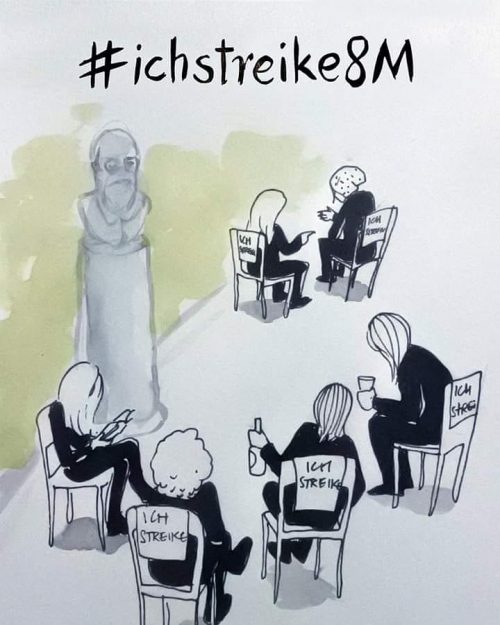
#Frauentag

Falls du nicht weisst, wie du morgen in berlin protestieren kannst oder sollst, oder whatever…
#ichstreike & #globalscream
8 March 2020 is on Sunday, so striking is less possible. Let’s strike symbolically on Sunday!
#IchStreike #Istrike #Strajkuje #WomensStrike
Are you ready?
Berlin: https://www.facebook.com/events/485240448816256/
https://www.facebook.com/events/539735906651212/

Jeśli zastanawiacie się co się będzie działo 8 marca, to będzie się działo dużo! Między innymi o 16 będzie akcja!

#GlobalScream
8.3.2020 | 4 PM
Es every year, on the International Women’s Day (8.3.2020) there will be thousands of people on the streets worldwide, all protesting for the same, against the same, regardless of nationalities, location, gender, and ideological differences. Womxn of the World will fight for their rights.

Mehr anzeigen

My Germany 2

Lech Milewski

Back home regular correspondence with Inge continued.
We both started work, she was giving lessons of singing and piano and also sang in a choir.
We both got married.
In 1968, Inge gave birth to a daughter – Nora.

In February 1969 I traveled by train to England. As I crossed Germany I decided to go via Frankfurt and visit Inge and Norbert.

At the beginning was crossing of borders between East and West Berlin and few more. There is a separate report about it on this blog (in Polish) – CLICK.

Travel to Frankfurt was uneventful. Inge and Norbert welcomed me on the train station. Just one night and one day. Too short after 9 years of contact by mail.

Then another 9 years passed.
At some stage I suggested we write letters in German.
I had tangible gains in mind.
Firstly I could earn some supplement to my salary for knowledge of foreign language.
I had it already for English. German exam was a bit more difficult, but I passed.
Secondly, soon another opportunity appeared – an Information Technology (I.T.) training in Essen.

In June 1978 we (three of us) flew to Germany.
Sunday evening at Essen train station. There were many people, band played popular melodies, people danced, drank beer.
Our accommodation brought us to reality.
It was a modest, quite nice, clean building.
In the reception we received a letter with basic information.
It started with apologies – training organizers – IBM Deutschland – explained that for the money they received from the Polish side, they could not find any accommodation in Essen at all, so they added a bit of their money and here is the best what they could find.
It was a 3 beds room, actually quite nice, but the room was located in the basement. So through our window we could watch shoes of passers by.

Our finances: we received in Poland an allowance – 20 DM per person per day. At that time it was worth a bit less than 10 US$.
In the reception we learned, that to use a shower we have to get a key – price 2 DM.
Other information was worse – a daily return bus to IBM Education Centre costs 8 DM per person.

We did our balancing.
We brought from Poland some cans with meat and fish and a big chunk (połeć) of bacon.
12 DM per day per person – we could easily buy some bakery and cheap wine, but there was no space for a hot meal.
Of course each of us had a long list – what to bring from Germany. On top of the list were electronic watches.

Next day we traveled to beautifully located Education Centre.
During the first tea break we received brochures with options for lunch in a number of nearby restaurants. Price of the cheapest lunch was around 14 DM.
Our training colleagues invited us cordially, offered transport. Luckily we had a good excuse – we need to use some of lunch break time to prepare for coming lectures.
So we ate sandwiches with bacon and lettuce and studied.

During our earlier tea break, which we had in a cafeteria, we looked into the menu.
Cafeteria served also lunches, quite large and tasty hot meals. But our ID cards, which we received at the beginning of the training, did not open cafeteria door during lunch time.

Our training.
Actually we did not need it too much.
Each of us had already long, practical I.T. experience. Surely there were gaps and inconsistencies, but our professional career proved, that we could make a good use of it.
Training in Western country – it was a privilege. For people like us, without any connections in the Party, the only way to get there was to get it as a reward for some substantial achievement.
This was exactly our case.

Our 3-persons team leader was asked by FSO – at that time the main car producer in Poland, for a rescue. Year or two years earlier, the company ordered from IBM three modern computers (IBM S7) for real time control of industrial processes. IBM provided computers and all support and training.
Two computers have been successfully installed.
The third one… was somehow forgotten. The computer was put to a store room, trained people changed the work place. And then, in May 1977, the director received a call from the Warsaw Committee of Communist Party – comrade, just a reminder – we will come to your place on 7th November, on the 60th anniversary of Great October Revolution, to join you on the opening of a real-time computer system in a car body pressing department.
Panic! 5 months left! Somehow they found 3 desperados, I was one of them.

We put clear conditions: on the successful project completion we will receive: a monetary reward – at least our monthly salary, a voucher for a car (Yugoslav Zastawa) and 2 weeks computer training in a Western country.
Car voucher – the lucky owner had still to pay a full price for the car, but waiting time was substantially shortened – from 5 years to 2,3 months.

Task was not simple. We had to learn to use a new computer with quite new technology, two new for us programming languages. Manuals were not quite complete, many of them in German.
For the first 2 months people from IBM were quite suspicious. They did not want to be connected to a project destined to fail. Then, gradually, we gained their confidence and completed out task in time.
We managed, got our rewards and here we were.

Our tactic was – attack.
Every night in our room we studied training material for the next day and prepared a strategy – take active part from the very beginning, start with presentation of something original, ask questions. It looks like it worked.

On the second or the third day, during our lunch break, between bites of a roll with bacon, we noticed some officials approaching. They came closer and introduced themselves as a Managing Director of the Centre and his deputies.
The Director mentioned, that this was the first visit of people from Poland in their centre, which made them extremely happy and to celebrate it somehow… well they cannot do much, they just want us to feel as being part of their team. A visible proof will be a regular IBM employee card, he handed us the cards, shook our hands and left us a bit disoriented.
– Employee  ID card opens door to the cafeteria – whispered to us one of Director deputies.
:))))

Weekend.
I contacted Inge earlier and on Saturday traveled by train to Düsseldorf. She drove me to their family home in Remscheid.
Her family grew like ours to 4 people. Nora got company of a brother – Jochen.
We spent very pleasantly all Saturday and Sunday morning.
Sunday afternoon Inge and Norbert drove me to Essen. On our way we visited some museum – exhibition of ancient Egyptian art.

The rest of stay in Essen was rather uneventful.

After return to Poland my professional life took few turns and 5 years later we landed in Australia.

I continued regular correspondence with Inge and we updated each other about our lives and families.
Norbert climbed steps of his professional career. He became a Professor in the Bergische Universität Wuppertal. Among his duties were few visits to Poland for lectures, workshops and consultations.
Nora is a respected specialist in Chinese medicine, Jochen – another professor, information systems. They live in different places in Germany, but when they gather at family home, there is music.

Portraits on the wall: Wagner, Mozart, Beethoven.
Inge and Norbert are frequent visitors to Bayreuth and music festivals there.

In the meantime in Australia…
My dominant hobby for number of years was cross country skiing. I discovered quite attractive places for skiing in Australia. I entered also a number of cross-country skiing marathons overseas.
This led me again to Austria and twice to Germany.
Germany meant Koenig Ludwig Lauf in Oberammergau. Very memorable event, skiing in the shade of castles in Ettal and Linderhof.

In 2001, after the race I spent few days in Munich. Music of course, opera, but this time it was not the famous Bayerische Staatsoper, but Gärtnerplatztheater – CLICK – which presented more challenging program. The Rake Progress by Igor Stravinsky.

Here I have to confess one shameful event.
At the time when I fought on European ski trails, in February 2001, Inge and Norbert visited Australia 😦
We were in not so frequent touch, I had to plan my leave to Europe many months earlier, so at the time when Inge notified me about their visit it would have been quite messy and costly to abandon my plans. So they visited our home and were hosted by my wife and I was far away.

We still remained pen-pals and then an additional German accent arrived in my life.
Our daughter got married to Peter, young man of German origin. His parents, both originally from Königsberg, live permanently in Melbourne. In our opinion they run a very German home.

Our granddaughter, Sabina, now in year 10 of school, learns German and last year participated in an interschool German Poetry Competition.

The finals were held in Austrian Club in Melbourne.

And the winners were…

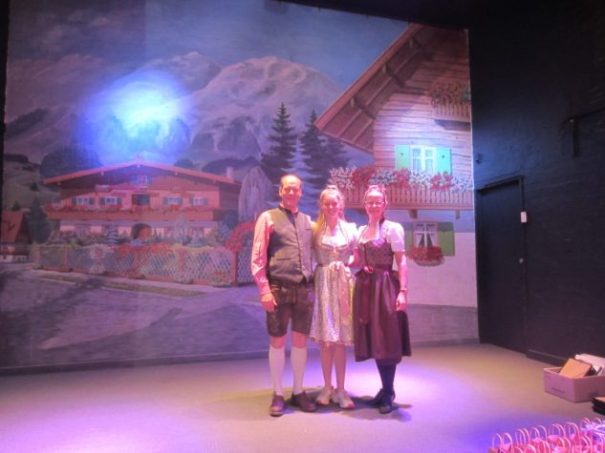
Well, Sabina won the second place. Above with her parents, all in dresses bought one year earlier during Oktoberfest in Munich.

More than a week ago I rang Inge and thanked her for 60 years of contact. We reminisced these times – solid, friendly times.

Let me finish with another of poems recited long, long ago by me – CLICK.

Worldwide Screening

Worldwide Screening on 75th International Day of Remembrance of the Victims of the Holocaust

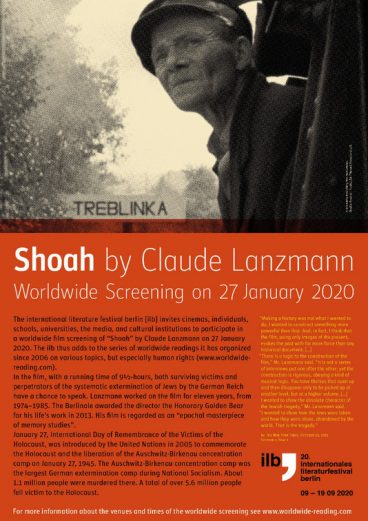
We called for participation in the worldwide screening of “Shoah” by Claude Lanzmann. This can take place privately in a small circle, in a school, in a cinema, in a cultural institution or through a TV channel.

In the 9½-hour film “Shoah” both, surviving victims and perpetrators of the systematic extermination of Jews by the German Reich, have a chance to speak. Lanzmann worked on the film for eleven years, from 1974–1985. The Berlinale awarded the director the Honorary Golden Bear for his life’s work in 2013. His film is regarded as an »epochal masterpiece of memory studies«.

January 27, International Day of Remembrance of the Victims of the Holocaust, was introduced by the United Nations in 2005 to commemorate the Holocaust and the liberation of the Auschwitz-Birkenau concentration camp on January 27, 1945. The Auschwitz-Birkenau concentration camp was the largest German extermination camp during National Socialism. About 1.1 million people were murdered there. A total of over 5.6 million people fell victim to the Holocaust.

Until January 20th we will collect information about the screening you have organized. Please send us an to worldwidescreening@literaturfestival.com so that we can communicate the events on our website www.worldwidereading.com.

Here you find a list of participants. There will be screenings in Austria, Canada, Chile, France, Germany, Great Britain, Greece, Italy, Nigeria, Spain, USA.

Worldwide Screening am 75. Internationalen Gedenktag für die Opfer des Holocaust

Das internationale literaturfestival berlin [ilb] rief Personen, Schulen, Universitäten, Medien und kulturelle Institutionen zu einer weltweiten Filmvorführung von »Shoah« von Claude Lanzmann am 27. Januar 2020 auf. Damit knüpft das ilb an die Serie der weltweiten Lesungen an, die es seit 2006 zu verschiedenen Themen, vor allem auf die Menschenrechte bezogen, organisiert hat.

In dem 9½-stündigen Film kommen überlebende Opfer wie Täter der systematisch betriebenen Vernichtung der Juden durch das Deutsche Reich zu Wort. Lanzmann arbeitete an dem Film elf Jahre, 1974-1985. Die Berlinale verlieh dem Regisseur 2013 den Goldenen Ehrenbären für sein Lebenswerk.

Der 27. Januar, Internationaler Tag des Gedenkens an die Opfer des Holocaust, wurde 2005 von den Vereinten Nationen eingeführt, um dem Holocaust und der Befreiung des Konzentrationslagers Auschwitz-Birkenau am 27. Januar 1945 zu gedenken. Bei dem Konzentrationslager Auschwitz-Birkenau handelte es sich um das größte deutsche Vernichtungslager während des Nationalsozialismus. Etwa 1,1 Millionen Menschen wurden hier ermordet. Insgesamt fielen über 5,6 Millionen Menschen dem Holocaust zum Opfer.

Bis zum 20.1. nehmen wir gern noch Veranstaltungshinweise an. Bitte schicken Sie uns eine Nachricht über Ihre Veranstaltung an worldwidescreening@literaturfestival.com. Auf unserer Website www.worldwidereading.com werden wir diese Informationen einstellen.

Eine aktuelle Veranstaltungsübersicht finden Sie hier. Es wird Veranstaltungen in Chile, Deutschland, Frankreich, Griechenland, Großbritannien, Italien, Kanada, Nigeria, Österreich, Spanien und USA geben.

Trailer #ilb19
With this video we commemorate a great festival in 2019 and look forward to the 20th ilb in Septembre 2020.

https://www.literaturfestival.com/%2B%2Bresource%2B%2Bcollective.flowplayer/flowplayer.swf

Mit diesem Video blicken wir zurück auf ein großartiges Festival in 2019 und schauen vorfreudig auf das 20. Jubiläum des ilb im September 2020.

internationales literaturfestival berlin
Chausseestr. 5
10115 Berlin
Fon +49 (0) 30 – 27 87 86 65
Fax +49 (0) 30 – 27 87 86 85
presse@literaturfestival.com

www.litfestodessa.com
www.worldwide-reading.com
www.comics-berlin.de
http://www.wordalliance.org
20. internationales literaturfestival berlin | 9-19. September 2020
#ilb20 #ilb2020


In Berlin gibt es Vorführungen sowohl heute als auch morgen:

Heinrich-Böll-Stiftung – Bundesstiftung Berlin
Schumannstr. 8
10117 Berlin
Sonntag, 26.01.2020
10.00 – 21.00 Uhr
Eintritt frei, Anmeldung unter
https://calendar.boell.de/de/civi_register/139583
https://calendar.boell.de/de/event/claude-lanzmann-shoah

Akademie der Künste
Hanseatenweg 10
Berlin
27.01.2020
10 Uhr
https://www.adk.de/de/programm/index.htm

Brotfabrik Berlin
Caligariplatz 1
13086 Berlin
27.01.2020
13 Uhr
Eintritt pro Teil: 5 EUR. Alle vier Teile: 15 EUR
https://www.brotfabrik-berlin.de

KulturMarktHalle
Hanns-Eisler-Str. 93
10409 Berlin
26.01., 12.00 Uhr (mit vier kleinen Pausen)
www.kulturmarkthalle-berlin.de

Container
Am Weidendamm 3
10117 Berlin-Mitte (Nähe Bahnhof Friedrichstraße, der Eingang wird ausgeschildert)
Sonntag, 26.01.2020, ab 13 Uhr in drei Etappen  (3,5h, 3h, 3h – jeweils eine Stunde Pause zwischen den Teilen)
Alle Mitschauenden werden gebeten, Essen und Getränke mitzubringen, damit in den Pausen zusammen gegessen werden kann
Interessierte werden gebeten ihr Kommen kurz per Mail an
verfolgt-verschwiegen-vergessen@riseup.net anzukündigen

Janusz-Korczak-Bibliothek
Berliner Straße 120
13187 Berlin
26. Januar, 10.00 – 19.30 Uhr
http://stadtbibliothek-pankow.berlin.de

SANDALIA – Un’isola a Berlino
Schillerstraße 106, 10625 Berlin-Charlottenburg
Montag, 27. Januar 2020, 11.00 Uhr – 21.00 Uhr
Eintritt frei
www.sandalia.org


My Germany 1

Lech Milewski

First days of January 1960.
I just returned from Christmas holidays to student dormitory in Warsaw. For a while I was alone in 4-persons room. I looked into freshly bought monthly magazine Radar.

Radar, magazine for youth, it tried to introduce some new trends in Polish People’s Republic’s press.
One of such novelties was a Pen-Pal Club. Radar published each month addresses of young people from other countries who would like to exchange letters with young people in Poland.
Strangely, majority of these people were from Western Europe, mostly Sweden and Finland, mostly females.

But on this day I noted a girl from Germany, West Germany – Inge from Frankfurt am Main.
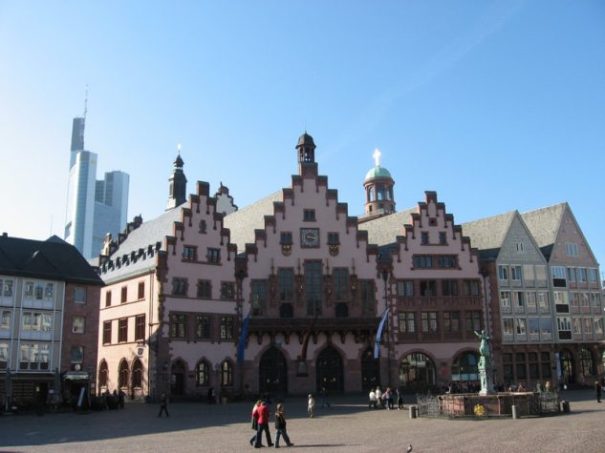
I wrote a letter in English and few weeks later received an answer – letter with a postcard – Frankfurt Rathaus.

Above my photo taken in 2007

I already had some bad experience with such correspondence – first few letters were the introduction of pen-pals, then… a trouble – what to write about?

First letter from Inge gave some hope, she was very interested in classical music, she studied singing at Frankfurt Musikakademie.

Music. For me it was connected to Germany, German language.
In high school we had in curriculum 3 foreign languages – Russian and in my case – German and English.

In all 3 cases we had exceptionally good language teachers.
German teacher, Mr Miętus, always immaculately shaved and dressed.
After entering the class he greeted students and started the lesson with the same phrase: gentlemen, take out your preparation, please.
Preparations meant our exercise books.

He put a lot of effort in teaching us German poems – J.W. Goethe, F. Schiller.
I think we learned them with pleasure and this caused a trouble.
On a day when learning the poem was due, he called few student to recite it and when the result was satisfactory, he proposed: maybe the whole class would recite it together.
For the first few lines it went smoothly, Mr Miętus, with delightful smile on his face, recited with us and marked pace with his hand, like an orchestra conductor.
Then, some students started to accelerate the pace, other shouted loudly only some words, other just shouted or made some strange sounds.
– Stop! Stop it! – shouted the teacher with tears in his eyes, but the class went on like a steam train..
Finally we ran out of steam, there was silence in the class. Mr Miętus sat at the table totally devastated. I think most of us felt sorry for him.
Still, after few weeks, he could not resist a temptation, and we turned it again into a disaster.

This passion for directing a collective recitation covered his real passion – music.
At that time I was already enchanted by the classical music, but the only source of it was a loudspeaker in our flat transmitting Program 1 of Polish radio.
Mr Miętus introduced me to live music performed in a very modest concert hall in provincial town – Kielce. He also was very keen to talk about music, about composers.
For the most of the class it was time to relax. For me it was more interesting than the German lesson. No wonder quite often my colleagues asked me to start some music discussion with the teacher, they had at least 20 minutes of rest.

Anyway, music stayed with me for the rest of my life. In the meantime it helped me to keep in touch with Inge. Other subject was – books. It looked, she was quite sensitive on human misery and found some answers in Charles Dickens books.
I have to admit that for me an important motivation for this correspondence was practice of English.

So passed 3 years and some new German accent arrived – student excursion to Austria.
There were some 20 participants, we traveled on a group passport.
Great excitement – visit to the country behind an “Iron Curtain”.

First was Czechoslovakia.
Meticulous control on two borders. Controllers crawled under the train, rolled mirrors under passenger seats.
On the border station between Czechoslovakia and Austria I noticed few men in strange uniforms entering our carriage.
When, eventually, our train moved and crossed the border, they pinned some emblems on their uniforms and greeted us: welcome to free Austria.

Atmosphere in our compartment relaxed. Some people revealed US dollars hidden in some clever places. It looked as I was the only one who did not smuggle anything.
Another revelation was an address of a shop in Vienna run by a Polish migrant: Mr Szumilas, Wipplinger Str. 11.

On arrival in Vienna we were greeted by our Austrian guides, they were members of a program of reconciliation run by some religious association.
They paid us our allowance for 2 weeks stay in Austria – some 280 Austrian Schillings. Exchange rate was about 24 Schillings per 1 US dollar.
With my knowledge of English and also limited German my help was frequently needed.

We spent one week in Vienna visiting most popular tourist venues: Hofburg, St Stephan Cathedral, Schonbrunn Palace and also a Soviet War Memorial – CLICK.
Note: from 1945 till 1955 Austria was occupied by Soviet Union, US, Great Britain and France.

In free time we visited a shop at 11 Wipplinger Str.
Shop attendant greeted us cordially: welcome to Polish working class.
– This is already communist bourgeoisie – corrected her Mr Szumilas.
I bought some novelty – non-iron shirt.

Our accommodation was in Student home at Pfeilgasse. We got our breakfast and supper there. Just sandwiches. Dinner we had in Mensa House in early afternoon.
I remember it so well as it was my first taste of Coca Cola.
Coca Cola, somehow for me was a symbol of rotten West. No wonder I drank it with some concern – will it make me dizzy or maybe there will be other side-effects?
There were none. Much later I read somewhere that it tastes like ping-pong balls. Absolutely right.

After one week in Vienna we traveled to Salzburg where we stayed in old US Army barracks near the airport.
Visit was dominated with W.A. Mozart memories.

Then to the mountains – Zell am See.
At one point our bus driver announced that we will be crossing to West Germany.
Our Polish tour guide protested – we haven’t got German visa!
– What a nonsense – commented the driver – everybody travels this way. This is the shortest route.
Our Austrian guides exchanged smiles – there is a strict control on the borders between friendly Communist countries – they explained to the driver.
Few minutes later Grenzpolizei sent us back to the longer route. Doubtful satisfaction.

Zell am See – CLICK – a mountain wonderland.
We visited Kaprun, Kitzsteinhorn Glacier, had a mountain walk.

On the last day we had an easy stroll around the lake.
Someone asked about the date – First of September.
And at that moment I realized that people around me speak German.
Somehow I felt that on this date I was in an improper place.

Finally back to Vienna and a nice surprise – a concert, Beethoven’s VII Symphony. I never heard it before, just listen to the II part, Allegretto – CLICK.

Here my memory from school – J.W. Goethe’s poem, also a song by F. Schubert – CLICK.

Kocim krokiem z nowym rokiem

Zebrałam obrazy kotów, które nadesłała mi ostatnio

Danuta Starzyńska-Rosiecka

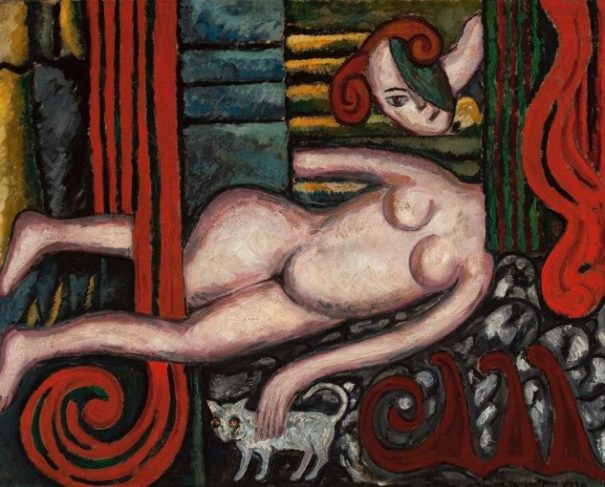
Tytus Czyżewski (1880–1945)
„Akt z kotem”
1920
olej na płótnie
Muzeum Narodowe w Warszawie

Jane Crowther
Contemporary Artist and designer living in Nottingham, UK

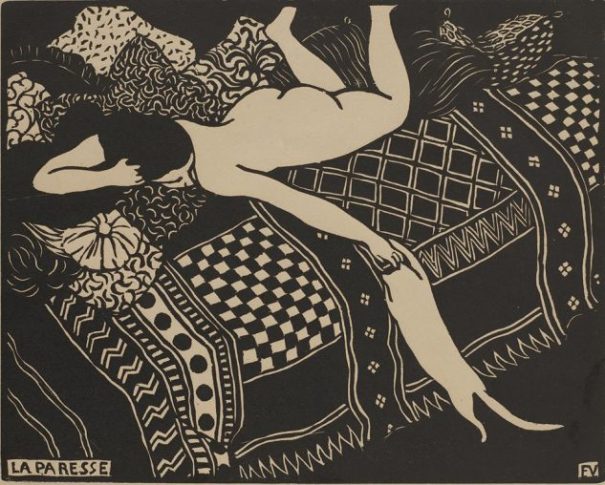
Felix Vallotton
(Swiss, 1865–1925). Laziness (La Paresse), 1896. Woodcut. © Musée cantonal des Beaux-Arts de Lausanne.

In 1891 Félix Vallotton began making woodcuts, a practice that brought him recognition and a steady income throughout the decade. Inspired by Japanese ukiyo-e woodblock prints, which were popular in Paris at the time, Vallotton’s prints captured the many facets of city living.⁣

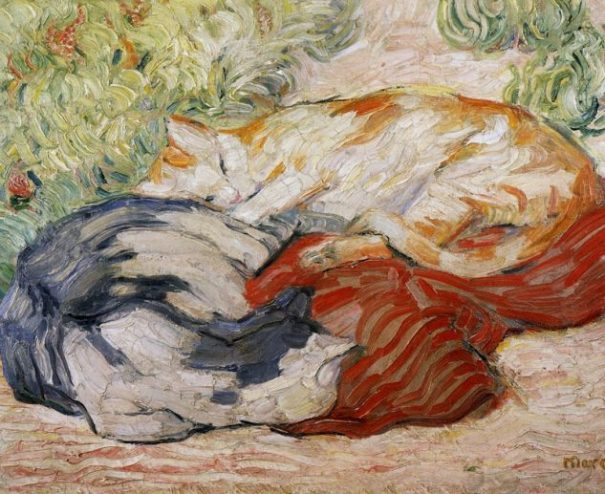
Franz Marc – Cats on a Red Cloth, 1910

Ernst Kreidolf (Swiss, 1863-1956)
Morgenidyll, 1893

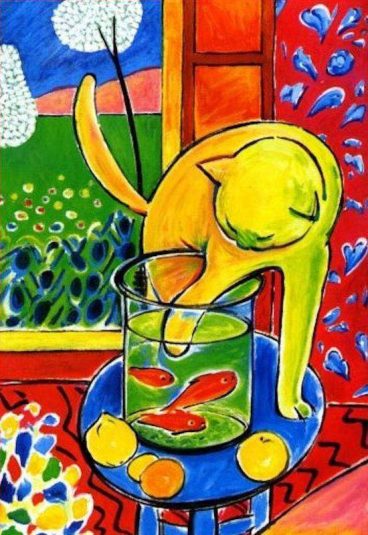
Le chat aux poissons rouges – Henri Matisse

Incredible paintings… (reblog+)

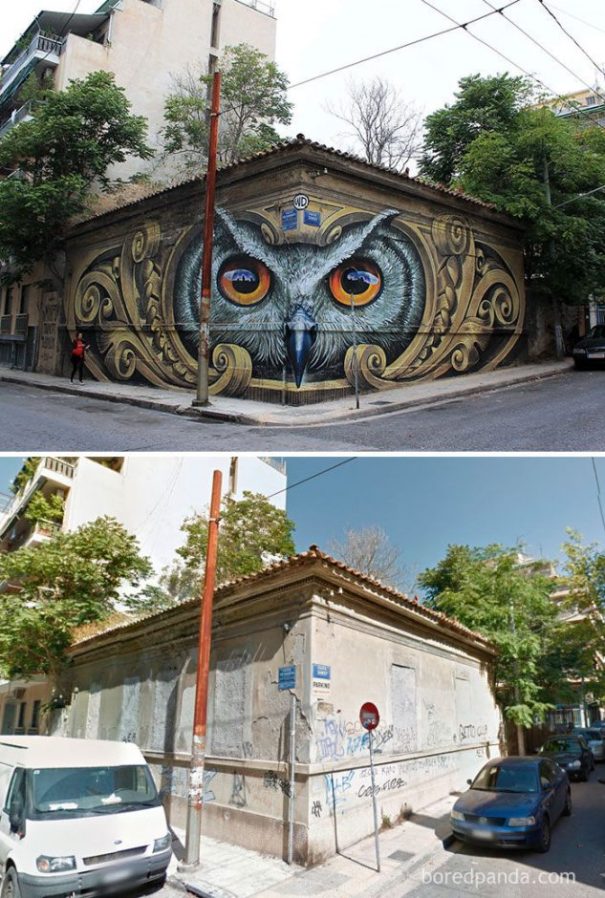
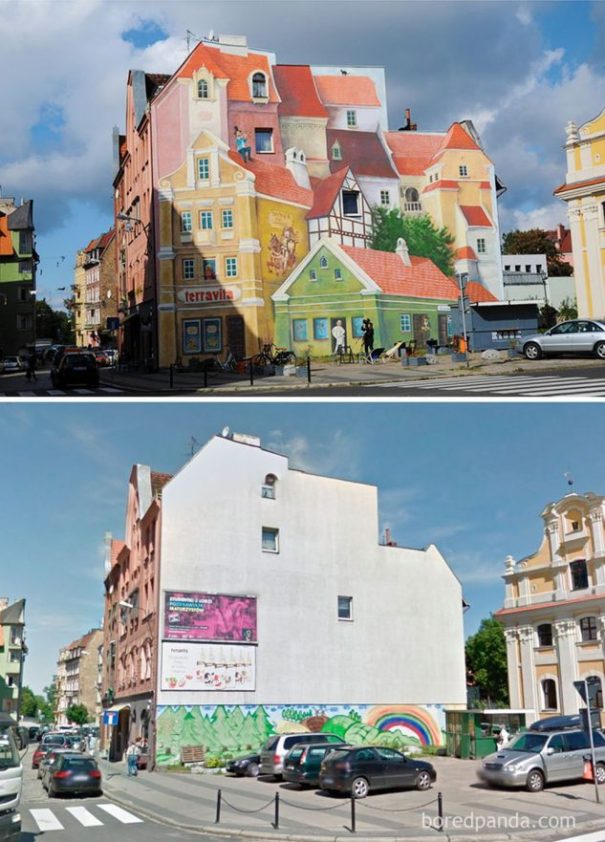
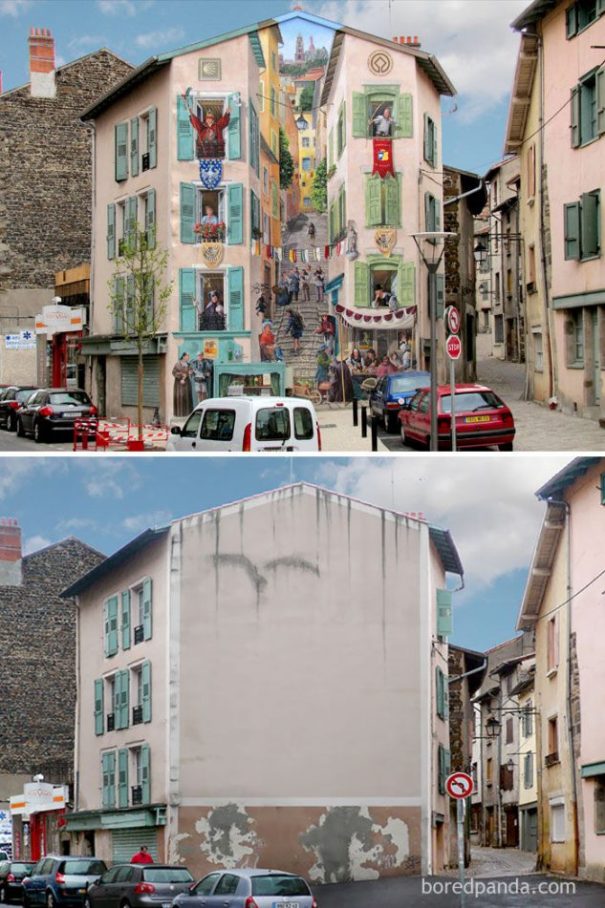
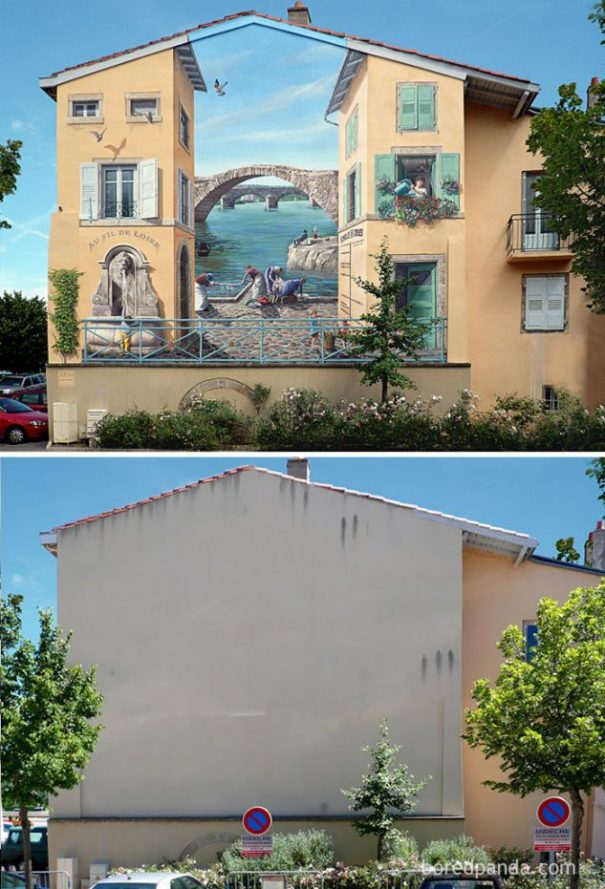
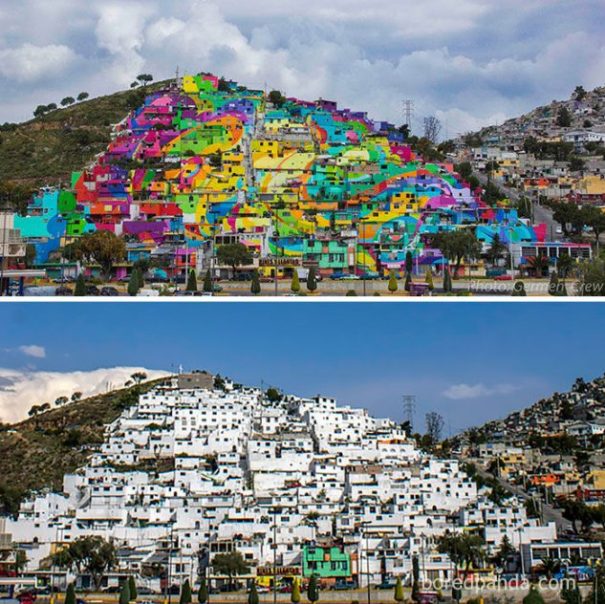
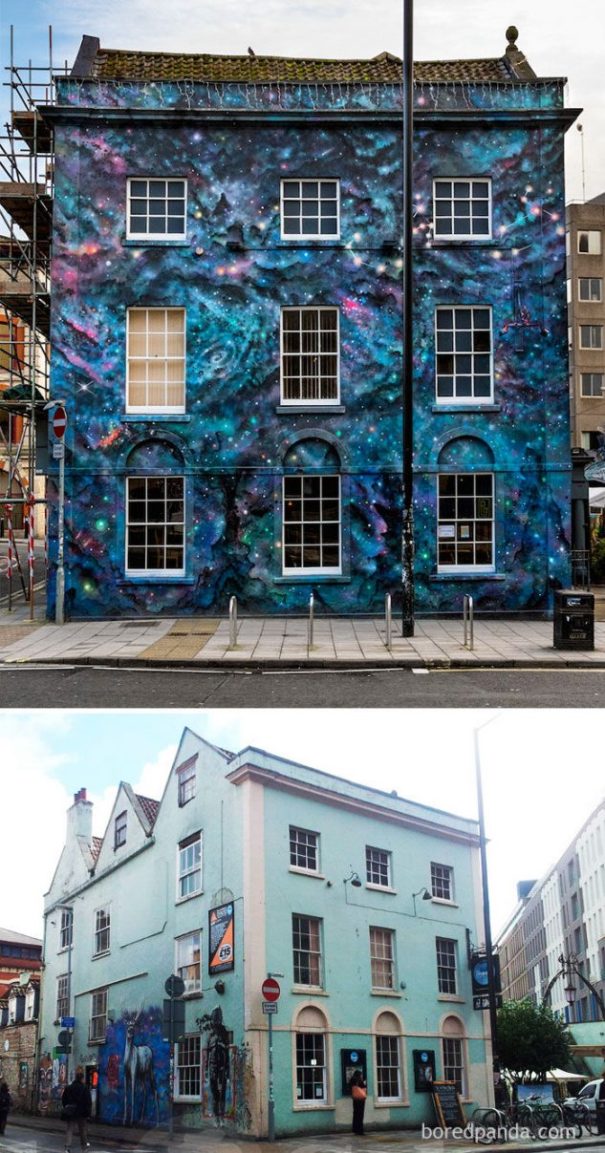
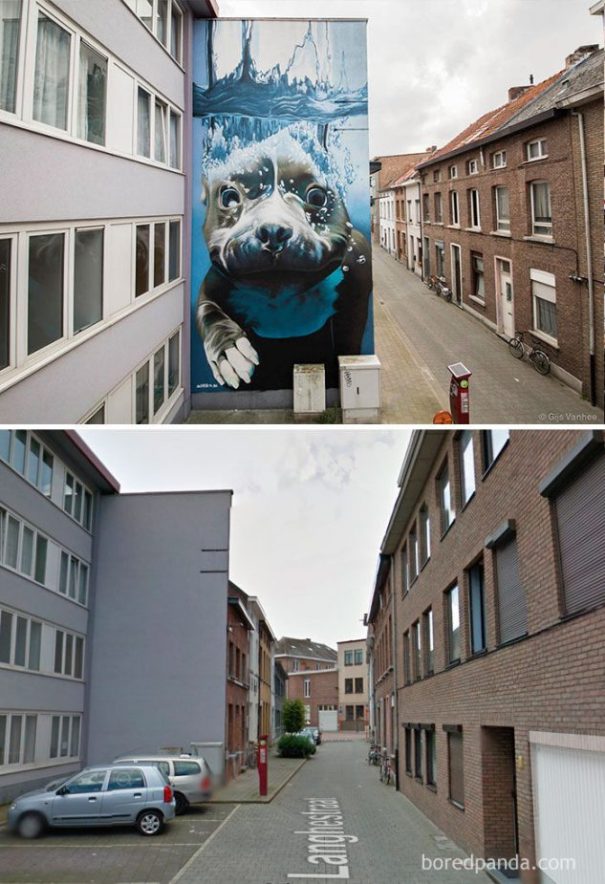
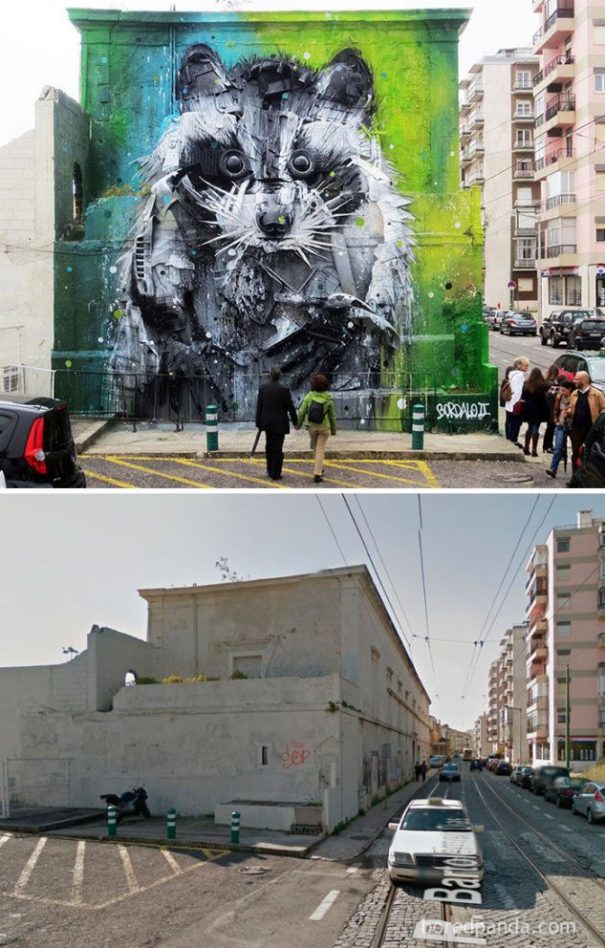
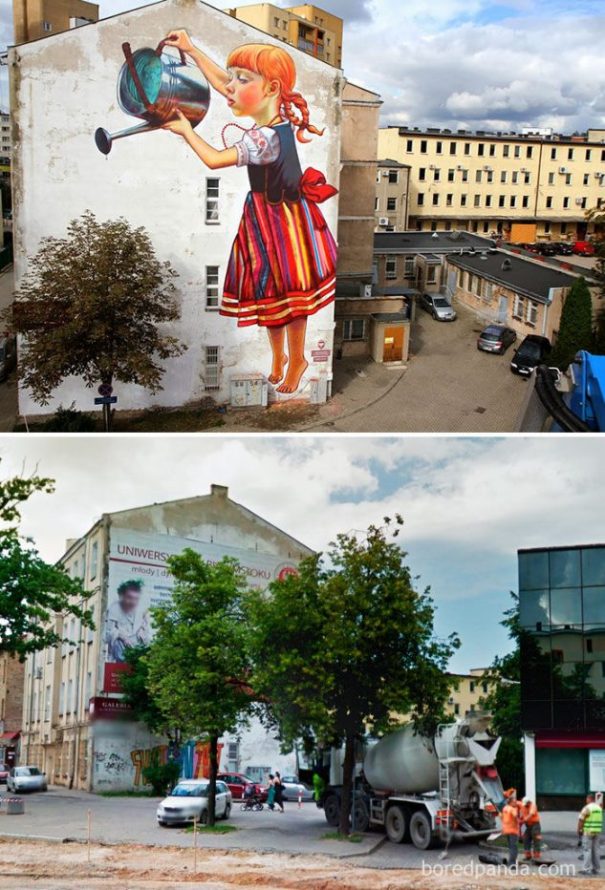
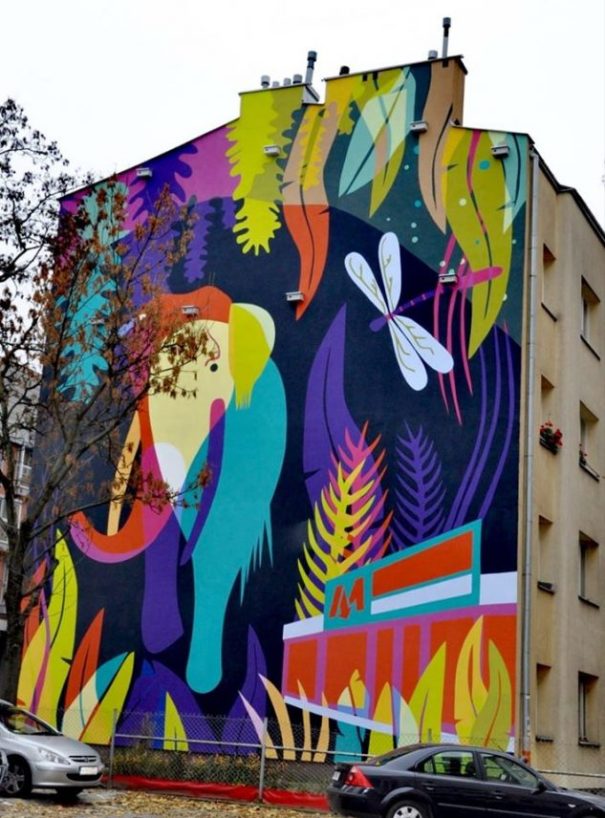
Yes, I know, you’ve seen it already. All those murals. Last year they were everywhere on Facebook. But then they vanished, as everything on Facebook. And now Kairos (a very very proper moment) for looking again at that murals come. And please, do not forget “our” mural in Stettin-Skolwin 🙂 or “our” mural in Berlin-Kreuzberg (foto Anne Schmidt)

15 Incredible Before & After Street Art Transformations

Hmmm.. actually they are first after and then before, but I do not change the serie. Never mind, bored panda – you are superb!
Yours
EMS

For those individuals among us who possess a talent for art, opportunities to create something beautiful can be found all around us. Everywhere you look, there are empty walls that are just crying out to become something more beautiful, if only someone would take the time. Thankfully, there are plenty of incredibly talented street artists out there who are doing just that, turning drab public spaces into explosions of color and creativity.

1. “Knowledge Speaks – Wisdom Listens,” Athens, Greece

2. “Juliette Et Les Esprits,” Montpellier, France

3. 3D Mural in Poznań (Śródka), Poland

4. “Renaissance,” Le Puy en Velay, France

5. Giant Starling Mural in Berlin, Germany (Star Haus Neheimer Str. 2 – 6, Tegel)

6. “Au Fil De Loire,” Brives Charensac, France

7. Photorealistic Mural, Glasgow, Scotland

8. An entire town was painted over, Palmitas, Mexico

9. Full Moon Hostel, Bristol, UK

10. “Topart,” Budapest, Hungary

11. Tiled Steps, 16th Avenue, San Francisco, California

12. Diving Dog Mural, Mechelen, Belgium

13. “Porte Des Lavandières,” Aurec Sur Loire, France

14. Racoon Mural made of trash and found objects, Lisbon, Portugal

15. “Let’s Keep The Plants Alive,” Białystok, Poland (“Dziewczynka z konewką”, Aleja Piłsudskiego 11/4)

A tu dodatek spoza listy światowej, ale przecież równie dobry. Pokazała to właśnie na Facebooku Danuta Starzyńska-Rosiecka. Słoń prehistoryczny na Skierniewickiej w Warszawie (Wola), namalowany na pamiątkę… wykopalisk archeologicznych. Podczas budowy metra na ulicy Płockiej znaleziono szczątki słonia sprzed 130 tysiący lat.

And here, ach…

Pamiętacie tę piosenkę?

W wersji oryginalnej oczywiście nie możecie (nie możemy) jej pamiętać, bo piosenka skończy w przyszłym roku sto lat, ale nawet w wersji ćwierć wieku późniejszej też jej nie możemy pamiętać:

Sur cette terre, ma seule joie, mon seul bonheur
C’est mon homme.
J’ai donné tout c’que j’ai, mon amour et tout mon cœur
À mon homme

Sur cette terre, ma seule joie, mon seul bonheur
C’est mon homme.
J’ai donné tout c’que j’ai, mon amour et tout mon cœur
À mon homme
Et même la nuit,
Quand je rêve, c’est de lui,
De mon homme.
Ce n’est pas qu’il soit beau, qu’il soit riche ni costaud
Mais je l’aime, c’est idiot,
Il m’fout des coups
Il m’prend mes sous,
Je suis à bout
Mais malgré tout
Que voulez-vous

Je l’ai tell’ment dans la peau
Qu’j’en d’viens marteau,
Dès qu’il s’approche c’est fini
Je suis à lui
Quand ses yeux sur moi se posent
Ça me rend toute chose
Je l’ai tell’ment dans la peau
Qu’au moindre mot
Il m’f’rait faire n’importe quoi
J’tuerais, ma foi
J’sens qu’il me rendrait infâme
Mais je n’suis qu’une femme
Et, j’l’ai tell’ment dans la peau…

Pour le quitter c’est fou ce que m’ont offert
D’autres hommes.
Entre nous, voyez-vous ils ne valent pas très cher
Tous les hommes
La femme à vrai dire
N’est faite que pour souffrir
Par les hommes.
Dans les bals, j’ai couru, afin d’l’oublier j’ai bu
Rien à faire, j’ai pas pu
Quand il m’dit: “Viens”
J’suis comme un chien
Y a pas moyen
C’est comme un lien
Qui me retient.

Je l’ai tell’ment dans la peau
Qu’j’en suis dingo.
Que celle qui n’a pas aussi
Connu ceci
Ose venir la première
Me j’ter la pierre.
En avoir un dans la peau
C’est l’pire des maux
Mais c’est connaître l’amour
Sous son vrai jour
Et j’dis qu’il faut qu’on pardonne
Quand une femme se donne
À l’homme qu’elle a dans la peau
C’est mon homme, c’est mon homme
Un homme que j’ai dans la peau
C’est mon homme
C’est mon homme, c’est mon homme, c’est mon homme


Ale w tej… o, w tej wersji słuchaliśmy jej wszyscy i być może to ona odpowiadała za nasze pierwsze uniesienia erotyczne (przynajmniej tak wynika z powieści Ni pies, ni wydra Wiki Korb, berlińskiej pisarki, o jej ostatnim roku w Polsce – przed i po Marcu 1968):
Blady Niko!

Grzegorz, który zrobił to wideo i wstawił tę piosenkę na youtube’a napisał:

Barbara Rylska — Blady Niko (Pale Nico) (Original French title: Mon Homme) (Muz. Maurice Yvain, Tekst: Stanisław Ratold) Recorded by Muza, 33 rpm. (Warsaw, Poland ca 1967)

“Mon Homme” (Polish title: Blady Niko, meaning in English: Pale Nico) was a great hit of the early 1920s, composed in Paris by Maurice Yvain and made famous in 1922 by Mistinguett – la grande vedette of the cabarets of Paris. Originally composed as a Fox-Trot, it was sung by her more “a la maniere du chanson artistique”. During its long and worldwide career, that song was sung by many artists also as tango – such was first Polish recording of “Blady Niko”, made in Warsaw in 1922 for Syrena Grand Rekord by a cabaret singer Stanisław Ratold, who was also author of the Polish text – full of passion and desire. I never heard that version, but only with an utmost effort of my imagination I can see a man! — confessing in public such heartbreaking story of his mad love for a criminal hunk Blady Niko, who: “beats me to blood, takes away my money but when he approaches to kiss me, every nerve trembles in my flesh” 🙂

Now, I am presenting “Mon Homme” (Blady Niko) performed as ultra-hot tango and recorded in late 1960s in Warsaw, by Barbara Rylska. In a communist Poland, Rylska was one of these wonderful stage artists who were able to recall with taste and refinement — in almost perfectly mimetic way and with only a discreet parodistic touch — the atmosphere and style of legendary pre-war cabarets and music theatres of Warsaw. The hot apache-tango “Blady Niko” sung by Rylska’s low and slightly harsh voice belongs, no doubt to her peak achievements. What a great loss for Polish stages was her withdrawal from artistic career, in the end of the 1970s!


Piosenkę śpiewały wszystkie liczące się piosenkarki na świecie. Tu Billie Holiday:

Although the song originated in France — where it was a hit for Mistinguett in 1916 — it was popularized in the English speaking world in the 1920s with the 1921 recording by Ziegfeld Follies singer Fanny Brice. The song was a hit, and the record eventually earned a Grammy Hall of Fame Award for Brice in 1999.

The ballad version recorded by Brice was modified by Billie Holiday, who introduced a jazz/blues recording of “My Man.” Holiday’s version was also successful, although the song continued to be associated with Brice. Over the years, other artists from both the United States and abroad covered the song, though none of the artists achieved as much success as Brice and Holliday. One notable version was a 1940s recording by Edith Piaf, the most notable recording of “Mon Homme” in its original language.

Peggy Lee recorded the song for her 1959 album “I Like Men!” Her arrangement is very minimalistic, with the drums predominant in the mix.

In 1965, the song was covered by Barbra Streisand, the then-rising star of the hit Broadway musical, Funny Girl, a semi-biographical account of Fanny Brice’s life. Streisand’s cover became a minor commercial success, and was also included on the album My Name Is Barbra and in the film adaptation of Funny Girl. Her emotional rendition of “My Man” as the film’s finale drew additional critical praise to an already lauded performance that earned her the Academy Award for Best Actress in 1968.

Diana Ross performed the song in her final concert appearance as a Supreme at the Frontier Hotel in Las Vegas, Nevada, on January 14, 1970. Her performance was recorded & later released on the 1970 live album, Farewell. Ross adopted Billie Holiday’s jazz and blues version rather than the Brice or Streisand versions. In 1972, Ross recorded “My Man” again for the soundtrack for the film Lady Sings the Blues, in which she portrayed music legend Billie Holiday. The soundtrack album peaked at #1 on Billboard’s Pop albums chart, reportedly selling over 300,000 copies during its first eight days of release. Ross’ acting received critical acclaim and Golden Globe and Academy Award nominations for Best Actress; she won the Golden Globe award for “Most Promising Newcomer.” Ross’ second version of the song was a revival of Holiday’s jazz/blues reading. Ross gave one of her most critically hailed performances of the song in 1979 at Caesars Palace, Las Vegas, Nevada, which was recorded for an HBO concert special during her “The Boss” world tour.

It’s cost me a lot
But there’s one thing
That I’ve got
It’s my man
It’s my man
Cold and wet
Tired you bet
All of this I’ll soon forget
With my man
He’s not much on looks
He’s no hero out of books
But I love him
Yes, I love him
Two or three
Girls has he
That he likes as well as me
But I love him
I don’t know why I should
He isn’t true
He beats me too
What can I do?(refrain)
Oh my man I love him so
He’ll never know
All my life is just despair
But I don’t care
When he takes me in his arms
The world is bright
All right
What’s the difference if I say
I’ll go away
When I know I’ll come back on
My knees someday
For whatever my man is
I’m his forever more
Oh, my man, I love him so, he’ll never know
All my life is just despair, but I don’t care
When he takes me in his arms
The world is bright, all right…
What’s the difference if I say I’ll go away
When I know I’ll come back on my knee someday
For whatever my man is, I am his forever more
It cost me a lot,
But there’s one thing that I’ve got, it’s my man
Cold and wet tired, you bet,
But all that I soon forget with my man
He’s not much for looks
And no hero out of books is my man
Two or three girls has he
That he likes as well as me, but I love him…
Oh, my man, I love him so, he’ll never know
All my life is just despair, but I don’t care
When he takes me in his arms
The world is bright, all right…
What’s the difference if I say I’ll go away
When I know I’ll come back on my knee someday
For whatever my man is, I am his forever more…

O dziwo, nie znalazłam tej piosenki w wersji niemieckiej, choć przecież powinny ją były śpiewać Claire Waldoff, Zarah Leander i Marlene Dietrich, natomiast jest jej wersja hiszpańska, nagrana przez Maruję Garrido z… Salvadorem Dali w roli tego obłędnego mążczyzny, którego śpiewająca kobieta kocha bez pamięci.

Lublinerzy i Lublinerowie

for English scroll down

czyli projekt Andrzeja Titkowa

Kiedyś wydałam książkę o rodzinie.

Kiedyś Andrzej Titkow zrealizował taki film, który po polsku nazywa się Lublinerzy.

Film Titkowa dotyczy mieszkańców Lublina. Moja książka to historia rodziny, która wzięła nazwisko od od tego miasta, ale to co ja jako kronikarka wiem, już się z tym miastem nie łączy. Dalekie ślady prowadzą do Galicji, do Krakowa, rodzina przeniosła się do Warszawy, a po wojnie rodzinne drogi rozeszły się po świecie, a my zawędrowaliśmy do Łodzi, Gdańska, Berlina, Ottawy i Florencji.


Teraz koleżanka tłumaczy książkę na niemiecki (pieniądze by się przydały, oczywiście, ale to nie o takie sumy tu teraz chodzi), a Andrzej Titkow chce zrobić film, a pieniędzy po prostu nie ma i prosi o nie w sieci. W apelu jest zdjęcie, jak Andrzej siedzi na schodach. Nie widać kapelusza, pewnie jest z drugiej strony. Postanowiłam, że usiądę sobie obok niego i też będę prosić na ten film. Dajcie, dobrzy ludzie, my naprawdę robimy te książki i filmy nie tylko dla siebie, ale dla Was, przede wszystkim dla Was!


Lublinerzy/ LUBLINERS
Jestem poetą, reżyserem, scenarzystą i producentem. W branży filmowej pracuję prawie pół wieku. Jestem autorem osiemdziesięciu filmów dokumentalnych, filmów fabularnych, spektakli teatralnych i telewizyjnych. Filmy o tematyce żydowskiej są obecne w mojej twórczości od wielu lat. Pełnometrażowy dokument „Lublinerzy” to jeden z nich. Pracuję nad nim od kilku lat. Pomysł filmu zrodził się podczas Lubliner Reunion, zorganizowanego przez Ośrodek “Brama Grodzka-Teatr NN, który odbył się w dniach 3-7 lipca 2017 roku. Uczestniczyłem w tym niezwykłym wydarzeniu i prowadziłem jego dokumentację.

W filmie „LUBLINERZY” chcę przedstawić historię kilku żydowskich rodzin na szerszym, społeczno-politycznym tle historii międzywojennej Polski. Chcę pokazać możliwie wszystkie aspekty tego życia, niczego nie pomijając, ani nie zatajając. Polska była przez wieki krajem wielokulturowym, a życie społeczności żydowskiej było nierozerwalnie związane z polską historią. Korzenie bohaterów tego filmu są ściśle związane z Lublinem i choć los rozrzucił ich po całym świecie, tysiące niewidzialnych nici wiążą ich wciąż z tym miastem. W tym filmie chcę pokazać problem Zagłady od strony psychologicznej i jednostkowej, poprzez bardzo osobiste, często intymne, opowieści filmowych protagonistów. Każda z tych historii jest inna, lecz wszystkie są jednakowo poruszające i niosą humanistyczne przesłanie. Chcę w tym filmie pokazać nie tylko niewyobrażalne cierpienie związane z żydowskim losem podczas Zagłady, ale także zaakcentować ludzką wolę przetrwania, która potrafi przezwyciężyć śmierć.

Ten dokument jest projektem bardzo wyjątkowym i trudnym ze względu na sam temat, jak również z powodu  ilości protagonistów i miejsc zdjęciowych oraz wielu innych elementów. Pewne środki finansowe zostały już pozyskane dzięki szczodrości Prezydenta Lublina, pan Krzysztofa Żuka, jednak jest to kwota niewystarczająca do rozpoczęcia produkcji. W tej sytuacji zmuszony jestem do poszukiwania jeszcze innych zródeł finansowania i, z tego powodu, zwracam się również do Państwa. Ten niezwykle ważny i potrzebny film ma szansę powstać jedynie dzięki Waszej wspaniałomyślnej pomocy. Wszyscy darczyńcy zostaną wymienieni w napisach końcowych filmu, dostaną płytę dvd z filmem oraz zostaną zaproszeni na uroczystą premierę, która zaplanowana jest na grudzień 2020 roku.

My name is Andrzej Titkow. I am a poet, film director, a producer and a scriptwriter with a long experience. I am the author of 80 documentaries and several TV feature films including a drama serial, a cinema feature, a few stage drama performances and TV spectacles. I am also an author of three Volumes of Verse. Throughout my career, the Jewish themes were constantly present in my artistic activity.

My latest project, a full-length documentary entitled “Lubliners” focuses on the history of several Jewish families in Diaspora. For centuries, Poland was a multicultural country, and the life of the Jewish community is inextricably linked to Polish history. The roots of my protagonists are closely related to Lublin. Although, their fate has spread them all over the world, thousands of invisible threads still tie them with this city. The idea to make such a documentary came up in my mind during Lubliner Reunion, which took place from 3 to 7 July 2017.

This documentary may provide an opportunity to unveil the truth hidden in the deepest part of the history. The testimony of protagonists bring valid and yet universal message. I am deeply convinced that this testimony will be able to preserve, reaching the subsequent generations. In my documentary, I would like to present Shoah through the stories of my protagonists. Each of them is different, yet they are all equally complex and moving. My goal is to present not only the enormity of the suffering bounded to the Jewish fate, but also to emphasize the great will to survive, which transcends death.

“LUBLINERS”  is very demanding project, which requires  a full commitment due to a number of protagonists, locations and other elements. I would like to mention that the some financial means were already provided by the President of Lublin. This amount of money was a great support, thanks to which I was able to finish the development stage. Nevertheless, this sum is not sufficient to start production and therefore I am asking for help. The amount acquired through this fundraising will allow me to start shooting in various places around the world. Your generous help is the only way to obtain the goal of creating valid and worthwhile film. I would like to assure that all the donators are going to be mentioned in the film credits. I also provide them a DVD copy of the documentary. Finally, all the benefactors are going to be invited for the official film premiere in Lublin in December 2020.

A Little History of Life and Death

Joscelyn Jurich, Columbia University

Six Photographs of Nermin Divović in Sarajevo Under Siege

Of the many news and personal photographs, international and local newspaper front pages, posters, and makeshift stoves and heaters that Sarajevans fashioned during the siege of Sarajevo – now displayed in the Historical Museum of Bosnia-Herzegovina’s permanent exhibition, Sarajevo Under Siege – one object stands out. It is a small blue-and-white striped handknit sweater that belonged to Nermin Divović a Sarajevan killed by a sniper on November 18, 1994, when he was seven years old. Donated to the museum by Divović‘s family, it lies stretched out under a glass case with a matter-of-fact caption printed on a rectangle of white paper testing atop. “Nermin Divović was a boy killed in 1994 by sniper fire, in the street Zmaja od Bosne” it reads. “The bullet first passed through the body of the boy`s mother and then shot him in the head. Nermin`s sister, who was with them, escaped the bullet, because she was just one step ahead of them. Nermin loved drawing, football and toy cars. He was a pupil at elementary school Edhem Muladbdić” Exhibited nearby is a black-and-white photograph by Spanish photographer Gervasio Sánchez: a portrait of Nermin wearing the sweater, holding a snowball in one hand in December1993, during the height of the almost four-year-long siege of Sarajevo (1992 – 1996). The same caption that accompanies the sweater is posted on another white rectangle of paper underneath this photograph.

A Nermin Divović’s sweater, Historical Museum of Bosnia and Herzegovina, July 2018; photograph by Joscelyn Jurich

Since 2016, visitors to the Historical Museum of Bosnia-Herzegovina, itself located just a hundred meters from where Nermin was killed, have been able to see this moving artifact that has inspired works of art such as Paul Coldwell‘s Seven Sweaters for Nermin Divović (2018), a series of seven handknit sweaters in sizes 0-7, seven sweaters to commemorate each year of the boy`s short life. Just a few feet away from the sweater and Sánchez‘s portrait is a small but potent exhibition of six recently acquired photographs by Sánchez and his colleague, AP photographer Enric Martí.

The series begins with a solemn photograph by Sánchez of Nermin wearing his blue-and-white sweater while with his mother, Dźenana Sokolović, and sister (unnamed) as they wait for former French President Valéry Giscard d‘Estaing in December 1993. The next three photographs, also taken in December 1993 by Sánchez, are jubilant scenes of Martí throwing snowballs and playing with Nermin on the street, followed by another portrait by Sánchez of Nermin playing with a snowball. The last photograph by Martí is the image of Nermin that was seen internationally. He is lying in Zmaja od Bosne, the street known as “sniper alley“, eyes closed, a large puddle of blood streaming around his head. The UN firefighters who tried to help him are standing nearby, and in the version of the photograph that circulated most widely, the UN firefighters are shown in action, seemingly trying to block the area around Nermin. Marti took a series ofphotographs after Nermin`s killing in addition to this one, including at Nermin‘s funeral on November 21, 1994 – an image that foregrounds Nermin‘s father, Pašo Divović, covering his face, crouched next to Nermin‘s freshly dug grave. AP photograph Jacqueline Arzt took dififerently arresting photographs of Nermin: one with a blanket over his head and body as he is about to be taken away from the scene of his death, and another of Nermin in the morgue as a morgue worker looks at his body.

The quietness of these five photographs, punctuated by the crushing violence of the last photograph and exhibited in a museum whose outside façade is punctured with the damage of sniper fire and whose steps are cracked with wear and disrepair, make the proximity of Nermin`s life and death intimate; as a series, the photographs work together as punctum is the narrative, rather than a singular detail, that pricks and wounds.

Exhibition of photographs of Nermin Divović by Enric Martí and Gervasio Sánchez, July 2018; photograph by Joscelyn Jurich

And though news photographs, they are far from what Roland Barthes describes as characterizing the genre: capable of shocking only through “shouting” at the viewer. In the silent and secluded space of this exhibit, they become just as much mementos as memento mori. When the photograph of Nermin dead is made part of a narrative of a life, however short, it becomes much more than an “arresting” or “seizing” image; it is not war reduced to a photograph. Rather, it opens the viewer up to imagine the relationship, what Ariella Azoulay describes as the civil contract between both of these photographers and Nermin, and between the photographers, Nermin, and spectator. Beyond the binding ties of a civil contract, one might work to imagine the connection between Martí and Nermin, and what Martí experienced realizing that the little boy he photographed shot dead by a sniper was the same little boy that he had been playing with just several months prior. While it is not unusual that this would be the case during a siege in which, by 1994 approximately sixteen hundred children and thirteen thousand adult civilians had already been killed, it does not lessen the imaginative shock. “There is a strong connection in their interaction“, said one of the curators of the exhibition, Tijana Krizanović. “Martí met Nermin in Sarajevo in completely opposite ways – one full of life, the other in death.“

Just a couple of weeks before Nermin was killed, three children were shelled along with their teacher at school; the next day, five children playing outside of their school and four adults nearby were killed. A monument to all of the children killed stands about a twenty-minute walk from the Historical Museum. In 2005, a memorial in the form of a stone marker was erected near where Nermin was killed with the statement “To not forget and to not repeat” engraved at the top. Recently the children killed during the siege have also had a more “living” memorial created through the planting of sixteen hundred roses that are cared for by the parents of the slain children

Memorial to Nermin Divović on Zmaja od Bosne, Sarajevo, July 2018; photograph by Joscelyn Jurich

In 2007 the War Childhood Museum opened in Sarajevo with an exhibition centered around three thousand personal objects – clothing, toys, notebooks – of children who survived the war.

“The dead and the survivors are not numbers, they are unfinished stories,” Sánchez recently said in an interview. “When I see a child, a teen or an adult that dies, I don’t think of that person as an unknown, I think of what their lives would have been like if they hadn’t been killed or wounded.”

In his 2009 collection Sarajevo: War und Peace (1991-2008) Sánchez includes his photograph of Nermin playing with a snowball; one with his family; another of Nermin‘s sweater; Martí‘s photograph of his death; and a 2008 photograph of Nermin‘s mother, brothers, and father sitting at his grave. When Ratko Mladić’s trial for war crimes – including the siege of Sarajevo and the genocide at Srebrenica – began in 2012 at the International Criminal Tribunal for the former Yugoslavia (ICTY) in The Hague, lead prosecutor Dermot Groome echoed Sánchez’s words. At the center of his argument about how sniping created a regime of terror against Sarajevans, Groome opened by reminding Mladić and the court of Nermin’s story. “Today Nermin Divović would be 25”, Groome stated, before detailing the circumstances of Nermin’s killing.
The constellation of the museum’s location, Nermin‘s sweater, and Sánchez‘s and Martí‘s photographs work together to create an atmosphere countering and complicating the “that-has-been” that Barthes described as photography‘s noeme. Rather, the series seen in this geographical context is closer to what John Berger describes as the necessary “radial system” that needs to be constructed around a photograph “so that it may be seen in terms which are simultaneously personal, political, economic, dramatic, everyday and historic.” As such, it represents a complex coalescing of “that-has-been” with that which “continues-to-be” and, potentially, that which “will-continue-to-be”, making it impossible to watch these photographs ethically as post-war photographs. They are instead closer to what Azoulay has called “regime-made disasters” that demand and deserve a civil viewing, or what she has also called a “non-governmental viewing”- one that emphasizes the process by which individuals are made into victims and that includes and implicates the spectator as a vital participant.“ In her 2005 essay “The Ethics of the Spectator” in Afterimage, Azoulay writes that the spectator is capable of seizing hold of the “atrocities of the present” to “identify and forewarn others of the dangers that lie ahead.” In this series by Sánchez and Martí, the blended and shifting temporalities of the past, the contemporary, and a looming potential future are fused into a most present and prescient emergency énoncé.