Powrót barda

Piękna dziś data, prawda? 02.02.2020
Zobaczcie TU
Ponadto jest to 33 dzień roku i do końca roku pozostały 333 dni

Kiedyś pisał tu co miesiąc, potem stał się bardem opozycji i zniknął, teraz wraca. Za pierwszy z opublikowanych poniżej wierszy dostał wczoraj, po raz kolejny zresztą, jak to sam określił, “bana na Facebooku”. Poczułam, że nie mam wyjścia, muszę poprzestawiać zaplanowane wpisy i natychmiast zamieścić te wiersze.

Roman Brodowski

Taka sobie polityczna rymowanka

Może ktoś mi głupiemu wyjaśni
Może ktoś mi zrozumieć pomoże
Jak to jest że nad naszą Ojczyzną
Kaczor krąży nie polski zaś orzeł.

W Sejmie PiSu czcigodni posłowie
Uczą nowych zasad konwersacji
Język płynąć ma prosto z rynsztoka
Mowa kłamstwa pomówień dewiacji

W rządzie także są sami kaczyści
Klub wzajemnej siebie adoracji
Rządzą w imię swej części narodu
Uwalniając ich z pęt demokracji.

Obiecują więc dają… na krechę
Pięćset plus dotacje socjalne…
Choć z pustego Salomon nie nalał
Oni leją – cud Tadka? – normalne?

Poza Sejmem też nowe zwyczaje
Faszyzm śmiało kroczy do wielkości
Krzyże w dłoniach różańce na szyjach
Wartko płyną słowa kat kaczo – miłości.

Może ktoś mi głupiemu wyjaśni
Bo zrozumieć nie potrafię tego
Skąd się biorą jednostki społeczne
Które mówią być z PiSem? – nic złego

Berlin 24.01.2019

A teraz kolejne wiersze już z tego roku, ale też jeszcze z ubiegłego.

To tylko sen

Przebudziłem się ciszą
Niby w domu a bezdomny
Odziany w wolność słowa
Krzywego zwierciadła prawd

Ruszyłem w ponad światy
Do ziemi bogatej w jutro
Do nowych lepszych idei
Do wspólnoty bez wad

W gniazdach bogobojnych
Plaga fałszywej miłości
Rozpoczęła kolejny już akt
Ojczyźnianej tragedii jutra

Przebudziłem się płaczem
Przodków czasem pokorny,
Głosem przestrogi wnętrza.
Pamięcią proszącą o trwanie

Berlin 07.01. 2020

Hobbysta

Wczoraj kupiłem
Czyjeś sumienie
Prawie za bezcen
Jak zużyty stary łach

Leżało przecenione
W starym koszu
A na nim napis
Towar przeterminowany

Zbędny przedmiot
A jednak to smutne
Powiedziałem ciszy
Podnosząc nabytek

Jak szalony zbieram
Sentyment wartości
Człowieczego “wczoraj”
Na pokarm filozofii

W mojej kolekcji
Jest wiele homo nihil
Pordzewiała prawda
Namiastka empatii

Jest zużyta tolerancja
I starcza życzliwość
Do oddania młodym
Jako relikt przemijania

Lecz nikt nie chce
Dziwny świat z lamusa
Stał się niemodny
Dla karłowatej pustyni

Dziś niepotrzebne
Zwierciadło bożych łask
Dobro tonie w rynsztoku
A przed nami?…. “lepszy” czas.

Berlin 09 .11. 2019

Na zawsze Ona

Odnalazłem poszarzały
Obleczony w przeszłość
List zapisany strofami
Młodzieńczego patosu

Kilka prostych rymów
W Intymności serca
Romantycznej duszy
Na przedsionku trwania

Odnalazłem czas miłości
Odziany w tęsknotę
Jęczącą pokorą wnętrza
I to pytanie – Dlaczego?

Tylko Jej uśmiech wędruje
W mroku przemijania
Moja wielka… no właśnie
A zegar wybija kolejny rok.

Berlin 22. 06. 2019

A w nowym roku inaczej

Obiecałem Ojczyźnie i sobie
Że się w nowym roku zmienię
Bo i szronu przybyło na głowie
I społecznie mniejsze przyzwolenie

Dziś po latach walki z PiS dyktatem
Walki w sprawie polskiej Konstytucji
Zrozumiałem czego chce nasz naród
Kasy, wódy, politycznej prostytucji

Znów historia zatoczyła koło
Kiedyś były “Bar” i była “Targowica”
A obecnie? – sorty – lepszy, gorszy
Władza PiSu dyktator ulica

Niepotrzebne są moim rodakom
Praworządność jedność demokracja
Dla nich ważne są treści z ambony,
Polityka dyktatu populizm dewiacja

Żal mi naszej polskiej tożsamości
Krwi ofiary przodków naszych…
Dziś historię nową pisze PiSu władza
Dumnie kroczy nacjonalizm faszyzm

Obiecałem Ojczyźnie i sobie
Że się w nowym roku zmienię
Gaśnie we mnie dusza romantyka
Pozostają: gorycz i oczu łzawienie

Berlin, Grudzień 2019

Moja Żoneczka

Moja Żoneczka jak przed laty,
Gdy ją ujrzałem po raz pierwszy
Uśmiechem kusi mnie codziennie
Więc nie żałuję dla niej wierszy

Z ochotą biorę pióro w dłonie
W myślach przytulam mą Liluszkę
I piszę strofy…. tylko dla iej
Ona jest moim dobrym duszkiem

Światełkiem w mroku mego życia
Lekarstwem na jesienny smutek
Płomieniem w czasie niepogody
I zbiorem najpiękniejszych nutek

Jest taka sama jak przed laty
Gdy ją ujrzałem tam… na kresach
Wierny Towarzysz na czas słoty
Który pociesza i rozgrzesza

Berlin 13. 04. 2019

Apokryf XXXVIl

Wiatr znów nam
Wieje ze złej strony
Znów nie tę prawdę
Purpura sprzedaje
Zmienia się wiara
Zmienia przeszłość
Płyną złowieszcze
Chmury nad krajem

Na horyzoncie
Armia zbawienia
Czeka na wiernych
Miecza i krzyża
Dzwony na alarm
Biją żałośnie
Lecz nikt nie wierzy
Że mrok się zbliża

Kroczy przed siebie
„Pierwiastek“ ludu
Z hasłem na ustach
„Bóg, honor, Ojczyzna“
A dla mnie słowa
Dumne, szlachetne
W tym towarzystwie
Brzmią jak „obczyzna“

Nie ma tam Boga
Gdzie nienawiść kwitnie
I nie ma honoru
Gdzie kłamstwo zwycięża
A Ojczyzna umiera
Gdy język wspólnoty
Miast mową przyjaźni
Jest językiem węża

Berlin, wrzesień 2019
My Germany 2

Lech Milewski

Back home regular correspondence with Inge continued.
We both started work, she was giving lessons of singing and piano and also sang in a choir.
We both got married.
In 1968, Inge gave birth to a daughter – Nora.

In February 1969 I traveled by train to England. As I crossed Germany I decided to go via Frankfurt and visit Inge and Norbert.

At the beginning was crossing of borders between East and West Berlin and few more. There is a separate report about it on this blog (in Polish) – CLICK.

Travel to Frankfurt was uneventful. Inge and Norbert welcomed me on the train station. Just one night and one day. Too short after 9 years of contact by mail.

Then another 9 years passed.
At some stage I suggested we write letters in German.
I had tangible gains in mind.
Firstly I could earn some supplement to my salary for knowledge of foreign language.
I had it already for English. German exam was a bit more difficult, but I passed.
Secondly, soon another opportunity appeared – an Information Technology (I.T.) training in Essen.

In June 1978 we (three of us) flew to Germany.
Sunday evening at Essen train station. There were many people, band played popular melodies, people danced, drank beer.
Our accommodation brought us to reality.
It was a modest, quite nice, clean building.
In the reception we received a letter with basic information.
It started with apologies – training organizers – IBM Deutschland – explained that for the money they received from the Polish side, they could not find any accommodation in Essen at all, so they added a bit of their money and here is the best what they could find.
It was a 3 beds room, actually quite nice, but the room was located in the basement. So through our window we could watch shoes of passers by.

Our finances: we received in Poland an allowance – 20 DM per person per day. At that time it was worth a bit less than 10 US$.
In the reception we learned, that to use a shower we have to get a key – price 2 DM.
Other information was worse – a daily return bus to IBM Education Centre costs 8 DM per person.

We did our balancing.
We brought from Poland some cans with meat and fish and a big chunk (połeć) of bacon.
12 DM per day per person – we could easily buy some bakery and cheap wine, but there was no space for a hot meal.
Of course each of us had a long list – what to bring from Germany. On top of the list were electronic watches.

Next day we traveled to beautifully located Education Centre.
During the first tea break we received brochures with options for lunch in a number of nearby restaurants. Price of the cheapest lunch was around 14 DM.
Our training colleagues invited us cordially, offered transport. Luckily we had a good excuse – we need to use some of lunch break time to prepare for coming lectures.
So we ate sandwiches with bacon and lettuce and studied.

During our earlier tea break, which we had in a cafeteria, we looked into the menu.
Cafeteria served also lunches, quite large and tasty hot meals. But our ID cards, which we received at the beginning of the training, did not open cafeteria door during lunch time.

Our training.
Actually we did not need it too much.
Each of us had already long, practical I.T. experience. Surely there were gaps and inconsistencies, but our professional career proved, that we could make a good use of it.
Training in Western country – it was a privilege. For people like us, without any connections in the Party, the only way to get there was to get it as a reward for some substantial achievement.
This was exactly our case.

Our 3-persons team leader was asked by FSO – at that time the main car producer in Poland, for a rescue. Year or two years earlier, the company ordered from IBM three modern computers (IBM S7) for real time control of industrial processes. IBM provided computers and all support and training.
Two computers have been successfully installed.
The third one… was somehow forgotten. The computer was put to a store room, trained people changed the work place. And then, in May 1977, the director received a call from the Warsaw Committee of Communist Party – comrade, just a reminder – we will come to your place on 7th November, on the 60th anniversary of Great October Revolution, to join you on the opening of a real-time computer system in a car body pressing department.
Panic! 5 months left! Somehow they found 3 desperados, I was one of them.

We put clear conditions: on the successful project completion we will receive: a monetary reward – at least our monthly salary, a voucher for a car (Yugoslav Zastawa) and 2 weeks computer training in a Western country.
Car voucher – the lucky owner had still to pay a full price for the car, but waiting time was substantially shortened – from 5 years to 2,3 months.

Task was not simple. We had to learn to use a new computer with quite new technology, two new for us programming languages. Manuals were not quite complete, many of them in German.
For the first 2 months people from IBM were quite suspicious. They did not want to be connected to a project destined to fail. Then, gradually, we gained their confidence and completed out task in time.
We managed, got our rewards and here we were.

Our tactic was – attack.
Every night in our room we studied training material for the next day and prepared a strategy – take active part from the very beginning, start with presentation of something original, ask questions. It looks like it worked.

On the second or the third day, during our lunch break, between bites of a roll with bacon, we noticed some officials approaching. They came closer and introduced themselves as a Managing Director of the Centre and his deputies.
The Director mentioned, that this was the first visit of people from Poland in their centre, which made them extremely happy and to celebrate it somehow… well they cannot do much, they just want us to feel as being part of their team. A visible proof will be a regular IBM employee card, he handed us the cards, shook our hands and left us a bit disoriented.
– Employee  ID card opens door to the cafeteria – whispered to us one of Director deputies.
:))))

Weekend.
I contacted Inge earlier and on Saturday traveled by train to Düsseldorf. She drove me to their family home in Remscheid.
Her family grew like ours to 4 people. Nora got company of a brother – Jochen.
We spent very pleasantly all Saturday and Sunday morning.
Sunday afternoon Inge and Norbert drove me to Essen. On our way we visited some museum – exhibition of ancient Egyptian art.

The rest of stay in Essen was rather uneventful.

After return to Poland my professional life took few turns and 5 years later we landed in Australia.

I continued regular correspondence with Inge and we updated each other about our lives and families.
Norbert climbed steps of his professional career. He became a Professor in the Bergische Universität Wuppertal. Among his duties were few visits to Poland for lectures, workshops and consultations.
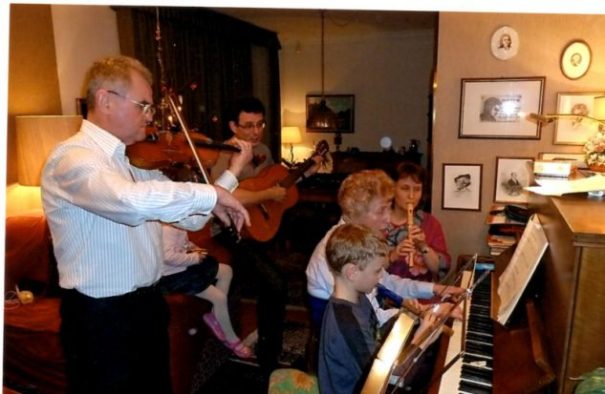
Nora is a respected specialist in Chinese medicine, Jochen – another professor, information systems. They live in different places in Germany, but when they gather at family home, there is music.

Portraits on the wall: Wagner, Mozart, Beethoven.
Inge and Norbert are frequent visitors to Bayreuth and music festivals there.

In the meantime in Australia…
My dominant hobby for number of years was cross country skiing. I discovered quite attractive places for skiing in Australia. I entered also a number of cross-country skiing marathons overseas.
This led me again to Austria and twice to Germany.
Germany meant Koenig Ludwig Lauf in Oberammergau. Very memorable event, skiing in the shade of castles in Ettal and Linderhof.

In 2001, after the race I spent few days in Munich. Music of course, opera, but this time it was not the famous Bayerische Staatsoper, but Gärtnerplatztheater – CLICK – which presented more challenging program. The Rake Progress by Igor Stravinsky.

Here I have to confess one shameful event.
At the time when I fought on European ski trails, in February 2001, Inge and Norbert visited Australia 😦
We were in not so frequent touch, I had to plan my leave to Europe many months earlier, so at the time when Inge notified me about their visit it would have been quite messy and costly to abandon my plans. So they visited our home and were hosted by my wife and I was far away.

We still remained pen-pals and then an additional German accent arrived in my life.
Our daughter got married to Peter, young man of German origin. His parents, both originally from Königsberg, live permanently in Melbourne. In our opinion they run a very German home.

Our granddaughter, Sabina, now in year 10 of school, learns German and last year participated in an interschool German Poetry Competition.

The finals were held in Austrian Club in Melbourne.

And the winners were…

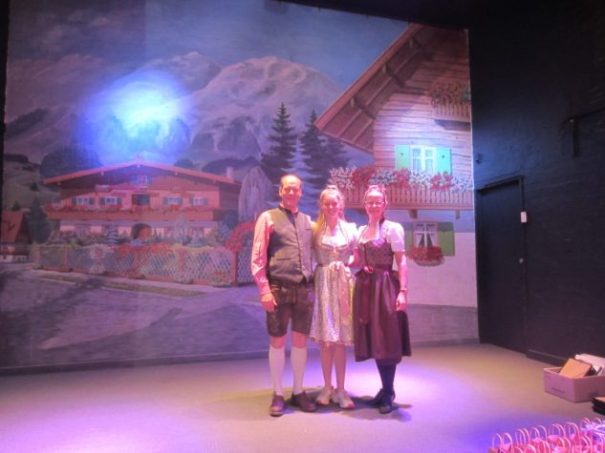
Well, Sabina won the second place. Above with her parents, all in dresses bought one year earlier during Oktoberfest in Munich.

More than a week ago I rang Inge and thanked her for 60 years of contact. We reminisced these times – solid, friendly times.

Let me finish with another of poems recited long, long ago by me – CLICK.

Sąsiedzi 6

Teresa Rudolf

Filomena i ten uśmiech…

Filomena weszła do swego mieszkania, kompletnie zdezorientowana po przypadkowej,  niespodziewanej wizycie u Pani Klary.
– U licha, przeciez nie cierpiałam tej kobiety od lat, nigdy nie rozmawiałyśmy wcześniej, a tu teraz jest tak, jakbyśmy się od lat znały – myślała – mało tego, mamy nawet coś ze sobą wspólnego, chociaż to kompletnie inna generacja.
Mąż Klary też czasem mówił do niej “Mona-Lizo”, jak i ten mój Franz do mnie.
Ale u niej to tak jakoś wszystko było romantyczno-dramatycznie, kochali się, a ona po jego śmierci do dziś jest tylko z nim, na każdym kroku. Prawie ogladam się, będąc u niej, czy aby on nie wyjdzie gdzieś do nas z balkonu, lub z kuchni.

Tak rozmyślając, Filomena siadła przy maleńkim stoliku, w małym pokoju. Zapaliła papierosa, który miał być znów ostatnim, tak jak to się działo od dwóch lat. Założyła nogę na nogę, włączyła radio i słuchając jakiejś sentymentalnej muzyki zatonęła, w gorzkich  wspomnieniach.
Franz (tak kazał na siebie mówić, po powrocie z Niemiec, po pięciu latach pobytu) na ogół kojarzył się jej teraz, dziesięć lat od rozstania, jak najgorzej.
Poznała go w podróży, stojąc na korytarzu pociągu linii Warszawa-Wrocław. Było tak  tłoczno, że nawet konduktor zrezygnował z przebijania się przez ten tłum.
Nadepnęła mu na nogę, zaklął siarczyście,  po polsku i po niemiecku, ale później jednak  przeprosił:
– Ach, zabolało, ale nie powinienem być tak ordynarny, bardzo Panią przepraszam, wie Pani, ból na ogół nie jest salonowy, jest albo bardzo wulgarnym, albo tchórzliwym fenomenem, czyli albo klnie, albo się modli. Jeszcze raz przepraszam, mogę to Pani jakoś wynagrodzić, może kawa, po wyjściu z tego, tutaj piekła?
Nagle pociąg  znów tak ostro przyhamował, że Franz zachwiał się z całej siły i teraz to on nadepnął na stopę Filomeny, a ona zaklęła jak robotnik na budowie, głęboko przekonany, że nikt go nie słyszy.
I dodała – Na razie klnę, bo tak to boli i tak zostanie, a modły zostawię Panu, bo chyba  zaraz oddam…
W tym momencie zaczęli się oboje tak  śmiać, że zarazili innych pasażerów, przylepionych do nich ciasno w tłoku…

Franz był wtedy bardzo czarującym brunetem, jak i ona w wieku około 40 lat.
Na poczekaniu miał slogany, dowcipy, cytaty, no i nie odrywał od niej wzroku, kiedy znaleźli się już na tej zapowiedzianej kawie.
Restauracja średniej jakości, niedaleko dworca, nagle stała się dla niej najpiekniejszą, najromantyczniejszą, jaką w tym mieście znała.
Ciągle mówił: – Pani będzie moją Moną-Lizą, ten uśmiech… Znów sobie przypomniała,  co opowiadała dziś Pani Klara i pomyślała, czy ci faceci naprawdę muszą wszyscy być tacy sami, tacy banalni???…
Ale z drugiej strony, nigdy wcześniej nikt do mnie tak nie mówił, i poza Panią Klarą nie znam też i innej kobiety, którą by podobnie nazywano, dziwne bardzo…

Znów w myślach wyłonił się nagle, w całej okazałości, Franz…
Nie mogla opanować złości na samą siebie, za to, że kiedyś tak była nim zaślepiona.
Dla niego prawie natychmiast rzuciła pracę w banku wrocławskim, gdzie byla szanowaną, elegancką, kompetentną pracownicą, zajmującą się udzielaniem kredytów. Pracę swą lubiła i ceniła.
Franz po powrocie z Niemiec zamieszkał na stałe w Krakowie. Tam też ustabilizował się zawodowo. Był dyrektorem administracyjnym jednego z większych przedsiębiorstw naftowych.
Posiadał ogromne mieszkanie w centrum miasta, pięć minut od Rynku. Był singlem z odzysku, po  intensywnym “koszmarnym małżeństwie” z niejaką Krystyną.
No i los rzucił go pod nogi Filomeny.
Stwierdzili oboje, że takiego zbiegu okoliczności nie wolno ignorować, trzeba było brać natychmiast “byka za rogi”.
Więc najlepiej, gdyby bykiem zajęła się Filomena, rzucając wszystko we Wrocławiu, a on zajmie sie rogami, aby, rymując, przygotowć im grunt pod nogami.
Przypominała teraz sobie, jak zaczał wprowadzać ją w swoje, jak później stwierdziła, szemrane towarzystwo.
Wszędzie przedstawiał ją: Filomena, moja Mona Liza!
– No proszę, pomyślała ironicznie, spotkałam dziś drugą Monę Lizę i to w tym samym bloku, starszą ode mnie o ponad 25 lat!!!
Ale za czasów, gdy Klara była młoda, Mona Liza miała się dużo lepiej, była muzą, boginią, a nie jak ona sama później – zdzirą.
Zapłakała gorzko nad sobą, swą naiwnościa, i nad swą samotnością, teraz już nie do zniesienia.
No i co zrobił z moim życiem ten bandyta?
Mona Liza, psiakrew…

Spotkania z Księciem Ciemności 4

Ksawery Kopański

Ktoś zauważy: to nepotyzm. Odpowiadam: oczywiście. Inny zarzuci: kolesiostwo! Replikuję: jak najbardziej. Świadome. Z premedytacją.

Dzisiejsza opowieść skupi się na mojej ukochanej Suni. Ją dzisiaj docenię, Ją będę bezwstydnie publicznie promował i Jej przymioty pod niebiosa wynosił. Nie może być inaczej, bo bez Niej nie zaczęłaby się cała historia z Księciem Ciemności w roli głównej. Zaś bez Jej uroku nie byłaby ta klechda taką, jaka jest.

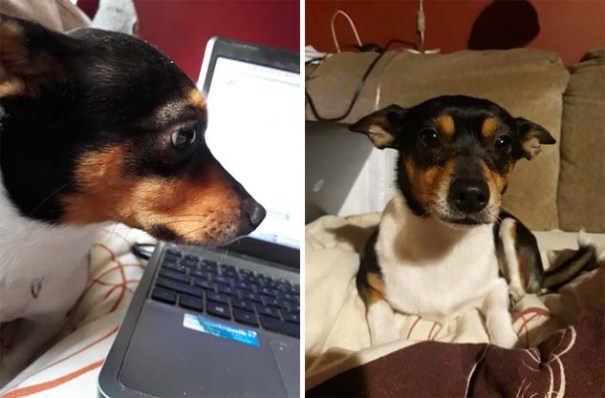
Bez samotności Kropki nie istniałaby bowiem potrzeba przyniesienia do domu na próbę małej, czarnej, futrzanej kuleczki: a nuż się polubią, zaprzyjaźnią? Zresztą i sama Kropka trafiła do nas krótko po swym urodzeniu, sześć i pół roku temu, jako osłoda i podpora starości Łatki. Łatka nie miała własnych dzieci, więc Kropkę potraktowała jak córkę. Przyjęła i wychowała. Były nierozłączne. A że istniało między nimi pewne podobieństwo, zwłaszcza dotyczące umaszczenia (przy tym Łatka była nieco większa) naprawdę wyglądały jak mama z córeczką. Cztery lata to trwało, aż Łatka – do dziś gardło i serce się ściskają, gdy sobie przypominam – krótko przed siedemnastymi urodzinami pobiegła niechętnie, wciąż oglądając się za nami, po tęczowym moście…

I tak Kropka została sama na długie dwa lata. Oczywiście: byliśmy Żona i ja, ale to przecież nie to samo.

Gdy więc koło domu zaczął się kręcić Czarnuszek, wpadłem na pomysł powtórzenia sprawdzonych rozwiązań. Do pewnego stopnia przynajmniej: jak wspominałem, nie było możliwości wzięcia Sierściuszka na stałe. Ale „na przychodne”? Czemu nie. I, jak również już pisałem, udało się. Przyjaźń kwitnie.

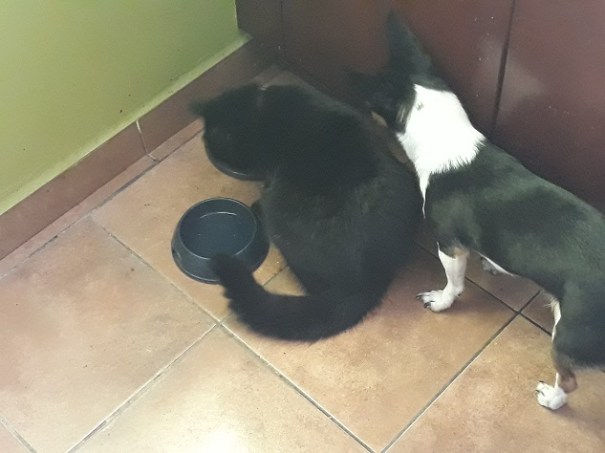
Właśnie… Czy słowo „przyjaźń” to dobre określenie na związek łączący Kropkę i Księcia? Jest w nim bliskość, jest czułość. Ale da się też zauważyć coś innego: Kropka okazuje wobec kotka dużą opiekuńczość. Zwłaszcza, jak zauważyłem dwa tygodnie temu, przy korytku. Pozwala mu się najeść, dba wręcz, by mógł to zrobić spokojnie.

Z jednej strony jest serdeczna, z drugiej jednak uczy nieraz moresu czarnego ancymonka i łobuza! Gdy skurkowaniec na przykład nadmiernie intensywnie tuli się do mojej Żony (a ukochanej Pani Kropki), albo gdy w zabawie staje się zbyt rozbrykany i niedelikatny, Kropka pokazuje ząbki i warczeniem przywołuje go do porządku. A on co prawda rezygnuje, odskakuje na kilkanaście centymetrów, uspokaja się. Ale żeby się szczególnie przejął, tym bardziej obraził? Skądże!

Gdybym chciał precyzyjnie określić charakter łączącej ich relacji, musiałbym chyba uznać, że to przyjaźń, ale szczególnego rodzaju, z domieszką czegoś więcej: Kropka do pewnego stopnia zachowuje się wobec Księcia jak mamusia. Lub raczej starsza siostra: kochająca, ale i wymagająca. I tak jest dobrze!

Wspomniałem, że Książę lubi się tulić do mojej Żony i z nią się miziać. A ze mną? Ze mną nie. Mnie traktuje, co ponoć dla kotów typowe, jako narzędzie do otwierania puszek i wykładania jedzonka do miseczki. Przyjąłem te warunki, kontentując się możliwością obserwowania kwitnącej kocio-psiej przyjaźni, jak i po prostu piękna czarnego futra oraz zielonych oczu.

Przyszło mi to tym łatwiej, że mam wsparcie w Kropce. Bo ona, jak to dla psów typowe, kocha głęboko, bezwarunkowo i czule. Zaś swe uczucia dzieli sprawiedliwie między Żoną a mną… i jeszcze dla kotka wystarcza.

Nie będę nawet próbował sportretować naszej wzajemnej miłości. Brak mi warsztatu, nie staje polotu. Uchwycić zachowania i wybryki kocurka to insza inszość – nie jest zbyt trudne. Ale opisać psie uczucia? To potrafiłby tylko mistrz. Mnie by wyszedł nieznośny banał. Powiem tylko, że jeśli chcecie coś z tego zrozumieć, szukajcie w oczach Kropki: tam wszystko jest. Tylko trzeba umieć patrzeć.

Zacząłem kilka tygodni temu swą opowieść deklaracją, iż jestem zaprzysięgłym psiarzem. Podtrzymuję.

Frauenblick. Prag.

Monika Wrzosek-Müller

Mein Prag, die ersten Tage

Prag hat sie in Beschlag genommen. Eine Stadt, die wirklich verzaubert und vereinnahmt, so dass man an wenig anderes denkt, denken kann. So viel Schönheit aus allen Epochen, so viel Vielfalt hat sie selten erlebt. Alle Stilrichtungen der Architektur sind vertreten: Romanik, Gotik, Renaissance, Barock, Rokoko, Klassizismus, Jugendstil, der böhmische Kubismus, Bauhaus und eine Menge der modernen experimentellen Architekturstile, die sie nicht zu benennen wüsste, die sich aber auch stolz präsentieren. Vieles sticht richtig ins Auge und breitet sich aus, wie in einem Lehrbuch für Architektur bei einem Spaziergang, besonders im Letna-Park, von dem ihr der Wahnsinnsausblick immer wieder den Atem stocken lässt. Im Moment sind wenig Touristen unterwegs, sie könnte sogar auf der Karlsbrücke verweilen und die Ausblicke genießen. Sie fühlt, dass in der Stadt verschiedene Kulturen aufeinander trafen und treffen, aber in weicher Variante, man erlaubt den anderen zu leben. Zugleich aber spürt sie so etwas, als ob die Stadt niemanden gehören würde, als ob sie für sich da stünde, eine wirklich globale europäische Stadt, weder deutsch noch jüdisch, aber tschechisch auch nicht. Wenn am Samstagabend die Kassiererin an der Kasse bei „Tesco“ zehn Personen auf Tschechisch immer wieder fragte, ob sie Kleingeld hätten, konnte ihr niemand in der Sprache antworten. Sie lächelte verschmitzt, als ich ihr dekuji sagte.

Zwar stehen in Prag viele tschechische Regierungsgebäude, doch den Tschechen gehöre sie auch nicht wirklich. Seit Jahrhunderten lebten hier Deutsche, Tschechen und Juden zusammen; dann kamen Vietnamesen und jetzt abertausende Touristen aus wirklich allen Ecken der Welt, erstaunlich viele aus asiatischen Ländern; Gruppen von sanft lächelnden asiatisch aussehenden Mädchen streifen durch die Straßen, kaufen in den tausenden Geschäften tausende Kleinigkeiten ein. Sie bestimmen das Bild der Stadt; auf sie stellt die Stadt sich um und davon lebt sie.

Für sie war aber erst mal wichtig, dass es eine weiche, harmonische, helle barocke Stadt ist, in sanftes Licht getaucht; oft steigen Nebelschwaden aus der Moldau hoch und die Sonnenstrahlen zerstreuen sich und tauchen die Stadt in einen goldenen Heiligenschein. Dann sieht man von oben nur die Konturen der Brücken, dadurch wirkten sie leichter, beschwingter, die Konturen der Kuppeln und der Türme; von da oben (den Letna-Park) scheint alles weit weg zu sein, am Horizont, hinter der Brücke, in Wirklichkeit aber ist fast alles zu Fuß zu erreichen in 10, 20 Minuten kann man in der Altstadt aber auch auf der Kleinseite alles erreichen. Natürlich geht sie auf den Wegen der Touristen, die waren auch sehr geschickt angelegt, so dass die Menschenströme später dann im Frühjahr oder Sommer gelenkt werden können: nach oben zum Hradschin, zum Veitsdom, nach unten zur Karlsbrücke, in die Mitte zum Altstädter Ring. Dafür wird man mit schönen Ausblicken belohnt, die Wege sind auch extra so gebaut, mit einer Bank zum Verweilen, oder einer Balustrade um sich daran anzulehnen, dass man länger sich auf ihnen aufhalten kann. Überall gibt es Hinweisschilder und man kann schnell zu einzelnen Denkmälern gelangen. Die Situation erinnert sie an Florenz, eine Stadt, die sich den Touristenmassen ergeben hat und eigentlich für sie existierte. Doch hier ist die Vielfalt und Größe vielleicht noch überwältigender.

Man kommt mit der Straßenbahn leicht überall hin; es gibt auch eine U-Bahn, doch die Stationen gehen so steil in die Tiefe hinunter, dass sie immer wieder Angst bekommt und die Straßenbahn vorzieht, außerdem kann man von der Straßenbahn am Fenster klebend die Fassaden der Häuser, der vorbei huschenden Bauten bestaunen. Natürlich gibt es für Touristen Kutschfahrten auch Bootsfahrten, allerdings in einem begrenzten Areal der Moldau, denn sie bildet Stufen. Man kann sich aus der Flotte von alten Automobilen in verschiedenen Farben eins aussuchen und durch die Altstadt rasen. Die jungen Leute ziehen neuerdings E-Roller, E-Scooter vor, auch wenn die meisten Straßen sich dafür eigentlich gar nicht eignen, sie sind nämlich mit Kopfstein gepflastert. Die Zahl der Cafés, Restaurants, Kneipen, Bistros ist schier unendlich; von edel bis Schnellimbiss ist alles dabei; auch Musik-, Jazzkneipen sind überall zu finden. Die Qualität des Essens ist gut bis sehr gut; die Touristen verschlingen alles, so dass es frisch ist, jeder kann für sich etwas finden.

Die Tschechen scheinen den Touristenrummel mit stoischer Ruhe zu ertragen, sie fallen nicht auf; ja sie sind fast unsichtbar in der Altstadt und auf der Kleinseite und doch müssten sie diese Stadt von irgendwoher dirigieren, leiten. Die meisten scheinen ihr sehr angenehm und zurückhaltend. Viele sprechen mehrere Sprachen, die jungen Leute meist eher Englisch.

Der Fluss Moldau bildet Mäander und kleine Inseln, die sich zum Spazieren sehr gut eignen. Wegen des Hundes entdeckte sie auch Kampa, die auf der Kleinseite gelegene Insel; durchzogen mit Kanälen, mit kleinen Brücken, kleinen alten Häuschen, wunderbaren Cafés, einem Museum für moderne Kunst und einen Skulpturenpark, das Ensemble präsentiert sich prachtvoll, wurde von Exiltschechen Jana und Medy Mladovych errichtet. Sie nannte es Kleinvenedig, jetzt, in Februar, ist noch alles eher leer und mühelos zu erreichen und zu durchwandern.

Auch hat sie Plattenbauten in den Peripherien von Prag entdeckt. Wie die französischen banlieues ziehen sich die Wohnblocks in die Täler und Hügel sternenförmig aus der Stadt hinaus, sie sind von Streifen mit Natur durchzogen, die wirklich sehr schön, naturbelassen wirken. Der Reiz dieser Landschaftsstreifen beruht auf den felsig-hügeligen Formationen, mit kleinen Waldabschnitten, dazwischen gibt es oft große Wiesen, die mit Obstbäumen bepflanzt sind; das müsste in Frühjahr toll aussehen, denkt sie. Die Plattenbauten sind selbst für sie, die aus Warschau kommt, gewöhnungsbedürftig, sie ziehen sich kilometerlang und haben somit mit der Altstadt und ihren Baudenkmälern nichts zu tun. Doch, wie ihre jungen Freunde feststellen, man lebt da angenehm, ist schnell in der Stadtmitte und vor Ort mit aller Infrastruktur ausgestattet.

Sie hat das Gefühl, die Stadt ist harmonisch und lebenswert, trotz der Touristen, wahrscheinlich doch wegen der Sehenswürdigkeiten und den jahrhundertealten, von Menschen für Menschen geschaffenen, gewachsenen Strukturen, auch die Lage mit den Hügeln, die Aussichten über größere Entfernungen erlauben, ist herrlich. Das bedeutet nicht, dass alles perfekt ist; dass alles zu bewundern gilt. Doch man merkt, dass Prag wieder zu seiner Größe zur Goldenen Stadt zurückgefunden hat.

Die ersten Tage waren sehr angenehm, hoffentlich nicht zu sehr…

KIG 115 (Reblog)

Ela Kargol

Tekst ze strony stowarzyszenia Städtepartner Stettin e.V. na FB / vom Fanpage des Vereins Städtepartner Stettin e.V. 

In Berlin und in Stettin / W Berlinie i Szczecinie

Vor 115 Jahren ist Konstanty Ildefons Gałczyński geboren, ein bekannter polnischer Dichter, der seine lyrischen Spuren sowohl in Berlin als auch in Stettin hinterlassen hat. Der Dichter arbeitete von 1931 bis 1933 als Kulturattaché bei der polnischen Botschaft in Berlin.

Er besichtigte Museen, unternahm viele Reisen und entdeckte für sich ein kleines Kabarett, nah am Potsdamer Platz.
“Die Katakombe” war ein politisch-literarisches Kabarett in Berlin, das von 1929 bis 1935 bestand.
Inge Bartsch, junge Schauspielerin und Sängerin, eine hübsche junge Frau mit roten Haaren, sang Tucholsky’s Texte: „du bist so stolz und fern, und hast mich doch so gern…”
Gałczyński war so beeindruckt, dass er über sie ein Gedicht verfasste, über sie und auch über den sich rasch entwickelnden Faschismus in Deutschland zu der Zeit.

Das ganze Gedicht ist unter diesem Link zu hören und zu sehen:
https://www.youtube.com/watch?v=3hlExHOrr_g…

Meine damals 15-jährige Tochter Helena nahm vor sieben Jahren an einem Projekt “Poesie verbindet” teil, wo sie das Gedicht rezitierte, durch Inge Bartsch’s Berlin schlenderte und in die 30er Jahre des letzten Jahrhunderts abtauchte.

Nach Stettin kam Gałczyński im Frühjahr 1948. Ihn beeindruckten die Magnolien, die gerade blühten, das neue Haus in Pogodno mit großem Garten und Veranda, auch die Straßenbahn, die vorbeifuhr, der Wind, der von der Oder wehte und… damals auch das neue Polen. Er schrieb:

Tutaj mój port, tu słońce mam na czole
i dom i sad i kota – nie do wiary!
Natalia na werandzie Kira w szkole.
A babci wchodzą sny pod okulary…

Hier ist mein Hafen, hier strahlt die Sonne auf meinen Stirn.
Und Haus und Garten und Katze – nicht zu Glauben!
Natalia auf der Veranda, Kira in der Schule
und Großmutter kriechen die Träume unter die Brillen.

Bevor er Szczecin nach einem Herzinfarkt verlassen hat, gründete er den Club der 13 Musen, der bis heute existiert.
In diesem Club wird jedes Jahr Gałczynskis Geburtstag gefeiert. Diesmal ist es der 115.

***
115 lat temu urodził się Konstanty Ildefons Gałczyński, poeta berliński i szczeciński.
W obu miastach nie zabawił zbyt dlugo, ale na tyle wystarczająco, żeby zostawić liryczne ślady. Berlińskim śladem oprócz słynnego „Balu u Salomona“ jest z całą pewnością „Inge Bartsch“ wiersz, nie tylko o pięknej Indze, której głosem i urodą poeta się zachwycił, ale też o rosnącym w Niemczech faszyzmie.

Inge Bartsch nie jest postacią wymyśloną, istniała naprawdę, była aktorką, piosenkarką. Poeta trafił pewnego dnia w Berlinie przy Placu Poczdamskim do kabaretu Katakombe. Na afiszu widniały dwa nazwiska: Kurt Tucholsky i Inge Bartsch. Inge o płomiennych włosach i drobnej sylwetce śpiewała niskim głosem „du bist so stolz und fern, und hast mich doch so gern…” Kabaret, który zapewniał, że jest apolityczny, takim nie był. Nie trzeba było długo czekać. W 1935 na wyraźny rozkaz Goebelsa kabaret zamknięto, a Wernera Fincka, jednego z założycieli aresztowano.
Gałczyński był już wtedy w Wilnie.

Potem była wojna, mobilizacja i cudem uniknięta śmierć w Kozielsku, obóz jeniecki w Niemczech, Kraków i w roku 1948 Szczecin.

Do Szczecina przyjechał wiosną w porze kwitnięcia magnolii. Zachwycony ukwieconymi drzewami, krzewami, wiatrem od Odry, domem na Pogodnie, i nową Polską, a nawet tramwajem „jedynką“, chciał tu pozostać na dłużej. Z żoną, córką i teściową.

Tutaj mój port, tu słońce mam na czole
i dom i sad i kota – nie do wiary!
Natalia na werandzie Kira w szkole.
A babci wchodzą sny pod okulary
Nad klombem ptaka cień przefrunął modry.
Grzmi w rękopisie moim epopeja.
Dobrze mi tu. I wieje wiatr od Odry,
odurzający i zwycięski jak nadzieja.

W Szczecinie powstał Klub 13 Muz, którego poeta, jak legenda głosi był założycielem. Klub działa do dzisiaj.
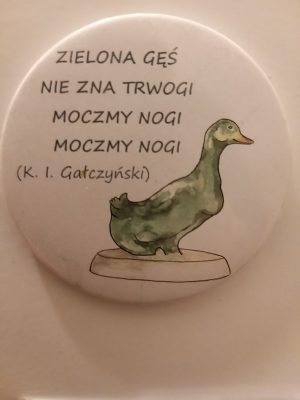
Urodziny Gałczyńskiego obchodzi się w klubie co roku. W tym roku Salon Artystyczny Seniorów „13 Muz” przygotował interpretacje wierszy poety. Panie recytowały, tańczyły, Zielona Gęś gęgała, szczecinianie bili brawo. Całości dopełnił pokaz filmu „Adresy Konstantego”, według pomysłu i scenariusza Marka Brzezińskiego, a… Konstanty, gdyby żył, może łagodniej spojrzałby na „Bożą krówkę” i nie dziwił się, że zimą jest ich coraz więcej.

Nasz autor Mieczysław Węglewicz spędził dzień 115 urodzin Gałczyńskiego w leśniczówce Pranie – zob. TU

KIG

Już rok temu, w rocznicę urodzin KIGa, autor przysłał mi wiersz. W tym roku wiersz (w nowej wersji) powrócił, a z nim opis urodzin w leśniczówce

Mieczysław Węglewicz

Urodziny poety

Jakie tajemne znaki
zwiastowały Polakom
dzielnym
że się narodzi Konstanty
poeta niebagatelny?
jak poznał lud i socjeta
że przyszedł na świat
poeta?
Nie anonse o niemowlętach
nie literackie gazety
nie blask
gwiazd
nie komety
to Wisła miała kolor zielony
pawie w królewskich
Łazienkach
rozkładały zielone ogony
to zorza była zielona
i atrament zielony podrożał
PS
Konstanty Ildefons Gałczyński urodził się w W-wie 23 01 1905 roku

Program imprezy urodzinowej
1. uwielbiać KIGa i czcić
2. opiewać gęś zieloną
3. śpiewać pieśni i wino pić
4. delektować się gęsią pieczoną

Leśniczówka z czerwonej cegły, porośnięta dzikim winem robiła wrażenie tajemniczej świątyni. Wejścia przed furtką strzegła drewniana gęś. Za furtką, druga gęś, zielona z brązu, na wysokim postumencie, witała przybyłych, szeroko rozpościerając skrzydlate ramiona. Pokornie weszliśmy na podwórze, z szacunkiem dla odchodzącego dnia. Wokół była cisza, chłód i szarość bezśnieżnej zimy. Zapadał zmierzch.
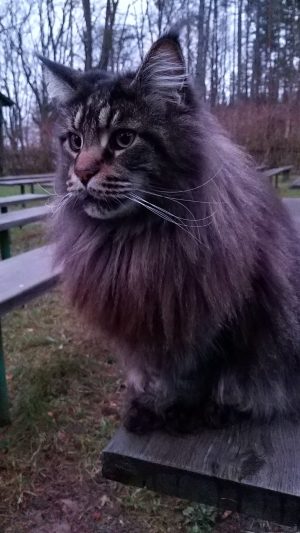
Na ławce przed drewnianym gankiem zjawił się po cichu jak leśny duch wielki, kudłaty kocur main coon.
Próbowaliśmy łasić się do niego, ale pozostawał obojetny na pieszczoty.
Uchyliły się drzwi i na ganek wyszedł wyrośniety czterdziestolatek w zimowej kurtce. Zaprosił przybyłych do leśniczówki. Na parterze w otwartym kantorku z biletami, książkami i pamiątkami, wsród kilku osób jest także pani Grażynka, zawsze uprzejma i pomocna. Droga wiodła po drewnianych schodach, które słyszą i czują każdy krok. Czasem nawet coś mówią skrzypiącym głosem.

Weszliśmy jako pierwsi do dużej izby na poddaszu z kaplicznymi rzędami krzeseł.

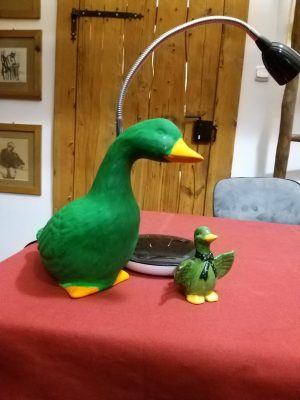
Przed pierwszym rzędem jak na ołtarzu stały dwie figury zielonych gęsi – duża i mała. Gęś i gąska. Mama i dziecko.

Z każdą minutą więcej i głośniej skrzypiały schody. Przybywało gości. Krzesła zostały zajęte. Niektórzy stali przy schodach. Wreszcie schody zamilkły. Natężała się cisza, niekiedy zakłócana powściągliwymi chrząknięciami.
I kiedy już wszyscy jakoś dojrzeliśmy do słuchania, poeta i dyrektor Wojciech Kass, podzielił się swoja dumą i pochwałami, że heroicznie przybywamy od sześciu lat na urodziny KIGa w Praniu.

Czysta przyjemność po naszej stronie, panie Wojciechu!

Gość honorowy 115 urodzin KIGa, pan prof. Piotr Mitzner (zdjęcie po prawej stronie), snuł ciekawą opowieść o życiu i twórczości ś.p. Jubilata, a my po cichu na huśtawce marzycieli sięgaliśmy w wyobraźni po tort urodzinowy, po herbatę i grzane wino, podane wkrótce podczas wspólnego ogniska.

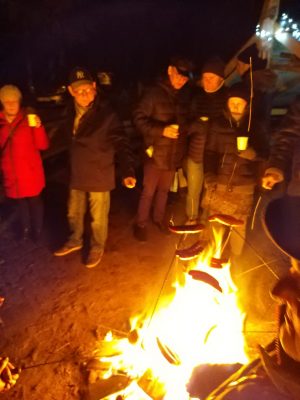
Na koniec nad ognisko zleciałały się kiełbasy, które co raz to unosiły się dostojnie nad ogniem, to opadały bliżej żaru. Widowisko to obserwowali zgromadzeni wokól ogniska ludzie. Niektórzy wyglądali tak jakby kierowali ruchem kiełbas wzrokiem, u innych zaś widać było czarodziejskie różdżki.

Nocne powietrze, wilgotne i chłodne, nasycone było żywicznym kadzidłem.
Trwały czary…


Nasza autorka, Ela Kargol, pojechała na urodziny poety do Szczecina – zob. TU

Barataria jako ogólna teoria wszystkiego (lub coś w tym rodzaju)

Uczony baratarysta, fizyk, filozof, taboryta i pacyfista, który podjął postanowienie napisania doktoratu z Baratarystyki. Pierwszym krokiem będzie powołanie do życia festiwalu, katedry i księgi…

Marek Włodarczak (vel Tabor Regresywny) 

Festiwal

Żeby Nieistniejący Festiwal Literatury nabrał rozpędu, potrzebny jest napęd i dobre hamulce. Najlepszym napędem są pieniądze. Powiedzmy sobie szczerze, nikt nam ich nie da. Na szczęście jest trochę pieniędzy zakopanych na płycie byłego lotniska Tempelhof, nie mówiąc już o tych zakopanych na Wdzydzach. Co do hamulców, to im lepsze hamulce, tym więcej gazu można dodawać. Mam w domu taki hamulec i chętnie go zabiorę na festiwal.

Autor wyjeżdża do Berlina na zebranie założycielskie Nieistniejącego Festiwalu Literatury, który przeto zaistniał

Katedra

Moje spotkanie z prof. Feliksem Przybylakiem zapoczątkowała myśl, którą będę wielokrotnie powtarzał – nic nie zdarzy się w kulturze, dopóki coś nie wydarzy się w fizyce.
Spotkanie zaowocowało propozycją studiów doktoranckich na wydziale filologii germańskiej w zakładzie poetyki i przekładu. Mając za sobą wszystkie egzaminy, otwarty przewód doktorski i spory zbiór tekstów, odmówiłem formy pisemnej doktoratu, proponując formę ustną.
Profesor stwierdził, że nie ma nic przeciwko temu, ale uniwersytet tego nie przetrzyma. Często gdy przynosiłem mu jakiś tekst, powtarzał. Genialne, ale w tym instytucie nikt tego nie zrozumie. Nie brał pod uwagę szatni i Pani szatniarki. Zbiór tekstów, który opatrzyłem wspólnym tytułem „Na płonącej granicy poetyki i nauki” należy do Baratarystyki, dziedziny, której nie ma w wykazie kierunków i dyscyplin naukowych. Konstytucja dla nauki nie zostawia tu żadnej furtki. Ściśle wyznacza, co jest nauką, a co nie jest. To oznacza koniec Uniwersytetu jako otwartej wszechnicy. Właściwie robi z niego Wyższą Szkołę Zawodową. Jedyna nadzieja w szatni, tu nie ma żadnych ograniczeń, nie obowiązują żadne wykazy, co najwyżej regulamin szatni. Jeśli miałbym bronić doktoratu z Baratarii, to tylko w szatni. Szatnia jako ostatni bastion uniwersytetu.

NA PŁONĄCEJ GRANICY POETYKI I NAUKI, czyli Księga Wstecz

Promotor: prof. Feliks Przybylak
Akuszerka: Ewa Maria Slaska

Motto: Nic nie wydarzy się w kulturze, dopóki coś nie wydarzy się w fizyce.
Feliks Przybylak

Spis treści

1. Barataria, czyli Chatka Puchatka
2. Klątwa, czyli o sposobie egzekwowania prawa w Baratarii
3. Tokarczuk, czyli mandat
4. Ucieczka na Wyspy Szczęśliwe, czyli ciąg dalszy
5. Każdy kto (o coś) walczy, jest Don Kichotem, czyli o walce dobra ze złem
6. Barataria, czyli odjazd na Wyspy Szczęśliwe (próba)
7. Barataria, czyli Wyspy Szczęśliwe (wiersze)
8. Niebiańska Jerozolima, czyli kubatura kuli
9. Barataria 66 (reblog), czyli Historia świata wg EKSK

Worldwide Screening

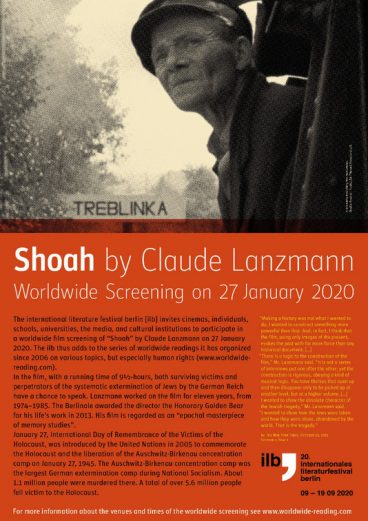
Worldwide Screening on 75th International Day of Remembrance of the Victims of the Holocaust

We called for participation in the worldwide screening of “Shoah” by Claude Lanzmann. This can take place privately in a small circle, in a school, in a cinema, in a cultural institution or through a TV channel.

In the 9½-hour film “Shoah” both, surviving victims and perpetrators of the systematic extermination of Jews by the German Reich, have a chance to speak. Lanzmann worked on the film for eleven years, from 1974–1985. The Berlinale awarded the director the Honorary Golden Bear for his life’s work in 2013. His film is regarded as an »epochal masterpiece of memory studies«.

January 27, International Day of Remembrance of the Victims of the Holocaust, was introduced by the United Nations in 2005 to commemorate the Holocaust and the liberation of the Auschwitz-Birkenau concentration camp on January 27, 1945. The Auschwitz-Birkenau concentration camp was the largest German extermination camp during National Socialism. About 1.1 million people were murdered there. A total of over 5.6 million people fell victim to the Holocaust.

Until January 20th we will collect information about the screening you have organized. Please send us an to worldwidescreening@literaturfestival.com so that we can communicate the events on our website www.worldwidereading.com.

Here you find a list of participants. There will be screenings in Austria, Canada, Chile, France, Germany, Great Britain, Greece, Italy, Nigeria, Spain, USA.

Worldwide Screening am 75. Internationalen Gedenktag für die Opfer des Holocaust

Das internationale literaturfestival berlin [ilb] rief Personen, Schulen, Universitäten, Medien und kulturelle Institutionen zu einer weltweiten Filmvorführung von »Shoah« von Claude Lanzmann am 27. Januar 2020 auf. Damit knüpft das ilb an die Serie der weltweiten Lesungen an, die es seit 2006 zu verschiedenen Themen, vor allem auf die Menschenrechte bezogen, organisiert hat.

In dem 9½-stündigen Film kommen überlebende Opfer wie Täter der systematisch betriebenen Vernichtung der Juden durch das Deutsche Reich zu Wort. Lanzmann arbeitete an dem Film elf Jahre, 1974-1985. Die Berlinale verlieh dem Regisseur 2013 den Goldenen Ehrenbären für sein Lebenswerk.

Der 27. Januar, Internationaler Tag des Gedenkens an die Opfer des Holocaust, wurde 2005 von den Vereinten Nationen eingeführt, um dem Holocaust und der Befreiung des Konzentrationslagers Auschwitz-Birkenau am 27. Januar 1945 zu gedenken. Bei dem Konzentrationslager Auschwitz-Birkenau handelte es sich um das größte deutsche Vernichtungslager während des Nationalsozialismus. Etwa 1,1 Millionen Menschen wurden hier ermordet. Insgesamt fielen über 5,6 Millionen Menschen dem Holocaust zum Opfer.

Bis zum 20.1. nehmen wir gern noch Veranstaltungshinweise an. Bitte schicken Sie uns eine Nachricht über Ihre Veranstaltung an worldwidescreening@literaturfestival.com. Auf unserer Website www.worldwidereading.com werden wir diese Informationen einstellen.

Eine aktuelle Veranstaltungsübersicht finden Sie hier. Es wird Veranstaltungen in Chile, Deutschland, Frankreich, Griechenland, Großbritannien, Italien, Kanada, Nigeria, Österreich, Spanien und USA geben.

Trailer #ilb19
With this video we commemorate a great festival in 2019 and look forward to the 20th ilb in Septembre 2020.

https://www.literaturfestival.com/%2B%2Bresource%2B%2Bcollective.flowplayer/flowplayer.swf

Mit diesem Video blicken wir zurück auf ein großartiges Festival in 2019 und schauen vorfreudig auf das 20. Jubiläum des ilb im September 2020.

internationales literaturfestival berlin
Chausseestr. 5
10115 Berlin
Fon +49 (0) 30 – 27 87 86 65
Fax +49 (0) 30 – 27 87 86 85
presse@literaturfestival.com

www.litfestodessa.com
www.worldwide-reading.com
www.comics-berlin.de
http://www.wordalliance.org
20. internationales literaturfestival berlin | 9-19. September 2020
#ilb20 #ilb2020


In Berlin gibt es Vorführungen sowohl heute als auch morgen:

Heinrich-Böll-Stiftung – Bundesstiftung Berlin
Schumannstr. 8
10117 Berlin
Sonntag, 26.01.2020
10.00 – 21.00 Uhr
Eintritt frei, Anmeldung unter
https://calendar.boell.de/de/civi_register/139583
https://calendar.boell.de/de/event/claude-lanzmann-shoah

Akademie der Künste
Hanseatenweg 10
Berlin
27.01.2020
10 Uhr
https://www.adk.de/de/programm/index.htm

Brotfabrik Berlin
Caligariplatz 1
13086 Berlin
27.01.2020
13 Uhr
Eintritt pro Teil: 5 EUR. Alle vier Teile: 15 EUR
https://www.brotfabrik-berlin.de

KulturMarktHalle
Hanns-Eisler-Str. 93
10409 Berlin
26.01., 12.00 Uhr (mit vier kleinen Pausen)
www.kulturmarkthalle-berlin.de

Container
Am Weidendamm 3
10117 Berlin-Mitte (Nähe Bahnhof Friedrichstraße, der Eingang wird ausgeschildert)
Sonntag, 26.01.2020, ab 13 Uhr in drei Etappen  (3,5h, 3h, 3h – jeweils eine Stunde Pause zwischen den Teilen)
Alle Mitschauenden werden gebeten, Essen und Getränke mitzubringen, damit in den Pausen zusammen gegessen werden kann
Interessierte werden gebeten ihr Kommen kurz per Mail an
verfolgt-verschwiegen-vergessen@riseup.net anzukündigen

Janusz-Korczak-Bibliothek
Berliner Straße 120
13187 Berlin
26. Januar, 10.00 – 19.30 Uhr
http://stadtbibliothek-pankow.berlin.de

SANDALIA – Un’isola a Berlino
Schillerstraße 106, 10625 Berlin-Charlottenburg
Montag, 27. Januar 2020, 11.00 Uhr – 21.00 Uhr
Eintritt frei
www.sandalia.org


My Germany 1

Lech Milewski

First days of January 1960.
I just returned from Christmas holidays to student dormitory in Warsaw. For a while I was alone in 4-persons room. I looked into freshly bought monthly magazine Radar.

Radar, magazine for youth, it tried to introduce some new trends in Polish People’s Republic’s press.
One of such novelties was a Pen-Pal Club. Radar published each month addresses of young people from other countries who would like to exchange letters with young people in Poland.
Strangely, majority of these people were from Western Europe, mostly Sweden and Finland, mostly females.

But on this day I noted a girl from Germany, West Germany – Inge from Frankfurt am Main.
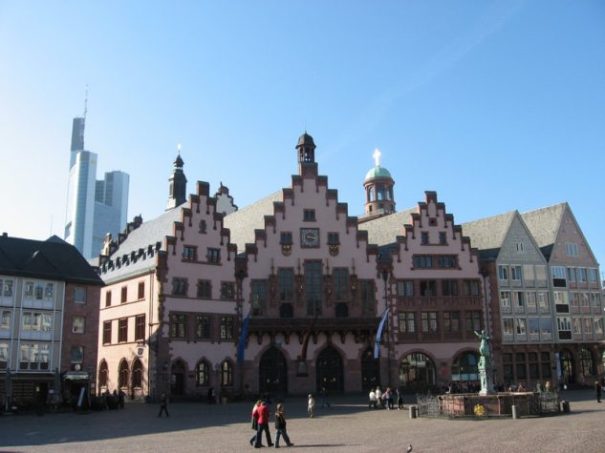
I wrote a letter in English and few weeks later received an answer – letter with a postcard – Frankfurt Rathaus.

Above my photo taken in 2007

I already had some bad experience with such correspondence – first few letters were the introduction of pen-pals, then… a trouble – what to write about?

First letter from Inge gave some hope, she was very interested in classical music, she studied singing at Frankfurt Musikakademie.

Music. For me it was connected to Germany, German language.
In high school we had in curriculum 3 foreign languages – Russian and in my case – German and English.

In all 3 cases we had exceptionally good language teachers.
German teacher, Mr Miętus, always immaculately shaved and dressed.
After entering the class he greeted students and started the lesson with the same phrase: gentlemen, take out your preparation, please.
Preparations meant our exercise books.

He put a lot of effort in teaching us German poems – J.W. Goethe, F. Schiller.
I think we learned them with pleasure and this caused a trouble.
On a day when learning the poem was due, he called few student to recite it and when the result was satisfactory, he proposed: maybe the whole class would recite it together.
For the first few lines it went smoothly, Mr Miętus, with delightful smile on his face, recited with us and marked pace with his hand, like an orchestra conductor.
Then, some students started to accelerate the pace, other shouted loudly only some words, other just shouted or made some strange sounds.
– Stop! Stop it! – shouted the teacher with tears in his eyes, but the class went on like a steam train..
Finally we ran out of steam, there was silence in the class. Mr Miętus sat at the table totally devastated. I think most of us felt sorry for him.
Still, after few weeks, he could not resist a temptation, and we turned it again into a disaster.

This passion for directing a collective recitation covered his real passion – music.
At that time I was already enchanted by the classical music, but the only source of it was a loudspeaker in our flat transmitting Program 1 of Polish radio.
Mr Miętus introduced me to live music performed in a very modest concert hall in provincial town – Kielce. He also was very keen to talk about music, about composers.
For the most of the class it was time to relax. For me it was more interesting than the German lesson. No wonder quite often my colleagues asked me to start some music discussion with the teacher, they had at least 20 minutes of rest.

Anyway, music stayed with me for the rest of my life. In the meantime it helped me to keep in touch with Inge. Other subject was – books. It looked, she was quite sensitive on human misery and found some answers in Charles Dickens books.
I have to admit that for me an important motivation for this correspondence was practice of English.

So passed 3 years and some new German accent arrived – student excursion to Austria.
There were some 20 participants, we traveled on a group passport.
Great excitement – visit to the country behind an “Iron Curtain”.

First was Czechoslovakia.
Meticulous control on two borders. Controllers crawled under the train, rolled mirrors under passenger seats.
On the border station between Czechoslovakia and Austria I noticed few men in strange uniforms entering our carriage.
When, eventually, our train moved and crossed the border, they pinned some emblems on their uniforms and greeted us: welcome to free Austria.

Atmosphere in our compartment relaxed. Some people revealed US dollars hidden in some clever places. It looked as I was the only one who did not smuggle anything.
Another revelation was an address of a shop in Vienna run by a Polish migrant: Mr Szumilas, Wipplinger Str. 11.

On arrival in Vienna we were greeted by our Austrian guides, they were members of a program of reconciliation run by some religious association.
They paid us our allowance for 2 weeks stay in Austria – some 280 Austrian Schillings. Exchange rate was about 24 Schillings per 1 US dollar.
With my knowledge of English and also limited German my help was frequently needed.

We spent one week in Vienna visiting most popular tourist venues: Hofburg, St Stephan Cathedral, Schonbrunn Palace and also a Soviet War Memorial – CLICK.
Note: from 1945 till 1955 Austria was occupied by Soviet Union, US, Great Britain and France.

In free time we visited a shop at 11 Wipplinger Str.
Shop attendant greeted us cordially: welcome to Polish working class.
– This is already communist bourgeoisie – corrected her Mr Szumilas.
I bought some novelty – non-iron shirt.

Our accommodation was in Student home at Pfeilgasse. We got our breakfast and supper there. Just sandwiches. Dinner we had in Mensa House in early afternoon.
I remember it so well as it was my first taste of Coca Cola.
Coca Cola, somehow for me was a symbol of rotten West. No wonder I drank it with some concern – will it make me dizzy or maybe there will be other side-effects?
There were none. Much later I read somewhere that it tastes like ping-pong balls. Absolutely right.

After one week in Vienna we traveled to Salzburg where we stayed in old US Army barracks near the airport.
Visit was dominated with W.A. Mozart memories.

Then to the mountains – Zell am See.
At one point our bus driver announced that we will be crossing to West Germany.
Our Polish tour guide protested – we haven’t got German visa!
– What a nonsense – commented the driver – everybody travels this way. This is the shortest route.
Our Austrian guides exchanged smiles – there is a strict control on the borders between friendly Communist countries – they explained to the driver.
Few minutes later Grenzpolizei sent us back to the longer route. Doubtful satisfaction.

Zell am See – CLICK – a mountain wonderland.
We visited Kaprun, Kitzsteinhorn Glacier, had a mountain walk.

On the last day we had an easy stroll around the lake.
Someone asked about the date – First of September.
And at that moment I realized that people around me speak German.
Somehow I felt that on this date I was in an improper place.

Finally back to Vienna and a nice surprise – a concert, Beethoven’s VII Symphony. I never heard it before, just listen to the II part, Allegretto – CLICK.

Here my memory from school – J.W. Goethe’s poem, also a song by F. Schubert – CLICK.