
Alla Marchenko
Inheriting Places, Remembering Lives
Isaac dug anew the wells that had been dug in the days of his father Abraham and that the Philistines had stopped up after Abraham’s death; and he gave them the same names that his father had given them.
— Genesis 26:18, Parashat Toldot
We began our journey in Germany on November 11, Poland’s Independence Day, two days after the anniversary of the November pogrom of 1938, commonly known as Kristallnacht. It was a striking coincidence for a study trip devoted to Jewish history in the Polish-German borderland: one date celebrating Poland’s regained independence, the other commemorating the Nazi violence that marked a decisive escalation in the persecution of German Jews. In Frankfurt (Oder), a memorial stone marking the site of a synagogue destroyed in 1938 was surrounded by numerous memorial candles and wreaths. In Beeskow, Stolpersteine embedded in the pavement still had flowers and candles placed beside them. The commemorative calendar had left visible traces in the everyday landscape.
Our three-day educational journey, organized within the broader Terra Transoderana project, took us through towns and landscapes on both sides of the Polish-German border. Of the many places we visited, a few stayed with me—not necessarily because they were the most historically significant, but because they raised questions I could not easily leave behind.
The November scenery offered a striking contrast. Forests glowed with fallen yellow and brown leaves, while mighty green pines stood above them, seemingly untouched by the seasons. There was peace in these surroundings, almost too much peace for the histories we were about to encounter. Some trees may have stood there for generations, silently present through wars, expulsions, and changing borders. But can we call them witnesses? Nature preserves its own continuities, not necessarily ours.
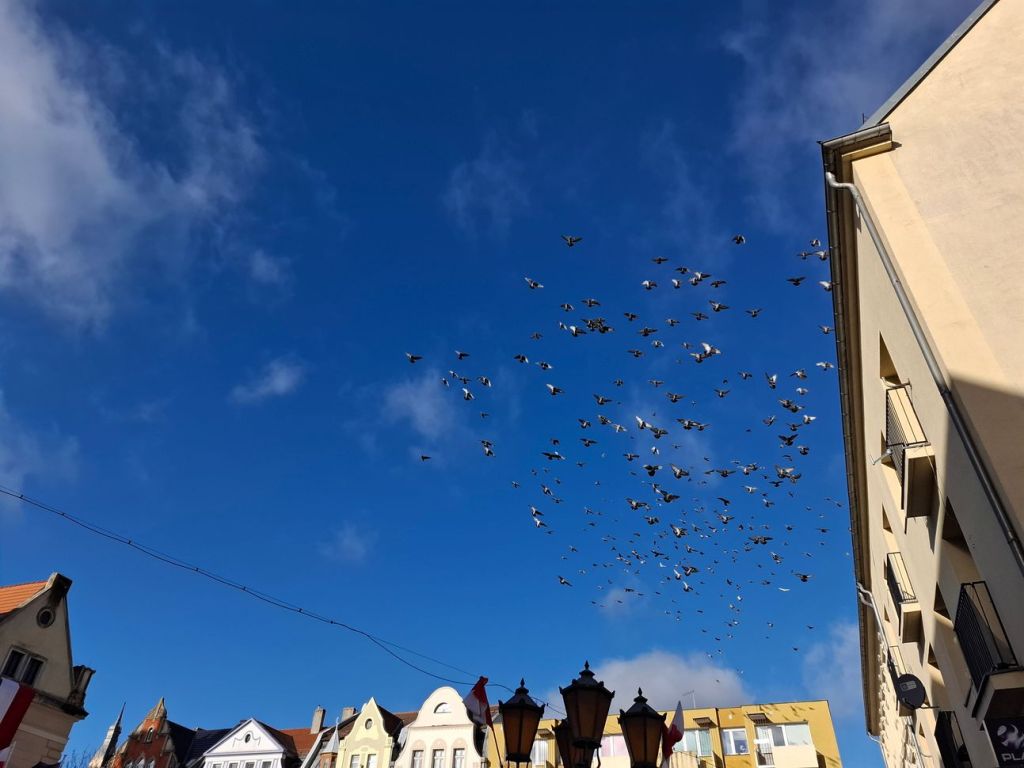
Birds in Świebodzin
We encountered traces of Jewish history in places that had acquired entirely different functions. In Beeskow, a former synagogue has become a private home; in Świebodzin, garages now occupy the site of a former synagogue, while in Zielona Góra, the site accommodates nothing less than a philharmonic hall. These transformations resist easy judgment. Cities change, and buildings acquire new functions. But must a new function make an earlier history invisible? Could contemporary life also accommodate the memory of what once existed there?
The colors of our journey were similarly ambiguous. We tend to associate colors with particular emotions and meanings, but the colors of our journey resisted such easy interpretations. At the Jewish cemetery in Świebodzin, green grass covered the ground. Elsewhere, in Brójce and Zielona Góra, cemetery spaces lay beneath colorful autumn leaves. In Słubice and Beeskow, scattered grey matzevot offered fragmentary evidence of prewar Jewish communities. The green grass did not make the cemetery less connected to death, nor did the absence of gravestones make it empty of history. What appeared full could conceal an absence; what appeared empty could hold generations of meaning.
In many places, signs were the only visible reminders of a formerly Jewish space. Some identified destroyed synagogues or cemeteries; others connected buildings to their former Jewish inhabitants. Several warned against dumping rubbish. The latter were especially unsettling. A prohibition against dumping rubbish at a historical site suggests that recognition alone may not be enough to secure respect.
The fragility of Jewish heritage preservation was particularly evident in Zielona Góra. The historical pre-burial house at the Jewish cemetery had broken windows, while some matzevot had been damaged or stolen. Local activists continue to care for the site, but their efforts cannot prevent every act of destruction. In the forest near Beeskow, a sturdy fence erected around the Jewish cemetery has provided greater protection against vandalism. These efforts reminded me that the survival of historical traces and their preservation are not the same thing. A gravestone may survive for decades, but protecting it requires someone to act.
Yet who takes responsibility for preserving the histories of people who are no longer there?
This question becomes particularly complicated in a region whose borders and populations changed dramatically after the Second World War. Much of the Polish territory we explored had belonged to Germany before 1945. Its buildings, streets, and cemeteries often originated in a German historical setting, while the towns themselves are now Polish.
The postwar expression Ziemie Odzyskane, or Recovered Territories, reflects one political understanding of this transformation. The word poniemieckie, meaning formerly German, suggests another: a landscape inherited from people who largely disappeared from it. But there is also pożydowskie—formerly Jewish. What happens when a place belongs to both categories? When the inherited German past is also a Jewish past, destroyed before the borders changed and new inhabitants arrived?
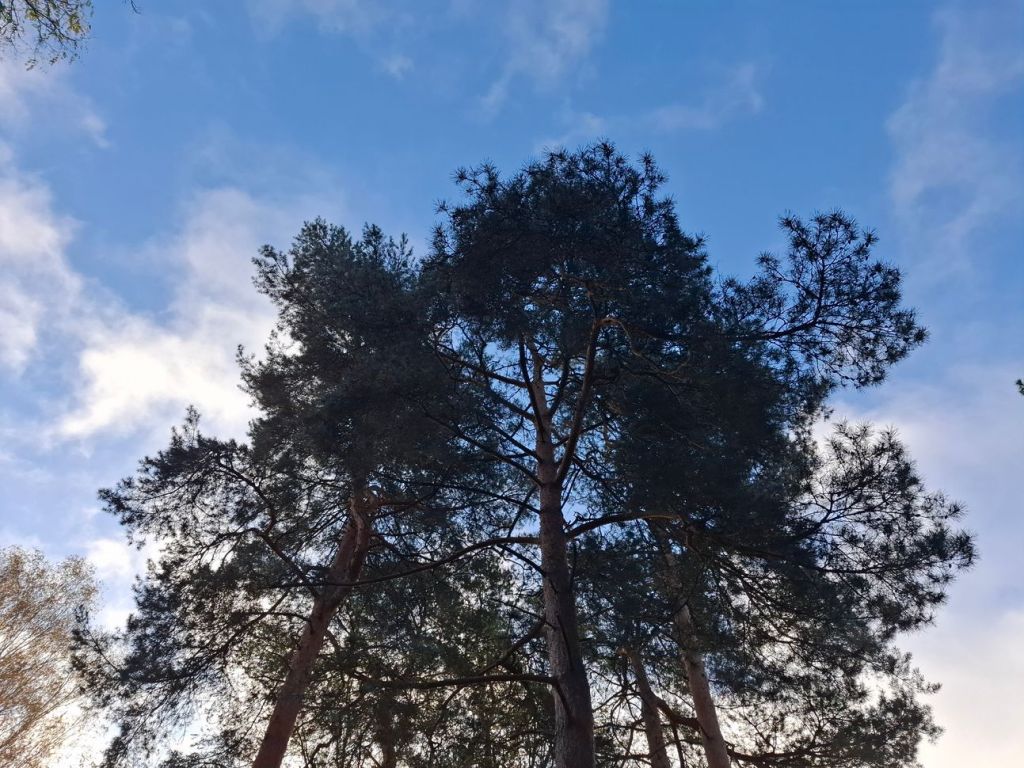
Pine trees in Brójcy
The Polish inhabitants who settled in these territories after 1945 often brought their own experiences of war, displacement, and loss. They inherited places whose previous histories were not necessarily part of their family memories. Inheriting a building or a landscape does not mean inheriting all the stories attached to it. Yet the absence of a personal connection does not necessarily prevent us from developing one through knowledge, attention, and care.
In Beeskow, a local man unexpectedly approached our group and shared a story passed down through his family. As he recalled it, members of his family had been the first customers of a Jewish family’s business in the town before the war.
It was such a small story. No dramatic event, no extraordinary achievement, just an ordinary encounter between Jewish and non-Jewish neighbours, preserved in a family’s memory. Yet the man’s decision to approach us and share it transformed that private recollection into an act of remembrance. He had inherited not a Jewish building or an object, but a story—and he wanted it to be heard.
One of the most difficult moments of the journey came during an evening visit to the former Obrawalde psychiatric institution in Obrzyce (Międzyrzecz, Poland) and the nearby Jewish cemetery. By the time we reached the cemetery, darkness had fallen. The peaceful colors of November had disappeared, replaced by an almost complete blackness.
I remember waves of despair as I listened to stories of cruelty carried out under the guise of medical care. The darkness seemed overwhelming. Yet I hesitate to interpret it as a revelation of the past. We cannot experience the suffering of earlier generations simply by standing where they once stood. The atmosphere of a place cannot, by itself, testify to what happened there. What we feel may deepen our desire to understand, but it cannot replace the work of learning.
Perhaps that is why the distinction between memory as a natural ability and memory as a deliberate effort became so important to me during this journey.
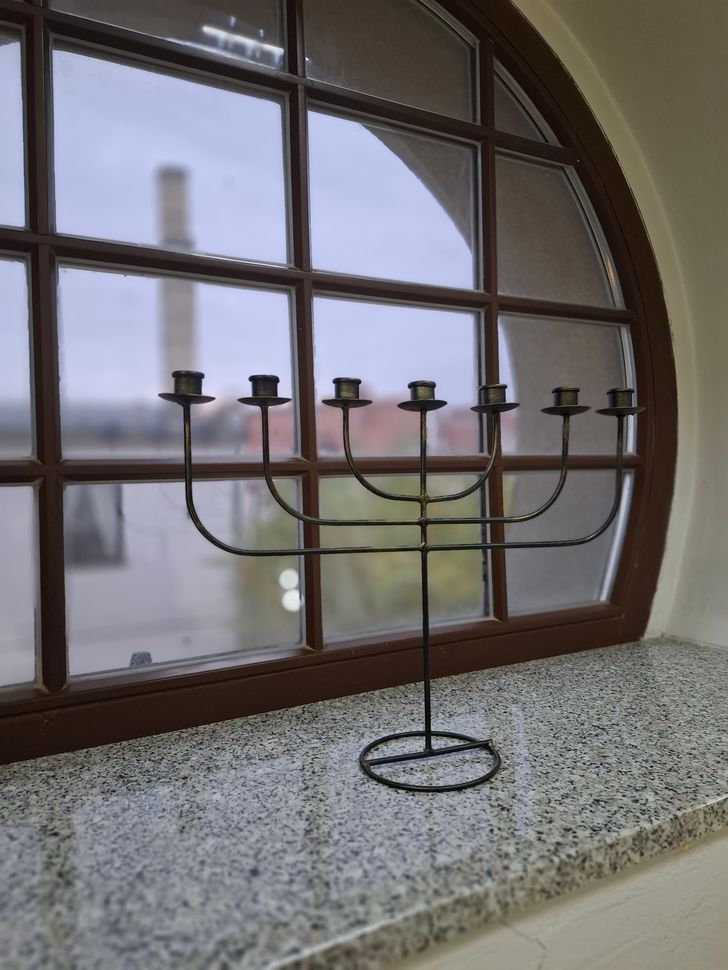
Menora in the former synagogue in Międzyrzecz
We remember our own experiences, and sometimes the stories transmitted through our families. Remembering people whose lives were interrupted before we were born, whose descendants may no longer live nearby, and whose histories have been obscured by changing borders and political narratives requires something more. It requires curiosity, knowledge, attention, and sometimes physical labour: clearing a cemetery, restoring a gravestone, protecting a building, recovering a name. Not knowing a history is not necessarily a choice. But once we encounter its traces, we may choose whether to look more closely, ask questions, and help preserve what remains.
Our journey took place during the week of Parashat Toldot. In Genesis, Isaac reopens the wells dug by his father Abraham, which had been filled after Abraham’s death. He restores their names, reconnecting the places with the previous generation.
The image stayed with me. The wells had not ceased to exist, but their continuity required someone to act. There is, however, a crucial difference between Isaac’s story and the places we visited. Isaac was reopening his father’s wells. The people preserving Jewish heritage in the Polish-German borderland are often caring for the histories of communities to which they have no direct familial connection. Perhaps this makes their work even more significant.
The forests will continue changing shapes and colors. Grass will grow over old cemeteries. Buildings will acquire new functions, and people will continue living among traces of histories they may never fully know. The past does not disappear simply because it becomes invisible. But neither does the survival of physical objects guarantee that they will be remembered.
Isaac knew whose wells he was reopening. We do not always know whose stories lie beneath the places we inherit, but we can choose whether to leave them undisturbed or begin asking questions. Perhaps remembering begins with that choice.

