
English
At the exhibition Thousand Times Berlin Monika Wrzosek-Müller and me, both of us seeing that exhibition separately, found that interesting piece of art and that small explanation, which we found utmost interesting.
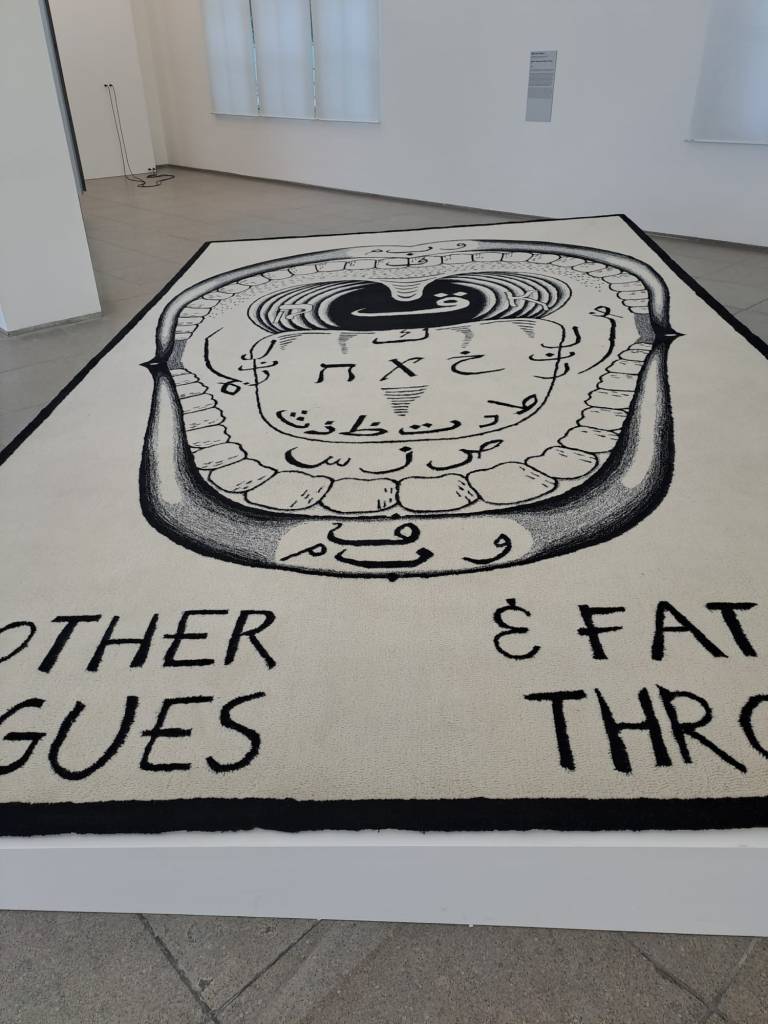
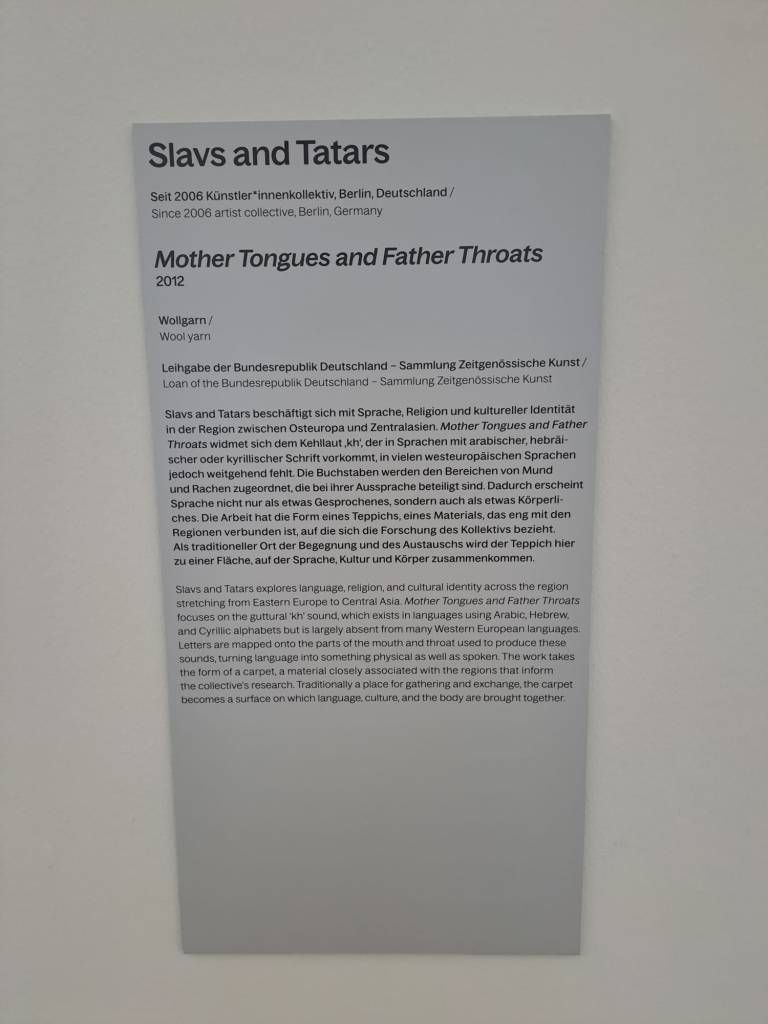
Mother Tongues and Father Throats, 2012, Wool yarn – Foto (c) Monika Wrzosek-Müller
Slavs and Tatars explores language, religion, and cultural identity across the region stretching from Eastern Europe to Central Asia. Mother Tongues and Father Throats focuses on the guttural ‘kh’ sound, which exists in languages using Arabic, Hebrew and Cyrillic alphabets but is largely absent from many Western European languages. Letters are mapped onto the parts of the mouth and throat used to produce these sounds, turning language into something physical as well as spoken. The work takes the form of a Carpet, a material closely associated with the regions that inform the collective’s research. Traditionally a place for gathering and exchange, the Carpet becomes a surface on which language, culture, and the body are brought together.
I am from Poland, after father from Tatar family. I looked for that artist group in internet and found it fantastic.
https://www.slavsandtatars.com
Slavs and Tatars is an internationally renowned art collective since 2006 devoted to an area East of the former Berlin Wall and West of the Great Wall of China known as Eurasia. They produce books, installations, and sculptures that unravel the complexities of religion, politics, and language in each region. Delectably witty and at times unabashedly absurd, their works blend intellectual references with a low-brow approach to upend facile narratives of history and identity.
Look f.e. here: https://www.artasiapacific.com/people/as-told-by-slavs-and-tatars-at-rossi-rossi/, at the newest exhibition of Slavs and Tatars.
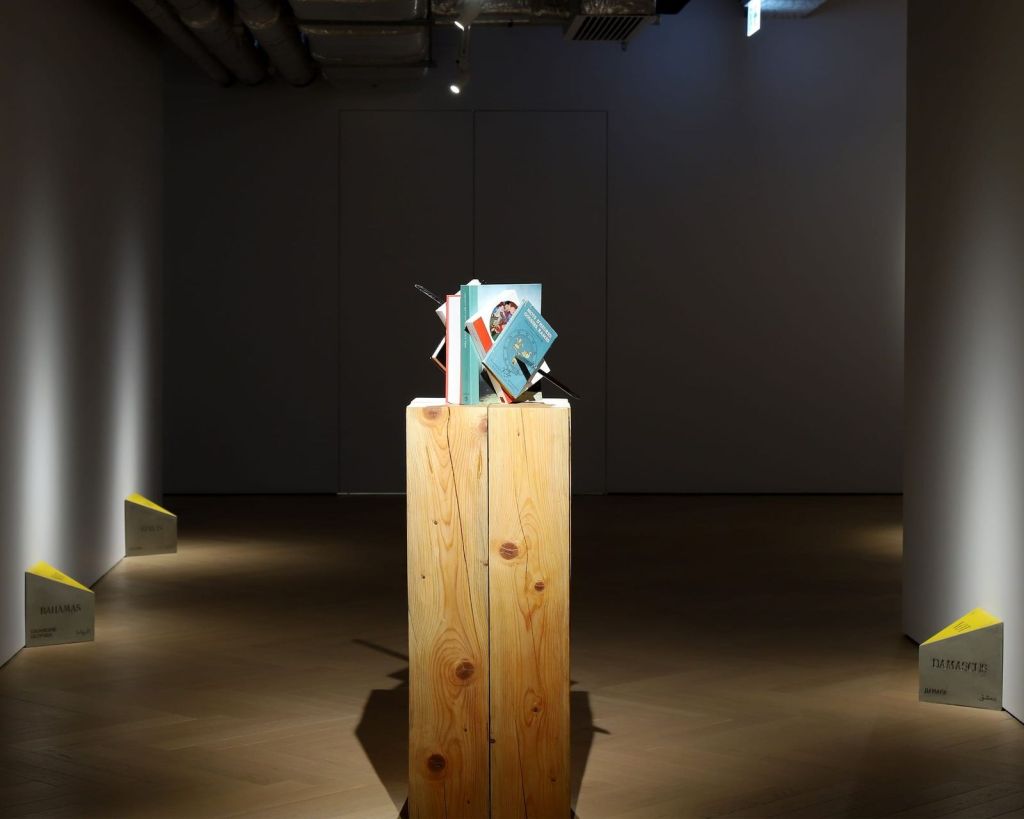
Installation view of SLAVS AND TATARS’s “胡 ( هو / who) are you?” at Rossi & Rossi, Hong Kong, 2026. Courtesy Rossi & Rossi.
Slavs and Tatars’ various exhibitions, lectures, and books primarily fall within one of eight research cycles. These cycles range from alphabet politics (Language Arts) to medieval advice literature (Mirrors for Princes) to an investigation of syncretism (Not Moscow Not Mecca), amongst others. This organizing principle stems from the collective’s editorial focus if not their beginnings as a make-shift book-club. Often, exhibitions focus on one particular cycle (for example, Friendship of Nations); at other times, though, they bleed into one another. Like yoghurt, Slavs and Tatars’ work has an element of totum simul: the whole is in the parts.
The collective’s practice is based on three activities: exhibitions, books and lecture-performances. In addition to launching a residency and mentorship program for young professionals from their region, Slavs and Tatars opened Pickle Bar, a slavic aperitivo bar-cum-project space in Berlin-Moabit, as well as an online merchandising store: MERCZbau.
Slavs and Tatars is represented by: Tanya Bonakdar (NYC), Kraupa-Tuskany Zeidler (Berlin), Raster (Warsaw), The Third Line (Dubai), Kalfayan (Athens), Rossi & Rossi (Hong Kong) and Nordenhake (Mexico City).
***
Art and design students can apply for an Erasmus internship at Slavs and Tatars by sending an application to info@slavsandtatars.com
Po polsku
Z tego, co powyżej napisano, wynika, że Słowianie i Tatarzy mają swoją reprezentację również w Warszawie. Na stronie grupy jest np. wzmieniony poniższy artykuł:
https://magazynszum.pl/wokol-barow-i-w-srodku-nich / Wokół barów (i w środku nich), tekst Michała Grzegorzka w magazynie ASP w Warszawie Szum (21.02.2020) nt. kultury klubowej czy barowej jako źródła inspiracji. Bar, pisze autor, to miejsce spotkań oparte na wyjątkowych zasadach, zarówno w sztukach wizualnych, jak i performatywnych, a także dalej – po zwrocie performatywnym, na przecięciu różnych dyscyplin. Być może oferuje on i twórcom sztuki, i jej odbiorcom znacznie więcej niż klasyczna wystawa. Choć może to być – jak i w wypadku wystaw – ból głowy. (…)
Mimo to Slavs and Tatars – międzynarodowy kolektyw, którego zainteresowania artystyczne rozciągają się między niegdysiejszym Murem Berlińskim a Murem Chińskim – przekonują do innego spojrzenia na tę figurę i zapraszają do swojego Pickle Bar. Jednym z obszarów zainteresowań artystycznej praktyki Slavs and Tatars (artyści porządkują swoje działania w osiem zakresów tematycznych, w obrębie których produkują wiedzę i prace artystyczne) są Polityki kiszenia, w których spoglądają na symbolikę i praktyki fermentacyjne z perspektywy działań i myśli politycznej, wykorzystując pojęcia gnicia, zepsucia czy rozpadu. (…)
Ironiczne spojrzenie artystów na kwestie narodowe i tożsamościowe, zwłaszcza te utrzymane w moralizatorskim tonie „obrońców ojczyzny”, odnajduje swój pełny wymiar w metaforze fermentacji. Przebrzmiałe nacjonalistyczne idee muszą ulec procesom zgnicia, rozpadu i przemiany. (…)
Slavs and Tatars wyrywają nas nie tylko z patosu patriotyzmu, ale również patosu instytucji.
I tak dalej…
A ten Pickle Bar jest w Berlinie na Stephanstraße 11, 10559 Berlin (zob. https://picklebar.berlin/) i tam się dzieje nieprawdopodobnie dużo.
Trzeba iść.

