»Worldwide Reading« on September 29, 2022: Novels and Essays by Salman Rushdie
Sehr geehrte Damen und Herren, liebe Freundinnen und Freunde,der Mordanschlag auf Salman Rushdie sitzt uns noch tief in den Knochen. Wir rufen hiermit zu einer »Weltweiten Lesung« des Werkes von Salman Rushdie auf, siehe unten. Viele Autor:innen aus allen Kontinenten unterstützen den Aufruf, so Adonis, Jennifer Clement, Andrei Kurkov, Wole Soyinka, Janne Teller, Bernard-Henri Levy, Peter Schneider, Amir Hassan Cheheltan, Robert Hass und Sergei Lebjedev. Die Autorin Madame Nielsen schlägt vor, dass wir bis zum 29. September überall im öffentlichen Raum »Die Satanischen Verse« mit uns tragen sollten, dass wir das Buch überall aufschlagen und lesen, in Cafés, Parks und der U-Bahn. Elfriede Jelinek regt Autor:innen an, Auszüge davon auf den eigenen Websites zu platzieren, falls die Rechte hierfür jeweils erworben werden können. Herzlich Ulrich Schreiber Festivaldirektor und Programmleiter internationales literaturfestival berlin
Ladies and gentlemen, dear friends,The assassination attempt on Salman Rushdie still has us in shock. We are hereby calling for a »Worldwide Reading« of Salman Rushdie’s works. Please see below. Many authors from all continents support the call, including Adonis, Jennifer Clement, Andrei Kurkov, Wole Soyinka, Janne Teller, Bernard-Henri Levy, Peter Schneider, Amir Hassan Cheheltan, Robert Hass and Sergei Lebjedev. The author Madame Nielsen also suggested that we carry »The Satanic Verses« with us everywhere in public spaces until September 29, and that we open and read the book everywhere, in cafes, parks, subways. Elfriede Jelinek encourages authors to place excerpts on their own websites if the rights can be acquired. Sincerely, Ulrich Schreiber Festival Director and Head of Program international literature festival berlin
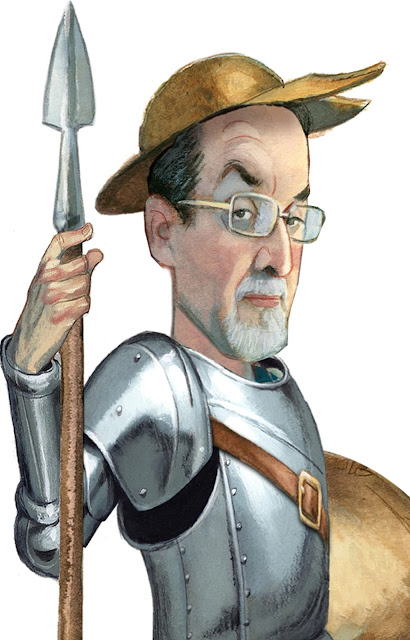
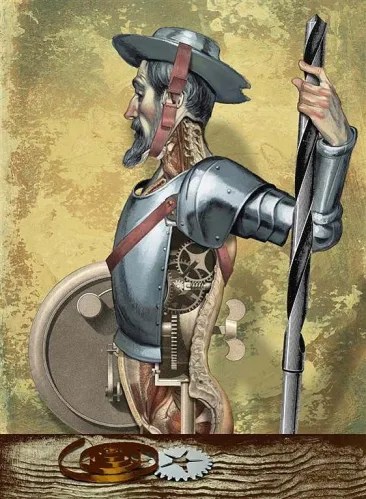
Fernando Vicente
Das internationale literaturfestival berlin [ilb] lädt Einzelpersonen, Schulen, Universitäten, Kulturinstitutionen und Medien ein, am 29. September 2022 an einer »Weltweiten Lesung« aus Salman Rushdies Werken teilzunehmen – von »Mitternachtskinder«, »Die satanischen Verse«, »Joseph Anton« bis zu seinen neuesten Büchern »Sprachen der Wahrheit« und »Victory City«. Mit der Lesung soll ein Zeichen für die Freiheit der Literatur und des öffentlichen Wortes sowie für die Solidarität mit dem Autor gesetzt werden, der Opfer eines grausamen Attentats wurde.
Zu den Erst-Unterzeichner:innen zählen: Adonis [Syrien/ Frankreich], Breyten Breytenbach [Südafrika], Amir Hassan Cheheltan [Iran], Robert Hass [USA], Elfriede Jelinek [Österreich], Sergei Lebjedev [Russland/ Deutschland], Bernard-Henri Levy [Frankreich], Yang Lian [China/ Großbritannien], Alberto Ruy Sánchez [Mexiko], Peter Schneider [Deutschland], Wole Soyinka [Nigeria] und Janne Teller [Dänemark].Auch wenn die konkreten Hintergründe des Attentats und das Motiv des Täters noch nicht geklärt sind, scheint klar, worauf sie vermutlich zurückgehen: auf die Fatwa, die der iranische »Revolutionsführer« Ayatollah Khomeini 1989 gegen Rushdie erlassen hat. Sie forderte die Tötung des in Indien geborenen, britischen Schriftstellers, weil er mit den »Satanischen Versen« angeblich den Islam, den Koran und den Propheten Mohammed beleidigt habe. Bis heute hat das iranische Regime den Aufruf zur Ermordung des Autors nicht zurückgenommen, ebenso wenig wie das Kopfgeld, das es damals auf ihn ausgesetzt hatte. Die wichtigen Medien im Iran applaudieren derzeit dem Attentäter.
Salman Rushdie musste deshalb jahrelang unter intensivem Polizeischutz leben. Mehr als 20 Jahre lang ging man davon aus, dass keine Gefahr mehr für sein Leben bestehe. Doch diese Annahme hat sich durch das blutige Attentat in New York auf schockierende Weise als trügerisch erwiesen. Es macht deutlich, dass die Bedrohung der elementaren Menschenrechte und Freiheiten virulent ist. Der Anschlag auf Rushdie fällt in eine Zeit, in der die demokratische Welt von immer aggressiveren autoritären Mächten unterschiedlichster Prägung in die Defensive gedrängt, wenn nicht – wie in der Ukraine – durch offenen Krieg und ein unglaubliches Ausmaß an Gewalt mit Tod und Zerstörung überzogen wird.Es ist daher dringend geboten, entschlossen aufzustehen und Recht und Menschenwürde zu verteidigen. Mit der Lektüre seiner Romane und Essays können freiheitsliebende Menschen in aller Welt ein Zeichen setzen, dass sie sich von Gewaltandrohungen nicht einschüchtern lassen und sich keinem Versuch beugen, Gedanken in Wort, Schrift und Bild zu unterdrücken oder auszulöschen.
Die Lesungen können überall stattfinden, auch privat im kleinen Kreis, in einer Schule, in einer Kultureinrichtung oder im Radio. Personen und Institutionen, die sich mit einer Lesung am 29. September beteiligen möchten, werden gebeten, uns folgende Informationen zukommen zu lassen: Organisatoren, Ort, Zeit, teilnehmende Akteure, Veranstaltungssprache, ggf. Link zu Ihrer Website. Die E-Mail-Adresse lautet: worldwidereading@literaturfestival.com. Wir bitten die Veranstalter, die Rechte für Lesungen selbst zu klären.
The international literature festival berlin [ilb] invites individuals, schools, universities, cultural institutions and media to participate in a »Worldwide Reading« of Salman Rushdie’s works – from »Midnight’s Children«, »The Satanic Verses«, »Joseph Anton« to his latest books »Languages of Truth« and »Victory City« – on September 29, 2022. The reading is intended to send a signal for the freedom of literature and public speech as well as the solidarity with the author, who was the victim of a horrific assassination attempt.
Among the first signatories of the call are: Adonis [Syria/ France], Breyten Breytenbach [South Africa], Amir Hassan Cheheltan [Iran], Robert Hass [USA], Elfriede Jelinek [Austria], Sergei Lebjedev [Russia/ Germany], Bernard-Henri Levy [France], Yang Lian [China/ UK], Alberto Ruy Sánchez [Mexico], Peter Schneider [Germany], Wole Soyinka [Nigeria] und Janne Teller [Denmark]. Even if the concrete background of the assassination attempt and the motive of the perpetrator have not yet been clarified, it is likely who seems responsible: It goes back to the fatwa that the Iranian »revolutionary leader« Ayatollah Khomeini issued against Rushdie in 1989. It called for the killing of the Indian-born, British writer because he had supposedly insulted the Islam, the Qur’an and the Prophet Muhammad with »The Satanic Verses«. To this day, the Iranian regime has not withdrawn the call to kill the author, just as it has not withdrawn the bounty it placed on his head at the time. The important media in Iran are currently applauding the attacker.
For years, Salman Rushdie therefore had to live under intensive police protection. For more than 20 years, it was assumed that there was no longer any danger to his life. But this assumption has been shockingly proven wrong by the bloody attack in New York. It makes it clear that the threat to elementary human rights and freedoms remains unbroken. Moreover, the attack on Rushdie comes at a time when the democratic world is being forced into the defensive by increasingly aggressive authoritarian powers of various kinds, if not – as in Ukraine – it is overrun with death and destruction through open war and an incredible range of violence.
It is therefore absolutely urgent to stand up firmly and defend law and human dignity. By reading Salman Rushdie’s novels and essays, freedom-loving people all over the world can send a signal that they will not be intimidated by threats of violence and will not bow to any attempt to suppress or annihilate thoughts expressed in speech, writing and images.
Readings can take place anywhere, even privately in a small circle, in a school, in a cultural institution or on the radio. People and institutions who would like to participate with a reading on September 29, 2022 are asked to send us the following information: Organizers, location, time, participating actors, event language, link to your website if applicable. The e-mail address is: worldwidereading@literaturfestival.com. We kindly ask organizers to clear the rights for readings on their own.
Angelika Murawska przedruk artykułu opublikowanego na stronie internetowej Akademia
„Pierre Menard, autor Don Kichota”. Technika zamierzonego anachronizmu i błędnych atrybucji.
Dzięki zabiegowi intertekstualności w utworze Borges’a przestaje obowiązywać naturalny porządek rzeczy i pojawia się miejsce dla innych dopuszczalnych interpretacji. Utwór wykracza nie tylko granice różnorodnego odbioru dzieła, ale także oczekiwania czytelników co do zastosowanych technik. „Przestrzeń hipertekstu jest (…) przestrzenią, w której przestają obowiązywać i tak arbitralne prawa, których dotkliwy wpływ na nasze życie obserwujemy na każdym kroku.” (Pisarski, Ja tu a ty tam 2004) Jednak eksperyment autora idzie dalej. Użycie techniki zamierzonego anachronizmu i błędnych atrybucji sprawia, że czytelnik przestaje patrzeć na dzieło dosłownie, jest zmuszony do głębszych przemyśleń w różnych kontekstach: literatury, historii czy tradycji. Główny bohater kreuje dzieło widzialne przez odtworzenie dzieła Cervantesa. Powstają fragmenty, które są pozornie identyczne z hypotekstem. Jest początek wieku XX. Menard postanawia nie tyle przełożyć dzieło Hiszpana, co napisać je „od nowa”. Stawia sobie jednak warunek, że posiądzie najpierw całą wiedzę autora książki z XVII wieku. Osiąga on swój zamierzony cel, jego własne dzieło jest identyczne z tekstem pierwotnym. Utwory są zgodne co do przecinka i kropki nad „i”. Całe zdarzenie jest relacjonowane przez narratora, który ma wgląd do tych dzieł i na swój własny sposób dokonuje ich interpretacji. Czytelnik ma z początku wrażenie, że powstaje nowy utwór. Kluczowa jest jednak analiza narratora, który w pewien sposób naprowadza odbiorcę na właściwy trop przez porównanie stylów i przytoczone fragmenty. Relacja narratora jest wyrazem użycia techniki błędnych atrybucji. To dzięki niemu i jego trafnym komentarzom na temat obydwu tekstów autorowi przypisane jest to, że napisał dzieło bardziej wartościowe od Cervantesa, gdyż jest to dzieło bardziej świadome. Co więcej, wychwala on czyn Menarda, który „postanowił wyprzedzić bezużyteczność” i urozmaicił sztukę lektury, zezwalając na przenoszenie się w czasie rzeczywistym. W opowiadaniu wszystko dzieje się na przekór namacalnemu porządkowi. Język utworu niegdyś współczesny staje się archaiczny, powstaje nowe dzieło, nowe doświadczenia mają miejsce, nowe interpretacje pojawiają się: powtórzona przez Menarda wypowiedź Don Kichota „przeciwko literaturze na korzyść broni” zyskała nowe znaczenie i była rozpatrywana przez baronową da Bacourt w kontekście filozofii Nietzschego. Wprowadzenie techniki zamierzonego anachronizmu jest interesującym literackim chwytem Borges’a. Dzięki niej czytelnik może spojrzeć na „Don Kichota” poprzez doświadczenia Menarda. Pojawia się ona już na poziomie języka kiedy cytowane jest dzieło Cervantesa, ale także dotyczy samego faktu, że ten utwór pojawia się w XX w. Absurdalny zamiar nabrał sensu ze względu na przepaść czasową dzielącą obydwóch twórców. Najpierw Menard chciał się nauczyć siedemnastowiecznej hiszpańszczyzny i zapomnieć historię Europy od 1602 do 1918 roku. Jednak doszedł do wniosku, że uwłacza to jemu jak pisarzowi i obniża jego wartość. Chciał stać się Cervantesem, ale to było zbyt wymagające, posiadał zbyt małą wiedzę. Wolał pozostać Menardem i z całym swym intelektualnym dorobkiem „dojść” do „Don Kichota”. Trafna jest uwaga narratora, który mógłby być traktowany jako recenzent pracy Menarda. Otóż, zaznacza on dosyć często w swych wywodach, że jego tekst wydaje się bogatszy od oryginału, ponieważ każde jego zdanie zawiera aluzję do przyszłych wydarzeń, o których Cervantes nie miał pojęcia cztery stulecia wcześniej. Myślę, że obłęd i ucieczka przed światem i odpowiedzialnością często przypisywana Cervantesowi, przeistacza się dzięki Menardowi w świadomy wybór. Jest odzwierciedleniem „zajęcia umysłowego” i czytelnik jak Menard jest w stanie rozważać historię. „Don Kichot” w wykonaniu Menarda jest dziełem bardziej świadomym. Tak jak wspomniałam już na początku intertekstualność w utworze Borges’a tworzy nowy porządek rzeczy i pojawia się miejsce dla innych dopuszczalnych interpretacji. „Don Kichot uosabiał rozdźwięk pomiędzy szlachetnością intencji, a niestosownością ich realizacji oraz pomiędzy subiektywnym poczuciem znaczenia a społeczną bezużytecznością, wynikającą z oderwania od swoich czasów i anachronizmu” /Wikipedia/. Czy tak samo można traktować „Don Kichota” z XX wieku? Czy kontekst historyczny wpływa na jego interpretację? Wg Cervantesa historia jest nauką badającą rzeczywistość, natomiast dla Menarda jest to już „źródło rzeczywistości”, będące swoistym punktem odniesienia. Wszystko ulega relatywizacji włącznie z przygodami Don Kichota. Dzięki inteligentnemu eksperymentowi Borges chciałby przybliżyć czytelnikowi jego moc nad interpretacją tekstu oraz wpływ różnych kontekstów na odbiór dzieła, czy to historycznych, kulturalnych czy tradycyjnych. Użycie wyżej wspomnianych i pokrótce tu omówionych technik „zaludnia przygodami najspokojniejsze utwory”. Dzieła mogą być dla jednych „widzialne” w pewien sposób, a dla innych odbiorców „widzialne” inaczej. Pierre Menard stworzył dzieło widzialne na miarę swoich możliwości intelektualnych, gotowości do interpretacji i otwartości umysłu, na które wpłynęły jego doświadczenia życiowe. Każdy z nas ciągle to robi, biorąc do ręki jakąkolwiek książkę i mniemam, że według Borges’a ten proces jest nieunikniony. Z drugiej strony, można to rozpatrywać oczami autora, który stoi przed możliwością powtarzania pewnych archetypów, wzorów czy języka w swych nowo powstających dziełach i jest to proces, który dzieje się bardzo często, ponieważ: „(…) zbieranie dawnych i cudzych myśli, wspominanie z niedowierzaniem tego, co pomyślał doctor universalis, to wyznawanie naszej bezsilności czy naszego barbarzyństwa.”
Sam tekst Borgesa przedrukowałam już dawno temu TU.
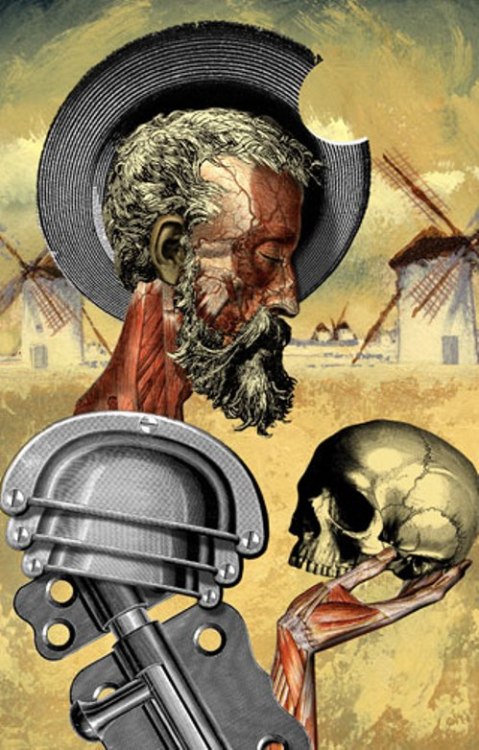
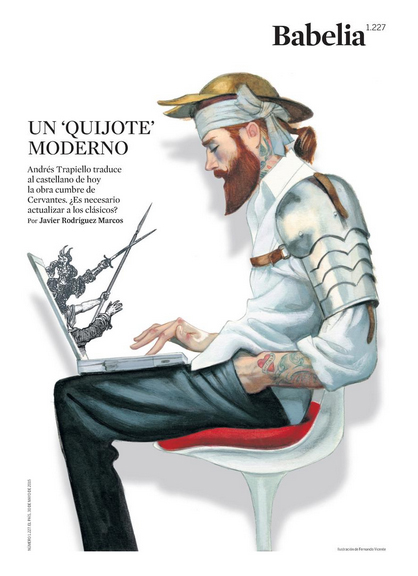
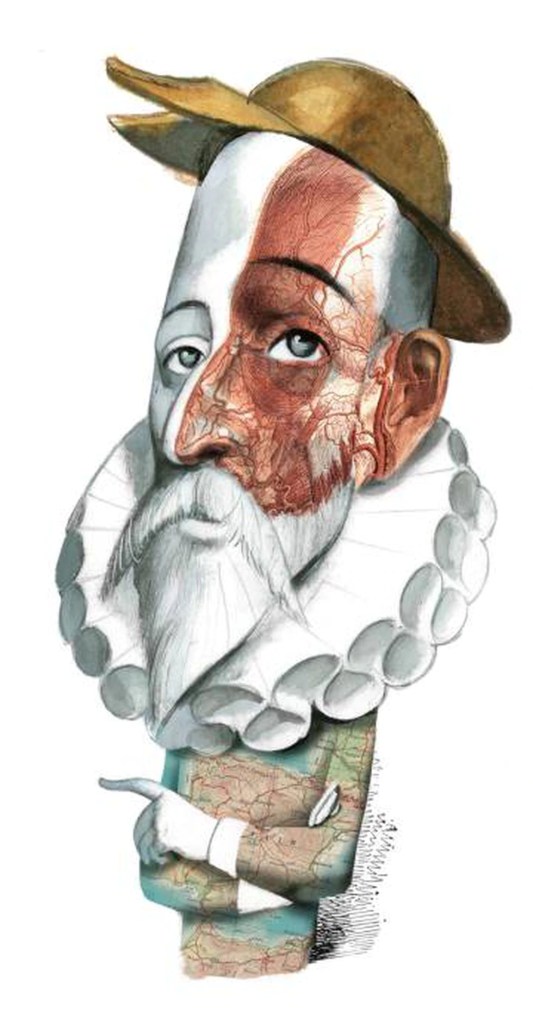
Niedawno wiadomo kto (Arkadiusz Łuba) podesłał mi świetny portret Salmana Rushdie jako Don Kichota. Gdy zajrzałam do internetu, stwierdziłam, że autor, Fernando Vicente, zresztą artysta niezwykle płodny, wielokrotnie w swej twórczości portretował Rycerza Smętnego Oblicza. Tu kilka przykładów znalezionych w sieci:
Wiersz taki, że mogła go 80 lat temu napisać nasza wrześniowa protagonistka, Irena Bobowska.
Autorka specjalnie namalowała tę winietę do dzisiejszego wpisu i dopisała serdeczne życzenia. Dziękuję!
ZACHWYT

Od dziś –
nie będziesz miał słońca, powietrza, swobody
nie będziesz miał nieba i kwiatów i wody
nie będziesz oglądał czerwieni, błękitu
nie będziesz oglądał zachodu i świtu
odbieram ci jasność, pogodę, wytchnienie
daję ci za to – ból i kamienie
niepewność, strach, ciężar, smutek i szarość
chłód, niespełnienie, słabość i małość
żelazo i stal, pociski, zasieki
błoto i doły, piach pod powieki
lecz –
dam ci nadzieję
gdy mocno ją chwycisz
przeniesie cię tu – gdy
- się zachwycisz
Heimat verloren, gefunden, gesucht. Was ist die Heimat und vermissen wir sie? Wie sind die deutsch-polnischen Beziehungen im Kontext der Geschichte, der Vorgeschichte und der Gegenwart? Ist eine nationale Identität notwendig? Ist die Liebe zu Polen verrückt? Was bedeutet Liebe für die Ukraine? Sind wir bereit, die Heimat abzugeben? Oder wollen wir sie verteidigen?
1. September 2022 (Donnerstag), 18.00 Uhr | Regenbogenfabrik, Lausitzer Str. 22, 10999 Berlin (Kreuzberg)
Performance: Karen Kandzia Diskussion mit: Dr. Anna Burek / Soziolinguistin, Autorin Masha Pryven / Fotografin instagram.com/masha.pryven/ Dr. Kamila Schöll-Mazurek / Leiterin Welcome-Willkommen-Witamy Interkulturelle Anlauf- und Beratungsstelle für Migranten, Polnischer Sozialrat e.V. / polskarada.de
Konzert: Don Philippe | Facebook Seit den 1980er Jahren als Musiker und ab 2016 als Solokünstler (Don Philippe) tätig. Spielte in Bands NoSé, Freundeskreis (Mitgründer), Kolchose, Laura Lopez Castro y Don Philippe.
Weitere Veranstaltungen:
Krieg
Krieg – wie schädlich ist er? Wer profitiert vom Führen von Kriegen, wer verliert am meisten? Wer sind die Krieger, wer sind die Opfer des Krieges?Ist es tatsächlich Krieg Hitlers gegen Europa gewesen / ist es jetzt tatsächlich der Krieg Putins gegen Ukraine? Oder ist es immer der Krieg der Alpha-Männer gegen den Rest der Welt gewesen?
8. September 2022 (Donnerstag), 18.00 Uhr | „Denkmal für unsere und eure Freiheit kämpfende Menschen“, Virchowstraße, 10249 Berlin (Volkspark Friedrichshain)
Performance: Karen Kandzia Diskussion mit: Oleksandra Bienert / Ukrainische Forscherin und Menschenrechtsaktivistin Aleksandra Puciłowska / Autorin (Instagram)
Statement: Konrad Kozaczek / Student, 22 J.a. (es liest Dorota Cygan)
CALL FOR STATEMENTS! Wir laden alle ein, sich mit einer Erklärung, einem Manifest oder Gedanken zum Krieg – sei es der Zweite Weltkrieg, der aktuelle Krieg in der Ukraine oder ganz allgemein – zu Wort zu melden. Unsere Worte sollen Macht haben! Besonders in diesen schwierigen Zeiten. Konzert: Jemek Jemowit | www.jemek.net
Unterdrückung
Räume der Gewalt, Räume der Unterdrückung und Räume der Freiheit: Bei der Unterdrückung geht es nicht nur um Gefängnisse, Mauern und Gitter. Die Unterdrückung findet in vielen Bereichen statt – kulturell, sozial, politisch, religiös. Was unterdrückt uns, Frauen, heute? Und wie gehen wir damit um?
Performance: Karen Kandzia Diskussion mit: Marta Ansilewska-Lehnstaedt / Historikerin, Gedenkstätte Deutscher Widerstand www.gdw-berlin.de Zofia Nierodzińska /Kuratorin, Künstlerin, Autorin, Aktivistin. Stellvertretende Direktorin der Galerie Arsenal in Poznań znierodzinska.com Marina Wesner /Architektin, Architekturhistorikerin, Autorin www.marinawesner.de
Ausstellung: “Frauengefängnis Barnimstraße” von Marina Wesner
Konzert: Helmut Mittermaier |www.guruclub.de/mittermaier/ Musiker und Komponist. Studierte an der UdK Berlin Experimentelle Klanggestaltung. Kompositionen für Konzert, Theater, Radio und Film. Radioautor Hörspiel und Feature (SWR, Deutschlandfunk Kultur).
Erinnerung
Erinnerungskultur, Erinnerungspolitik, Denkmäler, Frauen. Unsere Mütter, Großmütter, Tanten, Urgroßmütter. Kriegerinnen, Opfer. Wissenschaftlerinnen, Arbeiterinnen, Künstlerinnen, Hausfrauen. Anonyme Heldinnen. Was kann getan werden, um ihnen eine Stimme zu geben, um ihre Erinnerung in der kollektiven Kultur wiederherzustellen, insbesondere im Kontext der deutsch-polnischen Beziehungen?
22. September 2022 (Donnerstag), 18.00 Uhr | Städtischer Friedhof Altglienicke, Schönefelder Ch. 100, 12524 Berlin (Treptow – Köpenick) Schirmherrschaft Herr Oliver Igel, Bezirksbürgermeister von Berlin Treptow-Köpenick
Performance: Karen Kandzia Diskussion mit: Franziska Bruder / Lagergemeinschaft Ravensbrück Freundeskreis e.V. lg-ravensbrueck.vvn-bda.de dr Iwona Dadej / Instytut Historii PAN cbh.pan.pl Klaudyna Droske / Leiterin der Geschäftsstelle der Polonia polonia-biuro.de Nora Hogrefe / Leiterin der Koordinierungsstelle Historische Stadtmarkierungen im Verein Aktives Museum Faschismus und Widerstand in Berlin. www.aktives-museum.de Anja Witzel / Referentin der Berliner Landeszentrale für politische Bildung
Arbeitete in Big Bands und verschiedener Jazzformationen; Schwerpunkt: Improvisation und Zusammenarbeit mit anderen Kultursparten; Komponist.
Liebe Besucher*innen, laut Informationspflicht nach Art. 14 DSGVO weisen wir darauf hin, dass während dieser Veranstaltung Foto- und Videoaufnahmen angefertigt werden. Diese verwerten wir für Zwecke der Berichterstattung und der Öffentlichkeitsarbeit. Dazu werden die Aufnahmen in diversen lokalen und sozialen Medien, wie z.B. Internetauftritt (www.dziewuchyberlin) und unseren Facebook-Seiten veröffentlicht. Rechtsgrundlage für die Verarbeitung der Foto- und Videodaten von Ihnen ist Art. 6 Abs. 1 (f) DS-GVO, da ein berechtigtes Interesse daran besteht, die Öffentlichkeit über die Aktivitäten des Dziewuchy Berlin zu informieren und unsere Gruppenaktivitäten zu dokumentieren. Empfänger dieser Daten sind somit intern die mit Öffentlichkeitsarbeit betrauten Mitglieder*innen unserer Gruppe und extern die regionale Presse sowie Redaktionen und Redaktionssysteme von Printmedien, Onlinemedien und international operierende Social Media-Anbieter. Datenschutzrechtlich Verantwortlicher ist die Gruppe Dziewuchy Berlin.
9-euroticket

am abend
schnitten sie die holunderfrüchte ab
(den eimer haben sie mitgebracht)

die alte amsel
flog hoch
und fiel sichtlich überrascht
herunter

sie begriff ( oder auch nicht)
das die früchte
oder ihre welt
nicht mehr existierten

- wir machen einen saft oder ein gelle draus -
sagten  die zwei hocherfreuten 9 - euroticket geniesser

die  amsel kletterte noch auf den kahlen busch
und erstarrte
für immer *)

-----------------------------------------------------

*) am nächsten morgen begrub ich sie
unter den wurzeln
eines baumes

tibor,
sommer 2022
THE VISITORS OR GOD CREATED HUMAN

nach 3 jahren in takoma park
kommt sie mit zwei kindern zum besuch
nach old europe
(deutschland, schweiz, italien, frankreich)

frisch gepierct
(was für ein schnäppchen!)
aber noch nicht tatowiert
setzen sie sich in der
eher sparsam von mir angerichteten
tafelrunde

zu guter letzt
verwickelt sie mich in das gespräch
(beim abräumen des geschirrs
- ich habe auch essen gekocht und serviert)
in ein vortrag über ganz neue 6 geschlechter - religion
(na immerhin besser als eine diskussion über die alten haubitzen)
und bindet mir doch noch einen bären an die nase
(die erschrockenen kinder erfrieren fast von angst
 weil mir  tatsächlich die tatzen wachsen - ja!)

- zwei geschlechter? das ist doch wie in rußland! -

doch ich fühle mich
wie ein alter, morscher knochen
den man/frau/divers
in die ecke geworfen hat

eine abgenagte
durch die zähne des saturnus
evas rippe


https://commons.wikimedia.org/wiki/William_Blake?uselang=de#/media/File:William_Blake-Europe_Supported_By_Africa_and_America_1796.png

tibor, sommer 2020
Wenn ich mir vorstelle, Polen würde von Russland überfallen, kriege ich richtig Gänsehaut. Die Vorstellung ist aber nicht so absurd, abstrakt und von der Hand zu weisen. Wäre nicht Ukraine ein unabhängiger Staat, der dazwischen, wirklich geografisch existiert, wer weiß, wen es mit Putins imperialen Wahnvorstellungen getroffen hätte. Außerdem, damals als wir die Solidarność gründeten und demonstrierten, wussten wir auch nicht, was als nächstes passieren würde.
Desto mehr macht mich das Schicksal Tausender, nein inzwischen Millionen ukrainischen Flüchtlinge, hauptsächlich Frauen mit Kindern, betroffen. Sie sind in ihrer Wahrnehmung der Situation für kurze Zeit geflohen, langsam aber nach ca. 180 Tagen, also 6 Monaten des Krieges, wird ihnen allmählich klar, dass der Krieg vielleicht noch Jahre dauern könnte. Desto mehr höre ich denen, die ich kenne immer wieder zu, versuche mich mit ihnen zu treffen, beobachte die jungen Frauen mit ihren Kindern im Park, in der U- und S-Bahn, halte den Kontakt zu den Frauen in Warschau aufrecht.
Die jungen Frauen auf dem Foto sehen ganz unterschiedlich aus: die eine mit langen dunklen Haaren umarmt ein ca. 2-jähriges hellblondes Kind, dazwischen zwängt sich ein älterer Junge mit dunklen Haaren und dunklen Augen, sie schauen direkt in die Kamera, dann hinter ihnen zwängt sich noch ein Gesicht einer jungen Frau mit langen dunklen Haaren, von ihr sieht man eigentlich kaum was, sie schaut auch irgendwie in die Ferne. Seitlich, am Bildrand steht eine junge Frau mit helleren Haaren und einem schönen Gesicht mit markanten Backenknochen, sie ist grazil, um nicht zu sagen dünn, sie schaut nach oben, würde ich sagen Richtung Lampe, Decke. Neben ihr sitzt ein Junge mit strohblondem, vollem Haar, der schaut Richtung Boden, so dass das Haar ihm das Gesicht verdeckt. Hinten stehen noch zwei Frauen, eine hält ein Baby im Arm, hat ein grades Pony und langes mittelblondes Haar auch eher helle Augen, die andere ist auffällig schöne, reife Frau mit dunklem schulterlangem Haar und ovalem, offenem Gesicht. Alle tragen lange Hosen, man kann schwer erkennen, sind das Jeans oder eher Stoffhosen und Pullover, manch eine hat auch eine Bluse drunter, das sieht man am herausragenden Kragen, der eher heller als der Pullover ist. Hinter ihnen ragt ein altes Regal, vollgestopft mit Büchern, sie sitzen auf einem ausgezogenen, großen Sofa; eine Momentaufnahme, Warschau, dem 28. 02. 22.
Von diesen vier Frauen in einer Dreizimmerwohnung von ca. 60 m² in Warschau sind nur die eine Frau mit schönem ovalem Gesicht, nennen wir sie Natascha, in der Wohnung mit ihren zwei kleinen Söhnen geblieben; die Jungs gehen in meine alte Schule, sprechen inzwischen sehr gut polnisch und lernen fleißig. Ihre Zeugnisse waren voll von Einsern und der ältere bekam sogar ein Buch für seine besondere Leistungen. Beide Kindern nahmen im Sommer an einem fünf Woche langem Sommerlager teil, der in Warschau stattfand und sie gingen und machten jeden Tag verschiedene Aktivitäten. Es waren 30 Kinder angemeldet, 24-26 kamen regelmäßig, sie sprachen alle polnisch untereinander. Die Mutter besucht einen Polnisch-Kurs und als ausgebildete Krankenschwester wird sie bestimmt eine Stelle bekommen können. Die Familie kann sich glücklich schätzen, denn ihr Mann und Vater war bei der Invasion auf die Ukraine nicht im Land, er arbeitet als Fernfahrer für ein deutsches Unternehmen, also er ist weiterhin beschäftigt, bekommt Geld und muss nicht kämpfen. Die Frau hatte Gewissensbisse, dass sie so privilegiert wären. Die Familie lebte, also meistens die Frau mit den Kindern, in der Nähe von Saporischschja, in einem großen Haus mit Garten. Sie kann sich gut vorstellen, in Polen zu bleiben, in Warschau auch nach der Beendigung des Krieges zu leben.
Eine junge Frau mit dunklen Haaren und schönem ebenmäßigen Gesicht, nennen wir sie Daria, war nach einiger Zeit in Warschau zurück in die Ukraine gegangen; sie wollte ein Visum für Kanada besorgen und zu ihrem Freund aufbrechen. Sie war angeblich englisch Lehrerin, doch mir ist nie gelungen mit ihr nur einen Satz, ein Wort in irgendwelcher Sprache zu wechseln. Sie war sehr scheu und stand immer hinter jemanden. Doch ich weiß, dass sie das Visum bekommen hat und nach Kanada gegangen ist.
Eine Besondere Geschichte gilt der Frau mit dem Pony, die mit dem Baby und dem Jungen mit dem Gesicht nach unten; sie wurden von den anderen auf dem Bahnhof in Lemberg gefunden. Sie logierten dort schon drei Tage und wussten nicht weiter. Am Anfang wurde sie mir vorgestellt als Freundin der Freundin des Bruders der Mutter, doch es stellte sich nach einigen Tagen heraus, dass sie sie gar nicht kannten. Von ihr habe ich nicht einmal den Namen behalten, ich glaube, sie hat sich schon vorgestellt, aber in allgemeiner Aufregung und so vielen neuen Menschen, ist er mir entfallen. Nach einigen Wochen fanden die anderen eine andere Bleibe für sie.
Dann ist da noch diese schöne grazile, junge Frau, nennen wir sie Natalia, die dann letztendlich von Warschau nach Posen umgezogen ist. Sie hat eine neue Arbeitsstelle dort gefunden, wollte der Familie mit den zwei Jungen nicht im Wege stehen. Doch zusammen auf so einem kleinen Raum konnten sie längere Zeit auch nicht aushalten. Sie berichtet mir, dass sie sich in Posen eingelebt hat und ihr die Stadt sogar besser gefällt und sie mehr verdient. Sie kann inzwischen sehr gut Polnisch sprechen und schreiben. Sie wirkt aber trotzdem sehr verloren und einsam. Ihr Vater ist in Kiew als emeritierter Polizist für die Stadtverteidigung der Bodenkräfte zugeteilt, auch ihr Bruder ist in der Ukraine, doch wegen seiner Krankheit nicht einsatzfähig. Ihre ältere Schwester lebt schon länger mit ihrem Mann und zwei Kindern in Slowenien, wo auch ihre Mutter Unterschlupf gefunden hat und sie ständig anruft und androht, nach Hause fahren zu wollen. Sie lebten früher alle zusammen in Krywyj Rih, das sagt sie auch mit Stolz, denn das ist die Stadt aus der ihr Präsident Selenskyj stammt. Er besuchte angeblich auch dieselbe Oberschule, wie sie. Sie hat auch Probleme damit, dass es ihr verhältnismäßig gut geht und telefoniert ständig mit ihren Verwandten.
Letztendlich gibt es eine junge Mutter, nennen wir sie Sonja, auch hier in Berlin, die ich kennengelernt habe. Sie ist aus Butscha geflüchtet, noch vor den grausamen Zuständen, die dort von den Russen verübt worden sind. Doch ihr Mann ist dahin zurückgekehrt und schickt ihr Videos von der Stadt mit allen Zerstörungen und Gräuel, die dort passiert sind. Sie hat bei einer Bewohnerin in meiner Wohnanlage Bleibe gefunden, ist bei uns dann aufgetaucht mit ihrer kleinen Tochter und ihrem sechs Monate alten Baby, um erst einmal eine Zwiebel zu leihen, dann um zu erfahren, wo die Bushaltestelle wäre usw. Dann kam das kleine Mädchen zu uns und ich versuchte mit ihr etwas Deutsch zu lernen. Auffällig für mich war, ihr ständiger Gebrauch von Handy und Übersetzerprogrammen, so dass sie eigentlich gar nichts lernten, sondern immer mich das Handy ansprach. Trotz wirklich fantastischer Hilfe und Zuwendung ihrer deutschen Freunde, fühlte sich diese junge Mutter mit ihren zwei Kindern völlig verloren und mutlos. Ich merkte, dass der Spagat von ihrem Leben in der Ukraine zum Leben hier für sie extrem schwierig war. Irgendwann war das auch für die deutschen Freunde zu viel. Sie fanden für die dreien eine kleine Wohnung, wo sie ihr Leben hier weiterführen können, sie helfen der jungen Mutter aber weiterhin mit Rat und Tat, begleiten sie zu den vielen Ämtern, übersetzen die komplizierten Formulare. Die Anmeldung in der Schule verlief alles andere als erfreulich, sodass sie immer wieder beteuert, sofort nach der Beendigung des Krieges zurück in ihre Heimat zurückgehen zu wollen. Sie ist eigentlich sehr willig sich anzupassen, will auch Deutsch lernen, aber die Betreuung der Kinder, die Besuche bei den Ämtern und auch das Einleben zehren so sehr an ihren Kräften, dass sie sich gar nicht vorstellen kann, noch Deutsch richtig bei einem Kurs zu lernen oder gar zu arbeiten.
Diese einfachen Darstellungen der Erlebnisse der fünf Frauen, deren Leben so brutal durch den Angriffskrieg unterbrochen und aus der gewohnten Bahn geworfen wurde, wollte ich hier skizzieren, damit wir bei der ganzen Diskussion über die Gasknappheit und möglichen Einschränkungen und Mehrausgaben, immer diese Lebensläufe vor den Augen haben. Ihr Leben hängt zwischen der alten Realität vor dem Krieg, nach der sie sich sehnen und einer neuen, fremden Welt, die vielleicht einen Ausweg und Sicherheit bietet, aber keineswegs Normalzustand für sie bedeutet. Die Weihnachtsbeleuchtung steht meistens doch für die Herzwärme; also dimmen wir sie etwas ein und sorgen für die wirklich Betroffenen, und helfen ihnen die schwere Zeit zu überstehen, solange sie das brauchen.
W czwartek rozpoczynamy nasz projekt. Przychodźcie.
Gdy dziennikarze i osoby zainteresowane pytają nas, Anię Krenz i mnie, dlaczego zajęłyśmy się Ireną Bobowską, odpowiadamy z reguły, że tak się złożyło, że była nam bliska, że była aktywistką i artystką, ale odpowiadamy też, że tych młodych polskich dziewczyn było w Berlinie podczas wojny wiele tysięcy, a Irena jest dla nas postacią symboliczną i przypominamy ją jako uosobienie tych młodych, pięknych istot, których życie tak prędko zgasło, a takie było piękne.
Sonja Horn
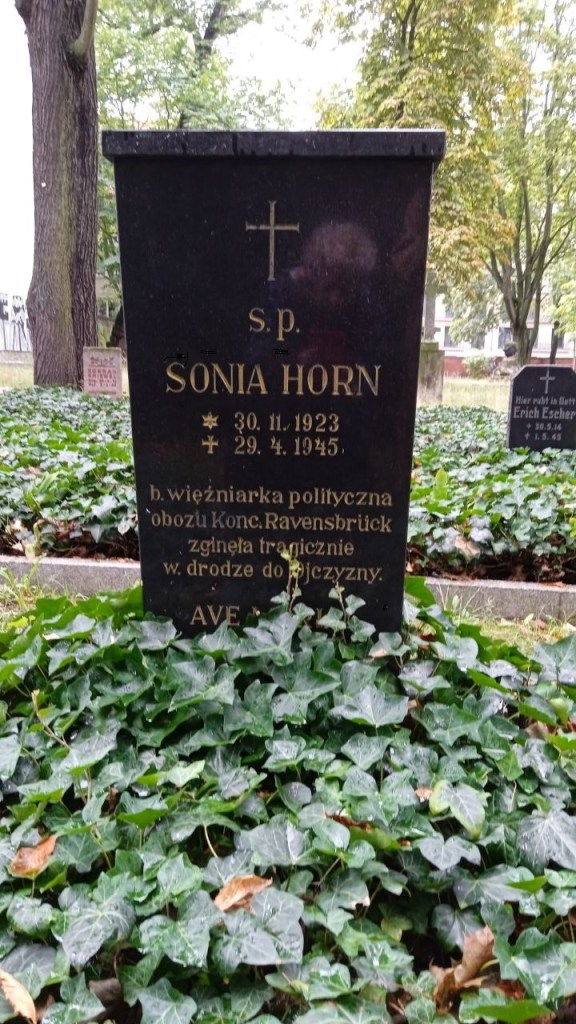
Grób Soni na Cmentarzu Garnizonowym w Berlinie na Invalidenstrasse
Miała, podobnie jak Irena, 22 lata, gdy zginęła podczas jednego z ostatnich bombardowań Berlina. Bombardowań, przypomnijmy, alianckich.
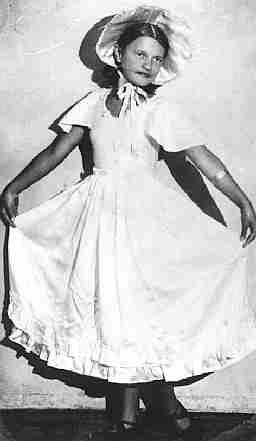
Sonia w wieku 10 lat podczas występów tanecznych
Urodziła się w roku 1923 w Mysłowicach. Jej ojciec był Niemcem, matka – Polką. Dziewczynka była wychowywana po polsku, głównie przez babcię, która nie znała ani słowa po niemiecku. Sonia niemal nie znała ojca, bo rodzice się rozwiedli, jak miała cztery lata. W wieku 14 lat poszła do Technikum Handlowego, które ukończyła w roku 1939. Podczas balu maturalnego poznała Franciszka Roja, nauczyciela i polskiego oficera, z którym w tymże roku wzięła ślub.
Zdjęcie zaręczynowe Soni i Franciszka
W początku wojny w Mysłowicach uformowała się organizacja podziemna »Braciom na otuchę«, w której aktywnie działali Sonia i jej mąż. Pomagali rodzinom pomordowanych, zdobywali dla nich odzież i pieniądze, przygotowywali odezwy i kolportowali ulotki.
W lutym 1943 roku Sonia została uwięziona. Po jakimś czasie wypuszczono ją, ale była śledzona. Sonia i Franciszek uciekli do Krakowa, gdzie zostali aresztowani 13 czerwca 1943 roku. Franciszek został deportowany w październiku do Auschwitz i tam rozstrzelany. Sonię przewieziono do obozu koncentracyjnego dla kobiet w Ravensbrück, numer obozowy – 25551.
I ona, podobnie jak Irena, pisała listy do ukochanej Mamy. Listy trzeba było pisać po niemiecku, atramentem i wyraźnie. List miał prawo liczyć 15 linijek, kartka pocztowa – dziesięć. W lipcu 1944 roku Sonia pisała:
Bin gesund… Mutti. Mach dir bitte keine Sorgen um mich, Du weißt, daß ich schon als Kind selbständig war, und auch jetzt, in den schweren für mich Zeit, werde ich nicht unter gehen… Denke so viel an die Tage, wo Du mich, liebste Mutti als Kind… auf meine Lippen aufgedrückt, da muß ich weinen.
Jestem zdrowa, Matuś. Nie martw się o mnie, proszę, wiesz przecież, że już jako dziecko byłam uparta, teraz też, w ten ciężki czas, nie dam się zgnębić… Dużo myślę o tamtych dniach, kiedy Ty, Matuś, mnie jako dziecko… do ust przyciskałaś i płakać mi się chce.
Sonia uciekła z obozu podczas jego likwidacji w kwietniu 1945 roku i na piechotę dotarła do Berlina w ostatnich dniach wojny. Zginęła 29 kwietnia 1945 roku, nie wiadomo, czy od kuli, czy trafiona odłamkiem granatu, czy przygnieciona walącą się ścianą?
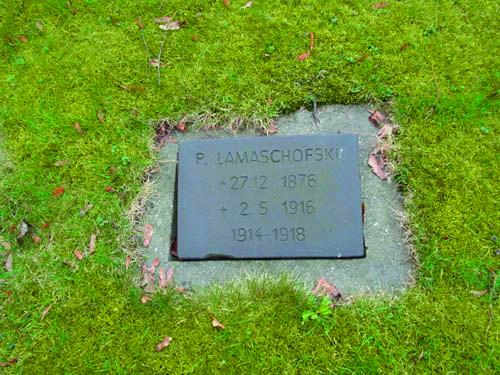
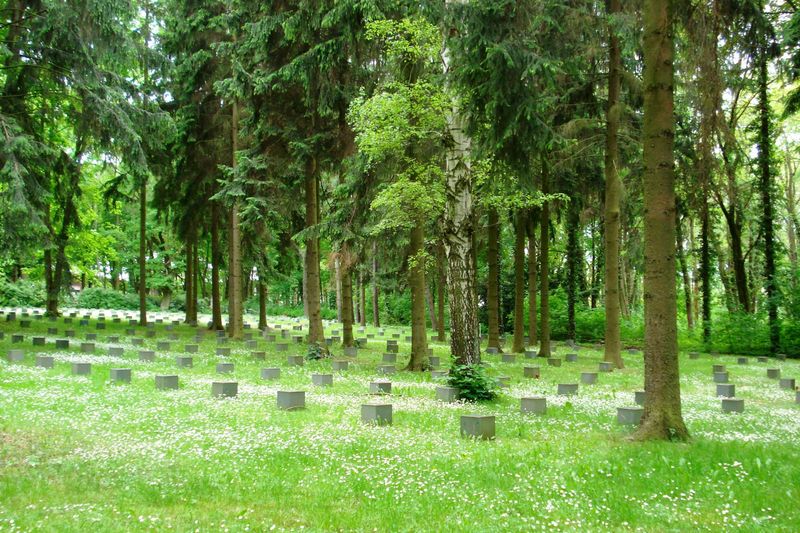
Zginęła, ale, w przeciwieństwie do tysięcy ofiar, nie została pochowana na cmentarnej łące w szeregu innych znanych i niezanych ofiar – na każdym berlińskim cmentarzu znajdują się takie łąki nagrobków – ją jednak pochowano w osobnym grobie z kamieniem nagrobnym.
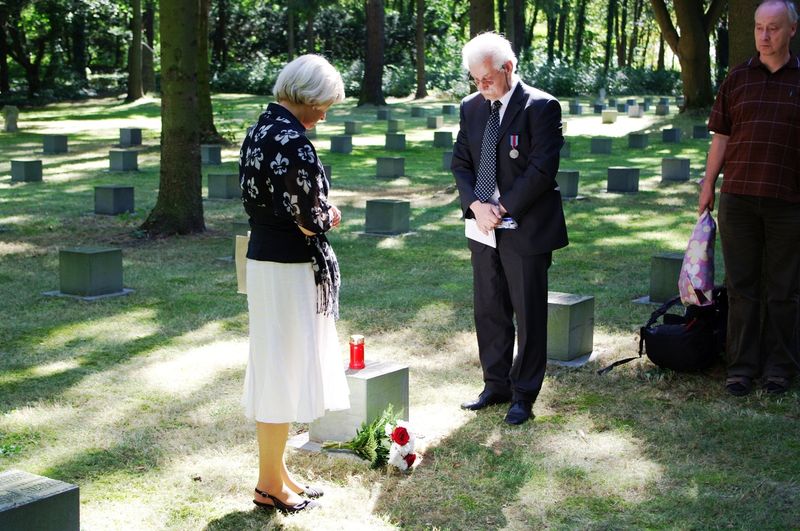
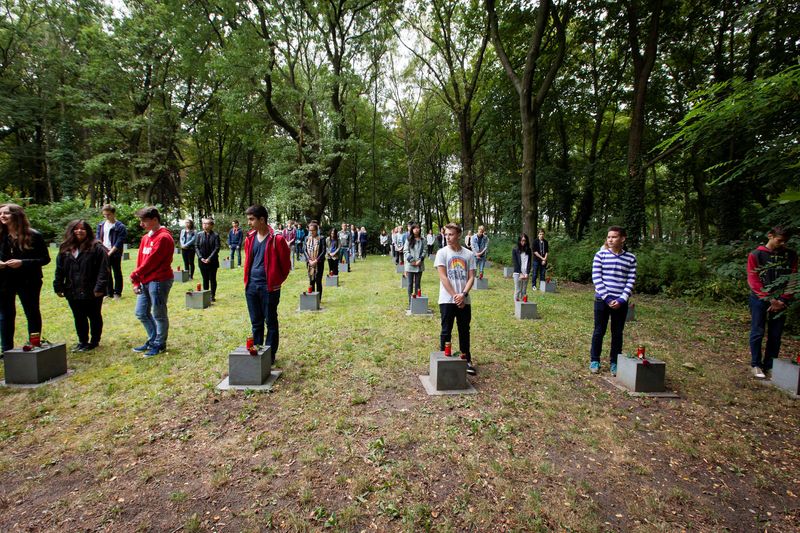
Bild: BA Spandau von Berlin, SGABild: BA Spandau von Berlin, SGAFoto (cmentarz na Turiner Str.); EMSNa cmentarzu św. Jadwigi Patrz zaproszenie w komentarzuUroczystości upamiętniające Alina i Klaus Leutner (patrz komentarz)Uroczystości upamiętniające, projekt szkolny
Zapraszamy na spacer po Zehlendorfie / Wir laden zu einem Spaziergang in Zehlendorf ein
Eine Blog-Veranstaltung in Zusammenarbeit mit Sprachcafé Polnisch / Spacer w ramach projektu My organizowanego przez ewamaria.blog i Polską Kafejkę Językową
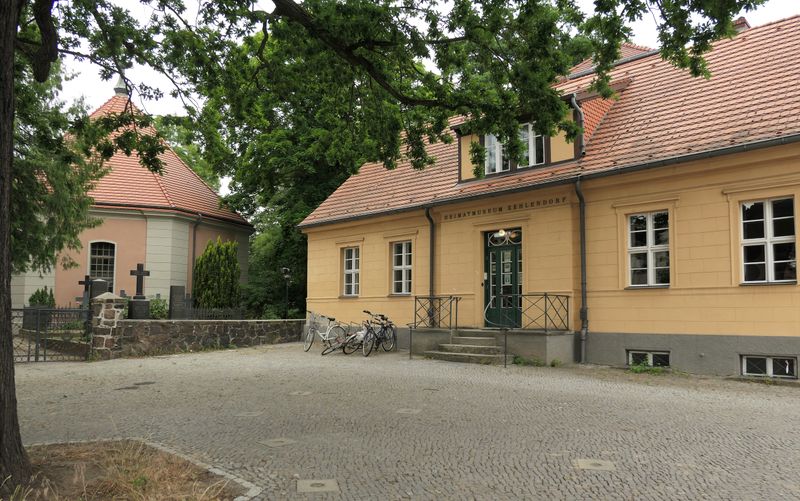
Treffpunkt / Miejsce spotkania: Heimatmuseum Zehlendorf um /o godzinie 11:00 Uhr Eintritt frei / Wejście za darmo
Clayallee 355 Historischer Winkel 14169 Berlin
S-Bahn S1 >>> Zehlendorf
Besuch im Historischen Winkel von Zehlendorf.
Alter Friedhof, alte Schule und alte Eiche. Die Hochzeitsvilla und ihre ehemalige Bewohnerin.
Zapraszamy na spacer do Historycznego Zakątka w Zehlendorfie. Odwiedzimy stary cmentarz i starą szkołę, w której obecnie mieści się lokalne muzeum (Heimatmuseum Zehlendorf). Dalej przejdziemy do willi znanej mieszkanki Zehlendorfu, zaangażowanej w życie społeczne dawnej wsi.
Ich sitze hier in Zehlendorf und warte auf den Bus
Ich will hier weg, das ist der Grund, warum ich warten muss
Der Bus kommt nich, wie könnt' es anders sein
Stattdessen kommt ein Schrank und haut mir eine rein

Ich sag: Du bist doch Proletarier, vereinig dich mit mir!
Doch er schnappt mich am Kragen und schleift mich zurück zu ihr
Vorbei am eig'nen Wasserfall, zum beheizten Swimmingpool
Dort sitzt sie und heult in 'nem antiken Schaukelstuhl

Ich sag: Zehlendorf-Mädchen, aus uns wird nie was werden
Ich träum nachts von Anarchie und du von deinen Pferden
Oh, Zehlendorf-Mädchen, wir hatten nur ne Nacht
Und, Ann-Kathrin, ich glaub, wir ha'm das Beste draus gemacht

***

Siedzę sobie w Zehlendorf, czekam na autobus
Chcę stąd zniknąć i dlatego czekać muszę ja tu
Autobus nie jedzie, wszak nie mogło być inaczej
Lecz przyszedł gostek, buch mnie w dziób i dlatego płaczę

Mówię mu, Proletariuszu, łączmy się w ucieczce!
On mnie za wszarz łaps, ciągnie k'niej, choć ja wcale nie chcę!
Nie chcę prywatnych wodospadów i słimmingpulu.
Gdzie ona płacze, siedząc w swoim antycznym fot'lu.

Dziewczyno z Zehlendorfu, zapomnij, nic nie będzie
Ja marzę o anarchii, ty konie swoje czeszesz.
Panno z Zehlendorf, tylko ta noc była nam dana
I wiesz, Anno-Kasiu, wierzę, nie była zmarnowana!

                                                            Przetłumaczyła (na chybcika) Ewa Maria Slaska
W latach 20 w Ameryce ideałem była mała stabilizacja – każdy uczciwie pracujący człowiek miał mieć dom, samochód (czarnego Forda T!), radio, pralkę, wodę w domu i ogrzewanie.
Zamieniwszy słowo dom na mieszkanie zwane M z cyferką, a zatem M2, M3, M4, i dodawszy telewizor, Polacy w drugiej połowie lat 70 wyprodukowali marzenie, które wyglądało dokładnie tak, jak amerykańskie pół wieku wcześniej. Kultowy serial Czterdziestolatek był orgiastyczną pochwałą peerelowskiego dorabiania się, czego symbolem stał się słynny „łuk Karwowskiego”, czyli wycięty w ścianie mieszkania w bloku łuk, mający udawać, że znaleźliśmy się we wnętrzu szlacheckiego dworku, a może nawet arystokratycznego pałacu.
Dorabianie się jest wprawdzie ideałem drobnomieszczańskim, ale jednak niezaprzeczalnym. W roku 2022 media doniosły, że w Brazylii zmniejsza się gwałtownie ilość katolików. Brazylijczycy opuszczają kościół katolicki i przenoszą się do sekty zielonoświątkowców, ci bowiem głoszą pochwałę dorabiania się. Im więcej zarobiłeś, tym bardziej Bóg Cię kocha, mówią zielonoświątkowcy. Kościół Powszechny pod wodzą Franciszka postawił na reprezenztowanie interesów biednych, biedni zaś postawili na zielonoświątkowców.
Jakie więc było nasze życie według Karwowskich? Zacznijmy od prostego pytania, czy w Czterdziestolatku były kartki? Tak, macie rację, nie było, bo jednak Karwowscy, którzy byli parę lat starsi niż Stefek i Basia, niż ja i mój mąż, wstrzelili się w świat gierkowskiego dobrobytu. Mieli mieszkanie w blokach, na podwórku stał trzepak, młoda Karwowska miała więc gdzie wykonywać fikołki na trzepaku. Mieli samochód. Gdy zaangażowali się społecznie w rozwiązanie jakiegoś lokalnego problemu i przyszła dziennikarka nagrywać z nimi wywiad, Karwowski prezentuje się w garniturze plus modne baczki, a Karwowska wkłada luźną czarną sukienkę z elany i ma długie sztuczne perły na szyi. Oczywiście oboje mają pracę, a dzieci się dobrze uczą. Standard Polski gierkowskiej nie zakłada innych możliwości. Na obiad była pomidorowa, schabowy, tłuczone ziemniaki, ale już się nieśmiało zaczął czas udziwnionego jedzenia – na jakiś proszony obiad Karwowscy przygotowują indyka na słodko i wytrawny deser.
My już nie żyliśmy w idealnym raju PRL-u, my znaliśmy kartki od 76 roku, kiedy na dziesięć lat pojawiły się i ustabilizowały swój byt kartki na cukier. Mój syn, podobnie jak Małgosia Szarzyńska, córka Basi i Stefana, od urodzenia znali tylko cukier na kartki. I był to szarawobiały cukier w szarawo-granatowych torebkach. Jacek i Małgosia nawet nie wiedzieli, że istnieje cukier w kostkach. Kiedy Jacek zobaczył taki cukier w sklepie, prawie się rozpłakał z potrzeby dostania takiego cuda do zjedzenia. Wiedziałam, że nic z tego nie będzie, ale mimo to zapytałam, jak można by było „dostać” to coś i dowiedziałam się, że jest to towar reglamentowany, tylko dla cukrzyków, którzy mają na ten luksus specjalne kartki.
Potem to już w ogóle zaczęły się kartki w iście kubańskim stylu – w kraju cukru, ludzie dostawali cukier na kartki, kilogram miesięcznie, ale z wymaganej przez partię oszczędności cukru, tylko przez 11 miesięcy w roku.
Były kartki, a i tak się stało w kolejce. Był tłok, wszyscy się pchali na wszystkich, Jackowi kiedyś w takiej kolejce jakieś dziecko wyrwało z ręki bułkę z serem i ją zjadło. To wtedy właśnie mój ośmioletni syn powiedział, że można by poustawiać takie płoty z lewa na prawą i z prawa na lewą, żeby ludzie porządnie stali w kolejce.
Gdy w roku 1985 wyjechaliśmy do Niemiec, wszystkie kolejki w Policji dla Cudzoziemców były regulowane takimi metalowymi płotami z lewa na prawą i z prawa na lewą, żeby ludzie porządnie stali w kolejce.
Tak to się niekiedy spełniają nasze marzenia. Spełniają się, a Los wykrzywia przy tym gębę w ironicznym uśmiechu.
Lots of Big Bang Theory discussions since Webb’s Deep Field was released. Here’s an article about the history and meaning of the Big Bang Theory from Big Think:
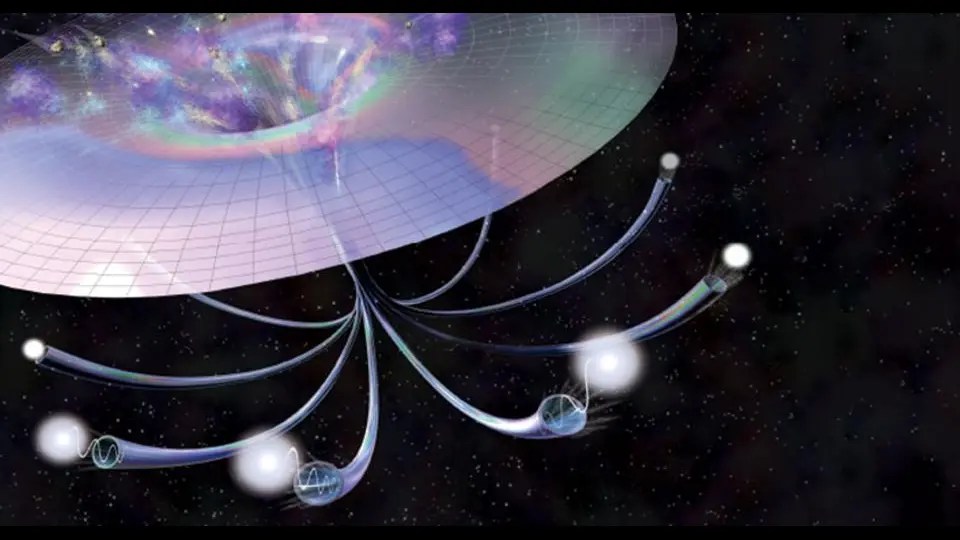
From a pre-existing state, inflation predicts that a series of universes will be spawned as inflation continues, with each one being completely disconnected from every other one, separated by more inflating space. One of these “bubbles,” where inflation ended, gave birth to our Universe some 13.8 billion years ago, where our entire visible Universe is just a tiny portion of that bubble’s volume. Each individual bubble is disconnected from all of the others, and each place where inflation ends gives rise to its own hot Big Bang. (Credit: Nicolle Rager Fuller)
As we gain new knowledge, our scientific picture of how the Universe works must evolve. This is a feature of the Big Bang, not a bug.
If there’s one hallmark inherent to science, it’s that our understanding of how the Universe works is always open to revision in the face of new evidence. Whenever our prevailing picture of reality — including the rules it plays by, the physical contents of a system, and how it evolved from its initial conditions to the present time — gets challenged by new experimental or observational data, we must open our minds to changing our conceptual picture of the cosmos. This has happened many times since the dawn of the 20th century, and the words we use to describe our Universe have shifted in meaning as our understanding has evolved.
Yet, there are always those who cling to the old definitions, much like linguistic prescriptivists, who refuse to acknowledge that these changes have occurred. But unlike the evolution of colloquial language, which is largely arbitrary, the evolution of scientific terms must reflect our current understanding of reality. Whenever we talk about the origin of our Universe, the term “the Big Bang” comes to mind, but our understanding of our cosmic origins have evolved tremendously since the idea that our Universe even had an origin, scientifically, was first put forth. Here’s how to resolve the confusion and bring you up to speed on what the Big Bang originally meant versus what it means today.
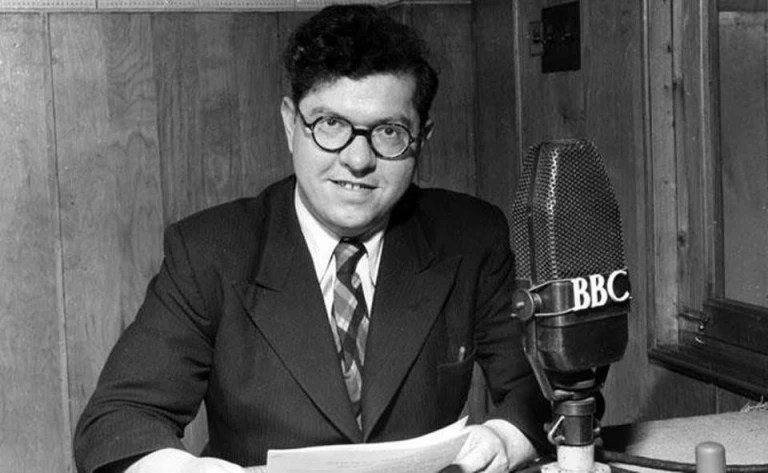
Fred Hoyle was a regular on BBC radio programsin the 1940s and 1950s, and one of the mostinfluential figures in the field of stellarnucleosynthesis. His role as the Big Bang’s most vocaldetractor, even after the critical evidence supportingit had been discovered, is one of his longest-enduringlegacies. (Credit: British Broadcasting Company)
The first time the phrase “the Big Bang” was uttered was over 20 years after the idea was first described. In fact, the term itself comes from one of the theory’s greatest detractors: Fred Hoyle, who was a staunch advocate of the rival idea of a Steady-State cosmology. In 1949, he appeared on BBC radio and advocated for what he called the perfect cosmological principle: the notion that the Universe was homogeneous in both space and time, meaning that any observer not only anywhere but anywhen would perceive the Universe to be in the same cosmic state. He went on to deride the opposing notion as a “hypothesis that all matter of the universe was created in one Big Bang at a particular time in the remote past,” which he then called “irrational” and claimed to be “outside science.”
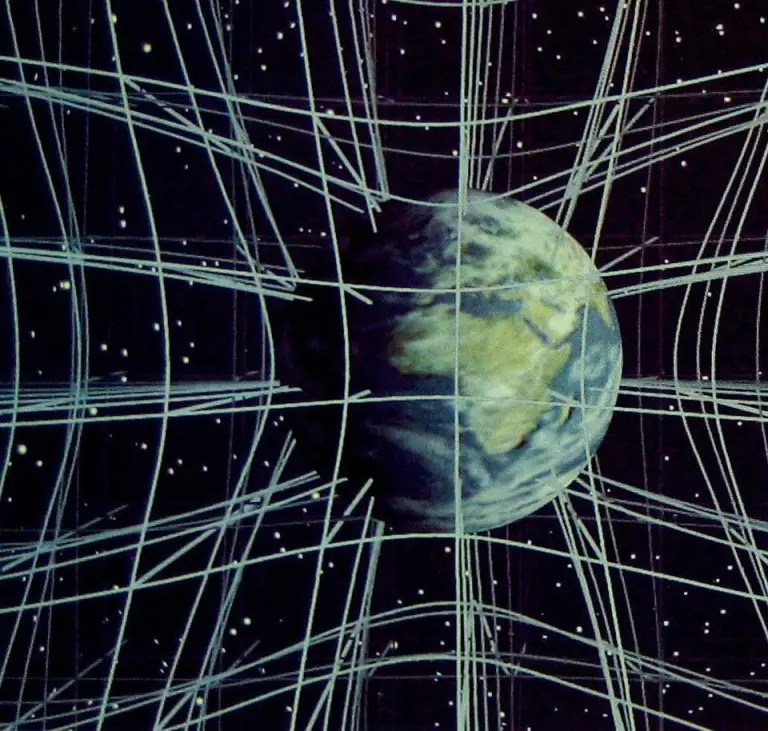
Instead of an empty, blank, three-dimensional grid, putting a mass down causes what would have been ‘straight’ lines to instead become curved by a specific amount. In General Relativity, we treat space and time as continuous, but all forms of energy, including but not limited to mass, contribute to spacetime curvature. The deeper you are in a gravitational field, the more severely all three dimensions of your space is curved, and the more severe the phenomena of time dilation and gravitational redshift become. (Credit: Christopher Vitale of Networkologies and the Pratt Institute)
But the idea, in its original form, wasn’t simply that all of the Universe’s matter was created in one moment in the finite past. That notion, derided by Hoyle, had already evolved from its original meaning. Originally, the idea was that the Universe itself, not just the matter within it, had emerged from a state of non-being in the finite past. And that idea, as wild as it sounds, was an inevitable but difficult-to-accept consequence of the new theory of gravity put forth by Einstein back in 1915: General Relativity.
When Einstein first cooked up the general theory of relativity, our conception of gravity forever shifted from the prevailing notion of Newtonian gravity. Under Newton’s laws, the way that gravitation worked was that any and all masses in the Universe exerted a force on one another, instantaneously across space, in direct proportion to the product of their masses and inversely proportional to the square of the distance between them. But in the aftermath of his discovery of special relativity, Einstein and many others quickly recognized that there was no such thing as a universally applicable definition of what “distance” was or even what “instantaneously” meant with respect to two different locations.
With the introduction of Einsteinian relativity — the notion that observers in different frames of reference would all have their own unique, equally valid perspectives on what distances between objects were and how the passage of time worked — it was only almost immediate that the previously absolute concepts of “space” and “time” were woven together into a single fabric: spacetime. All objects in the Universe moved through this fabric, and the task for a novel theory of gravity would be to explain how not just masses, but all forms of energy, shaped this fabric that underpinned the Universe itself.
If you begin with a bound, stationary configuration of mass, and there are no non-gravitational forces or effects present (or they’re all negligible compared to gravity), that mass will always inevitably collapse down to a black hole. It’s one of the main reasons why a static, non-expanding Universe is inconsistent with Einstein’s General Relativity. (Credit: E. Siegel/Beyond the Galaxy)
Although the laws that governed how gravitation worked in our Universe were put forth in 1915, the critical information about how our Universe was structured had not yet come in. While some astronomers favored the notion that many objects in the sky were actually “island Universes” that were located well outside the Milky Way galaxy, most astronomers at the time thought that the Milky Way galaxy represented the full extent of the Universe. Einstein sided with this latter view, and — thinking the Universe was static and eternal — added a special type of fudge factor into his equations: a cosmological constant.
Although it was mathematically permissible to make this addition, the reason Einstein did so was because without one, the laws of General Relativity would ensure that a Universe that was evenly, uniformly distributed with matter (which ours seemed to be) would be unstable against gravitational collapse. In fact, it was very easy to demonstrate that any initially uniform distribution of motionless matter, regardless of shape or size, would inevitably collapse into a singular state under its own gravitational pull. By introducing this extra term of a cosmological constant, Einstein could tune it so that it would balance out the inward pull of gravity by proverbially pushing the Universe out with an equal and opposing action.
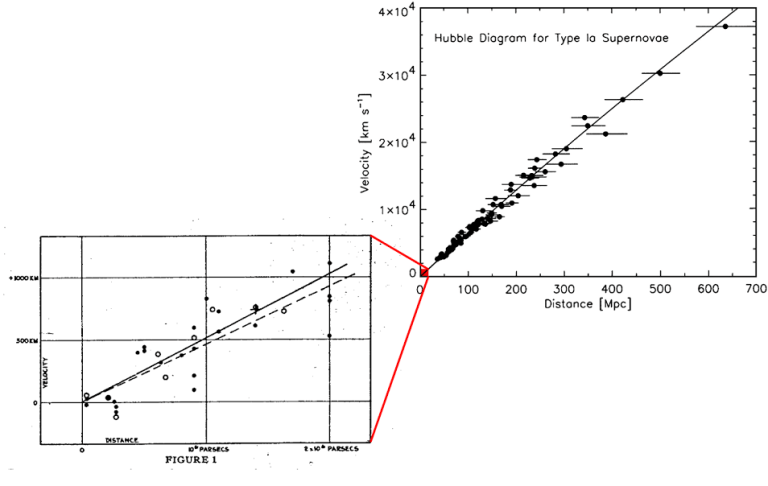
Edwin Hubble’s original plot of galaxy distances versus redshift (left), establishing the expanding Universe, versus a more modern counterpart from approximately 70 years later (right). In agreement with both observation and theory, the Universe is expanding, and the slope of the line relating distance to recession speed is a constant.
Two developments — one theoretical and one observational — would quickly change this early story that Einstein and others had told themselves.
In 1922, Alexander Friedmann worked out, fully, the equations that governed a Universe that was isotropically (the same in all directions) and homogeneously (the same in all locations) filled with any type of matter, radiation, or other form of energy. He found that such a Universe would never remain static, not even in the presence of a cosmological constant, and that it must either expand or contract, dependent on the specifics of its initial conditions.
In 1923, Edwin Hubble became the first to determine that the spiral nebulae in our skies were not contained within the Milky Way, but rather were located many times farther away than any of the objects that comprised our home galaxy. The spirals and ellipticals found throughout the Universe were, in fact, their own “island Universes,” now known as galaxies, and that moreover — as had previously been observed by Vesto Slipher — the vast majority of them appeared to be moving away from us at remarkably rapid speeds.
In 1927, Georges Lemaître became the very first person to put these pieces of information together, recognizing that the Universe today is expanding, and that if things are getting farther apart and less dense today, then they must have been closer together and denser in the past. Extrapolating this back all the way to its logical conclusion, he deduced that the Universe must have expanded to its present state from a single point-of-origin, which he called either the “cosmic egg” or the “primeval atom.”
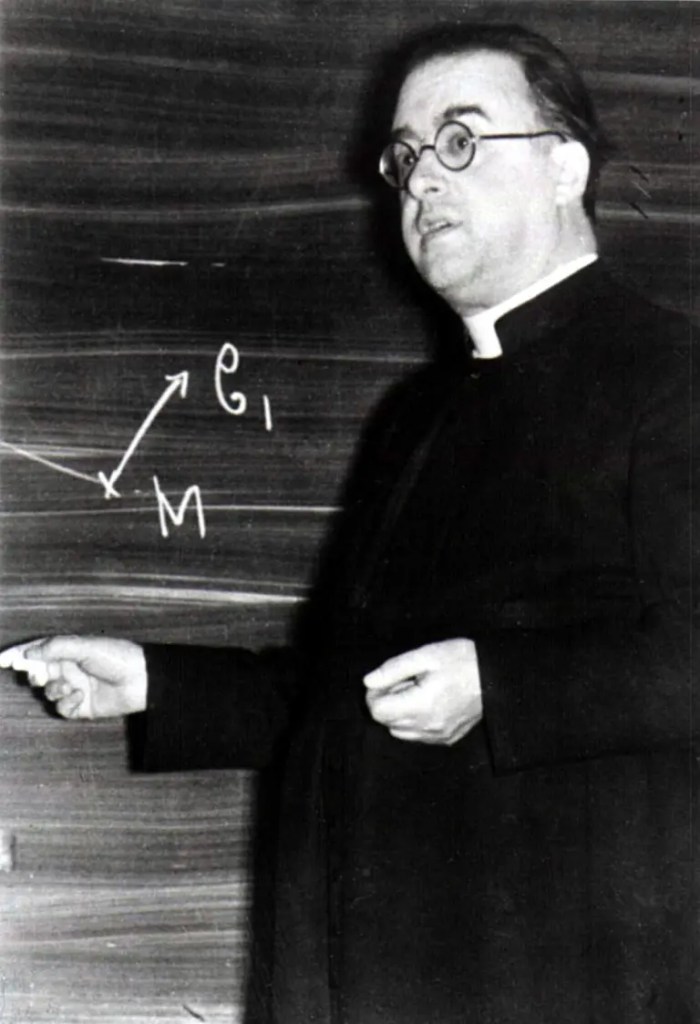
This image shows Catholic priest and theoretical cosmologist Georges Lemaître at the Catholic University of Leuven, ca. 1933. Lemaître was among the first to conceptualize the Big Bang as the origin of our Universe within the framework of General Relativity, even though he didn’t use that name himself. (Credit: public domain)
This was the original notion of what would grow into the modern theory of the Big Bang: the idea that the Universe had a beginning, or a “day without yesterday.” It was not, however, generally accepted for some time. Lemaître originally sent his ideas to Einstein, who infamously dismissed Lemaître’s work by responding, “Your calculations are correct, but your physics is abominable.”
Despite the resistance to his ideas, however, Lemaître would be vindicated by further observations of the Universe. Many more galaxies would have their distances and redshifts measured, leading to the overwhelming conclusion the Universe was and still is expanding, equally and uniformly in all directions on large cosmic scales. In the 1930s, Einstein conceded, referring to his introduction of the cosmological constant in an attempt to keep the Universe static as his “greatest blunder.”
However, the next great development in formulating what we know of as the Big Bang wouldn’t come until the 1940s, when George Gamow — perhaps not so coincidentally, an advisee of Alexander Friedmann — came along. In a remarkable leap forward, he recognized that the Universe was not only full of matter, but also radiation, and that radiation evolved somewhat differently from matter in an expanding Universe. This would be of little consequence today, but in the early stages of the Universe, it mattered tremendously.
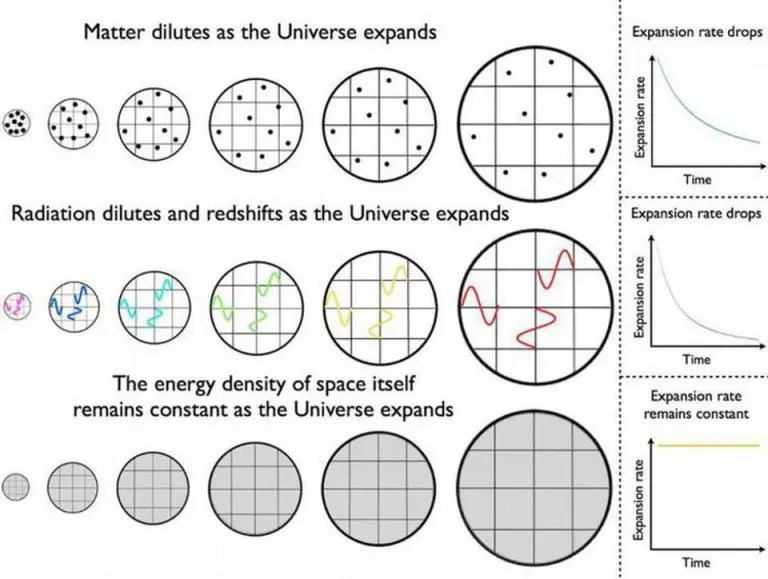
Matter, Gamow realized, was made up of particles, and as the Universe expanded and the volume that these particles occupied increased, the number density of matter particles would drop in direct proportion to how the volume grew.
But radiation, while also made up of a fixed number particles in the form of photons, had an additional property: the energy inherent to each photon is determined by the photon’s wavelength. As the Universe expands, the wavelength of each photon gets lengthened by the expansion, meaning that the amount of energy present in the form of radiation decreases faster than the amount of energy present in the form of matter in the expanding Universe.
But in the past, when the Universe was smaller, the opposite would have been true. If we were to extrapolate backward in time, the Universe would have been in a hotter, denser, more radiation-dominated state. Gamow leveraged this fact to make three great, generic predictions about the young Universe.
At some point, the Universe’s radiation was hot enough so that every neutral atom would have been ionized by a quantum of radiation, and that this leftover bath of radiation should still persist today at only a few degrees above absolute zero.
At some even earlier point, it would have been too hot to even form stable atomic nuclei, and so an early stage of nuclear fusion should have occurred, where an initial mix of protons-and-neutrons should have fused together to create an initial set of atomic nuclei: an abundance of elements that predates the formation of atoms.
And finally, this means that there would be some point in the Universe’s history, after atoms had formed, where gravitation pulled this matter together into clumps, leading to the formation of stars and galaxies for the first time.
Schematic diagram of the Universe’s history, highlighting reionization. Before stars or galaxies formed, the Universe was full of light-blocking, neutral atoms that formed back when the Universe was ~380,000 years old. Most of the Universe doesn’t become reionized until 550 million years afterwards, with some regions achieving full reionization earlier and others later. The first major waves of reionization begin happening at around ~200 million years of age, while a few fortunate stars may form just 50-to-100 million years after the Big Bang. With the right tools, like the JWST, we hope to reveal the earliest galaxies of all. (Credit: S. G. Djorgovski et al., Caltech; Caltech Digital Media Center)
These three major points, along with the already-observed expansion of the Universe, form what we know today as the four cornerstones of the Big Bang. Although one was still free to extrapolate the Universe back to an arbitrarily small, dense state — even to a singularity, if you’re daring enough to do so — that was no longer the part of the Big Bang theory that had any predictive power to it. Instead, it was the emergence of the Universe from a hot, dense state that led to our concrete predictions about the Universe.
Over the 1960s and 1970s, as well as ever since, a combination of observational and theoretical advances unequivocally demonstrated the success of the Big Bang in describing our Universe and predicting its properties.
The discovery of the cosmic microwave background and the subsequent measurement of its temperature and the blackbody nature of its spectrum eliminated alternative theories like the Steady State model.
The measured abundances of the light elements throughout the Universe verified the predictions of Big Bang nucleosynthesis, while also demonstrating the need for fusion in stars to provide the heavy elements in our cosmos.
And the farther away we look in space, the less grown-up and evolved galaxies and stellar populations appear to be, while the largest-scale structures like galaxy groups and clusters are less rich and abundant the farther back we look.
The Big Bang, as verified by our observations, accurately and precisely describes the emergence of our Universe, as we see it, from a hot, dense, almost-perfectly uniform early stage.
But what about the “beginning of time?” What about the original idea of a singularity, and an arbitrarily hot, dense state from which space and time themselves could have first emerged?
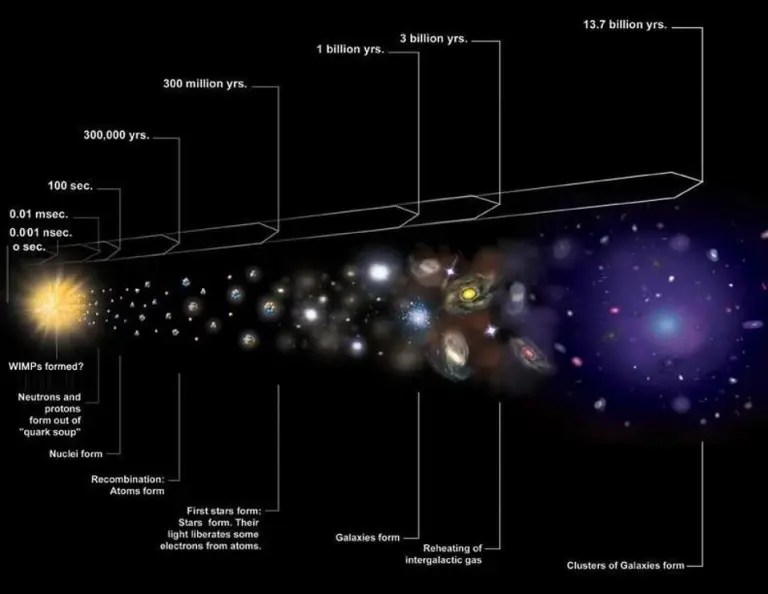
A visual history of the expanding Universe includes the hot, dense state known as the Big Bang and the growth and formation of structure subsequently. The full suite of data, including the observations of the light elements and the cosmic microwave background, leaves only the Big Bang as a valid explanation for all we see. As the Universe expands, it also cools, enabling ions, neutral atoms, and eventually molecules, gas clouds, stars, and finally galaxies to form. However, the Big Bang was not an explosion, and cosmic expansion is very different from that idea.
That’s a different conversation, today, than it was back in the 1970s and earlier. Back then, we knew that we could extrapolate the hot Big Bang back in time: back to the first fraction-of-a-second of the observable Universe’s history. Between what we could learn from particle colliders and what we could observe in the deepest depths of space, we had lots of evidence that this picture accurately described our Universe.
But at the absolute earliest times, this picture breaks down. There was a new idea — proposed and developed in the 1980s — known as cosmological inflation, that made a slew of predictions that contrasted with those that arose from the idea of a singularity at the start of the hot Big Bang. In particular, inflation predicted:
A curvature for the Universe that was indistinguishable from flat, to the level of between 99.99% and 99.9999%; comparably, a singularly hot Universe made no prediction at all.
Equal temperatures and properties for the Universe even in causally disconnected regions; a Universe with a singular beginning made no such prediction.
A Universe devoid of exotic high-energy relics like magnetic monopoles; an arbitrarily hot Universe would possess them.
A Universe seeded with small-magnitude fluctuations that were almost, but not perfectly, scale invariant; a non-inflationary Universe produces large-magnitude fluctuations that conflict with observations.
A Universe where 100% of the fluctuations are adiabatic and 0% are isocurvature; a non-inflationary Universe has no preference.
A Universe with fluctuations on scales larger than the cosmic horizon; a Universe originating solely from a hot Big Bang cannot have them.
And a Universe that reached a finite maximum temperature that’s well below the Planck scale; as opposed to one whose maximum temperature reached all the way up to that energy scale.
The first three were post-dictions of inflation; the latter four were predictions that had not yet been observed when they were made. On all of these accounts, the inflationary picture has succeeded in ways that the hot Big Bang, without inflation, has not.
The quantum fluctuations that occur during inflation get stretched across the Universe, and when inflation ends, they become density fluctuations. This leads, over time, to the large-scale structure in the Universe today, as well as the fluctuations in temperature observed in the CMB. New predictions like these are essential for demonstrating the validity of a proposed fine-tuning mechanism, and to test (and potentially rule out) alternatives. (Credit: E. Siegel; ESA/Planck and the DOE/NASA/NSF Interagency Task Force on CMB research)
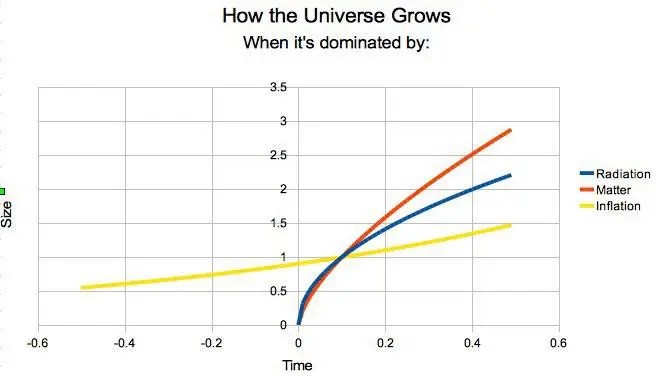
During inflation, the Universe must have been devoid of matter-and-radiation and instead contained some sort of energy — whether inherent to space or as part of a field — that didn’t dilute as the Universe expanded. This means that inflationary expansion, unlike matter-and-radiation, didn’t follow a power law that leads back to a singularity but rather is exponential in character. One of the fascinating aspects about this is that something that increases exponentially, even if you extrapolate it back to arbitrarily early times, even to a time where t → -∞, it never reaches a singular beginning.
Now, there are many reasons to believe that the inflationary state wasn’t one that was eternal to the past, that there might have been a pre-inflationary state that gave rise to inflation, and that, whatever that pre-inflationary state was, perhaps it did have a beginning. There are theorems that have been proven and loopholes discovered to those theorems, some of which have been closed and some of which remain open, and this remains an active and exciting area of research.
Blue and red lines represent a “traditional” Big Bang scenario, where everything starts at time t=0, including spacetime itself. But in an inflationary scenario (yellow), we never reach a singularity, where space goes to a singular state; instead, it can only get arbitrarily small in the past, while time continues to go backward forever. Only the last minuscule fraction of a second, from the end of inflation, imprints itself on our observable Universe today. (Credit: E. Siegel)
But one thing is for certain.
Whether there was a singular, ultimate beginning to all of existence or not, it no longer has anything to do with the hot Big Bang that describes our Universe from the moment that:
inflation ended,
the hot Big Bang occurred,
the Universe became filled with matter and radiation and more,
and it began expanding, cooling, and gravitating,
eventually leading to the present day. There are still a minority of astronomers, astrophysicists and cosmologists who use “the Big Bang” to refer to this theorized beginning and emergence of time-and-space, but not only is that not a foregone conclusion anymore, but it doesn’t have anything to do with the hot Big Bang that gave rise to our Universe. The original definition of the Big Bang has now changed, just as our understanding of the Universe has changed. If you’re still behind, that’s ok; the best time to catch up is always right now.













 Ewa Maria and Friends
