Kiedy człowiek zaczyna wprowadzać w błąd? Precyzyjne określenie tego pozostawiam specjalistom, ale wcześnie. Każdy rodzic wie, że kilkumiesięczne dziecko często drze się w niebogłosy, tylko dlatego że się nudzi i kiedy bliska osoba dotrzyma mu towarzystwa, to się zaraz uspokoi. Dziecko szybko uczy się, że jego rozpacz przywołuje opiekunów i jeżeli ten nawyk się utrwali, to może się przenieść później do dorosłego życia. Trudno będzie jednak nazwać wyjące maleństwo niemoralnym i uznać, że oszukuje, bo nic go nie boli, jest syte i suche. Kłamie, aby milej spędzić czas, albo – językiem naukowym – zoptymalizować warunki przetrwania.
Tomasz Witkowski, autor Psychologii kłamstwa, uważa, że w świetle zgromadzonych faktów możemy uznać to zjawisko za zwykłą umiejętność i trudno byłoby nadać jej wymiar moralny. A jednak oburzamy się – pisze – wewętrznie na samo słowo „kłamstwo”, bronimy się przed podejrzeniami o kłamstwo, myślimy źle o kimś, o kim wiemy, że kłamie. Próbując wyjaśnić, dlaczego kłamstwo ma taką fatalną kondycję w naszej współczesnej kulturze, wraca do postaci Odyseusza, którego starożytni Grecy kochali za przebiegłość.
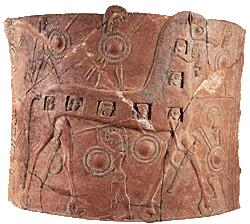
Najważniejszy podstęp Odyseusza – koń trojański (naczynie gliniane, VII w.p.n.e.)
Według Sofoklesa na pytanie, czy kłamstwo jest godne pogardy, odpowiedział: “Nie, jeżeli kłamstwo może nas ocalić“. Był to V wiek p.n.e., a więc o ile pojawiały się wątpliwości co do istoty kłamstwa, były one bardzo słabe i łatwo można było kłamstwo uzasadnić. Pamiętajmy również, że bliskość kłamstwa i bardzo wysoko cenionej umiejętności tworzenia fikcji, opowiadania pięknych, choć zmyślonych, historii zabarwiała cieplejszymi odcieniami wszelkie oceny kłamstwa i doprowadziła do stworzenia i rozkwitu m.in. pięknej sztuki retoryki. Jak drastycznie ocena kłamstwa i jego uzasadnień uległy transformacji, świadczyć najlepiej może fakt, że Dante umieścił Odyseusza w ósmym rozdziale w ósmym kręgu piekła! A przecież już w Księdze Rodzaju Abraham dopuszcza się ewidentnego oszustwa, polegającego na tym, że swoją żonę podaje za siostrę i nie wzbrania się oddać jej na dwór faraona. Ale Abraham był wybranym przez Pana, więc karę za ten postępek ponosi ofiara oszustwa! Gniew Boga spada na faraona. Czyż takie „ załatwienie” sprawy oszustwa Abrahama nie legitymizowało kłamstwa?
Dobre, retoryczne pytanie. Oszustwo to było środkiem do realizacji celu, czyli zniszczenia złego faraona, ale jego autorem był sam Bóg. Arystoteles w swoim dziele Etyka nikomachejska umieszczał jeszcze kłamstwo pośrodku, między dobrem a złem, ale filozof i teolog Augustyn Aureliusz potraktował je już jako bezwarunkowe zło. To był przełom IV i V wieku n.e. i chodziło o dwa jego dzieła: De mendacio i Contra mendacium, czyli O kłamstwie i Przeciw kłamstwu, które wpłynęły na nowożytny sposób jego rozumienia. Głoszą one, że fałsz, nieprawda odwodzi człowieka od poznania Boga i już samo to jest wystarczającym powodem, dla którego zasługuje na miano zła. Czczony w kościele katolickim, prawosławnym i luterańskim jako święty Augustyn, autor wymienionych rozpraw oddzielił kłamstwo od pojęcia trafności i na zawsze powiązał je z zamiarem wprowadzenia w bład. Z zamiarem najczęściej motywowanym, nierzadko zbrodniczo, z czym oszust stara się nie zdradzić przed otoczeniem.
Ojciec kościoła dopuszczał wprawdzie stosowanie fałszu w żartach, kiedy wiadomo, że zamierza się odbiorcę wprowadzić w błąd, m.in. w treściach komedii, ale już wszelkie inne kłamstwa, łącznie z tak zwanym kłamstwem służebnym (popełnianym w interesie zachowania wiary), uważał za zło. Jego zakazy – pisze T. Witkowski – były bezwarunkowe i zbudowane w oparciu o autorytet Biblii, chociaż czasami dość mozolnie, bowiem ta święta księga zawiera aż nazbyt wiele opisów oszustw i podstępów pozostawionych bez komentarza i, co najważniejsze, bez kary bożej. Augustyn uczynił szatana ojcem kłamstwa, bowiem wszystko, co zwodnicze, pozorne, urojone jest domeną diabła. Zdolność do rozmijania się z prawdą jest przyrodzoną ułomnością człowieka, świadectwem upadku w grzech.
Ta podjęta walka z kłamstwem spełniała także konkretne, polityczne cele. W czasach współczesnych Augustynowi chrześcijaństwo działało jeszcze w pewnym ukryciu, czesto nielegalnie. Przetrwanie tych gmin zależało nierzadko właśnie od… różnych konfabulacji. Głośne wyznawanie prawd wiary miało być więc sposobem na wyprowadzenie pierwszych chrześcijan na światło dzienne i na umocnienie wiary. Wtedy, niestety, przybywało męczenników, nowych świętych. Jawne głoszenie chrześcijańskich prawd narażało bowiem na prześladowania, a ofiary te umacniały wiarę. Miały one również znaczenie w posłudze misyjnej, bo jeżeli ktoś był gotów oddać życie za swoją prawdę, to pewnie była ona tego warta i godna poznania.
Autor książki zastanawia się, czy przypadkiem Augustyn Aureliusz nie był pierwszym, nieświadomym odkrywcą dysonansu poznawczego – niezwykle silnego mechanizmu psychologicznego, który został opisany przez Leona Festingera w 1956 roku*. A jeśli nawet odmówimy mu miana odkrywcy, był z pewnością praktykiem, który na taką skalę mechanizm ów wykorzystał.
Chyba od tego czasu zaczyna się era totalnego zakłamania w sprawach kamstwa. O ile głoszenie prawdy i męczeństwo w jej obronie mogą być godne podziwu, o tyle trudno odnaleźć niezwykle cienką granicę, gdzie kończy się męczeństwo, a zaczyna walka o prawdę z innymi. Ta granica jest bowiem granicą zła. W tym miejscu kłamstwo przestaje być złem, a złem zaczyna być prawda. Oczywiście o tym Augustyn już nie pomyślał, nie pomyśleli twórcy Inkwizycji, nie zawracali sobie tym głowy fundamentaliści wszelkiej maści, Hitler, Stalin i wielu, wielu innych dyktatorów moralnych, dla których ich prawda i walka o nią była podstawą działania.
Skupiłem się zaledwie na streszczeniu części pierwszego rozdziału tej książki, jakże aktualnej we współczesnych czasach powszechnej dezinformacji. Nie ruszyłem choćby pojęcia kłamstwa koniecznego, tego, dlaczego kłamiemy i jakimi metodami, kto to robi najczęściej i najlepiej, jak rozpoznawać oszustów i dawać im odpór, co to jest wariograf i jak go oszukać? oraz wielu innych spraw, którymi zajmuje się ta dziedzina psychologii. W ogóle nie wspomniałem o bogatym doświadczeniu i repertuarze środków masowego przekazu tudzież polityków w biciu propagandowej piany, ale o tym wszystkim możecie Państwo poczytać we wspomnianej książce, jeżeli uda się Wam ją zdobyć, na przykład przez internet.
Na zakończenie, żeby diabła trochę odczarować, zacytuję trafną myśl XVIII-wiecznego francuskiego pisarza i filozofa: Kłamstwo jest grzechem, jeżeli wyrządza zło, jest wielką cnotą, jeżeli czyni dobro. Voltaire, który to powiedział, dodał z troską: Bądźcie więc bardziej cnotliwi niż kiedykolwiek.
* When prophecy fails. University of Minnesota Press, Minneapolis 1956.
Drei Fragen zu dem Ereignis von 1772 sollen hier gestellt und diskutiert werden. Die erste ist die, ob – und, wenn ja, warum – die erste Teilung Polens eine Zäsur in der europäischen Geschichte markiert. Sehr klar hat Edmund Burke schon 1773 diese Frage beantwortet. Die „gewaltsame Zerstückelung“ Polens, „ohne den Vorwand eines Kriegs oder auch nur den Anschein von Recht“, schrieb er im Annual Register für das Jahr 1772, sei „der erste wirklich große Bruch in der modernen Ordnung Europas“, ein Akt, mit dem „die Axt an die Wurzeln unserer großen westlichen Republik gelegt worden ist“.
So dramatisch das klingen mag – auch Historikerinnen und Historiker müssen Burke heute bei nüchterner Analyse im Kern Recht geben. Zunächst einmal: Es gab tatsächlich keinerlei plausiblen Grund und keinerlei nachvollziehbare Rechtfertigung dafür, dass die drei Nachbarmächte der polnischen Republik 1772 große Teile von deren Territorium willkürlich annektierten. Kein heißer Krieg zwischen Polen und den Teilungsmächten war vorausgegangen. Keine internationale Krise, die nur auf diese Weise hätte entschärft werden können. Die Nachbarn wollten es einfach. Um genau zu sein: Russland, das de facto weitgehend alleine in den polnischen Angelegenheiten entschied, entschloss sich dazu und gab 1771 grünes Licht für das Teilungsgeschäft. Preußen und, etwas verzögert, Österreich ließen sich mehr als willig darauf ein. Alle drei gewannen dabei.
Weiterhin: Ein Bruch in der „modernen Ordnung Europas“ im Sinne Burke’s war das in der Tat. Was Burke mit „unserer großen westlichen Republik“ meinte, war im Wesentlichen die Gemeinschaft der europäischen Signatarmächte des Westfälischen Friedens von 1648 und der Friedensverträge am Ende des Spanischen Erbfolgekriegs (1713-1715). Die Friedenschlüsse hatten die großen Hegemonial- und Religionskriege beendet und sie sollten eine Art neuartigen europäischen Konsensus etablieren: einen Konsensus über die gemeinsame Erhaltung des europäischen Gleichgewichts und über die strikte Achtung der Souveränität und Integrität der Staaten. Beide Prinzipien wurden mit den Teilungsverträgen ausgehebelt.
Interessant dabei nicht zuletzt, wie die Teilungsmächte die Nicht-Achtung des Verbots der Intervention gegen souveräne Staaten gerechtfertigt haben: Sie erfanden eine neue Formel, wonach ein Zustand von „Anarchie“ (so wie er in Polen seit 1768 angeblich geherrscht habe) die Nachbarn zur Intervention zwinge – auch um der Sicherheit ganz Europas willen. Das war nach zeitgenössischen Standards ungefähr ähnlich plausibel wie heute Putins Rede von der Verantwortung Russlands für die Entnazifizierung der Ukraine.
Aber sehen wir einmal von dem völkerrechtlichen Aspekt ab. Auch ganz praktisch wurde der Zäsurcharakter der Entscheidung von 1772 sofort sichtbar. Von außen gesehen war die neue Liga der Teilungsmächte derart dominant, dass sie nicht nur willkürlich über Polen verfügen konnte, sondern auch über die Verhältnisse in Deutschland. Die panikartigen und zugleich hilflosen Reaktionen der deutschen Reichsstände auf die Teilungsnachricht (z.B. Sachsens, Bayerns, der Pfalz) zeugten davon. Im Innenverhältnis aber funktionierte die Teilungsliga als eine Art kompetitive Zwangsgemeinschaft. So alternativlos das weitere Zusammenwirken in Bezug auf Polen war, so deutlich konkurrierten hier einzelstaatliche Ziele und Interessen; dass es früher oder später zur weiteren Aufteilung Polens kommen würde, lag angesichts dieser Spannungen auf der Hand. Herr Krzeminski hat also absolut recht: 1772 war der Anfang vom Ende des alten Polen, aber ebenso des alten Reichs.
Den Langzeitfolgen der Teilungen gilt meine zweite Frage. Wie, und wie lange eigentlich, haben die Teilungen nachgewirkt? Fasst man die Frage eng, und bezieht man sie allein auf Polen, dann scheint die Antwort auf der Hand zu liegen. Die polnische Gesellschaft blieb auf ihrem Weg in die Moderne solange fremdbestimmt, beeinträchtigt, in ihrer Entwicklung gehemmt, wie die Teilungslage selbst andauerte, also bis zum Ende des Ersten Weltkriegs. Der Verlust der Souveränität bedeutete für alle drei Teilungsgebiete eine nachhaltige Marginalisierung im Rahmen des jeweiligen Teilungsstaats – nicht nur politisch, sondern auch wirtschaftlich, struktur- und bildungspolitisch, elitensoziologisch, in unterschiedlichem Maße auch kulturell. Man könnte, in Abwandlung von Milan Kunderas Diktum vom „gekidnappten Westen“, von einer „gekidnappten Nation“ sprechen. Die Traumata dieses Kidnapping haben natürlich lange über 1918 hinaus nachgewirkt. Bis heute sind die Trennungslinien zwischen den Teilungsgebieten als Phantomgrenzen erkennbar.
Fasst man die Frage nach den Folgen der Teilungen weiter, bezieht man sie auf Ostmitteleuropa insgesamt, dann wird es komplizierter. Ganz sicher waren die Teilungen jedenfalls ein zentraler Faktor bei Preußens weiterer Entwicklung. Der territoriale Zuwachs hat Preußens wirtschaftlich-fiskalische Ressourcen beträchtlich vermehrt, sein militärisches Potential gestärkt, zugleich neue außenpolitische Optionen geschaffen. Die napoleonischen Kriege blieben in dieser Hinsicht Episode; Preußen blieb auch nach 1815, wie Klaus Zernack gesagt hat, eine „halbdeutsche Großmacht“ mit einer Machtbasis außerhalb des alten Reichs. Die Entwicklung des österreichisch-preußischen Dualismus im Deutschland des 19. Jahrhunderts und der Weg zur Reichsgründung von 1871 waren davon deutlich geprägt.
Die Kehrseite aber – und zwar nicht nur für Preußen, sondern für alle Teilungsmächte: die dauernde Herausforderung durch die polnische nationale Bewegung. Sie entwickelte trotz, oder eher wegen, aller Versuche, sie zu unterdrücken, eine über die Generationen wachsende gesellschaftliche Mobilisierungskraft gegen die Staatsmacht. Wie Hans-Ulrich Wehler gezeigt hat, entwickelte sich die sogenannte Polen-Frage, sogar zu einem der großen „Krisenherde des Kaiserreichs“. Zugrunde gegangen ist das Kaiserreich daran natürlich nicht. Aber der sich ständig radikalisierende, um 1900 omnipräsente Nationalitätenkonflikt in den sogenannten Ostmarken hat das Verhältnis zwischen Deutschen und Polen irreparabel beschädigt.
Zum ideologischen Erbe des Kaiserreichs sollte denn auch eine tief verwurzelte deutsche Polenfeindlichkeit gehören. Nach 1918 hielt die Mehrheit der Deutschen die bloße Existenz des wiedererstandenen Polen, dieses „Saisonstaats“, für unerträglich; die nach dem Ersten Weltkrieg gezogene deutsch-polnische Grenze (auf die sich übrigens nach 1945 die Bundesrepublik stets berufen hat) galt damals als „blutende Grenze“ und deshalb als inakzeptabel; der Anweisung des deutschen Oberkommandos im Jahr 1939, dass der Krieg gegen Polen mit (Zitat) „größter Härte“ geführt werden müsse, folgte die Wehrmacht im September `39 willig. Wann endete auf dieser Ebene die Wirkungsgeschichte der Teilungen? Auf deutscher Seite: vielleicht 1980, als uns die Solidarnosc-Bewegung neuen Respekt für Polen gelehrt hat? Vielleicht aber auch erst später?
Meine dritte und letzte Frage ist die nach der kollektiven Erinnerung an die Teilungen Polens und deren Wirkungsgeschichte. Sind die Teilungen Polens ein lieu demémoire im Sinn von Pierre Norat? In Deutschland ganz sicher nicht. Das in Deutschland durchaus vorhandene Bewusstsein von einer deutsch-polnischen Konfliktgeschichte reicht in der Regel kaum hinter den Zweiten Weltkrieg zurück. Man mag gehört haben von den Grenzkonflikten nach dem Versailler Frieden oder auch von den „Nationalitätenkämpfen“ im Osten des Kaiserreichs. Welche Vorgeschichte diese hatten, erfuhr man im Geschichtsunterricht aber nicht. Das Schulbuch zur europäischen Geschichte, das wir – die Deutsch-Polnischen Schulbuchkommission – jetzt gemeinsam erarbeitet haben, ist meines Wissens das erste Geschichtsbuch in Deutschland, in dem die Teilungen Polens überhaupt als eigenes Thema vorkommen.
Ganz anders natürlich in Polen. Vielleicht nicht die Verlaufsgeschichte der Teilungen selbst, umso mehr aber deren Wirkungsgeschichte bildet die Hauptachse der Erinnerung an Polens Geschichte im 19. und 20. Jahrhundert – der Verlust der Souveränität, der Freiheit, die Anstrengungen für die nationale Selbstbehauptung (Aufstände und organisierte Nationalbewegung), die Kämpfe um die Wiederherstellung des unabhängigen Staats. Mit diesen kollektiven Erfahrungen verbunden war aber wohl auch die Ausprägung bestimmter kollektiver Haltungen und Wertordnungen – z.B. eine tiefe Aversion gegen Fremdbestimmung, ein Sinn für Widerständigkeit als gesellschaftliche Tugend, der größte Respekt für das Prinzip staatlicher Souveränität und territorialer Integrität.
Nur vor diesem Hintergrund kann ich mir die Haltung der polnischen Gesellschaft gegenüber dem Krieg gegen die Ukraine erklären. Noch 2019 tobte zwischen Polen und der Ukraine ein von der PiS-Regierung befeuerter geschichtspolitischer Krieg (um die ukrainischen Massaker an Polen in Wolhynien 1943/44, um den berühmt-berüchtigten Stepan Bandera). Nach dem 24. Februar 2022 aber spielte das keine Rolle mehr. Die Empathie für, und Solidarität mit, der um ihre Souveränität kämpfenden Ukraine war und ist in Polen so nachhaltig und so ungeteilt wie wohl kaum irgendwo sonst in Europa.
Aber zurück zur Erinnerung an die Teilungen Polens im 18. Jahrhundert. Als deutscher Historiker fände ich es gut, wenn wir in Deutschland etwas klarer und bewusster mit dem historischen Erbe der Teilungen umgehen würden. Dabei geht es nicht darum, im Seitenblick auf unsere Nachbarn die Bilanz unserer „Vergangenheitsbewältigung“ noch einmal zu verbessern. Es geht vielmehr um Selbstverständigung über unsere eigene Geschichte – darum, zu verstehen, was Preußen und Österreich mit der Teilung Polens für sich selbst angerichtet haben.
Publikując przed dwoma tygodniami swój wpis, dotknąłem problemu manipulacji ludźmi w mediach i polityce, czyli wszechobecnego oszustwa. Jest tak mocno zakorzenione, że nawet nie drgnęło, ale kłamie się przecież nie tylko w Polsce, a pod każdą szerokością geograficzną. W każdej możliwej sytuacji i to od zarania dziejów ludzkości. Robimy to wszyscy, bez względu na wiek i status społeczny. Dr Tomasz Witkowski, autor Psychologii kłamstwa* cytuje na pierwszych stronicach następującą myśl Michela de Montaigne, XVI wiecznego, francuskiego filozofa i sceptyka:
Gdyby kłamstwo, podobnie jak prawda, miało tylko jedną twarz, łatwiej dalibyśmy sobie z nim rady; przyjęlibyśmy po prostu za pewnik przeciwieństwo tego, co mówi kłamca, ale odwrotna strona prawdy ma sto tysięcy postaci i nieograniczone pole.
W cywilizacji chrześcijańskiej kłamstwo idzie w parze z pojęciem moralności i stanowi problem prawny lub filozoficzny. W starożytności nie zaprzątano nim sobie zbytnio głowy, gdyż problem nie istniał. Zdaniem autora starożytni Grecy nie znali pojęcia kłamstwa, podobnie, jak określenia grzech, co w opinii jednych badaczy doprowadziło właśnie do tak wielkiego rozkwitu ich cywilizacji, a dla drugich było niestety przyczyną jej upadku. Na określenie aktów, które współcześni nazywają kłamstwem, język starogrecki miał słowo yeudox, co oznaczało przede wszystkim czynność tworzenia fikcji. Nie istniało rozróżnienie pomiędzy fikcją, świadomym wprowadzeniem w błąd, fałszem. Takie rozumienie zjawiska nie wiązało się z żadnymi moralnymi konotacjami! Czy zatem Grecy kłamali? Czy nie byli przypadkiem w tej uprzywilejowanej pozycji, że nieświadomi tego, co skłonni bylibyśmy nazwać grzechem, zwyczajnie nie mogli kłamać?
Pojęcie, o którym mowa, istniało już w czasach Hezjoda, czyli co najmniej od VIII w. p.n.e. Ale przecież w stuleciu poprzedzającym czasy Hezjoda opisana została przez Homera postać Odyseusza – mistrza fortelu, wprowadzania w błąd i kłamstwa, gdyby chcieć użyćwspółczesnego nam języka. Bohater Homera jest postacią pozytywną, jego umiejętności starożytni uznawali za pożyteczne w życiu, wychowało się na nich wiele pokoleń młodych ludzi i chyba mało kto się zastanawiał, jak ocenić postępowanie Odyseusza z moralnego punktu widzenia.
Nie ma w tym nic dziwnego – pisze T. Witkowski – jeżeli spojrzymy na historię naszego gatunku daleko, daleko wstecz. Nietrudno będzie odnaleźć kłamstwo i uznać je za jedno z naczelnych praw natury. Bo to nie człowiek, lecz natura, a ściślej rzecz biorąc ewolucja „wynalazła“ zachowania, które my nazywamy kłamstwem, lub oszustwem!
Autor zostawia na chwilę starożytnych Greków i zabiera czytelników do Południowej Ameryki, gdzie żyje pewna odmiana gąsienic, bezbronnych stworzeń, których jedyną obroną jest mimikra. Wielkie, zielone, żyjące na drzewach gąsienice z Gujany Brytyjskiej trwają zazwyczaj w bezruchu, podobne do gałązki winorośli. Lecz gdy tylko wstrząsnąć gałęzią, podnoszą przednią część ciała i ustawiają ją poziomo, a równocześnie wyginając się rozszerzają bulwiasto przedni segment z wielką, groźną, czarną plamą podobną do oka, otoczoną żółtym pierścieniem. W tym stanie gąsienica pozostaje przez kilka minut i bardzo przypomina jadowitego węża drzewnego żyjącego wśród zielonych liści. Gąsienice takie są też pospolite w Brazylii. Najlepszym przykładem jest Leucorhampha triptolemus, normalnie zwisająca z łodyg roślin. Zaniepokojona, wygina się i wówczas przód jej ciała uderzająco przypomina głowę i grzbiet węża. Przez kilka sekund kołysze się na boki i to, co dopiero wydawało się niewinną gałązką, nagle przekształca się w węża z otwartą paszczą, czerwonymi szczękami i okrutnymi oczyma.**
Jednymi z najlepszych oszustów są pasożyty, organizmy, które, aby przetrwać, wyprowadzają w pole układ odpornościowy żywiciela.
Wyrafinowane metody zmagań z układem odpornościowym prowadzą do zmylenia go lub unieczynnienia. Wiele robaków (…) po przyłączeniu przeciwciał do powierzchniowych antygenów pasożyta, ale przed dalszymi komórkowymi etapami reakcji przeciwpasożytniczej, zrzuca antygeny powierzchniowe wraz z przeciwciałami. Te krążą we krwi i odkładają się w różnych miejscach organizmu, wywołując stany zapalne tam, gdzie wcale nie ma pasożyta! (…) Za szczególnie podstępne uznać możemy te pasożyty, które przebywając w żywicielu zmieniają swoje antygeny powierzchniowe tak, że z wysiłkiem zmontowana odpowiedź układu odpornościowego okazuje się niewarta nawet przysłowiowego funta kłaków. Postępują tak na przykład nicienie, których kolejne stadia larwalne mają coraz to inne „przebranie”. Do perfekcji doszły jednak świdrowce. Otóż te przebywające we krwi pierwotniaki systematycznie zmieniają cząsteczki glikoprotein (są to związki białkowo-cukrowe) pokrywające powierzchnię komórki. Gdy tylko organizm żywiciela zaczyna rozpoznawać dany typ cząsteczki, pierwotniaki te zmieniają powierzchniową glikoproteinę na nową, której żywiciel rozpoznawać jeszcze nie potrafi. Uzyskują czasową przewagę, a co za tym idzie, szybko się mnożą. Świdrowce mogą wyprodukować ponad 120 odmian powierzchniowej glikoproteiny.***
Przy tych podstępach natury fortele Odyseusza są niewinnymi igraszkami. Wystarczy pójść teraz jesienią do lasu, na grzybobranie i próbować znaleźć coś jadalnego. Przynajmniej ja mam z tym zawsze kłopoty. Maślaki, borowiki i podgrzybki tak doskonale kamuflują się między różnobarwnymi liśćmi na podłożu, że na pierwszy rzut oka trudno odróżnić jedne od drugich. Ciekawe, że tylko muchomory widać z daleka. Może dlatego są takie „odważne“, bo „wiedzą”, tak jak ludzie, czym skończyłaby się ich konsumpcja. Wiele zwierząt drapieżnych przypomina otoczenie po to, aby nie spłoszyć ofiary. A kwiaty upodabniające się do samic owadów, aby swym wyglądem zwabić samce, które przeniosą dalej ich pyłek…
Oczywiście, mimikra czy chomochromia to zachowania zaprogramowane genetycznie lub sterowane instynktem – wywodzi dalej T. Witkowski – i można ich występowanie oddzielić od naszego pojmowania kłamstwa, które nasuwa od razu myśl o intencjonalnym wykorzystaniu oszustwa. Współczesna biologia dostarcza jednak faktów, które możemy interpretować, jako kontrolowane (…)
Mowa o aktywnym ukrywaniu się, zachowaniach odwracających uwagę przeciwnika (np. odciganie od gniazda), czy kontrolowanym wprowadzaniu w błąd podczas walki i obrony. K. Szymborski pisze: Jedną z oznak inteligencji jest zdolność do użycia podstępu. Żyjący w Kaliforni wąż heterodon płaskonosy (hognose – przedmiot studiów Harry`ego Greene`a i Gordona Burghardta) jest w tej dziedzinie mistrzem. W sytuacji zagrożenia rozdyma kark jak kobra i pozoruje kąsanie (choć sam jest całkiem niejadowity). Jeżeli to nie odstrasza napastnika, symuluje gwałtowny atak śmiertelnej choroby, dostaje drgawek, wije się, wypróżnia (zapewne z zamiarem zmniejszenia swojej apetyczności), po czym wywala język, przewraca się na grzbiet i udaje trupa. Dr Burghardt – który przyznaje zresztą, że prowadząc swoje obserwacje zawsze próbuje sobie wyobrazić, jak sam czułby się będąc wężem – twierdzi, że całe to przedstawienie trudno wyjaśnić jako mechaniczne odegranie instynktownie opanowanej roli, wąż bowiem cały czas bacznie obserwuje poczynania przeciwnika i dostosowuje do nich swoją taktykę.****
Heterodon płaskonosy – Wikipedia
T. Witkowski podsumowuje, że takie zachowania stają się jeszcze bardziej wyrafinowane u wyższych ssaków, w szczególności u naczelnych, a umiejętność ich stosowania decyduje bardzo często o sukcesie rozrodczym i o przeżyciu. A kiedy człowiek zaczyna kłamać i dlaczego to robi? O tym za tydzień w Dziejach kłamstwa. Tak zatytułowany jest pierwszy podrozdział tej ciekawej książki.
* Tomasz Witkowski, Psychologia kłamstwa, Biblioteka Moderatora, wyd. Jacek Santorski & Co, Warszawa 2006
** T.R. Henry, Paradoksy natury. Wiedza Powszechna, Warszawa 1967
*** W. Kofta, Oszustwo za cenę życia. „Wiedza i Życie“, nr. 11. 1998
**** K. Szymborski, Ludzie i bestie, „Wiedza i Życie“, nr. 4. 1997
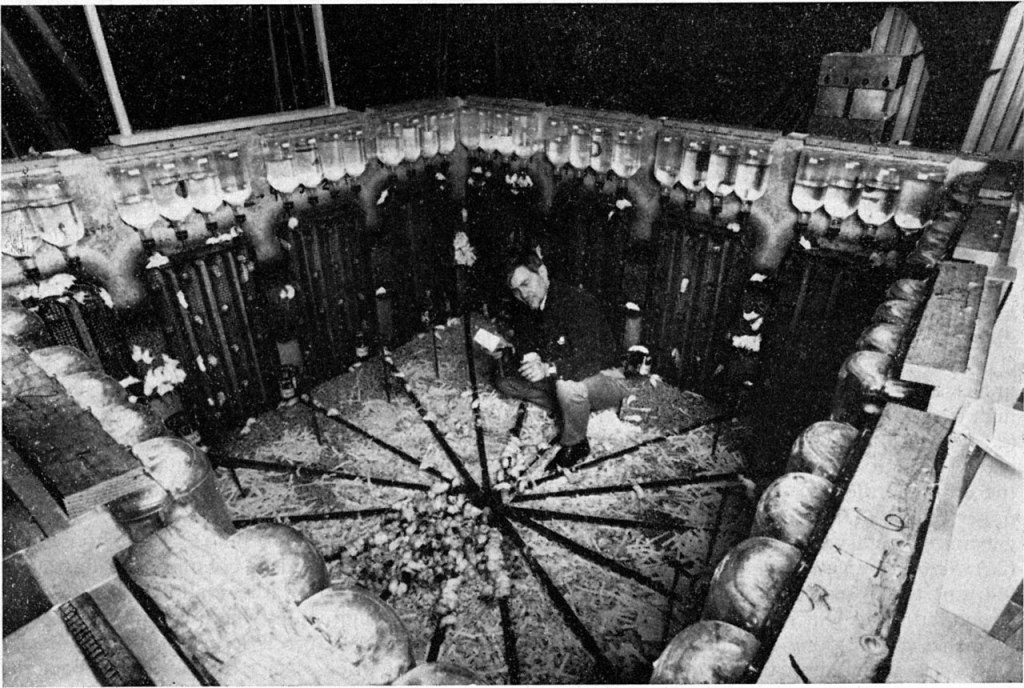
Eksperyment Calhouna zwany mysią utopią – doświadczenie naukowe prowadzone od lipca 1968 do 1972 roku przez amerykańskiego etologaJohna B. Calhouna i kilkakrotnie powtarzane.
Założenia
Doświadczenie polegało na stworzeniu populacji myszy, składającej się najpierw z ośmiu osobników (4 pary), idealnego środowiska do życia. Myszy miały nieograniczony dostęp do pożywienia, wody i materiałów do budowy gniazd, z ich środowiska usunięto wszystkie drapieżniki, a także zapewniono im opiekę medyczną, by uchronić populację przed chorobami zakaźnymi. Jedynym ograniczeniem była powierzchnia – klatka o podstawie kwadratu o bokach długości 2,7 metra i wysokości 1,4 mogła pomieścić maksymalnie 3840 osobników.
Przebieg
Eksperyment trwał 1588 dni. Jego przebieg podzielono na cztery fazy:
Okres przystosowywania się – trwał do 104 dnia, kiedy to urodziły się pierwsze myszy nowego pokolenia. Jest to najkrótsza faza eksperymentu. W tym okresie myszy dokonały podziału terytorium i zaczęły budować pierwsze gniazda.
Okres gwałtownego rozwoju – trwał od dnia 105 do dnia 314. Liczebność myszy dubluje się co 55 dni. Osobniki dominujące, których pozycja społeczna jest wyższa, posiadają liczniejsze potomstwo niż słabsze osobniki. Zauważyć można, że myszy chętniej niż w pierwszej fazie przebywają w towarzystwie innych, obcych myszy.
Okres stagnacji – trwał od dnia 315 do dnia 559. Na początku tej fazy żyło 620 osobników. Populacja dubluje swoją liczebność co 145 dni. U samców następuje stopniowy zanik umiejętności obrony własnego terytorium, natomiast u samic powszechniejsze stają się zachowania agresywne i następuje zanik instynktu macierzyńskiego – potomstwo jest odrzucane przez matki. W fazie tej populacja myszy osiągnęła szczytową liczebność wynoszącą 2200 osobników. Stale zamieszkanych była tylko jedna piąta boksów przeznaczonych dla myszy.
Okres wymierania – trwał od dnia 560, w którym wskaźnik przyrostu naturalnego stał się ujemny, do dnia 1588, w którym zdechła ostatnia mysz, kończąc tym samym eksperyment. Samice coraz rzadziej zachodziły w ciążę, a w końcowej fazie eksperymentu populacja całkowicie utraciła zdolność reprodukcji. Dnia 600 nastąpiło ostatnie żywe urodzenie. W dniu 920 doszło do ostatniej kopulacji. Była to najdłuższa faza eksperymentu. Wśród myszy nastąpił całkowity zanik zachowań społecznych takich jak obrona własnego terytorium i potomstwa. Ich czynności sprowadzały się do zaspokajania potrzeb naturalnych i czyszczenia futra.
Wnioski
Badacz wskazuje, że redukcja naturalnej umieralności w warunkach ograniczonej przestrzeni doprowadziła do nadmiernego zagęszczenia populacji. Młode osobniki dojrzewając nie znajdowały miejsca dla siebie w organizacji społecznej, w której wszystkie role były już obsadzone. W warunkach naturalnych wyjściem z takiej sytuacji jest emigracja, ale w eksperymencie była ona niemożliwa. Walczyły więc o te role tak zaciekle, że efektem ubocznym stał się upadek normalnej organizacji społecznej. Ponadto nadmierna liczba spotkań z innymi osobnikami doprowadziła do unikania kontaktów społecznych. Kolejne młode urodzone w takich warunkach były przedwcześnie porzucane przez matki oraz grupy rodzinne i, wychowując się w zaburzonych warunkach, nabywały cech autystycznych. W szczególności stawały się same niezdolne do podjęcia prokreacji i wychowania młodych[1].
Calhoun podsumowywał te obserwacje pisząc, że śmierć śmierci cielesnej („śmierć do kwadratu” z tytułu jego pracy) prowadzi do śmierci organizacji społecznej i w konsekwencji do śmierci duchowej jednostek i formułował hipotezy, że w analogicznych warunkach społeczność ludzi także podlegałaby podobnym procesom.
Z drugiej strony zwracano uwagę, że eksperymenty laboratoryjne badają organizmy umieszczone w warunkach całkowicie odmiennych od naturalnych. Wpływa to na morfologię i funkcjonowanie ich mózgów, a więc na ich zachowania, rytm dobowy, rozród, reakcje na stres. W efekcie uzyskane wyniki nie muszą prowadzić do wniosków dotyczących organizmów w warunkach innych niż założone w badaniu.
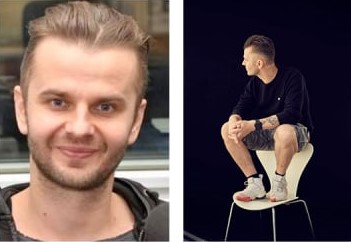
Andrzej Dragan jest profesorem fizyki teoretycznej i laureatem kilkudziesięciu nagród za działalność naukową oraz fotograficzną, filmową i muzyczną. Jako nastolatek działał w grupach crackerskich, obecnie wstrząsa światem nauki. W 2020 roku wraz z profesorem Arturem Ekertem opublikował pracę Kwantowa zasada względności, która może okazać się największym przełomem w rozumieniu teorii kwantowej od czasów Einsteina.
Andrzej Dragan (ur. 16 maja1978) – polski fizyk teoretyk i artysta: fotograf, kompozytor oraz twórca filmowy, a także popularyzator nauki. Doktor habilitowany fizyki, profesor uczelni na Wydziale Fizyki Uniwersytetu Warszawskiego (FUW) i profesor wizytujący na Narodowym Uniwersytecie Singapuru (NUS). Zdobywca wielu nagród krajowych i międzynarodowych. Jako fizyk zajmował się m.in. informacją kwantową w wersji relatywistycznej, habilitując się właśnie na ten temat. Jako fotograf stworzył własny styl portretu.
Studiował na Wydziale Fizyki Uniwersytetu Warszawskiego. 9 stycznia 2006 roku uzyskał tamże stopień doktora nauk fizycznych na podstawie pracy pt. Komunikacja przy użyciu pojedynczych fotonów poprzez niedoskonałe kanały kwantowe. 15 grudnia 2014 roku habilitował się tamże na podstawie pracy pt. Relatywistyczna informacja kwantowa. Pracował w Imperial College London oraz w University of Nottingham. Został profesorem wizytującym na Narodowym Uniwersytecie Singapuru. W Instytucie Fizyki Teoretycznej Uniwersytetu Warszawskiego kierował grupą badawczą, która zajmowała się relatywistycznymi aspektami zjawisk kwantowych.
Twórczość Fizyka Napisał 50 prac z zakresu optyki kwantowej, relatywistycznej teorii informacji kwantowej, teorii względności, kwantowej teorii pola w zakrzywionych czasoprzestrzeniach oraz dwie książki: • podręcznik teorii względności pt. Unusually Special Relativity wydany w 2021 roku przez World Scientific Publishing; • w 2019 roku nakładem wydawnictwa Fabuła Fraza ukazała się jego książka popularnonaukowa poświęcona m.in. fizyce kwantowej pt. Kwantechizm, czyli klatka na ludzi. Popularyzował fizykę także przez artykuły i publiczne wykłady, np. dla FUW i konferencji TEDx w Poznaniu. Udzielał też wywiadów internetowemu Radiu Naukowemu i polskim youtuberom. Fotografia Fotografować zaczął w 2003 roku. Wypracował własną technikę cyfrowej obróbki fotograficznej, nazywaną efektem Dragana. Obróbka ta polega na stosowaniu, oprócz prostej manipulacji kolorem i filtrowania tonalnego, kombinacji charakterystycznego oświetlenia modela oraz ręcznej edycji zdjęcia przy użyciu zestawu specjalnych pędzli, sztucznie korygujących oryginalne oświetlenie. Publikował swoje zdjęcia na okładkach kilkudziesięciu czasopism i książek w wielu krajach świata. Dragan znany jest z szokujących, prowokacyjnych i kontrowersyjnych sesji fotograficznych. Wykonał m.in. serię portretów anorektycznej modelki i portret poranionego mężczyzny w koronie cierniowej (obydwie sesje z 2006 r.) Znany jest również jako autor zdjęć do kampanii reklamowych takich marek jak Energizer, Playstation, XBox, Play czy Converse. Jest też zdobywcą tytułu Fotograf Rok 2007 brytyjskiego czasopisma Digital Camera. Muzyka i film W latach 90 komponował, pod ksywą „Dreamer”, muzykę na komputerach Amiga. Andrzej Dragan stworzył także: • nagradzane krótkometrażowe filmy artystyczne, inspirowane teoriami fizycznymi, • krótkie filmy i reklamy m.in. dla HBO oraz Netflixa, • teledyski, m.in. dla Behemotha, Quebonafide i Hani Rani.
Po wykładzie będzie okazja do rozmów przy lampce wina i preclach.
Życzymy dużo przyjemności. Rada Programowa UTP
Meine Damen und Herren, liebe Freunde,
wir laden Sie zu einem Vortrag in den Hörsaal der Humboldt-Universität, Unter der Linden 6 ein. Am 14. Oktober 2022 um 18.00 Uhr in Raum 3038. Mit Simultanübersetzung ins Deutsche. Das Leitthema dieses Semesters wird Der Neue Humanismus sein. Dr. habil. Andrzej Dragan widmet seinen Vortrag dem Thema: Wissenschaft ist Antihumanismus.
Moderation: Brygida Helbig-Mischewski.
Nach dem Vortrag gibt es Gelegenheit zu Gesprächen bei einem Glas Wein und einem kleinen Imbiss
Andrzej Dragan hat in Warschau, Oxford, Amsterdam sowie Lissabon Physik studiert. Seine Abschlussarbeit wurde 2001 als beste Master Thesis von Polen ausgezeichnet. 2001 und 2002 erhielt er ein Stipendium der Europäischen Wissenschaftsstiftung. 2005 promovierte er mit einer Arbeit über Quantenmechanik. Danach erhielt er die Stelle eines wissenschaftlichen Assistenten im Bereich der „Quantenoptik und Atomphysik“ am Institut für Theoretische Physik der Universität Warschau. Im akademischen Jahr 2008 war er Research Fellow am Imperial College London. Seit 2010 ist er Dozent an der University of Nottingham. Im gleichen Jahr erhielt er ein zweijähriges Stipendium vom polnischen Bildungsministerium für hervorragende junge Wissenschaftler.
Dragans veröffentlichte Fotografien sind ausnahmslos Porträts. Die Sitzungen mit den Modellen dauern nur kurz, er sagt dazu: „Ich mag es nicht, zu fotografieren.“ Der Nachbearbeitung einer Fotografie hingegen widmet er bis zu einem Monat. Seine Bilder werden mit flämischer Malerei verglichen. Das von ihm eingesetzte Licht erzeuge sowohl Nüchternheit als auch Düsterkeit, wodurch die Details Kraft und Klarheit gewännen. Die verwendeten Farben wirkten rein. Er vermeidet es, seine Modelle in einer Bewegung einzufangen. Seine Bilder überarbeitet er mit Photoshop, u. a. zur Montage verschiedener Aufnahmen in ein Bild. Dragan äußert zu seiner Arbeitsweise, diese sei dem Malen ähnlich, nur dass er einen digitalen Pinsel nutze. Er füge keine neuen Elemente hinzu, sondern arbeite bereits Vorhandenes heraus und betone es. Dragan arbeitet als Werbefotograf, wie z. B. für Converse, Fairy, Pilsner Urquell, Avon und Playstation. Er verwendet digitale Spiegelreflexkameras und Objektive von Canon, wie die Canon 10D.
Werke
Physik Er hat 50 Arbeiten über Quantenoptik, relativistische Quanteninformationstheorie, Relativitätstheorie, Quantenfeldtheorie in gekrümmter Raumzeit sowie zwei Bücher geschrieben: – ein Lehrbuch zur Relativitätstheorie mit dem Titel Unusually Special Relativity, das 2021 bei World Scientific Publishing veröffentlicht wurde; – 2019 erschien sein populärwissenschaftliches Buch, das unter anderem Quantenphysik gewidmet ist, mit dem Titel Quantenchismus oder der Menschenkäfig beim Verlag Fabula Fraza. Er popularisierte Physik auch durch Artikel und öffentliche Vorträge, z. B. für den FUW (Fachbereich Physik der Universität Warschau) und die TEDx-Konferenz in Poznań. Außerdem gab er auch Interviews, u a. dem Internet-Sender Wissenschaft und polnischen Youtubern.
Fotografie Er begann 2003 zu fotografieren und entwickelte seine eigene Technik der digitalen Fotobearbeitung, den so genannten Dragan-Effekt. Bei dieser Bearbeitung wird neben einfacher Farbmanipulation und Tonwertfilterung eine Kombination aus charakteristischer Beleuchtung des Modells und manueller Bearbeitung des Fotos mit einem Satz spezieller Pinsel verwendet, um die ursprüngliche Beleuchtung künstlich zu korrigieren.
Der Fotograf hat seine Fotos auf den Titelseiten von Dutzenden von Zeitschriften und Büchern in vielen Ländern der Welt veröffentlicht.
Dragan ist bekannt für seine schockierenden, provokanten und kontroversen Fotoshootings. Unter anderem hat er eine Serie von Porträts eines magersüchtigen Models und ein Porträt eines verletzten Mannes mit Dornenkrone angefertigt (beide Sessions aus dem Jahr 2006). Er ist auch als Autor von Fotos für Werbekampagnen von Marken wie Energizer, Playstation, XBox, Play und Converse bekannt. Außerdem gewann er den Titel Fotograf des Jahres 2007 der britischen Zeitschrift Digital Camera.
Musik und Film In den 90er Jahren komponierte er unter dem Spitznamen ‚Dreamer‘ Musik mit Amiga-Computern. Andrzej Dragan schuf auch: – preisgekrönte, von Physiktheorien inspirierte Kurzfilme, – Kurzfilme und Werbespots u. a. für HBO und Netflix, – Musikvideos, z. B. für Behemoth, Quebonafide und Hani Rani.Moderation: Dr. habil. Brygida Helbig
Proszę o wybaczenie Teresę, której obiecałam, że dziś umieszczę jej wiersze, ale niestety, przesuwam je na jutro, no bo dziś muszę się po prostu zachłysnąć faktem, że archeolog dostał nagrodę Nobla. Wiem, wiem, to nagroda Nobla z medycyny, ale naprawdę chlubę przynosi archeologii.
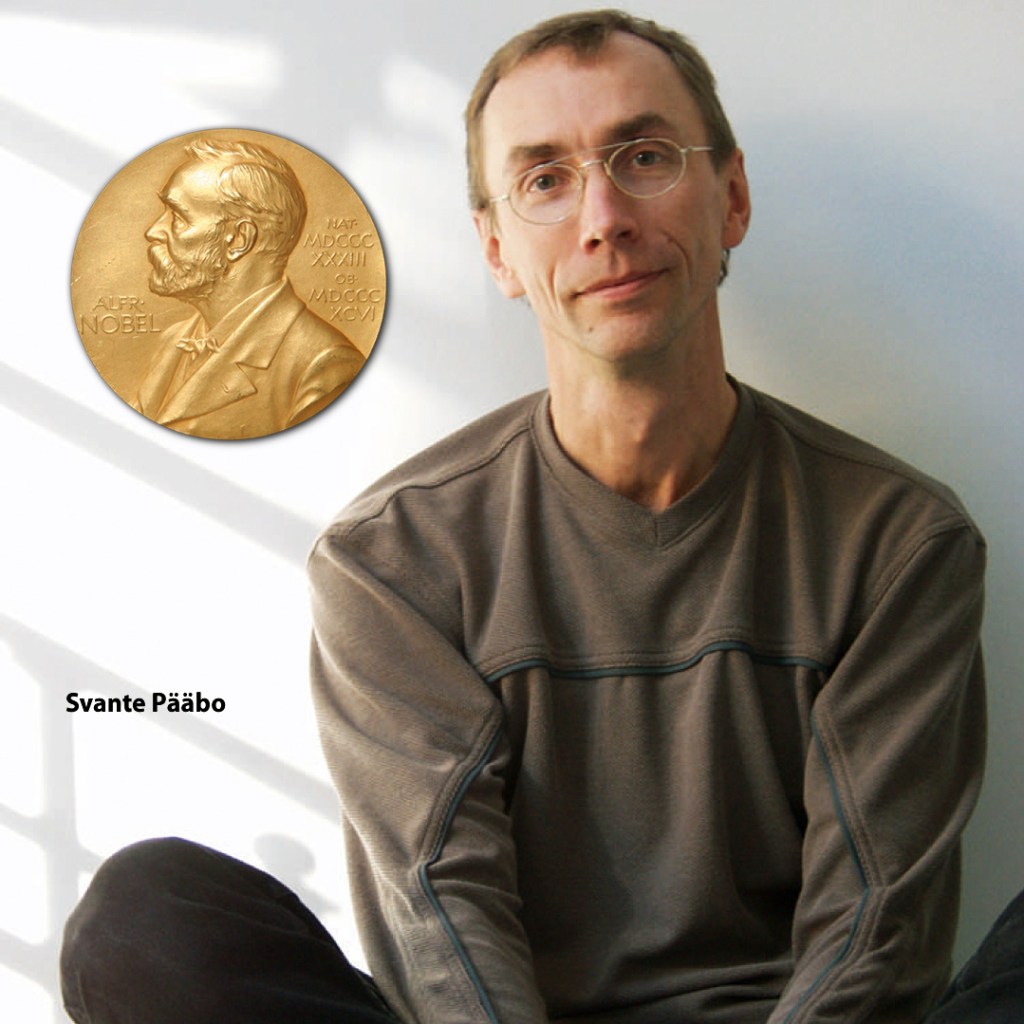
Bez Svante Pääbo, który 3 października otrzymał nagrodę Nobla z medycyny, nie poznalibyśmy genomów neandertalczyka i denisowianina, no i nie umielibyśmy wskazać, jaki odsetek genów dzielimy z tymi wymarłymi krewniakami
To Pääbo jako pierwszy na świecie uznał, że możliwe jest zsekwencjonowanie DNA faraona sprzed 3000 lat i neandertalczyka sprzed 30 tysięcy. Wymyślił to w czasach, kiedy samo sekwencjonowanie było wyczynem, nie mówiąc już o sekwencjonowaniu genomu uszkodzonego lub, co gorsza, należącego do dawno wymarłego gatunku!
Fot. PLoS
Svante Pääbo to geniusz i prekursor w jednym. A do tego niezwykle barwna postać.
Od fascynacji egiptologią i mumiami egipskimi szwedzki naukowiec przeniósł zainteresowania na neandertalczyka i niezwykle tajemniczego człowieka z jaskini Denisowej, który okazał się jeszcze jednym wymarłym gatunkiem Homo.
To w dużej mierze dzięki drobiazgowości Pääbo zrekonstruowane zostały trasy wędrówek Homo sapiens po opuszczeniu kolebki ludzkości, Afryki.
Szwedzki naukowiec sam obsesyjnie wypracowywał metody pracy w laboratorium, z których korzystają teraz wszyscy genetycy, a które pozwoliły mu uniknąć kompromitacji wynikającej z zanieczyszczenia genomów wymarłych gatunków DNA pochodzącym od pracowników laboratorium czy też od przyniesionych przez nich bakterii. Bo jakby to było, gdyby światło dzienne ujrzał nie genom neandertalczyka czy denisowianina, tylko genom jednego z laborantów z pracowni Pääbo?
Pääbo całymi latami był uznawany za naukowca niepokornego i trochę niewygodnego, wskutek czego w zasadzie został “zesłany”, jak sam napisał w książce “Neandertalczyk”, do Instytutu Maxa Plancka w Lipsku. A następnie, ku zaskoczeniu wielu osób, wprowadził ten instytut, założony w miejscu poenerdowskiego ośrodka, do ścisłej światowej czołówki!
Pääbo to jeden z najwybitniejszych współczesnych genetyków, twórca nowej dyscypliny naukowej – paleogenomiki. To nazwisko po prostu trzeba znać.
O tym, czego dokonał Svante Pääbo przeczytajcie TU.
PS. A może to jest Don Kichot? Taki chudy. I tak robi w nauce wszystko na opak.
zapraszamy na inaugurację nowego semestru tym razem w sali wykładowej Uniwersytetu Humboldtów przy Unter der Linden 6.
Pierwszy po pandemii wykład odbędzie się
16 września 2022 roku o godz. 18.00 w sali 2094.
Z tłumaczeniem symultanicznym na niemiecki
Tematem wiodącym w tym semestrze będzie “Nowa humanistyka”
Prof. Przemysław Czapliński poświęci swój wykład tematowi:
„Nowa humanistyka: sojusze i konflikty”
Przemysław Czapliński – profesor zwyczajny; historyk literatury polskiej i europejskiej XX i XXI wieku, eseista, tłumacz, krytyk literacki; współtwórca Zakładu Antropologii Literatury (UAM, Poznań), dyrektor Centrum Humanistyki Otwartej przy UAM, członek-korespondent Polskiej Akademii Nauk. Ostatnie publikacje: Polska do wymiany (2009), Resztki nowoczesności (2011), Poruszona mapa (2016), Literatura i jej natury (2017; współautorzy: Joanna B. Bednarek, Dawid Gostyński). Redaktor tomów zbiorowych – m. in.: O jeden las za daleko. Demokracja, kapitalizm i nieposłuszeństwo ekologiczne w Polsce (współredaktorzy: J.B. Bednarek, D. Gostyński; 2019), Tożsamość po pogromie. Świadectwa i interpretacje Marca ’68 (współredaktor: Alina Molisak, Warszawa 2019). Visting professor Uniwersytetu w Heidelbergu (2017) i Moguncji (2020). Laureat nagród: im. Ludwika Frydego (1997), Fundacji im. Kościelskich (1998), im. Kazimierza Wyki (2004), im. Jana Długosza (2017), Marszałka Województwa Wielkopolskiego (2019). Przedmiot badań: literatura i problemy późnej nowoczesności. Wkrótce ukaże się książka To wróci, Przeszłość i przyszłość pandemii (red.: P. Czapliński, J.B. Bednarek).
Tytuł wykładu: „Nowa humanistyka: sojusze i konflikty”.
Wykład zostanie poświęcony dwóm przeciwstawnym zjawiskom, które charakteryzują współczesną humanistykę. Jedno z nich polega na stopniowym rozpuszczaniu granic między dziedzinami naukowymi, drugie – na krystalizowaniu się postawy oporu. Sojusze między humanistyką, prawem, socjologią, informatyką, ekonomią i wieloma innymi dziedzinami nadają humanistyce charakter uniwersalnego koalicjanta, zacierają wyrazistość dotychczasowej profesji i utrudniają odpowiedź na pytanie, czym humanista się zajmuje. Zatarte oblicze nabiera jednak wyrazistości, kiedy weźmiemy pod uwagę rosnące zaangażowanie humanistyki w rozpoznawanie i diagnozowanie współczesnych konfliktów – społecznych, ekonomicznych, ekologicznych czy prawnych. Pytanie zasadnicze brzmi: w jaki sposób rozmyty profesjonalizm sprzyja zwiększonej odpowiedzialności? Na jakiej podstawie humanista, który może zajmować się niemal wszystkim, określa, czego powinien bronić?
Moderacja: dr habil. Brygida Helbig
Życzymy dużo przyjemności. Rada Programowa UTP
Meine Damen und Herren, liebe Freunde,
wir laden Sie ein zur Eröffnung des neuen Semesters, diesmal in den Hörsaal der Humboldt-Universität Unter der Linden 6. Der erste Vortrag nach der Pandemie findet 16. September 2022 um 18.00 Uhr im Raum 2094 statt.
Mit Simultanübersetzung ins Deutsche
Leitthema: Der Neue Humanismus
Przemysław Czapliński – ordentlicher Professor; Literaturhistoriker mit dem Forschungsschwerpunkt polnische und europäische Literatur des 20. Und 21. Jahrhunderts, Essayist, Übersetzer, Literaturkritiker; Mitbegründer der Forschungsstelle für Literaturanthropologie der Universität Poznań (UAM), Direktor des Zentrums für freie Geisteswissenschaften an der UAM, korrespondierendes Mitglied der Polnischen Akademie der Wissenschaften. Zuletzt publiziert: Polska do wymiany [Polen zum Auswechseln] (2009), Resztki nowoczesności [Überbleibsel der Modernität] (2011), Poruszona mapa [Verrutschte Landkarte] (2016), Literatura i jej natury [Literatur und ihre Naturen] (2017; Mitverfasser: Joanna B. Bednarek, Dawid Gostyński). Herausgeber von Sammelbänden – u.a.: O jeden las za daleko. Demokracja, kapitalizm i nieposłuszeństwo ekologiczne w Polsce [Einen Wald zu weit. Demokratie, Kapitalismus und ökologischer Ungehorsam in Polen] (Mitherausgeber: J.B. Bednarek, D. Gostyński; 2019), Tożsamość po pogromie. Świadectwa i interpretacje Marca ’68 [Identität nach dem Pogrom. Zeugnisse und Interpretationen] (Mitherausgeberin: Alina Molisak, Warszawa 2019). Gastprofessor an der Ruprecht-Karls-Universität Heidelberg (2017) und der Johannes-Gutenberg-Universität Mainz (2020). Preisträger folgender Auszeichnungen: Ludwik Fryde-Preis (1997), Preis der Kościelski-Stiftung (1998), Kazimierz-Wyka-Preis (2004), Jan-Długosz-Preis (2017), Preis des Marschalls der Woiwodschaft Wielkopolskie (2019). Forschungsschwerpunkte: Literatur und Probleme der späten Moderne. Demnächst erscheint die Buchpublikation To wróci, Przeszłość i przyszłość pandemii [Das kommt wieder. Zur Vergangenheit und Zukunft der Pandemie] (Hgg.: P. Czapliński, J.B. Bednarek).
Titel des Vortrags: „Neue Geisteswissenschaften: Bündnisse und Konflikte“. Der Vortrag wird zwei entgegengesetzten Phänomenen gewidmet, welche die zeitgenössischen Geisteswissenschaften prägen: Das eine beruht auf der stufenweisen Verwischung der Grenzen zwischen den Wissenschaftsgebieten, und das andere zeigt, wie sich Widerstandshaltungen herauskristallisieren. Die Bündnisse zwischen Geisteswissenschaft, Jura, Soziologie, Informatik, Ökonomie und vielen anderen Gebieten haben den Charakter einer universellen Bündnispartnerschaft, sie verwischen die Konturen der bisherigen Berufsfelder und erschweren die Beantwortung der Frage, womit sich der Geisteswissenschaftler befasst. Das verschwommene Antlitz des Faches gewinnt allerdings an Deutlichkeit, wenn wir das Engagement der Geisteswissenschaftler in die Erkennung und Diagnostizierung der zeitgenössischen – sozialen, ökonomischen und ökologischen oder rechtlichen – Konflikte berücksichtigen. Die grundsätzliche Frage lautet: Auf welche Weise begünstigt die konturschwache Professionalität eine verstärkte Bereitschaft zur Verantwortung? Was nimmt ein Geisteswissenschaftler – der sich ja mit beinahe jeder Problematik beschäftigen kann – zur Grundlage, wenn er bestimmt, was er verteidigen sollte? Moderation: Dr. habil. Brygida Helbig
Lots of Big Bang Theory discussions since Webb’s Deep Field was released. Here’s an article about the history and meaning of the Big Bang Theory from Big Think:
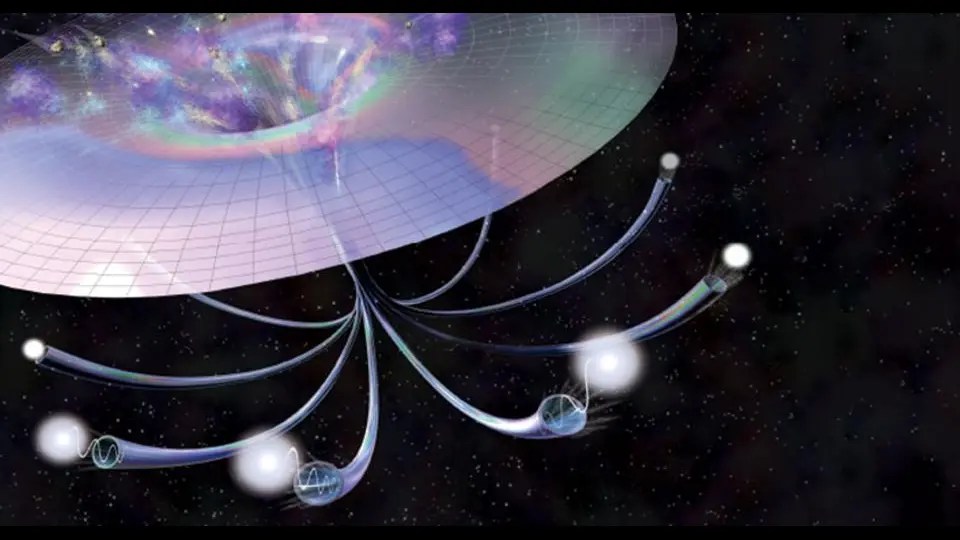
From a pre-existing state, inflation predicts that a series of universes will be spawned as inflation continues, with each one being completely disconnected from every other one, separated by more inflating space. One of these “bubbles,” where inflation ended, gave birth to our Universe some 13.8 billion years ago, where our entire visible Universe is just a tiny portion of that bubble’s volume. Each individual bubble is disconnected from all of the others, and each place where inflation ends gives rise to its own hot Big Bang. (Credit: Nicolle Rager Fuller)
As we gain new knowledge, our scientific picture of how the Universe works must evolve. This is a feature of the Big Bang, not a bug.
If there’s one hallmark inherent to science, it’s that our understanding of how the Universe works is always open to revision in the face of new evidence. Whenever our prevailing picture of reality — including the rules it plays by, the physical contents of a system, and how it evolved from its initial conditions to the present time — gets challenged by new experimental or observational data, we must open our minds to changing our conceptual picture of the cosmos. This has happened many times since the dawn of the 20th century, and the words we use to describe our Universe have shifted in meaning as our understanding has evolved.
Yet, there are always those who cling to the old definitions, much like linguistic prescriptivists, who refuse to acknowledge that these changes have occurred. But unlike the evolution of colloquial language, which is largely arbitrary, the evolution of scientific terms must reflect our current understanding of reality. Whenever we talk about the origin of our Universe, the term “the Big Bang” comes to mind, but our understanding of our cosmic origins have evolved tremendously since the idea that our Universe even had an origin, scientifically, was first put forth. Here’s how to resolve the confusion and bring you up to speed on what the Big Bang originally meant versus what it means today.
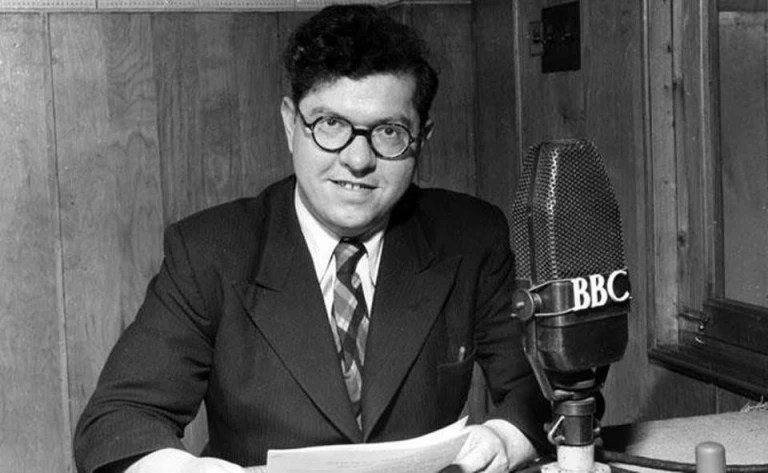
Fred Hoyle was a regular on BBC radio programsin the 1940s and 1950s, and one of the mostinfluential figures in the field of stellarnucleosynthesis. His role as the Big Bang’s most vocaldetractor, even after the critical evidence supportingit had been discovered, is one of his longest-enduringlegacies. (Credit: British Broadcasting Company)
The first time the phrase “the Big Bang” was uttered was over 20 years after the idea was first described. In fact, the term itself comes from one of the theory’s greatest detractors: Fred Hoyle, who was a staunch advocate of the rival idea of a Steady-State cosmology. In 1949, he appeared on BBC radio and advocated for what he called the perfect cosmological principle: the notion that the Universe was homogeneous in both space and time, meaning that any observer not only anywhere but anywhen would perceive the Universe to be in the same cosmic state. He went on to deride the opposing notion as a “hypothesis that all matter of the universe was created in one Big Bang at a particular time in the remote past,” which he then called “irrational” and claimed to be “outside science.”
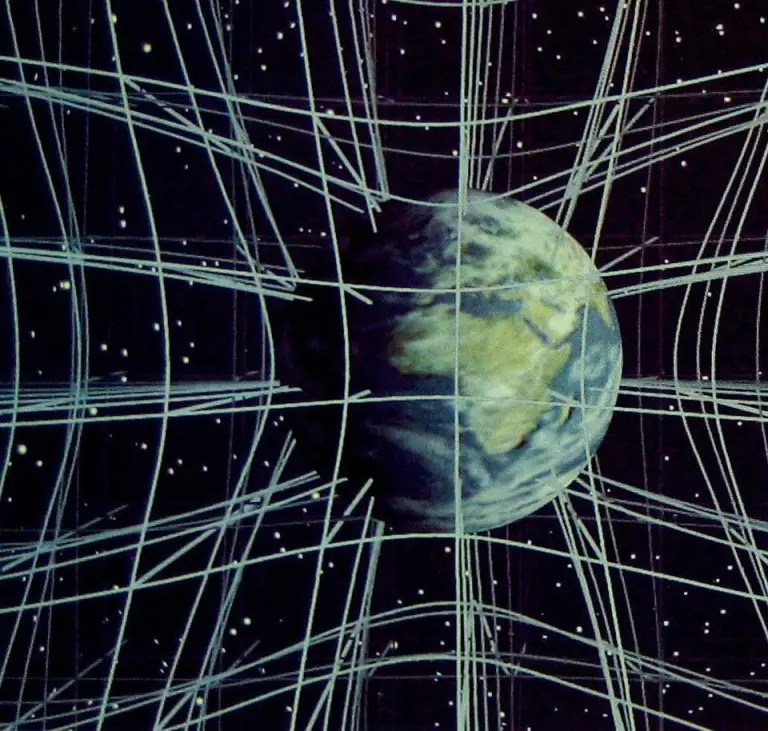
Instead of an empty, blank, three-dimensional grid, putting a mass down causes what would have been ‘straight’ lines to instead become curved by a specific amount. In General Relativity, we treat space and time as continuous, but all forms of energy, including but not limited to mass, contribute to spacetime curvature. The deeper you are in a gravitational field, the more severely all three dimensions of your space is curved, and the more severe the phenomena of time dilation and gravitational redshift become. (Credit: Christopher Vitale of Networkologies and the Pratt Institute)
But the idea, in its original form, wasn’t simply that all of the Universe’s matter was created in one moment in the finite past. That notion, derided by Hoyle, had already evolved from its original meaning. Originally, the idea was that the Universe itself, not just the matter within it, had emerged from a state of non-being in the finite past. And that idea, as wild as it sounds, was an inevitable but difficult-to-accept consequence of the new theory of gravity put forth by Einstein back in 1915: General Relativity.
When Einstein first cooked up the general theory of relativity, our conception of gravity forever shifted from the prevailing notion of Newtonian gravity. Under Newton’s laws, the way that gravitation worked was that any and all masses in the Universe exerted a force on one another, instantaneously across space, in direct proportion to the product of their masses and inversely proportional to the square of the distance between them. But in the aftermath of his discovery of special relativity, Einstein and many others quickly recognized that there was no such thing as a universally applicable definition of what “distance” was or even what “instantaneously” meant with respect to two different locations.
With the introduction of Einsteinian relativity — the notion that observers in different frames of reference would all have their own unique, equally valid perspectives on what distances between objects were and how the passage of time worked — it was only almost immediate that the previously absolute concepts of “space” and “time” were woven together into a single fabric: spacetime. All objects in the Universe moved through this fabric, and the task for a novel theory of gravity would be to explain how not just masses, but all forms of energy, shaped this fabric that underpinned the Universe itself.
If you begin with a bound, stationary configuration of mass, and there are no non-gravitational forces or effects present (or they’re all negligible compared to gravity), that mass will always inevitably collapse down to a black hole. It’s one of the main reasons why a static, non-expanding Universe is inconsistent with Einstein’s General Relativity. (Credit: E. Siegel/Beyond the Galaxy)
Although the laws that governed how gravitation worked in our Universe were put forth in 1915, the critical information about how our Universe was structured had not yet come in. While some astronomers favored the notion that many objects in the sky were actually “island Universes” that were located well outside the Milky Way galaxy, most astronomers at the time thought that the Milky Way galaxy represented the full extent of the Universe. Einstein sided with this latter view, and — thinking the Universe was static and eternal — added a special type of fudge factor into his equations: a cosmological constant.
Although it was mathematically permissible to make this addition, the reason Einstein did so was because without one, the laws of General Relativity would ensure that a Universe that was evenly, uniformly distributed with matter (which ours seemed to be) would be unstable against gravitational collapse. In fact, it was very easy to demonstrate that any initially uniform distribution of motionless matter, regardless of shape or size, would inevitably collapse into a singular state under its own gravitational pull. By introducing this extra term of a cosmological constant, Einstein could tune it so that it would balance out the inward pull of gravity by proverbially pushing the Universe out with an equal and opposing action.
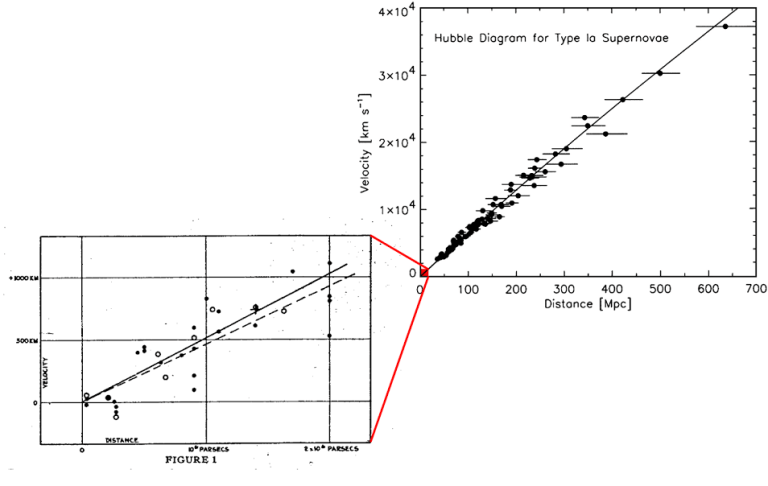
Edwin Hubble’s original plot of galaxy distances versus redshift (left), establishing the expanding Universe, versus a more modern counterpart from approximately 70 years later (right). In agreement with both observation and theory, the Universe is expanding, and the slope of the line relating distance to recession speed is a constant.
Two developments — one theoretical and one observational — would quickly change this early story that Einstein and others had told themselves.
In 1922, Alexander Friedmann worked out, fully, the equations that governed a Universe that was isotropically (the same in all directions) and homogeneously (the same in all locations) filled with any type of matter, radiation, or other form of energy. He found that such a Universe would never remain static, not even in the presence of a cosmological constant, and that it must either expand or contract, dependent on the specifics of its initial conditions.
In 1923, Edwin Hubble became the first to determine that the spiral nebulae in our skies were not contained within the Milky Way, but rather were located many times farther away than any of the objects that comprised our home galaxy. The spirals and ellipticals found throughout the Universe were, in fact, their own “island Universes,” now known as galaxies, and that moreover — as had previously been observed by Vesto Slipher — the vast majority of them appeared to be moving away from us at remarkably rapid speeds.
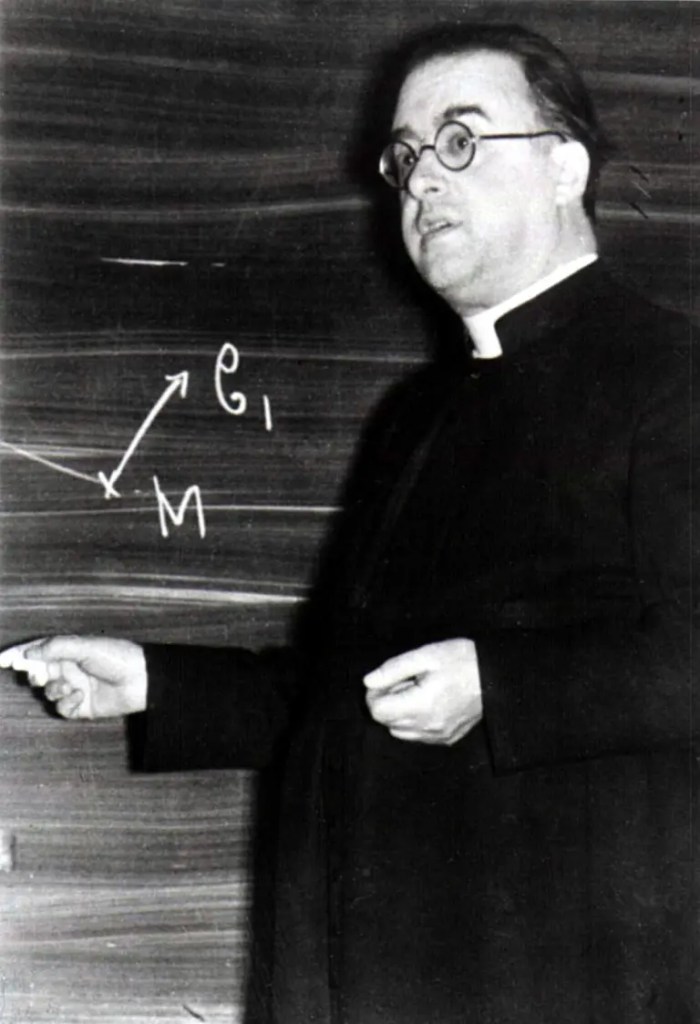
In 1927, Georges Lemaître became the very first person to put these pieces of information together, recognizing that the Universe today is expanding, and that if things are getting farther apart and less dense today, then they must have been closer together and denser in the past. Extrapolating this back all the way to its logical conclusion, he deduced that the Universe must have expanded to its present state from a single point-of-origin, which he called either the “cosmic egg” or the “primeval atom.”
This image shows Catholic priest and theoretical cosmologist Georges Lemaître at the Catholic University of Leuven, ca. 1933. Lemaître was among the first to conceptualize the Big Bang as the origin of our Universe within the framework of General Relativity, even though he didn’t use that name himself. (Credit: public domain)
This was the original notion of what would grow into the modern theory of the Big Bang: the idea that the Universe had a beginning, or a “day without yesterday.” It was not, however, generally accepted for some time. Lemaître originally sent his ideas to Einstein, who infamously dismissed Lemaître’s work by responding, “Your calculations are correct, but your physics is abominable.”
Despite the resistance to his ideas, however, Lemaître would be vindicated by further observations of the Universe. Many more galaxies would have their distances and redshifts measured, leading to the overwhelming conclusion the Universe was and still is expanding, equally and uniformly in all directions on large cosmic scales. In the 1930s, Einstein conceded, referring to his introduction of the cosmological constant in an attempt to keep the Universe static as his “greatest blunder.”
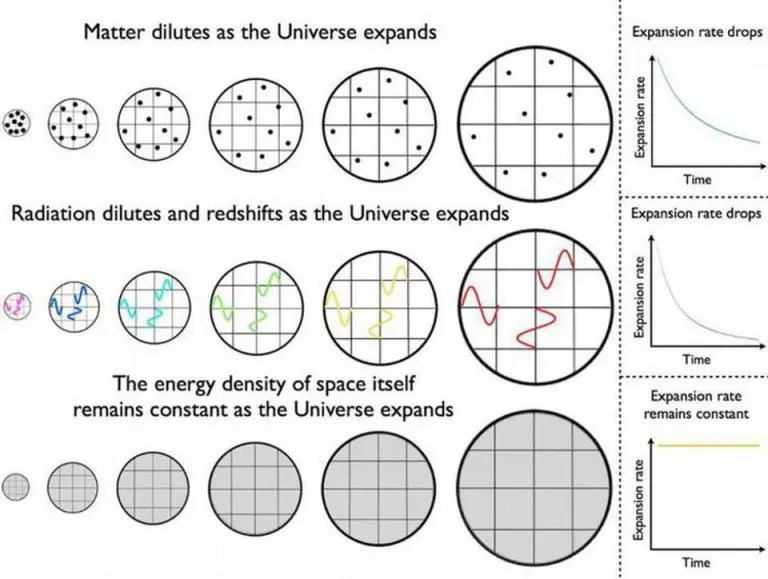
However, the next great development in formulating what we know of as the Big Bang wouldn’t come until the 1940s, when George Gamow — perhaps not so coincidentally, an advisee of Alexander Friedmann — came along. In a remarkable leap forward, he recognized that the Universe was not only full of matter, but also radiation, and that radiation evolved somewhat differently from matter in an expanding Universe. This would be of little consequence today, but in the early stages of the Universe, it mattered tremendously.
Matter, Gamow realized, was made up of particles, and as the Universe expanded and the volume that these particles occupied increased, the number density of matter particles would drop in direct proportion to how the volume grew.
But radiation, while also made up of a fixed number particles in the form of photons, had an additional property: the energy inherent to each photon is determined by the photon’s wavelength. As the Universe expands, the wavelength of each photon gets lengthened by the expansion, meaning that the amount of energy present in the form of radiation decreases faster than the amount of energy present in the form of matter in the expanding Universe.
But in the past, when the Universe was smaller, the opposite would have been true. If we were to extrapolate backward in time, the Universe would have been in a hotter, denser, more radiation-dominated state. Gamow leveraged this fact to make three great, generic predictions about the young Universe.
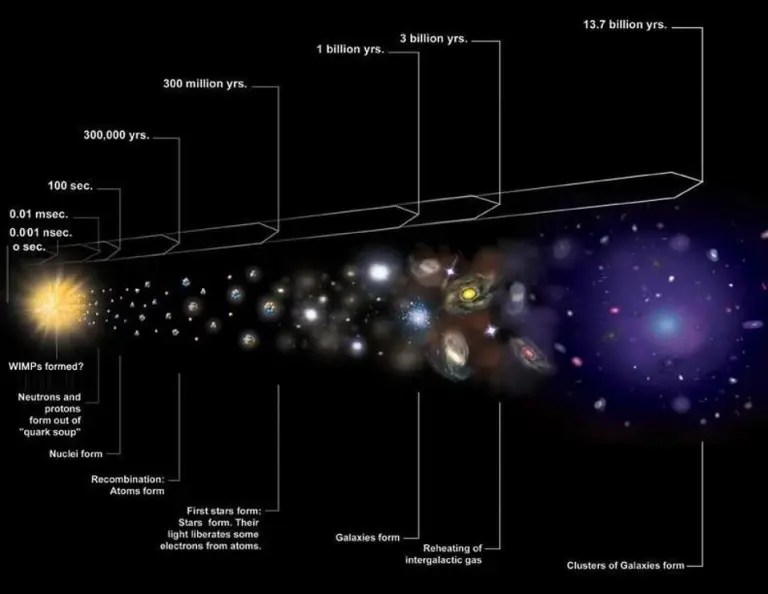
At some point, the Universe’s radiation was hot enough so that every neutral atom would have been ionized by a quantum of radiation, and that this leftover bath of radiation should still persist today at only a few degrees above absolute zero.
At some even earlier point, it would have been too hot to even form stable atomic nuclei, and so an early stage of nuclear fusion should have occurred, where an initial mix of protons-and-neutrons should have fused together to create an initial set of atomic nuclei: an abundance of elements that predates the formation of atoms.
And finally, this means that there would be some point in the Universe’s history, after atoms had formed, where gravitation pulled this matter together into clumps, leading to the formation of stars and galaxies for the first time.
Schematic diagram of the Universe’s history, highlighting reionization. Before stars or galaxies formed, the Universe was full of light-blocking, neutral atoms that formed back when the Universe was ~380,000 years old. Most of the Universe doesn’t become reionized until 550 million years afterwards, with some regions achieving full reionization earlier and others later. The first major waves of reionization begin happening at around ~200 million years of age, while a few fortunate stars may form just 50-to-100 million years after the Big Bang. With the right tools, like the JWST, we hope to reveal the earliest galaxies of all. (Credit: S. G. Djorgovski et al., Caltech; Caltech Digital Media Center)
These three major points, along with the already-observed expansion of the Universe, form what we know today as the four cornerstones of the Big Bang. Although one was still free to extrapolate the Universe back to an arbitrarily small, dense state — even to a singularity, if you’re daring enough to do so — that was no longer the part of the Big Bang theory that had any predictive power to it. Instead, it was the emergence of the Universe from a hot, dense state that led to our concrete predictions about the Universe.
Over the 1960s and 1970s, as well as ever since, a combination of observational and theoretical advances unequivocally demonstrated the success of the Big Bang in describing our Universe and predicting its properties.
The discovery of the cosmic microwave background and the subsequent measurement of its temperature and the blackbody nature of its spectrum eliminated alternative theories like the Steady State model.
The measured abundances of the light elements throughout the Universe verified the predictions of Big Bang nucleosynthesis, while also demonstrating the need for fusion in stars to provide the heavy elements in our cosmos.
And the farther away we look in space, the less grown-up and evolved galaxies and stellar populations appear to be, while the largest-scale structures like galaxy groups and clusters are less rich and abundant the farther back we look.
The Big Bang, as verified by our observations, accurately and precisely describes the emergence of our Universe, as we see it, from a hot, dense, almost-perfectly uniform early stage.
But what about the “beginning of time?” What about the original idea of a singularity, and an arbitrarily hot, dense state from which space and time themselves could have first emerged?
A visual history of the expanding Universe includes the hot, dense state known as the Big Bang and the growth and formation of structure subsequently. The full suite of data, including the observations of the light elements and the cosmic microwave background, leaves only the Big Bang as a valid explanation for all we see. As the Universe expands, it also cools, enabling ions, neutral atoms, and eventually molecules, gas clouds, stars, and finally galaxies to form. However, the Big Bang was not an explosion, and cosmic expansion is very different from that idea.
That’s a different conversation, today, than it was back in the 1970s and earlier. Back then, we knew that we could extrapolate the hot Big Bang back in time: back to the first fraction-of-a-second of the observable Universe’s history. Between what we could learn from particle colliders and what we could observe in the deepest depths of space, we had lots of evidence that this picture accurately described our Universe.
But at the absolute earliest times, this picture breaks down. There was a new idea — proposed and developed in the 1980s — known as cosmological inflation, that made a slew of predictions that contrasted with those that arose from the idea of a singularity at the start of the hot Big Bang. In particular, inflation predicted:
A curvature for the Universe that was indistinguishable from flat, to the level of between 99.99% and 99.9999%; comparably, a singularly hot Universe made no prediction at all.
Equal temperatures and properties for the Universe even in causally disconnected regions; a Universe with a singular beginning made no such prediction.
A Universe devoid of exotic high-energy relics like magnetic monopoles; an arbitrarily hot Universe would possess them.
A Universe seeded with small-magnitude fluctuations that were almost, but not perfectly, scale invariant; a non-inflationary Universe produces large-magnitude fluctuations that conflict with observations.
A Universe where 100% of the fluctuations are adiabatic and 0% are isocurvature; a non-inflationary Universe has no preference.
A Universe with fluctuations on scales larger than the cosmic horizon; a Universe originating solely from a hot Big Bang cannot have them.
And a Universe that reached a finite maximum temperature that’s well below the Planck scale; as opposed to one whose maximum temperature reached all the way up to that energy scale.
The first three were post-dictions of inflation; the latter four were predictions that had not yet been observed when they were made. On all of these accounts, the inflationary picture has succeeded in ways that the hot Big Bang, without inflation, has not.
The quantum fluctuations that occur during inflation get stretched across the Universe, and when inflation ends, they become density fluctuations. This leads, over time, to the large-scale structure in the Universe today, as well as the fluctuations in temperature observed in the CMB. New predictions like these are essential for demonstrating the validity of a proposed fine-tuning mechanism, and to test (and potentially rule out) alternatives. (Credit: E. Siegel; ESA/Planck and the DOE/NASA/NSF Interagency Task Force on CMB research)
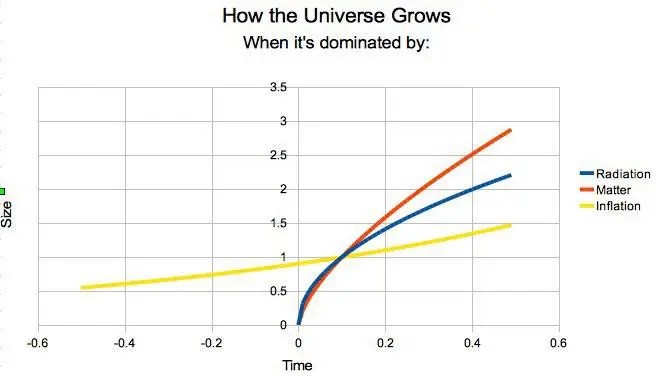
During inflation, the Universe must have been devoid of matter-and-radiation and instead contained some sort of energy — whether inherent to space or as part of a field — that didn’t dilute as the Universe expanded. This means that inflationary expansion, unlike matter-and-radiation, didn’t follow a power law that leads back to a singularity but rather is exponential in character. One of the fascinating aspects about this is that something that increases exponentially, even if you extrapolate it back to arbitrarily early times, even to a time where t → -∞, it never reaches a singular beginning.
Now, there are many reasons to believe that the inflationary state wasn’t one that was eternal to the past, that there might have been a pre-inflationary state that gave rise to inflation, and that, whatever that pre-inflationary state was, perhaps it did have a beginning. There are theorems that have been proven and loopholes discovered to those theorems, some of which have been closed and some of which remain open, and this remains an active and exciting area of research.
Blue and red lines represent a “traditional” Big Bang scenario, where everything starts at time t=0, including spacetime itself. But in an inflationary scenario (yellow), we never reach a singularity, where space goes to a singular state; instead, it can only get arbitrarily small in the past, while time continues to go backward forever. Only the last minuscule fraction of a second, from the end of inflation, imprints itself on our observable Universe today. (Credit: E. Siegel)
But one thing is for certain.
Whether there was a singular, ultimate beginning to all of existence or not, it no longer has anything to do with the hot Big Bang that describes our Universe from the moment that:
inflation ended,
the hot Big Bang occurred,
the Universe became filled with matter and radiation and more,
and it began expanding, cooling, and gravitating,
eventually leading to the present day. There are still a minority of astronomers, astrophysicists and cosmologists who use “the Big Bang” to refer to this theorized beginning and emergence of time-and-space, but not only is that not a foregone conclusion anymore, but it doesn’t have anything to do with the hot Big Bang that gave rise to our Universe. The original definition of the Big Bang has now changed, just as our understanding of the Universe has changed. If you’re still behind, that’s ok; the best time to catch up is always right now.
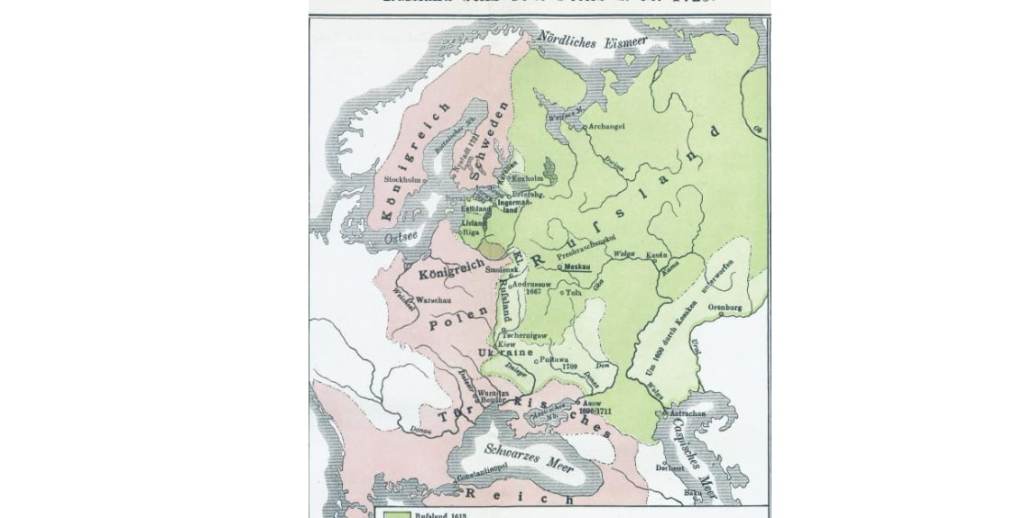
Was könnte Vladimir Putin gemeint haben, als er bei einem öffentlichen Gespräch anlässlich des 350. Geburtstags Peters des Großen laut über dessen Vermächtnis für das heutige Russland nachdachte. Gesagt hat er Folgendes: „Peter der Große führte 21 Jahre lang den Großen Nordischen Krieg. Er kämpfte gegen Schweden und versuchte, dem Land einige seiner Teile zu entreißen. Er hat nichts genommen, sondern er hat das Land zurückgeholt. Ja, er holte das Land zurück und stärkte es. Genau das hat er getan. Offensichtlich sind jetzt wir an der Reihe, das Land zurückzuholen und zu stärken. Und wenn wir davon ausgehen, dass diese Werte die Grundlage unseres Daseins sind, dann werden wir die Aufgaben, vor denen wir stehen, sicher erfolgreich lösen.” Was Putin sicher nicht meinte, wenn von den „Werten“ der Peter-Zeit sprach, ist immerhin klar. Peter I. verstand sich als Vorkämpfer einer radikalen Öffnung Russlands für die westliche Zivilisation – durch welche er das hoffnungslos rückständige Moskauer Zartum „vom Nicht-Sein ins Sein“ führen wollte. Putin dagegen verficht vehement dieselben Thesen, welche alle russischen Kritiker Peters I. vom 19. Jahrhundert bis heute, darunter auch Aleksander Solschenizyn, vertreten haben: Die „Unterwerfung“ unter die dekadente westliche Zivilisation sei Russlands Verderben. Nicht die Vision Peters I. von einer neuen, aufgeklärten russischen Gesellschaft könne das Leitbild sein, sondern die Rückkehr zu dem alten Leitbild einer religiös-mythisch begründeten russischen Gemeinschaft. Ganz unklar ist aber, warum und wie sich Putin auf Peters Außen- und Eroberungspolitik, auf den 21 Jahre dauernden Großen Nordischen Krieg und dessen Resultate berufen könnte. Gewiss, der am Ende dieses Kriegs 1721 in Nystad besiegelte Frieden markierte einen spektakulären Sieg Russland; er ließ auch Peters Anspruch darauf, nicht mehr nur als „moskowitscher Zar“, sondern als russischer Kaiser tituliert und behandelt zu werden, plausibel erscheinen. Doch um welche territorialen Ansprüche und tatsächlichen Erwerbungen des Moskauer/des Russischen Reichs ging es damals? Durch den Nystad-Frieden kam Russland in den Besitz von Ingermanland und Teilen Kareliens (wo es immerhin russischsprachige Bewohner gab), außerdem von Estland und Livland (Ländern ohne traditionelle ethnisch-politische Verbindung zu Russland). Im Süden dagegen, an der Front zum Osmanischen Reich, waren Zar Peters ehrgeizige Eroberungspläne weitgehend gescheitert. Zwar gehörten seit dem späten 17. Jahrhunderts auch Teile des Ukraine (mit der Stadt Kiev) zum russischen Reichsgebiet. Doch sämtliche Zugänge zum Schwarzen Meer waren und blieben Russland noch lange verschlossen; auch die von Tataren bewohnte Krim und deren nördliche Festlandsgebiete sollten noch bis 1783 weit außerhalb des russischen Zugriffs bleiben. Mit einem Wort: An eine „Wiederherstellung“ des Imperiums Peters I. kann Putin heute wohl nicht denken.
Das europäische Russland in den Grenzen von 1725
Eigentlich geht es Putin um etwas Anderes. Wenn er betont, dass Peter I. nicht etwa neues Territorium erobert, vielmehr altes russisches Land „zurückgeholt“ hat, spielt er auf eine alte Denktradition in der russischen Staats- oder Reichsgeschichte an – die Doktrin vom „Sammeln der russischen Erde“, welche seit dem 15. Jahrhundert, seit der Zeit des Großfürsten Ivan III., die Expansionspolitik des Moskauer Staats begleitet und gerechtfertigt hatte – und zwar nicht nur die politische Unterwerfung alter russischer Teilfürstentümer, sondern auch die Expansion in Gebiete ohne altrussischer Herrschaftstradition. “Es ist unmöglich, verstehen Sie, unmöglich“, sagt Putin, „einen Zaun um ein Land wie Russland zu bauen”. Will sagen: Wo Russland, d.h. das russische Reich, endet, entscheiden die Russen selbst. Die Ansprüche der direkten Nachbarn auf nationale Souveränität und demokratische Selbstbestimmung sind hier unerheblich. Kann man darüber mit Putins Regierung „verhandeln“, wie nicht wenige westliche Anhänger einer Appeasement-Politik gegenüber Russland fordern? Solches Verhandeln hätte wahrscheinlich ähnliche Erfolgsaussichten wie analoge Bemühungen im Zweiten Weltkrieg, nach Deutschlands Überfall auf Polen 1939 und auf die Sowjetunion 1941, mit Hitler über eine Begrenzung seiner Kriegsziele zu reden.
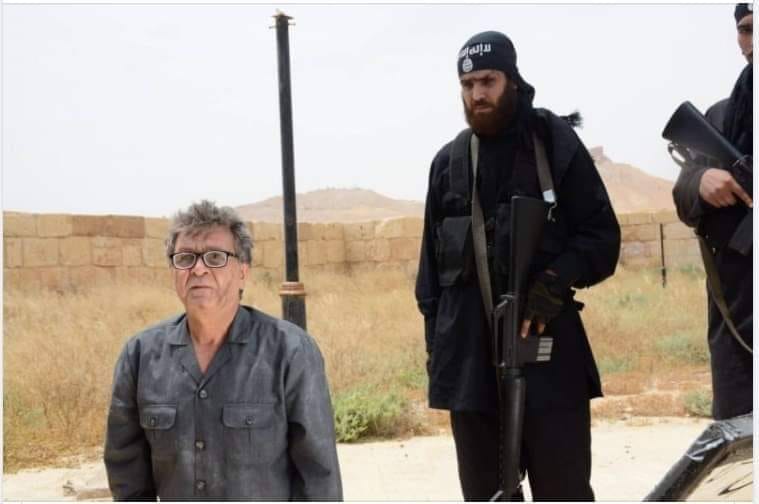
This is Syrian archaeologist Dr. Khaled al-Asaad, chief of the excavations of Palmir (Palmyra). Khaled al-Asaad refused to reveal the location of the treasures and antiques of Tadmur (now Palmyra) that he hid before the arrival of the Islamic State.
Al-Asaad was beheaded in the square in front of the museum where he worked for over 50 years.
His mutilated body was then hung at a traffic light.
Khaled al-Asaad was the top guardian of Palmyra antiques and, in July 2015, he was captured by Islamic State fighters. Despite many tortures, he did not reveal the location of the museum’s treasures and was executed in the central square of Palmyre. When it became clear that fighters were going to capture Palmyre, scientists led by Al Asaad went to all lengths to hide Palmyre’s unique and invaluable antiques. He played a central role in saving hundreds of artifacts, transporting them from Palmyre to a safe location.
Khaled al-Asaad spoke five languages in addition to six ancient idiomatic languages, some of which are now extinct. Several European countries offered him residence and citizenship, but he refused to leave Syria.
He fought to his death to save the heritage of humanity.
Kaveh AkbarPalmyra
after Khaled al-Asaad
bonepole bonepole since you died
there’s been dying everywhere
do you see it slivered where you are
between a crown and a tongue
the question still
more god or less
I am all tangled
in the smoke you left
the swampy herbs
the paper crows
horror leans in and brings
its own light
this life so often inadequately
lit your skin peels away your bones soften
your rich unbecoming a kind of apology
when you were alive your cheekbones
dropped shadows across your jaw
I saw a picture
I want to dive into that darkness
smell
the rosewater
the sand irreplaceable
jewel how much of the map did you leave
unfinished
lthere were so many spiders
your mouth a moonless system
of caves filling with dust
the dust thickened to tar
your mouth opened and tar spilled out
I am an archeologist, I cann’t stop thinking about Khaled – al Asaad. Requiescat in Pace, Brother.









 Ewa Maria and Friends