Samochwała w kącie stała (Noch zum Blogjubiläum)
04.11.2022 Teresa Rudolf napisała jako pierwsza:
Continue reading “10 Jahre / 10 lat / 10 years (2)”
Post in English
Samochwała w kącie stała (Noch zum Blogjubiläum)
04.11.2022 Teresa Rudolf napisała jako pierwsza:
Continue reading “10 Jahre / 10 lat / 10 years (2)”Konrad
Poprosiłem AI żeby napisało wiersz o Don Kichocie w Berlinie:

Don Quixote in Berlin, a knight so bold
In search of adventure and stories untold
In the city of culture and modern art
He's ready to battle and conquer his heart

He strides through the streets, with a twinkle in his eye
And a quickness to his step, as he moves on by
His sword by his side, he's ever so brave
Not caring if he's late, or if he misbehaves

He looks to the sky, and stops to behold
The beauty of the city, the buildings unfold
A city so free, the feel of the air
The culture and art, it's all so fair

He stands tall and proud, with a heart of steel
Determined to make his journey real
With a spirit so strong, and a mind so deep
He'll make his mark in this land so grand and keep

Don Quixote in Berlin, a knight so brave
With a heart so pure and a spirit so brave
He'll take on the challenges and stories untold
And make Berlin his very own, the tales will unfold.
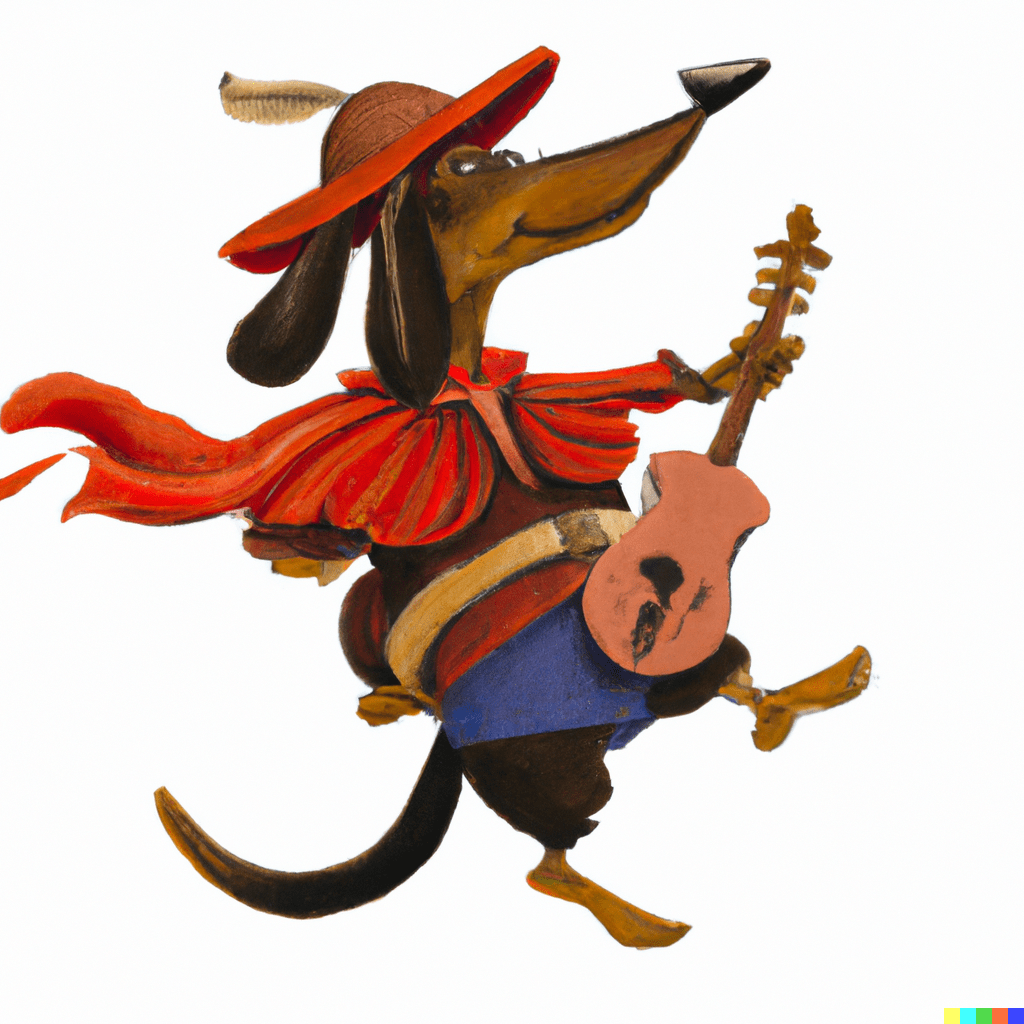
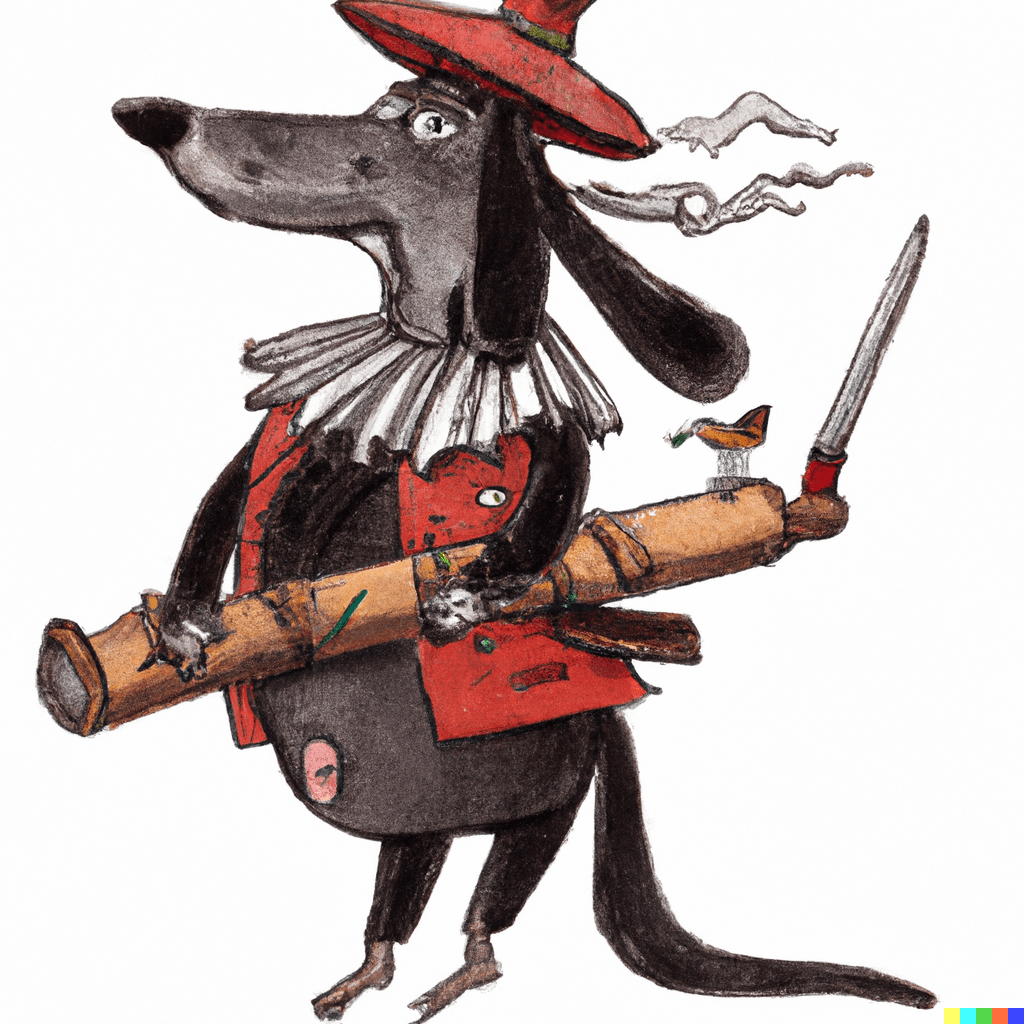
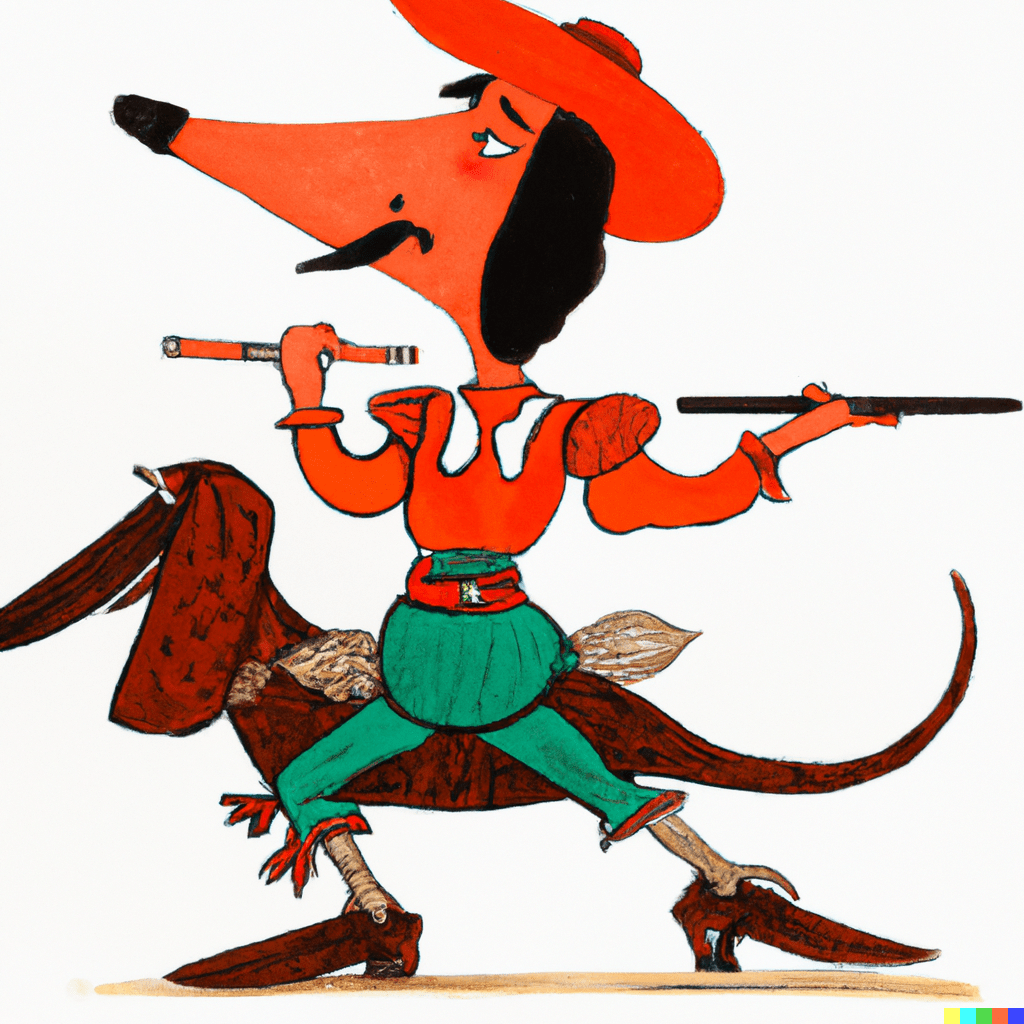
Robi wrażenie, ale nie do końca mi się podoba, bo Berlin mógłby być w wierszu zamieniony z wieloma innymi miastami, i byłoby tak samo.

Poprosiłem też o wiersz o Don Kichocie po polsku:

Don Kichot, mąż bez uczuć,
Oślepiony w wiecznej walce,
Szuka miłości wśród ruin,
Bez skutku, jak ślepy strzał.

Nie może uwierzyć, że istnieje,
Choć niewidzialne jak mgła,
Aż kiedyś, gdy słońce zajdzie,
Odkryje blask uczuć w ciemności.
***
EMS: Na zakończenie inny temat baratarystyczny. Tym razem na zdjęciu widać prawdziwy wiatrak, a nie coś wyprodukowanego przez sztuczną inteligencję, tym niemniej obrazek i podpis zostały mi podsunięte przez jakiś system Microsofta, który co rano wybiera dla mnie nowe zdjęcie i codziennie pyta, czy podoba mi się to, co widzę. Ja grzecznie odpowiadam “Tak” (lub “Nie”), żeby system nie podrzucał mi jakiegoś badziewia, którego nie lubię, no i bang – bingo! Dostaję tylko to, co lubię, czym, jak sądzę, przyczyniam się do wzmocnienia wszechwładzy systemów.
Sama wkładam głowę w pętlę.
Halnaker, Anglia.
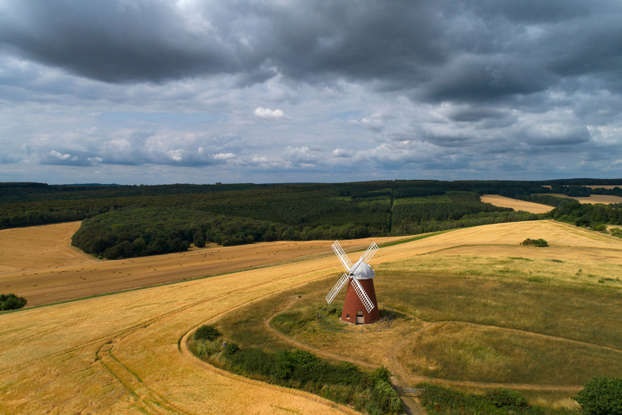
Ten wiatrak stojący na wzgórzu Halnaker o wysokości 128 m n.p.m., jest dobrze widoczny z dużej odległości. Został wybudowany w 1740 r. i stanowi zabytek klasy 2. W ostatnich latach przeszedł gruntowną renowację, ale jest ogrodzony i nie można go zwiedzać. Atrakcją samą w sobie jest malownicza droga do wiatraka, z której roztaczają się wspaniałe widoki na pobliskie wybrzeże.
Wiatrak jest ogrodzony, nie da się go zaatakować.
Thanks to Konrad for finding that text and producing some pictures
Previous versions of French novel featured stale bread, toast and biscuit as trigger for author’s childhood memories
Kim Willsher in Paris Mon 10 Oct 2022
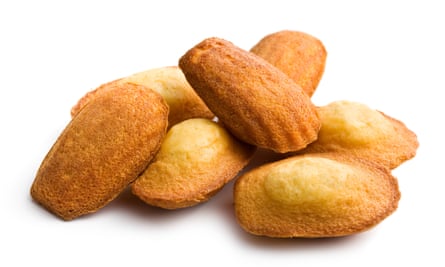
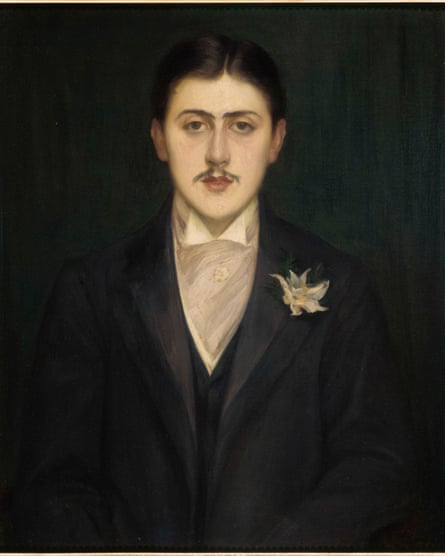
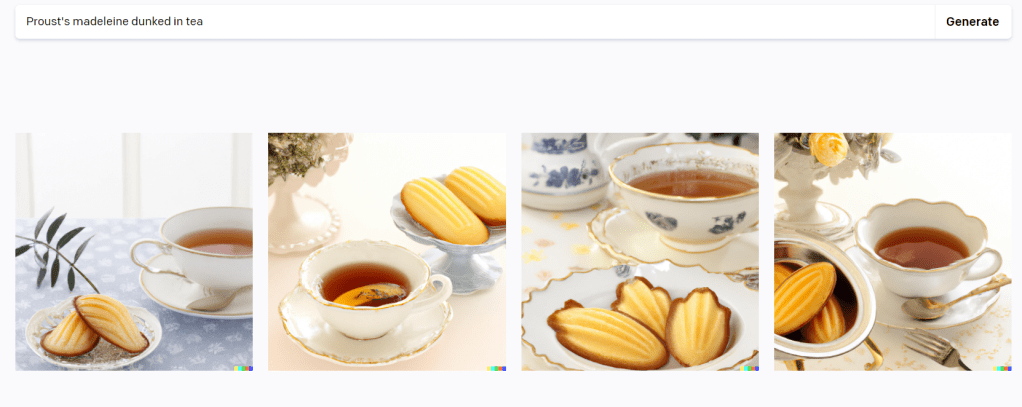
Before Marcel Proust went into raptures over his petites madeleines he was waxing lyrical over a rusk-like biscuit and before that a piece of stale bread. The “episode of the madeleines” as it became known, is one of the most celebrated events in his seminal work À la Recherche du Temps Perdu (In Search of Lost Time), encapsulating its theme of involuntary memory.
Over the space of two years, however, the passage started with a very different flavour as the French author wrote various versions of his childhood recollection.
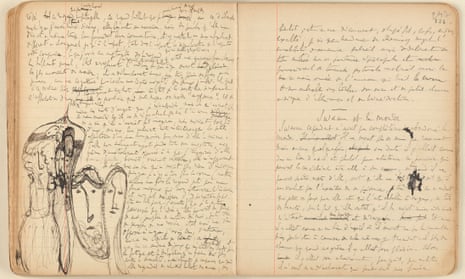
In 1907 when he was working on the first volume, Swann’s Way, it was the dunking of pain rassis, a piece of stale bread, into tea that provoked his elation. In the next version, it had become pain grillé, or toast, then some time around 1908 it was a biscotte, a kind of hard biscuit.
The rest, of course, is literary history.
In the end, Proust settled on “those short, plump little cakes … which look as though they had been moulded in the fluted scallop of a pilgrim’s shell” to evoke the crumbs dipped in lime-flower tea his Aunt Léonie would feed him as a boy.
A new exhibition to mark the 100th anniversary of the writer’s death opens in Paris and traces the meticulous process through which Proust produced his monumental seven-volume novel – the first tome of which appeared in 1913 and the last in 1937.
On display are almost 350 items; including never-before-seen documents, manuscripts, photographs, paintings, objects and costumes tracing and illustrating Proust’s creative process at the time he was writing from the late 19th century until his death in 1922.
Proust preferred to write with a fountain pen in bed, which was just as well as he was frequently ailing and spent the last three years of his life mostly confined to his bedroom, where he slept during the day and worked at night.
Among the most extraordinary exhibits at the François Mitterrand Library – part of the French National Library – are the many notebooks he filled with fluid and almost illegible cursive writing; the rough drafts on loose sheets of yellowing lined paper torn from those same books and the dozens of pages of handwritten and typed manuscripts, as well as publisher’s proof editions filled with editing marks, annotations and revisions.
They reveal a writer who was pedantic and a perfectionist; a tireless editor and reviser of his own work who would toil over a single word, whole sentences and even entire pages struck through with edits scrawled in the top, bottom and side margins. In a pre-computer version of cut-and-paste, Proust would physically cut out large passages of handwritten or typed text and glue them elsewhere.
Even the first sentence of the first volume, Swann’s Way, that has become one of the most instantly recognisable novel openings: Longtemps, je me suis couché de bonne heure (For a long time, I went to bed early) was written, mulled over, crossed out, then reinstated.
Nathalie Mauriac, one of the exhibition curators, said it had been “very complicated” to follow the order of Proust’s writing. “He wrote the first and last volume at almost the same time and made multiple changes in the organisation of the work,” she said.
“There is something disproportionate in the scope of Proust’s work, as evidenced by the very materiality of his manuscripts, starting with the famous paperoles (paper drafts), those accordions of fragments of paper folded and pasted into his notebooks.”
She said the huge number of corrected and changed manuscripts, and proofs were “very Proust” and were evidence of “the enormous amount of work he put into each book… and the evolution of each”.
In Search of Lost Time is a fictional autobiography in which Proust mirrors his own life, recounting it as a young boy and as an older man recalling his youth. A central theme is the role of memory and the notion that experiences are not lost but remain in the unconscious. The seven volumes eventually ran to more than 3,200 pages and featured more than 2,000 different characters, but the first was refused by several publishers forcing Proust to publish it at his own expense with Grasset. The work is frequently listed among the greatest books of all time.
“Proust was the greatest novelist of the 20th century, just as Tolstoy was in the 19th,” wrote the English novelist Graham Greene.
To the delight of literary historians, Proust kept most of his manuscripts. He was working on and revising the last three tomes of the novel the night before his death on the 18 November 1922, when he died of pneumonia and a pulmonary abscess, aged 50. His work and documents passed to his brother Robert, who ensured the posthumous publication of the three books – and in 1962 Robert’s daughter Suzy Mante-Proust handed all the documents to France’s National Library.
Proust is buried at the Père Lachaise cemetery in Paris.
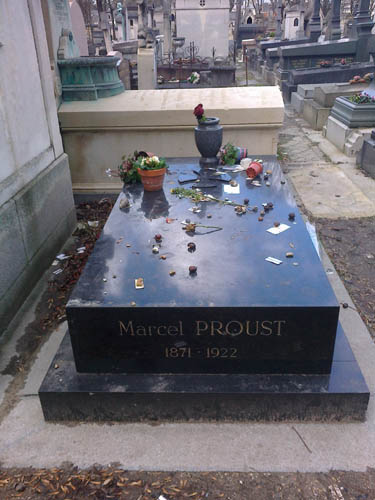
Foto: EMS
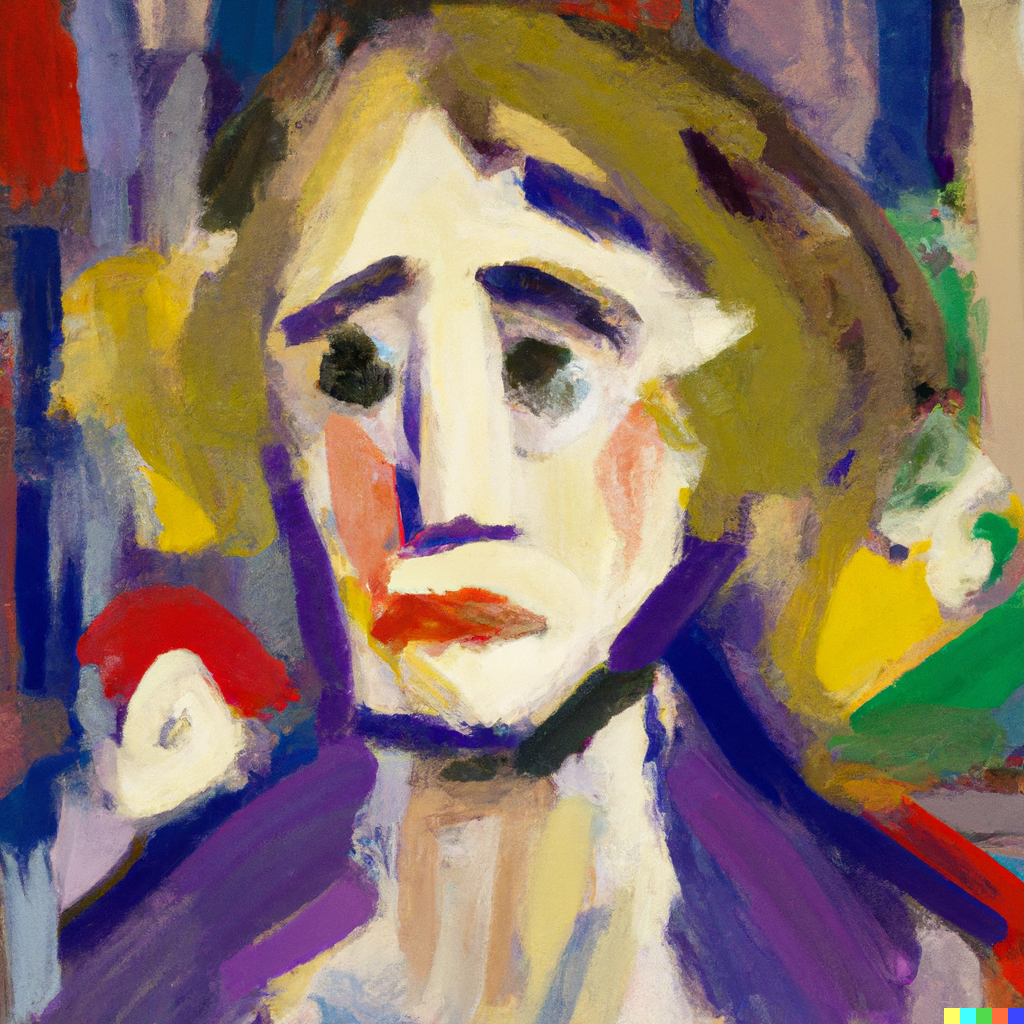
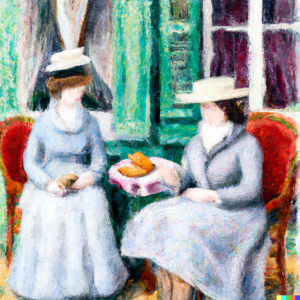
Konrad using the AI-Program DALL-E produced some pictures for the topic Proust and his (no)madeleine… Actually you can say, the program knows exactly what madeleine is (a woman AND a cake) but is ignorant in the question, who is Proust (a man AND a writer). Anyway a wonder!

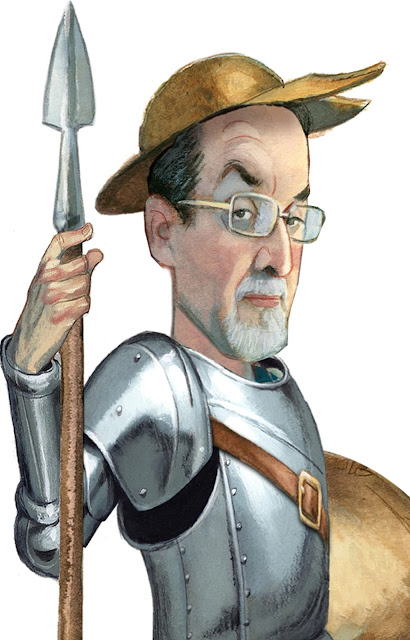
»Worldwide Reading« on September 29, 2022: Novels and Essays by Salman Rushdie
| Sehr geehrte Damen und Herren, liebe Freundinnen und Freunde,der Mordanschlag auf Salman Rushdie sitzt uns noch tief in den Knochen. Wir rufen hiermit zu einer »Weltweiten Lesung« des Werkes von Salman Rushdie auf, siehe unten. Viele Autor:innen aus allen Kontinenten unterstützen den Aufruf, so Adonis, Jennifer Clement, Andrei Kurkov, Wole Soyinka, Janne Teller, Bernard-Henri Levy, Peter Schneider, Amir Hassan Cheheltan, Robert Hass und Sergei Lebjedev. Die Autorin Madame Nielsen schlägt vor, dass wir bis zum 29. September überall im öffentlichen Raum »Die Satanischen Verse« mit uns tragen sollten, dass wir das Buch überall aufschlagen und lesen, in Cafés, Parks und der U-Bahn. Elfriede Jelinek regt Autor:innen an, Auszüge davon auf den eigenen Websites zu platzieren, falls die Rechte hierfür jeweils erworben werden können. Herzlich Ulrich Schreiber Festivaldirektor und Programmleiter internationales literaturfestival berlin |
| Ladies and gentlemen, dear friends,The assassination attempt on Salman Rushdie still has us in shock. We are hereby calling for a »Worldwide Reading« of Salman Rushdie’s works. Please see below. Many authors from all continents support the call, including Adonis, Jennifer Clement, Andrei Kurkov, Wole Soyinka, Janne Teller, Bernard-Henri Levy, Peter Schneider, Amir Hassan Cheheltan, Robert Hass and Sergei Lebjedev. The author Madame Nielsen also suggested that we carry »The Satanic Verses« with us everywhere in public spaces until September 29, and that we open and read the book everywhere, in cafes, parks, subways. Elfriede Jelinek encourages authors to place excerpts on their own websites if the rights can be acquired. Sincerely, Ulrich Schreiber Festival Director and Head of Program international literature festival berlin |
| Das internationale literaturfestival berlin [ilb] lädt Einzelpersonen, Schulen, Universitäten, Kulturinstitutionen und Medien ein, am 29. September 2022 an einer »Weltweiten Lesung« aus Salman Rushdies Werken teilzunehmen – von »Mitternachtskinder«, »Die satanischen Verse«, »Joseph Anton« bis zu seinen neuesten Büchern »Sprachen der Wahrheit« und »Victory City«. Mit der Lesung soll ein Zeichen für die Freiheit der Literatur und des öffentlichen Wortes sowie für die Solidarität mit dem Autor gesetzt werden, der Opfer eines grausamen Attentats wurde. Zu den Erst-Unterzeichner:innen zählen: Adonis [Syrien/ Frankreich], Breyten Breytenbach [Südafrika], Amir Hassan Cheheltan [Iran], Robert Hass [USA], Elfriede Jelinek [Österreich], Sergei Lebjedev [Russland/ Deutschland], Bernard-Henri Levy [Frankreich], Yang Lian [China/ Großbritannien], Alberto Ruy Sánchez [Mexiko], Peter Schneider [Deutschland], Wole Soyinka [Nigeria] und Janne Teller [Dänemark].Auch wenn die konkreten Hintergründe des Attentats und das Motiv des Täters noch nicht geklärt sind, scheint klar, worauf sie vermutlich zurückgehen: auf die Fatwa, die der iranische »Revolutionsführer« Ayatollah Khomeini 1989 gegen Rushdie erlassen hat. Sie forderte die Tötung des in Indien geborenen, britischen Schriftstellers, weil er mit den »Satanischen Versen« angeblich den Islam, den Koran und den Propheten Mohammed beleidigt habe. Bis heute hat das iranische Regime den Aufruf zur Ermordung des Autors nicht zurückgenommen, ebenso wenig wie das Kopfgeld, das es damals auf ihn ausgesetzt hatte. Die wichtigen Medien im Iran applaudieren derzeit dem Attentäter. Salman Rushdie musste deshalb jahrelang unter intensivem Polizeischutz leben. Mehr als 20 Jahre lang ging man davon aus, dass keine Gefahr mehr für sein Leben bestehe. Doch diese Annahme hat sich durch das blutige Attentat in New York auf schockierende Weise als trügerisch erwiesen. Es macht deutlich, dass die Bedrohung der elementaren Menschenrechte und Freiheiten virulent ist. Der Anschlag auf Rushdie fällt in eine Zeit, in der die demokratische Welt von immer aggressiveren autoritären Mächten unterschiedlichster Prägung in die Defensive gedrängt, wenn nicht – wie in der Ukraine – durch offenen Krieg und ein unglaubliches Ausmaß an Gewalt mit Tod und Zerstörung überzogen wird.Es ist daher dringend geboten, entschlossen aufzustehen und Recht und Menschenwürde zu verteidigen. Mit der Lektüre seiner Romane und Essays können freiheitsliebende Menschen in aller Welt ein Zeichen setzen, dass sie sich von Gewaltandrohungen nicht einschüchtern lassen und sich keinem Versuch beugen, Gedanken in Wort, Schrift und Bild zu unterdrücken oder auszulöschen. Die Lesungen können überall stattfinden, auch privat im kleinen Kreis, in einer Schule, in einer Kultureinrichtung oder im Radio. Personen und Institutionen, die sich mit einer Lesung am 29. September beteiligen möchten, werden gebeten, uns folgende Informationen zukommen zu lassen: Organisatoren, Ort, Zeit, teilnehmende Akteure, Veranstaltungssprache, ggf. Link zu Ihrer Website. Die E-Mail-Adresse lautet: worldwidereading@literaturfestival.com. Wir bitten die Veranstalter, die Rechte für Lesungen selbst zu klären. |
| The international literature festival berlin [ilb] invites individuals, schools, universities, cultural institutions and media to participate in a »Worldwide Reading« of Salman Rushdie’s works – from »Midnight’s Children«, »The Satanic Verses«, »Joseph Anton« to his latest books »Languages of Truth« and »Victory City« – on September 29, 2022. The reading is intended to send a signal for the freedom of literature and public speech as well as the solidarity with the author, who was the victim of a horrific assassination attempt. Among the first signatories of the call are: Adonis [Syria/ France], Breyten Breytenbach [South Africa], Amir Hassan Cheheltan [Iran], Robert Hass [USA], Elfriede Jelinek [Austria], Sergei Lebjedev [Russia/ Germany], Bernard-Henri Levy [France], Yang Lian [China/ UK], Alberto Ruy Sánchez [Mexico], Peter Schneider [Germany], Wole Soyinka [Nigeria] und Janne Teller [Denmark]. Even if the concrete background of the assassination attempt and the motive of the perpetrator have not yet been clarified, it is likely who seems responsible: It goes back to the fatwa that the Iranian »revolutionary leader« Ayatollah Khomeini issued against Rushdie in 1989. It called for the killing of the Indian-born, British writer because he had supposedly insulted the Islam, the Qur’an and the Prophet Muhammad with »The Satanic Verses«. To this day, the Iranian regime has not withdrawn the call to kill the author, just as it has not withdrawn the bounty it placed on his head at the time. The important media in Iran are currently applauding the attacker. For years, Salman Rushdie therefore had to live under intensive police protection. For more than 20 years, it was assumed that there was no longer any danger to his life. But this assumption has been shockingly proven wrong by the bloody attack in New York. It makes it clear that the threat to elementary human rights and freedoms remains unbroken. Moreover, the attack on Rushdie comes at a time when the democratic world is being forced into the defensive by increasingly aggressive authoritarian powers of various kinds, if not – as in Ukraine – it is overrun with death and destruction through open war and an incredible range of violence. It is therefore absolutely urgent to stand up firmly and defend law and human dignity. By reading Salman Rushdie’s novels and essays, freedom-loving people all over the world can send a signal that they will not be intimidated by threats of violence and will not bow to any attempt to suppress or annihilate thoughts expressed in speech, writing and images. Readings can take place anywhere, even privately in a small circle, in a school, in a cultural institution or on the radio. People and institutions who would like to participate with a reading on September 29, 2022 are asked to send us the following information: Organizers, location, time, participating actors, event language, link to your website if applicable. The e-mail address is: worldwidereading@literaturfestival.com. We kindly ask organizers to clear the rights for readings on their own. |
Lots of Big Bang Theory discussions since Webb’s Deep Field was released.
Here’s an article about the history and meaning of the Big Bang Theory from Big Think:
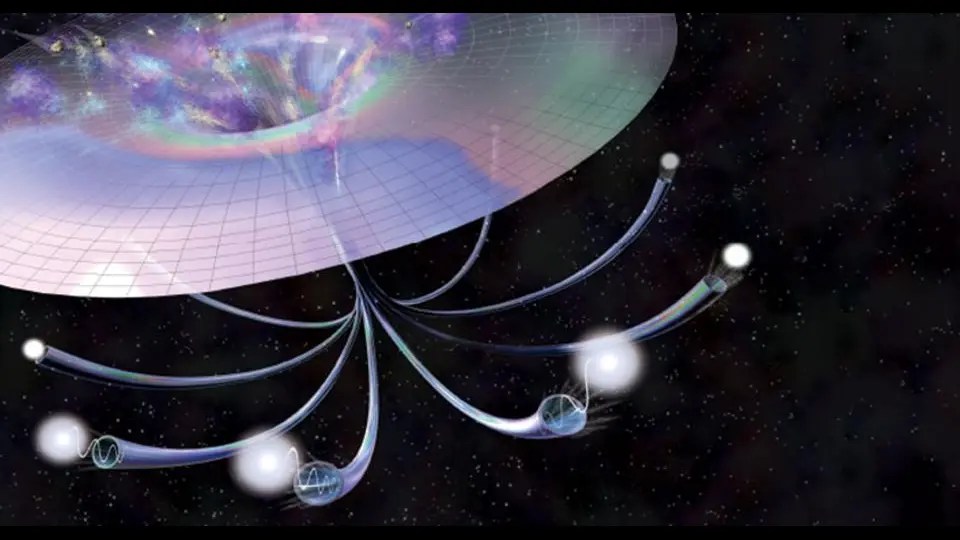
As we gain new knowledge, our scientific picture of how the Universe works must evolve. This is a feature of the Big Bang, not a bug.
If there’s one hallmark inherent to science, it’s that our understanding of how the Universe works is always open to revision in the face of new evidence. Whenever our prevailing picture of reality — including the rules it plays by, the physical contents of a system, and how it evolved from its initial conditions to the present time — gets challenged by new experimental or observational data, we must open our minds to changing our conceptual picture of the cosmos. This has happened many times since the dawn of the 20th century, and the words we use to describe our Universe have shifted in meaning as our understanding has evolved.
Yet, there are always those who cling to the old definitions, much like linguistic prescriptivists, who refuse to acknowledge that these changes have occurred. But unlike the evolution of colloquial language, which is largely arbitrary, the evolution of scientific terms must reflect our current understanding of reality. Whenever we talk about the origin of our Universe, the term “the Big Bang” comes to mind, but our understanding of our cosmic origins have evolved tremendously since the idea that our Universe even had an origin, scientifically, was first put forth. Here’s how to resolve the confusion and bring you up to speed on what the Big Bang originally meant versus what it means today.
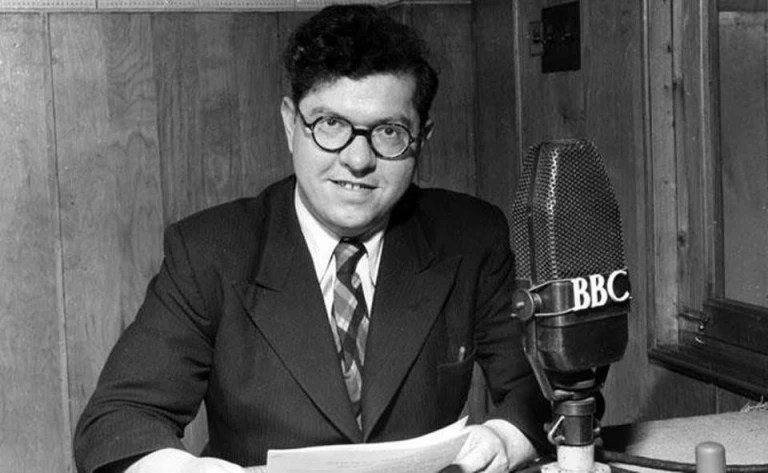
The first time the phrase “the Big Bang” was uttered was over 20 years after the idea was first described. In fact, the term itself comes from one of the theory’s greatest detractors: Fred Hoyle, who was a staunch advocate of the rival idea of a Steady-State cosmology. In 1949, he appeared on BBC radio and advocated for what he called the perfect cosmological principle: the notion that the Universe was homogeneous in both space and time, meaning that any observer not only anywhere but anywhen would perceive the Universe to be in the same cosmic state. He went on to deride the opposing notion as a “hypothesis that all matter of the universe was created in one Big Bang at a particular time in the remote past,” which he then called “irrational” and claimed to be “outside science.”
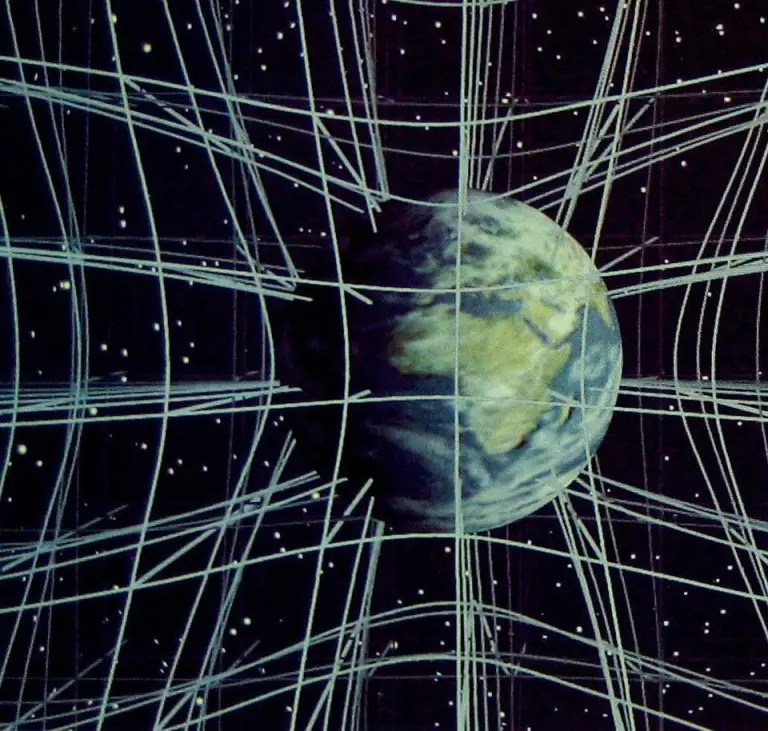
But the idea, in its original form, wasn’t simply that all of the Universe’s matter was created in one moment in the finite past. That notion, derided by Hoyle, had already evolved from its original meaning. Originally, the idea was that the Universe itself, not just the matter within it, had emerged from a state of non-being in the finite past. And that idea, as wild as it sounds, was an inevitable but difficult-to-accept consequence of the new theory of gravity put forth by Einstein back in 1915: General Relativity.
When Einstein first cooked up the general theory of relativity, our conception of gravity forever shifted from the prevailing notion of Newtonian gravity. Under Newton’s laws, the way that gravitation worked was that any and all masses in the Universe exerted a force on one another, instantaneously across space, in direct proportion to the product of their masses and inversely proportional to the square of the distance between them. But in the aftermath of his discovery of special relativity, Einstein and many others quickly recognized that there was no such thing as a universally applicable definition of what “distance” was or even what “instantaneously” meant with respect to two different locations.
With the introduction of Einsteinian relativity — the notion that observers in different frames of reference would all have their own unique, equally valid perspectives on what distances between objects were and how the passage of time worked — it was only almost immediate that the previously absolute concepts of “space” and “time” were woven together into a single fabric: spacetime. All objects in the Universe moved through this fabric, and the task for a novel theory of gravity would be to explain how not just masses, but all forms of energy, shaped this fabric that underpinned the Universe itself.

Although the laws that governed how gravitation worked in our Universe were put forth in 1915, the critical information about how our Universe was structured had not yet come in. While some astronomers favored the notion that many objects in the sky were actually “island Universes” that were located well outside the Milky Way galaxy, most astronomers at the time thought that the Milky Way galaxy represented the full extent of the Universe. Einstein sided with this latter view, and — thinking the Universe was static and eternal — added a special type of fudge factor into his equations: a cosmological constant.
Although it was mathematically permissible to make this addition, the reason Einstein did so was because without one, the laws of General Relativity would ensure that a Universe that was evenly, uniformly distributed with matter (which ours seemed to be) would be unstable against gravitational collapse. In fact, it was very easy to demonstrate that any initially uniform distribution of motionless matter, regardless of shape or size, would inevitably collapse into a singular state under its own gravitational pull. By introducing this extra term of a cosmological constant, Einstein could tune it so that it would balance out the inward pull of gravity by proverbially pushing the Universe out with an equal and opposing action.
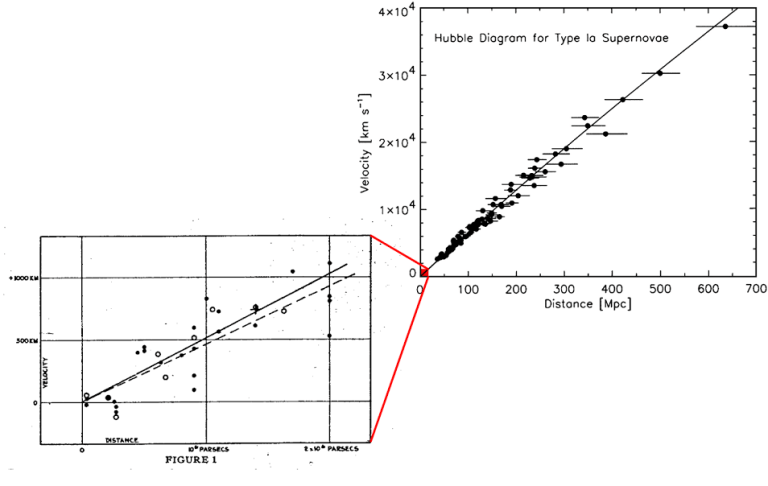
Edwin Hubble’s original plot of galaxy distances versus redshift (left), establishing the expanding Universe, versus a more modern counterpart from approximately 70 years later (right). In agreement with both observation and theory, the Universe is expanding, and the slope of the line relating distance to recession speed is a constant.
Two developments — one theoretical and one observational — would quickly change this early story that Einstein and others had told themselves.
In 1927, Georges Lemaître became the very first person to put these pieces of information together, recognizing that the Universe today is expanding, and that if things are getting farther apart and less dense today, then they must have been closer together and denser in the past. Extrapolating this back all the way to its logical conclusion, he deduced that the Universe must have expanded to its present state from a single point-of-origin, which he called either the “cosmic egg” or the “primeval atom.”
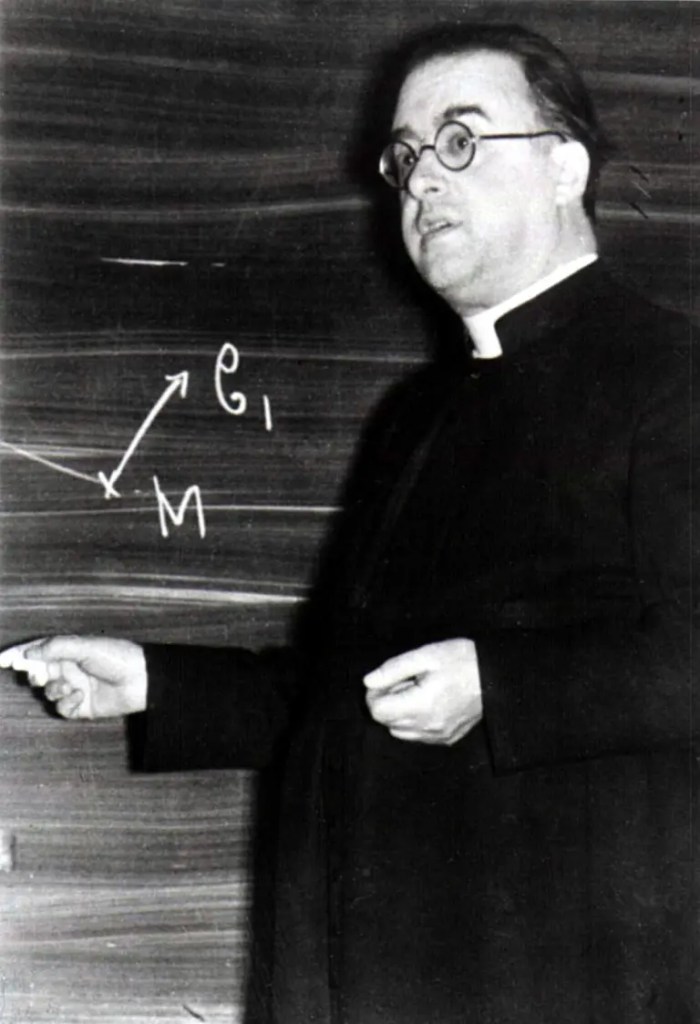
This was the original notion of what would grow into the modern theory of the Big Bang: the idea that the Universe had a beginning, or a “day without yesterday.” It was not, however, generally accepted for some time. Lemaître originally sent his ideas to Einstein, who infamously dismissed Lemaître’s work by responding, “Your calculations are correct, but your physics is abominable.”
Despite the resistance to his ideas, however, Lemaître would be vindicated by further observations of the Universe. Many more galaxies would have their distances and redshifts measured, leading to the overwhelming conclusion the Universe was and still is expanding, equally and uniformly in all directions on large cosmic scales. In the 1930s, Einstein conceded, referring to his introduction of the cosmological constant in an attempt to keep the Universe static as his “greatest blunder.”
However, the next great development in formulating what we know of as the Big Bang wouldn’t come until the 1940s, when George Gamow — perhaps not so coincidentally, an advisee of Alexander Friedmann — came along. In a remarkable leap forward, he recognized that the Universe was not only full of matter, but also radiation, and that radiation evolved somewhat differently from matter in an expanding Universe. This would be of little consequence today, but in the early stages of the Universe, it mattered tremendously.
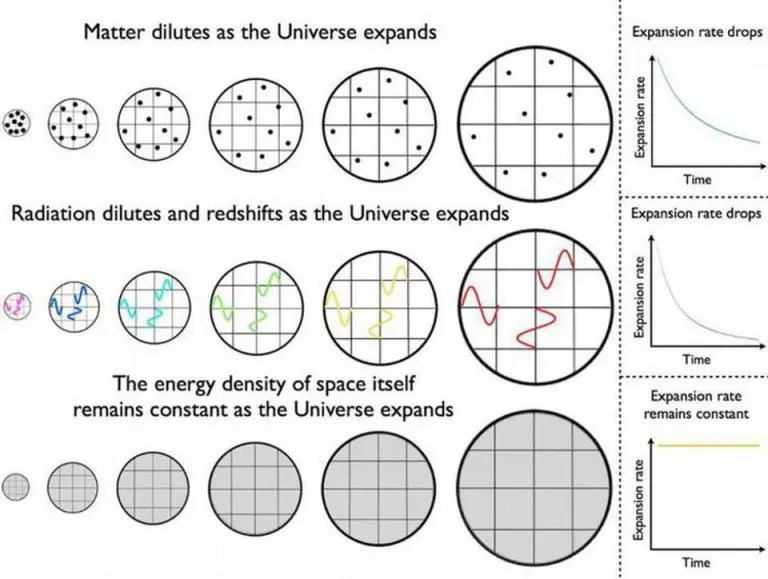
Matter, Gamow realized, was made up of particles, and as the Universe expanded and the volume that these particles occupied increased, the number density of matter particles would drop in direct proportion to how the volume grew.
But radiation, while also made up of a fixed number particles in the form of photons, had an additional property: the energy inherent to each photon is determined by the photon’s wavelength. As the Universe expands, the wavelength of each photon gets lengthened by the expansion, meaning that the amount of energy present in the form of radiation decreases faster than the amount of energy present in the form of matter in the expanding Universe.
But in the past, when the Universe was smaller, the opposite would have been true. If we were to extrapolate backward in time, the Universe would have been in a hotter, denser, more radiation-dominated state. Gamow leveraged this fact to make three great, generic predictions about the young Universe.

These three major points, along with the already-observed expansion of the Universe, form what we know today as the four cornerstones of the Big Bang. Although one was still free to extrapolate the Universe back to an arbitrarily small, dense state — even to a singularity, if you’re daring enough to do so — that was no longer the part of the Big Bang theory that had any predictive power to it. Instead, it was the emergence of the Universe from a hot, dense state that led to our concrete predictions about the Universe.
Over the 1960s and 1970s, as well as ever since, a combination of observational and theoretical advances unequivocally demonstrated the success of the Big Bang in describing our Universe and predicting its properties.
The Big Bang, as verified by our observations, accurately and precisely describes the emergence of our Universe, as we see it, from a hot, dense, almost-perfectly uniform early stage.
But what about the “beginning of time?” What about the original idea of a singularity, and an arbitrarily hot, dense state from which space and time themselves could have first emerged?
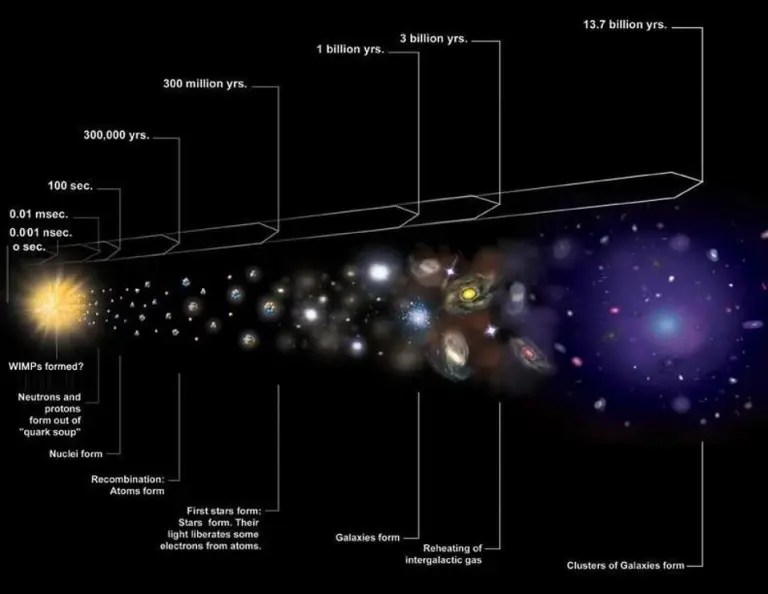
That’s a different conversation, today, than it was back in the 1970s and earlier. Back then, we knew that we could extrapolate the hot Big Bang back in time: back to the first fraction-of-a-second of the observable Universe’s history. Between what we could learn from particle colliders and what we could observe in the deepest depths of space, we had lots of evidence that this picture accurately described our Universe.
But at the absolute earliest times, this picture breaks down. There was a new idea — proposed and developed in the 1980s — known as cosmological inflation, that made a slew of predictions that contrasted with those that arose from the idea of a singularity at the start of the hot Big Bang. In particular, inflation predicted:
The first three were post-dictions of inflation; the latter four were predictions that had not yet been observed when they were made. On all of these accounts, the inflationary picture has succeeded in ways that the hot Big Bang, without inflation, has not.

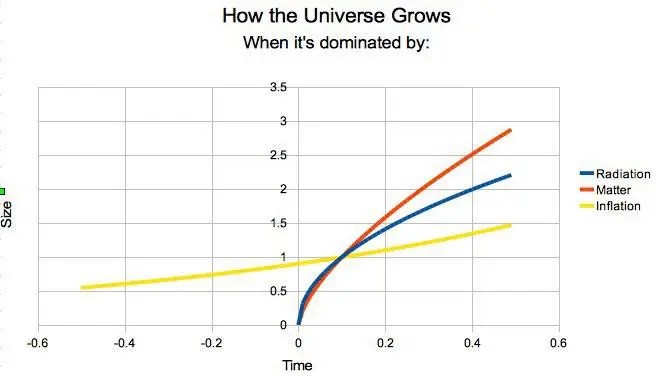
During inflation, the Universe must have been devoid of matter-and-radiation and instead contained some sort of energy — whether inherent to space or as part of a field — that didn’t dilute as the Universe expanded. This means that inflationary expansion, unlike matter-and-radiation, didn’t follow a power law that leads back to a singularity but rather is exponential in character. One of the fascinating aspects about this is that something that increases exponentially, even if you extrapolate it back to arbitrarily early times, even to a time where t → -∞, it never reaches a singular beginning.
Now, there are many reasons to believe that the inflationary state wasn’t one that was eternal to the past, that there might have been a pre-inflationary state that gave rise to inflation, and that, whatever that pre-inflationary state was, perhaps it did have a beginning. There are theorems that have been proven and loopholes discovered to those theorems, some of which have been closed and some of which remain open, and this remains an active and exciting area of research.
But one thing is for certain.
Whether there was a singular, ultimate beginning to all of existence or not, it no longer has anything to do with the hot Big Bang that describes our Universe from the moment that:
eventually leading to the present day. There are still a minority of astronomers, astrophysicists and cosmologists who use “the Big Bang” to refer to this theorized beginning and emergence of time-and-space, but not only is that not a foregone conclusion anymore, but it doesn’t have anything to do with the hot Big Bang that gave rise to our Universe. The original definition of the Big Bang has now changed, just as our understanding of the Universe has changed. If you’re still behind, that’s ok; the best time to catch up is always right now.
or art in it’s incredibility
found on https://artsartistsartwork.com
you can buy it
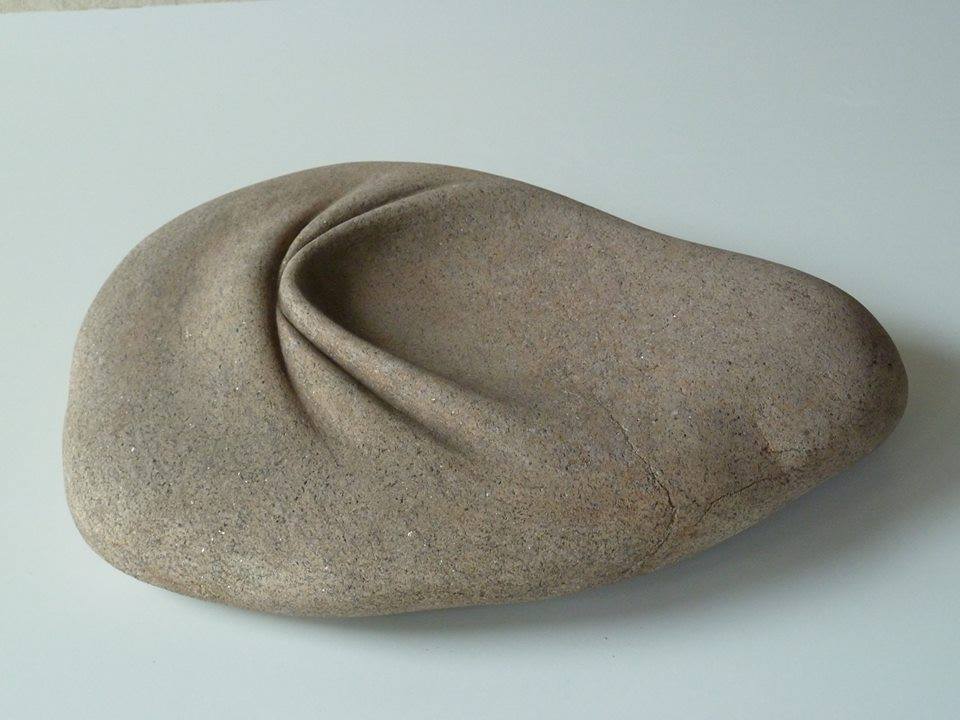
José Manuel Castro López works the stone in an amazing way, for him stones are malleable, they melt, liquefy, form and deform. It manages to give them a soft and organic look. Real optical illusions, his sculptures are beautiful and well made of quartz, granite and other rocks all harder than the others.
***
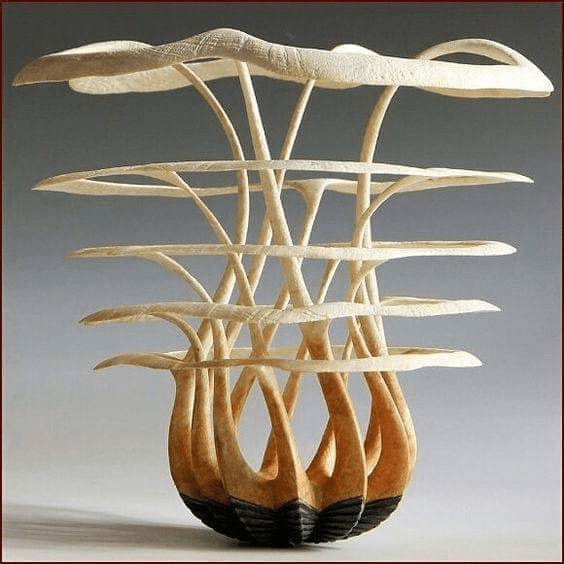
This is a fascinating sculpture made of wood. It must be carved but no matter how he created it, it appears so delicate. I can just imaging the skill Alain Mailland has with his tools to create something so complex and beautiful out of wood. 
***
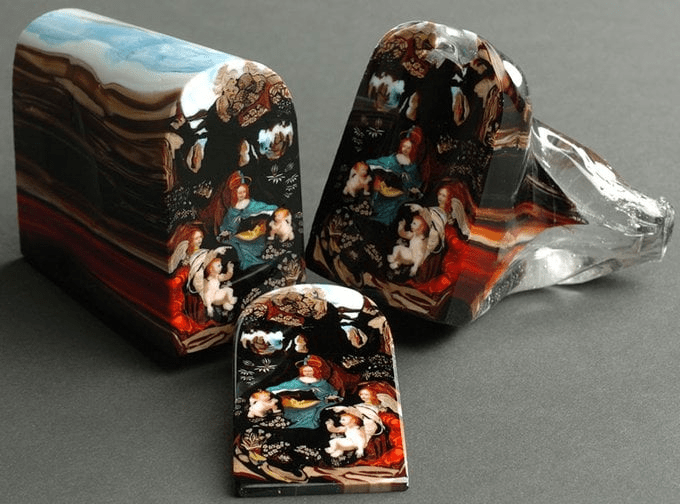
Master glassblower and stained glass artist Loren Stump in California has created a “loaf” of glass, called murrine, out of carefully layered glass rods that, when sliced, reveal a painstakingly detailed work of art in cross-section. 
***
Intricate paper sculptures by @juliaibbini [IG} are meticulously crafted to appear as though they have been made in nature. Artist Julia Ibbini and computer scientist Stephane Noyer, who are behind the Abu Dhabi-based studio, spent the last year working on a collection of geometric cylindrical pieces swirling with vine-like forms, mirrored geometric designs that resemble the repeating patterns in honeycomb, and sculptures that look like delicate shells. 

Bogdan Twardochleb
Autor przysłał kilka dni temu takiego maila:
Kochani,
Gero Hellmuth, artysta z Singen, prawie znad jeziora Bodeńskiego, dziecko wojny (ur. w 1940 w Neustrelitz, Mecklenburg) przywiózł do Gdańska swoją wystawę, której otwarcie będzie w czwartek, czyli pojutrze, 14 lipca 2022 roku w Muzeum Drugiej Wojny Światowej. Termin otwarcia wystawy był z powodu pandemii kilkakrotnie przekładany. Hellmuth bardzo chciał tę wystawę w Gdańsku zorganizować. Początkowo była mowa o innym miejscu, ostatecznie jest Muzeum Drugiej Wojny. Nieważne. Bardzo ważne jest to, że postanowił przekazać Gdańskowi (Polsce) swą symboliczną rzeźbę – Tryptyk z Auschwitz.
Na wernisażu miałem wygłosić mowę, o którą Gero Hellmuth mnie prosił. Jestem po operacji i niestety nie mogę pojechać do Gdańska. O ile wiem, moją mowę przeczyta pani konsul generalna Cornelia Pieper. Przesyłam Wam tekst tej mowy i katalog wystawy.
Wydaje mi się, że to, co Gero Hellmuth postanowił zrobić, jest bardzo, bardzo ważne. A dziś, ze względu na to, co się w Polsce opowiada o Niemczech, jeszcze ważniejsze. Dlatego chciałem się z Wami podzielić tą ważną wiadomością. Może Was zainteresuje.
Serdecznie pozdrawiam
Bogdan
Bogdan Twardochleb
Otwierajmy drzwi
Gero Hellmuth urodził się w 1940 roku w urokliwym miasteczku Neustrelitz w Meklemburgii. Od ponad pięćdziesięciu lat mieszka w Singen am Hohentwiel blisko granicy niemiecko-szwajcarskiej. Maturę zdał w Stuttgarcie. Studiował w Akademii Sztuk Pięknych w Karlsruhe. Ukończył też historię sztuki i filozofię.
Cykl jego prac „Hiob” był w Niemczech prezentowany wielokrotnie. Przed czterema laty został po raz pierwszy pokazany w Polsce, w nowej filharmonii w Szczecinie. Muzeum Drugiej Wojny Światowej jest drugim w Polsce miejscem, gdzie można go zobaczyć. Przygotowując wystawę w Gdańsku autor poszerzył go o cykl „Auschwitz”. Dołączył też obrazy z cyklu „Dzieci wojny” w innym wyborze niż w Szczecinie, podkreślającym przerażenie jego dzisiejszą aktualnością.
Wystawa w Gdańsku ma znacznie symboliczne, bo tu, od napaści Niemiec na Polskę, wojna się zaczęła. Jest to również miasto, gdzie powstał ruch, kierowany ideą solidarności, jakże inną od wszystkiego, co niesie ze sobą wojna. Solidarność nie szuka wrogów, nie przynosi cierpienia, lecz przezwyciężając je przynosi nadzieję.
Dla Gero Hellmutha wystawa w Gdańsku jest szczególnie ważna. Sugeruje to jej nowy tytuł: „Hiob – lament i przezwyciężenie”.
W twórczość artysty z Siengen, która wynika z przemyśleń nad współczesnością, wpisane jest przekonanie o zanurzeniu człowieka w odwiecznym losie świata, rozpiętym między życiem a śmiercią, cierpieniem a nadzieją. Dlatego tak ważna jest dla niego Księga Hioba – dramat o cierpieniu i nadziei. Przeżycia i wątpliwości Hioba są w naszej kulturze doświadczeniem każdego człowieka, bo jego cierpienie jest wpisane w los każdego.
Ale jest też cierpienie, nie wynikające z losu. Cierpienie, jakie jeden człowiek świadomie zadaje drugiemu człowiekowi, decydując o jego bólu i śmierci. Lata drugiej wojny światowej były nabrzmiałe od takiego cierpienia. Jesteśmy jego dziedzicami.
Gero Hellmuth sięga po najbardziej bolesny czas w historii człowieka. Obrazuje to cykl „Auschwitz”, inspirowany filmem dokumentalnym, pokazującym więźniów tego obozu śmierci w dniu jego wyzwolenia. Na ręce jednego z nich artysta dostrzegł wytatuowany numer 19… Uznał go za symbol XX wieku, w którym ludzie zostali obrabowani przez innych ludzi z nazwisk i godności, sprowadzeni do kilkucyfrowego numeru.
Na wystawie jest też obraz „Straße der Trauer II – Weg zum Vernichtungslager“, w który wpisane są strzępy słów z Księgi Hioba, jakby wyryte na świadectwo w obozowej celi śmierci.
Częścią cyklu „Auschwitz” jest tryptyk „Auschwitz – Uwolnienie 1945”, przypominający krzyż. Powstał na 50. rocznicę wyzwolenia więźniów Auschwitz i końca wojny. Gdy był pokazywany w Berlinie, w znanym kościele św. Mateusza, został ustawiony na ołtarzu. Było to symboliczne utożsamienie ofiar Auschwitz z ukrzyżowaniem Chrystusa. Ludzie, którzy w Auschwitz decydowali o cierpieniu i śmierci innych, przywłaszczyli sobie prawo Boskie, bo nie Bóg przecież, a – jak napisała w 1946 roku polska pisarka Zofia Nałkowska – to „ludzie ludziom zgotowali ten los”. Nad sprawcami takich cierpień nie wolno roztaczać parasola milczenia. Poprzez swoje prace Gero Hellmuth, przenosząc w przyszłość ból i cierpienie więźniów Auschwitz, staje się świadkiem ich losu, a jednocześnie świadkiem czynów tych ludzi, którzy taki los im zgotowali. Napisał: „Tryptyk Auschwitz (…) ma przypominać barbarzyństwo niemieckiego narodowego socjalizmu, pod panowaniem którego Polacy i wiele innych narodowości doznało niewysłowionych cierpień, a poprzez to ma ożywiać potrzebę wyciągania nauk z przeszłości”.
Tryptyk przypomina krzyż. Jest symbolicznym przedstawieniem przejścia od mroków wojny do światła przyszłości. Jego lewa część to obraz zagłady, centrum to drzewce krzyża, zwieńczone symbolicznymi drzwiami z numerem 19, a część prawa, jasna, to obraz nowego życia, w które wpisana jest pamięć o zagładzie.
Prologiem do wystawy jest niewielka rzeźba „Znalezisko” – metalowa kołatka, ocalona z drzwi domu, który utracił swych mieszkańców. Na co dzień kołatka służy do tego, aby ktoś, kto chce wejść do domu, mógł zapukać do drzwi. Po drugiej ich stronie musi jednak być ktoś, kto zechce te drzwi otworzyć.
W latach 1939-1945 drzwi między Polakami a Niemcami były szczelnie zamknięte. Nikt do nich nie pukał – nikt nie otwierał. Kołatki i klucze do wielu domów były i pozostały bezdomne, niczyje. W tym sensie również są metaforą cierpienia.
Od wielu lat między Polakami i Niemcami jest inaczej. Drzwi są otwarte. Nie znaczy to jednak, że tak musi być zawsze. Gero Hellmuth podpowiada więc, aby korzystając z tego, co dobre w polsko-niemieckim sąsiedztwie, umacniając je, nie zapominać o czasach dla niego najgorszych. By przypominać drogę, jaką przeszliśmy od nich do wzajemnego zaufania, otwierania drzwi i symbolicznie ją powtarzać. Nie wolno nam zapomnieć, jak była trudna, bo tylko pamiętając, będziemy odczuwać, jak bezcenne jest to, co mamy dziś.
Takie przesłanie jest w pracach Gero Hellmutha. Ma wymiar ogólnoludzki, bo też w ogólnoludzkim wymiarze trzeba widzieć historyczne doświadczenie polsko-niemieckie. Wtedy będzie niczym Księga Nadziei.
W 2015 roku artysta pisał: „Kołatka wskazuje na niezwykłą wartość zaufania, jakie pomimo (…) nieszczęsnej przeszłości zrodziło się między naszymi narodami w ciągu ostatniego siedemdziesięciolecia. Częstokroć zaczynało się od tego, że ktoś pukał do czyjegoś domu”.
Wystawa Gero Hellmutha jest właśnie pukaniem do drzwi naszego domu. Zostały otwarte w Szczecinie, a teraz w Gdańsku. Dlatego tak symbolicznie ważna jest zarówno otwierana dziś wystawa, jak i jej przyjęcie.
Do wystawy artysta włączył obrazy, symbolizujące cierpienia dzieci wojny. W katalogu wystawy szczecińskiej pisał: „Dziecięce oczy (…) stawiają nieme, przeszywające pytania: Co myśmy wam zrobiły? Co skłania was do tego, by zabierać nam pokój, poczucie bezpieczeństwa, miłość, otaczające nas ramiona rodziców…”.
W 1945 roku Gero Hellmuth miał pięć lat, gdy musiał uciekać z rodzinnego domu w idyllicznym Neustrelitz. Jak wszystkie dzieci wszystkich wojen poznał niewysłowiony dziecięcy strach. Dzieci wojny, które na pewno nie się niczemu winne, doświadczają losu Hioba.
Gdy pokolenie niemieckich dzieci wojny zaczęło rozliczać się z pokoleniem swoich rodziców, wzięło na siebie odpowiedzialność za jego winy i cierpienia, jakie wyrządziło innym. Świadectw tej odpowiedzialności, której symbolem stała się Akcji Pokuty, jest w niemieckiej sztuce współczesnej i życiu społecznym bardzo wiele. Za mało je w Polsce znamy. Należą do nich prace Gero Hellmutha.
Na wystawę w Gdańsku artysta przygotował nowy obraz „Krzyk dzieci wojny”, który powstał niedawno, pod wpływem wiadomości o wojnie w Ukrainie. Los Hioba znów jest losem dzieci. Cierpią, uciekają z matkami ze swych domów, chronią się także u nas, w Polsce i Niemczech. Ich cierpienie nas łączy.
Jest też na wystawie obraz „Oczy”. Gero Hellmuth umieścił w nim fragment wiersza Hilde Domin, poetki bardzo znanej w Niemczech, zatytułowanego „Napalm-Lazarett” (1970). Wstrząsający jest opisany słowami jakby pokrewnymi stylistyce Tadeusza Różewicza obraz dziecięcego cierpienia.
„Hiob” Gero Hellmutha jest zmetaforyzowaną opowieścią o upadku ludzi i dźwiganiu się z upadku. W obrazy z tego cyklu wpisana jest sylwetka człowieka, uwikłanego w biel i czerń, odcienie szarości, wieloznaczność budzącej się czerwieni.
Po drugiej wojnie światowej ludzkość z trudem dźwigała się z upadku. Europejczycy zaczęli budować nowy dom na fundamentach obrony godności człowieka, jego praw, zgody narodów, pojednania, dialogu, solidarności, wzajemnej odpowiedzialności za świat – nasze dobro wspólne. Mimo to po drugiej wojnie światowej nie było na świecie dnia bez wojny. Dziś boleśnie uświadamia to agresja Rosji na Ukrainę. W tym kontekście wystawa Gero Hellmutha zmusza do przemyśleń, czy te wartości, w oparciu o które budujemy nasz dom, mogą zatrzymać morze zła i cierpienia? Czy są na tyle silne, by odebrać im siłę? Jak to zrobić?
Na te pytania wciąż nie ma odpowiedzi, której szuka także Gero Hellmuth. Nie zakończył swej pracy. W szkicu „Przekraczanie granic” Hans Gercke pisał, że punktem wyjścia dla jego sztuki jest „empatyczne cierpienie wobec cierpienia innych” oraz „ufność, że w tym wszystkim musi być (…) perspektywa światła i nadziei”.
Taka perspektywa jest także we wspólnych przedsięwzięciach artystów polskich i niemieckich. Przykładem tego jest dzisiejszy wernisaż, podczas którego prace Gero Hellmutha dopełniają utwory młodego polskiego kompozytora, Michała Dobrzyńskiego oraz improwizacje jego żony Ewy Gruszki-Dobrzyńskiej do Tryptyku Auschwitz, który artysta z Siengen postanowił podarować Polsce tu, w Gdańsku.
Gdańsk to miasto, gdzie od napadu Niemiec na Polskę zaczęła się druga wojna światowa, która przyniosła ludziom bezbrzeżne morze cierpień. Wciąż słychać bolesny lament, jaki spowodowała. Mocno wybrzmiewa on m.in. w słynnej „Symfonii pieśni żałosnych” Henryka Mikołaja Góreckiego.
Ideą Muzeum Drugiej Wojny Światowej jest dokumentować owo morze zła i cierpienia, a poprzez to uczyć i ostrzegać, że wojna to najwyższy przejaw zła.
Jest to tym bardziej ważne, że wciąż są ludzie, którzy uznając wojnę za metodę rozwiązywania problemów, pomnażają morze cierpień.
Gdańsk to również miasto idei solidarności. Ona wyrosła w Polsce, zrodziła się tu, w Gdańsku, i stąd rozlała się po Europie morzem nadziei, co dokumentuje Europejskie Centrum Solidarności. Przezwyciężając lament Hioba, obalając mury i kurtyny, dotarła także do Niemiec.
Rozważając to wszystko, wyraźniej możemy dostrzec głęboki sens gdańskiej wystawy Gero Hellmutha, mającej tytuł „Hiob. Lament i przezwyciężenie”. W darze artysty z Siengen widzę symbol osobiście doświadczanego przezwyciężania zła.
Gero Hellmuth puka do drzwi. Otwórzmy mu je.
Sławomir Sierakowski Zweryfikowany przelewem i dowodem osobistym
Wczoraj, gdy ja wpłacałam na konto i wstawiałam ten wpis wpłynęło już 6 892 316 zł
z 22 500 000 zł, jakie inicjatorzuy chcą zebrać, czyli 30%.
Zostało 21 dni do końca (dziś już 20).
Było 62429 wspierających.
Zrzutka została udostępniona 74 640 razy.
Tu można wpłacić
Kupmy Ukraińcom Bayraktara!
Litwini zebrali środki błyskawicznie i firma produkująca Bayraktary postanowiła przekazać drona za darmo Ukrainie, a zebrane pieniądze przeznaczyć na pomoc ludności. Później to samo stało się z kolejną zbiórką na trzy Bayraktary! Czas na nas. Pamiętacie Buczę, Irpień, Mariupol? Weźmy udział w tej walce. Kupmy polskiego Bayraktara.
Suma jest wyjątkowo ambitna, ale zrzutka idzie doskonale! Jeśli zbierzemy mniej, przekażemy wszystko na fundusz Sił Zbrojnych Ukrainy w Narodowym Banku Ukrainy. To samo zrobimy z nadwyżką. Działamy!
Love, S
Jeśli chcesz wesprzeć akcję, możesz równocześnie wziąć udział w konkursach i licytacjach organizowanych na grupie na Facebooku Zrzutka.Licytacje pod #goBayraktar lub na Allegro. Listę aktualnych konkursów i licytacji znajdziesz w aktualnościach zrzutki. Możesz także wystawić własne aukcje w tych kanałach, aby dochód z nich zasilił zrzutkę! Dołącz do nas!
_________________________________
Придбаймо українцям Байрактар!
Придбаймо для українців Байрактар!
Литовці зібрали кошти миттєво, і фірма, що виготовляє Байрактари, вирішила віддати безпілотник Україні безкоштовно, а зібрані гроші перерахувати на допомогу населенню. Пізніше так само відбулося і з наступним збором коштів на три Байрактари! Тепер наша черга.
Пам’ятаєте Бучу, Ірпінь, Маріуполь? Візьмімо участь у цій боротьбі. Придбаймо польський Байрактар.
Потрібна велика сума, але збір коштів проходить чудово! Якщо ми зберемо менше, то все перерахуємо для ЗСУ через Національний банк України. Так само зробимо з різницею коштів, якщо зберемо більше. Діймо!
З любов’ю, С
_________________________________
Let’s buy Bayraktar for Ukrainians!
The Lithuanians immediately raised money. The Bayraktar-making company decided to give the drone for free to Ukraine. What about money? All the gathered funds were donated to help people.
Later the same thing happened with the next fundraising for three Bayraktars! Now is our turn. Do you remember Bucha, Irpin, Mariupol? Let’s take part in the battle. Let’s buy the Polish Bayraktar!
The amount of funds is tremendous, but fundraising is going perfectly. If we collect less, we will transfer everything to the account of the Armed Forces of Ukraine to the National Bank of Ukraine. We’ll do the same if we’ll raise more money. Let’s do it together!
With love, S.
A może Bayraktar to Barataria?
GRATULIERE DALAI LAMA ZUM GEBURTSTAG! ZŁÓŻ ŻYCZENIA DALAJ LAMIE! WISH DALAI LAMA A HAPPY BIRTHDAY!
Am 6. Juli 2022 hat der Dalai Lama Geburtstag: Das geistliche Oberhaupt der Tibeter wird 87 – hier könnt Ihr Eure Grußbotschaft hinterlassen!
Die Anzahl aller gesammelten Glückwünsche und einzelne, ausgewählte Wünsche werden dem Dalai Lama übermittelt.
Dalaj Lama obchodzi urodziny 6 lipca 2022: Duchowy przywódca Tybetańczyków kończy 87 lat – tutaj możesz zostawić wiadomość z życzeniami!
Dalaj Lama otrzyma informację, ile osób złożyło mu życzania, otrzyma też kilka wybranych życzeń.
The Dalai Lama’s birthday is on 6 July 2022: The spiritual leader of the Tibetans turns 87 – you can leave your greeting message here!
The number of all collected wishes and some individual ones are sent to him.
https://savetibet.de/dalai-lama-geburtstag

Aktion / Akcja / Action of International Campaign for Tibet Deutschland e. V.
Menschenrechtsorganisation, International Campaign for Tibet (ICT) wurde 1988 gegründet und hat ihre Büros in Washington, Amsterdam, Brüssel, Berlin und in Dharamsala, Indien. Internationaler Vorsitzender ist der Schauspieler Richard Gere.
Wir wollen, dass das tibetische Volk in Freiheit und Selbstbestimmung lebt und die Menschenrechte geachtet werden. Wir treten für
– ein demokratisches Selbstbestimmungsrecht
– die Sicherung der Menschenrechte
– den Schutz der landeseigenen Kultur und Umwelt in Tibet ein.
International Campaign for Tibet Deutschland e. V.
Schönhauser Allee 163
10435 Berlin
E-Mail: info@savetibet.de
Tel.: 030 / 27 87 90 86
for Kate & Clint
Me
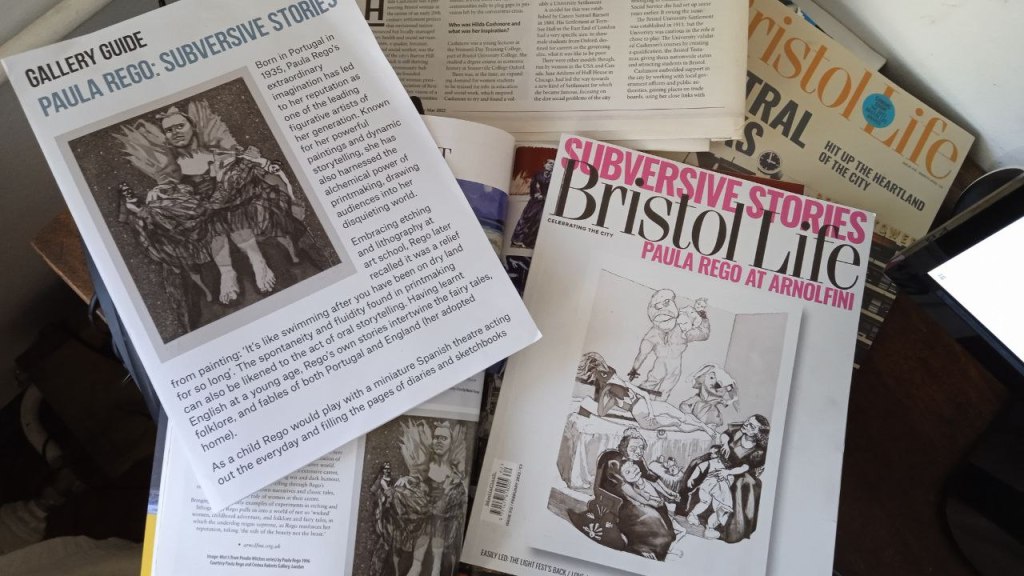
She died two weeks ago and everybody wrote some words about her. So I decided to do it also, but on different way.
On March 2022 I saw her exhibition in Bristol in a big gallery Arnolfini.
Now, knowing she died, I took rather that exhibition text to remember her as everything, that should be written about her now as a hommage. In that text she is still alive.
She
Paula Rego, (26 January 1935 – 8 June 2022) was a Portuguese-British visual artist known particularly for her paintings and prints based on storybooks. Rego’s style evolved from abstract towards representational, and she favoured pastels for much of her career. Her work often reflects feminism, coloured by folk-themes from her native Portugal.
Rego studied at the Slade School of Fine Art, University College London, and was an exhibiting member of the London Group, along with David Hockney and Frank Auerbach. She lived and worked in London.
In 1957 she returned to live in Portugal with her husband, the painter Victor Willing, and their three children, before finally settling in London in 1963.
In 2009 The Casa das Histórias, a museum dedicated to Rego, opened as a permanent home to the artist’s entire collection of over 200 prints alongside drawings, preparatory works and paintings loaned by the artist.
Major solo exhibitions and retrospectives have been key to Rego’s extensive career, with her work housed in major public and museum collections all over the world.
Rego explores themes of power, rebellion, sexuality and gender, grief and poverty, often through female protagonists. One of the most important figurative artists of her generation, her work ranges from painting, pastel, and prints to sculptural installations.
The Exhibition
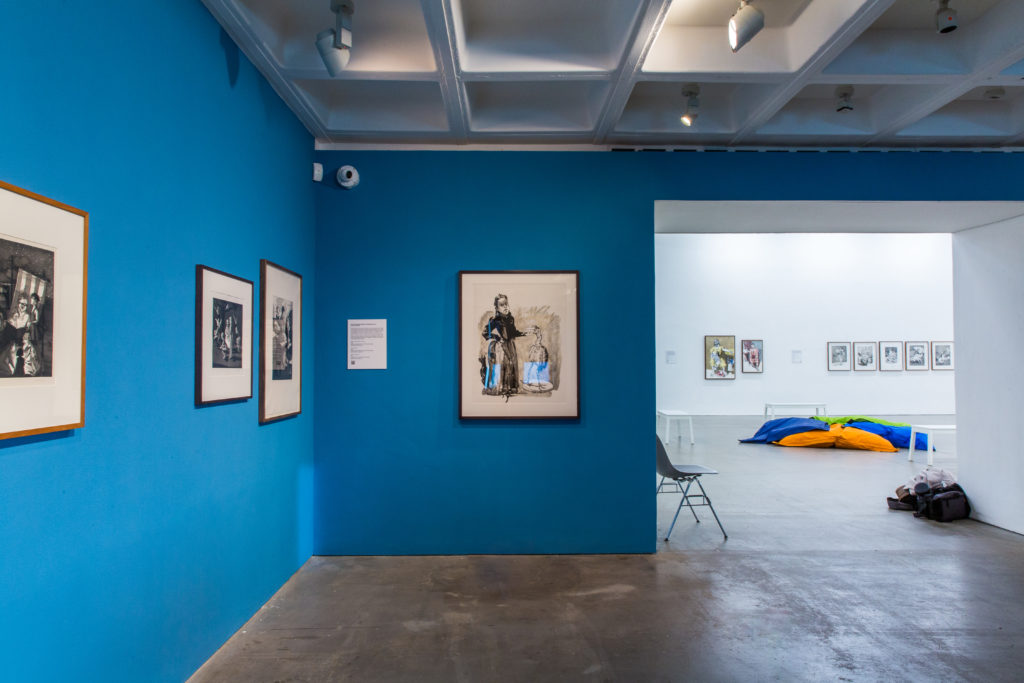
Rego makes a welcome return to Bristol (almost 40 years after her first exhibition here in 1982-83), creating an opportunity for a new generation of visitors to explore the artist’s rich and imaginative world. Featuring over 80 prints from across Rego’s extensive career, the exhibition explores her interweaving wit and dark humour, delving into the art of storytelling through Rego’s reinterpretations of well-known narratives and classic tales, repositioning the role of women at their centre.
Subversive Stories also looks deeper at Rego’s mastery of the printed medium, exploring the process of printmaking as it informs Rego’s multi-layered interpretations, bringing shadowy readings to childish mischief, whilst casting a light on present-day politics, most notably those affecting women.
Bringing together early examples of experiments in etching and lithography, her much-loved series Nursery Rhymes, Peter Pan, Jane Eyre and the Pendle Witches, and less familiar stories, such as The Prince Pig and The Curved Planks, Rego pulls us into a world of not so ‘wicked’ women, childhood adventure, and folklore and fairy tales, in which the underdog reigns supreme, as Rego reinforces her reputation, taking ‘the side of the beauty not the beast.’
Warning
Please note, this exhibition includes images that explore sexuality, abortion, and the practice of female genital mutilation.

Subversive Stories
Arnolfini welcome us to venture into the extraordinary imagination of Paula Rego, one of the leading figurative artists of our generation. Known for her powerful paintings and dynamic storytelling, she has also harnessed the alchemical power of printmaking, drawing audiences into her disquieting world.
Embracing etching and lithography at art school, Rego later recalled it was a relief from painting: ‘It’s like swimming after you have been on a dry land for so long.’ The spontaneity and fluidity found in printmaking can also be likened to the act of oral storytelling. Having learnt English at a young age, Rego’s own stories intertwine the fairy tales, folklore and fables of both, Portugal and England (her adopted home).
As a child Rego would play with a miniature Spanish theatre acting aut the everyday and filling the pages of diaries and sketchbooks with ilustrated word and images. Her subsequent work explores a multitude of themes including power, rebellion, sexuality, gender, religion, and the inherent brutality of life. Like her subject matter, the inspiration for her stories is vast, encompassing childhood, fairy tales, opera, politics, and her own interior world.
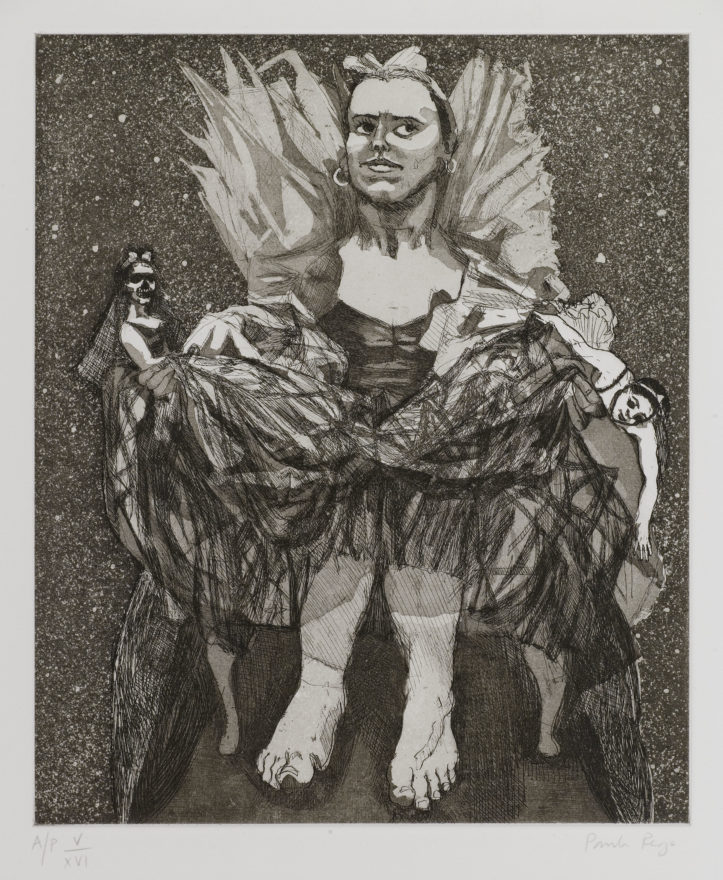
It is within these hybrid, interwoven stories, that Rego reinterprets and subverts narratives. Placing women and girls at their centre, her storytelling challenges established gender roles, fuels sexual ambiguity, undermines the innocence of children, and interchanges traditional notions of good and evil.
Rego utilises the implicit nature of storytelling as a subversive act, employing its shapeshifting qualities to explore an idea from multiple angles, often in series. In similar manner she draws on the metaphorical possibilities of printmaking, a medium reliant upon the contrast between light and shade. Childish mischief is embodied with darker meaning, whereas the harrowing practice of illegal abortion is brought out of shadows.
Within these ‘subversive stories’ Rego draws together the multilayered language of print with an age-old love of literature, reminding us taht: ‘it is through stories that we interpret the world around us’. A master of reinterpreting, reimagining, and reinspiring it is with glee that she shares (in recent documentary) that she is, still, ‘always looking out for a story’.
Podcast
Berlin, 10th of June 2022

 Ewa Maria and Friends