Mantegna & Bellini

Ewa Maria Slaska

Dla Danusi

Deutsch & English in Text

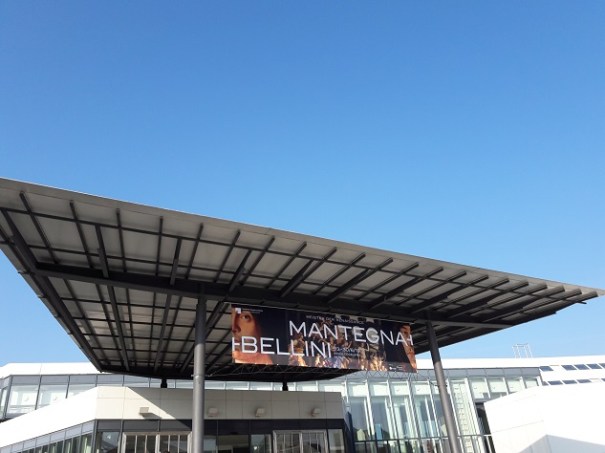
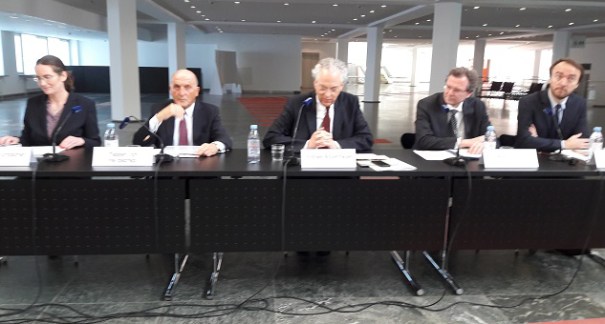
1 marca otwarta została w Berlinie wystawa superlatyw. Podczas konferencji prasowej nazwano ją wprawdzie tylko wystawą roku, ale czuło się, że mówcy, rozpływając się nad wartością wystawy, a więc tego, co przygotowali bądź opłacili, wiedzą, że mówią o wystawie dekady, a może stulecia. Jest w każdym razie spektakularna, niezwykła, nadzwyczajna, sensacyjna. To słowo pojawia się wielokrotnie i nader skutecznie, bo recenzje też piszą o sensacji.

Nota bene pan drugi z prawej, przewodniczący Towarzystwa Ubezpieczeń Od Ognia (Feuer-Sozietät) poinformował zebranych, że jego instytucja wydaje rocznie 1,5 miliarda euro na sponsorowanie popularyzacji sztuki. Och!

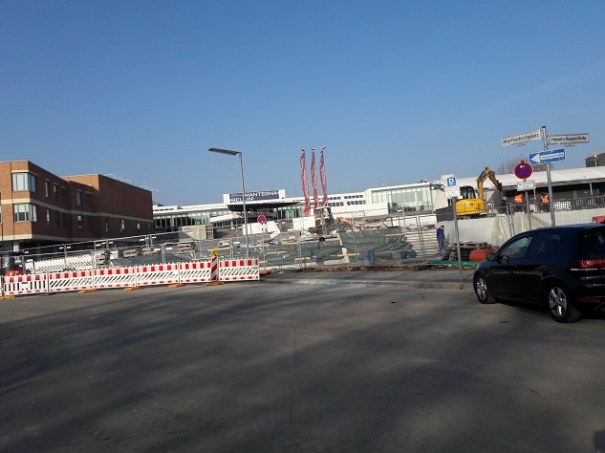
Gościa zamierzającego udać się na wystawę informuję, że zanim tam dojdzie czeka go przedostanie się przez rozległy plac budowy. Z tyłu widać już zbawcze napisy, że owszem Mantegna i Bellini, ale przed nami droga przez mękę. Na pociechę dodam, że jakoś się dojdzie. Idźcie wzdłuż płotów.

Potem już będzie coraz lepiej.

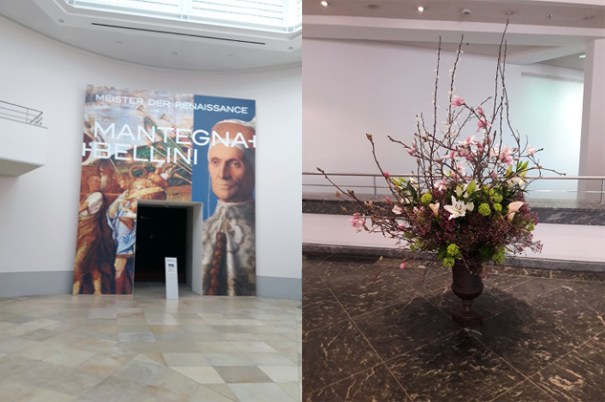
Wystawa zajęła również reprezentacyjny holl wejściowy Nowej Galerii Narodowej (Neue National Galerie) z piękną instalacją wodną Waltera de Maria, a ja słysząc to wyobrażałam sobie, że będzie nam dane doświadczać przyjemności, jakie mieli bogacze, którzy zamawiając dzieło sztuki, nie wieszali go bezdusznie na ścianie, lecz umieszczali je pomiędzy drogimi kwiatami, w otoczeniu drogocennych przedmiotów  i wkomponowywali je w gry wodne i ogrody…

Dzieło Waltera de Maria zniknęło jednak całkowicie, wodę wyłączono, kamienne baseny przykryto podłogami i dywanami, jeśli w salach były kiedykolwiek jakiekolwiek okna, to wszystkie zostały pokryte gęstą, intensywnie kolorową materią spowijającą sufity, podłogi i ściany. Zielenie, szarości, czerwień. Wystawa jest zbiorem coraz mniejszych szkatułek, zamykających nas w czarodziejskim świecie. Gdy potem wyjdziemy z muzeum, ze zdumieniem stwierdzimy, że tam na zewnątrz nadal trwają prace budowlane, a niebo jest niebieskie.

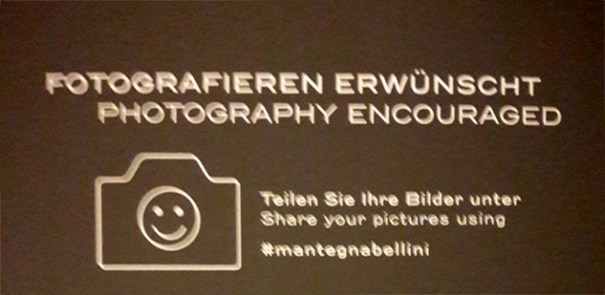
Co naprawdę wzrusza na wystawie jest maleńka informacja – Fotografujcie (przepraszam za jakość zdjęcia) i jak chcecie, to wyślijcie swoje fotografię na stronę #mantegnabellini (oczywiście jak wam się uda – mnie się nie udało, ale cóż bym ja tam miała wysyłać :-).

Podczas konferencji zostaliśmy dobitnie poinformowani, że galeria ma teraz super nowoczesną stronę, ale może jestem zbyt archaiczna, żeby odkryć jakieś jej nieopisane uroki, a zdjęcia (choćbym chciała) nie udało mi się przesłać, więc chyba wszystko jest nie dla mnie. Ale inni wstawili tam zdjęcia i filmiki, co wygląda bardzo ładnie. Poniżej filmik z wystawy w londyńskiej National Gallery, która poprzedziła tę naszą, berlińską.

Und hier (endlich) eine richtige Kritik auf Deutsch.

A ja od siebie dodam na koniec – piękna wystawa, czarodziejska, pozwala zapomnieć o stresie i zmartwieniach :-). Wielcy artyści, wielkie obrazy.

Alle Infos hier

Barataria 104: Weź rdzeń młodej palmy…

Tibor Jagielski już kilkakrotnie raczył nas tu ciekawymi przepisami kulinarnymi; ten został znaleziony przez Autora podczas podróży morskiej.

Weź rdzeń młodej palmy (ok. 0,5 – 0,75 m),
owiń w liście bananowca i umieść w wysmarowanej tłuszczem brytfannie.
Obsyp orzeszkami arachidowymi (0,5 kg, najlepiej świeżo prażone),
dodaj fasolki soi (0,5 kg, najlepiej świeże, ale mogą być z puszki),
dorzuć parę papryczek chili, kilka grzybów (boczniak, shitake, ale mogą być i pieczarki),
dopraw kilkoma ząbkami czosnku i posól (do smaku – każdy ma inny, ale można znaleźć wspólną podstawę),
zalej klasycznym  wywarem z warzyw (0,5 litra).
Brytfannę dobrze przykryj i wstaw do piekarnika (180°C) na  45 minut (próba widelca).
Smacznego!


Ewa Maria Slaska

Zastanawiam się, czym możnaby zastąpić rdzeń młodej palmy? Mam oczywiście trudności, bo nigdy tego nie jadłam, choć raz jadłam potrawę owiniętą w liście bananowca i powiązaną rafią na kształt paczuszki. Liści bananowca się potem nie jadło. Widzę tu pewne pole do popisu dla inwencji kulinarnej autora i postanawiam mu wysłać tych kilka zdań.

Odpowiedź przyszła enigmatyczna:
Jemy, jemy! (jak rozumiem – jemy liście bananowca). Również kwiaty bananowca jemy (nazywa się je „sercami bananów“). Wszystko jemy, a dodatkowo liście mogą służyć jako talerze lub opakowanie potraw.
Rdzeń palmy kupuje się w afroshopie.


Wpis wydaje mi się nieco za mały, postanawiam go samodzielnie uzupełnić, bo autor dosyła wprawdzie świetny przepis (wykorzystam kiedy indziej), ale na sałatkę z kwaśnej kapusty.

Sięgam jeszcze raz do książki Barataria Summer. Pisałam już o niej. To powieść naładowana wesołym swobodnym seksem (każdy śpi z każdym, a w rodzinie to już w ogóle), nie wiadomo też, czy jest to opowieść
o przemycie czy o walce z przemytem, ale na pewno wiadomo, że jest to powieść o tym, jak w ciągu jednego lata, przy pomocy rodzinnego seksu, przemytu, pływania łodziami i statkami po zatoce Barataria oraz  jedzenia można z rozpieszczonego szesnastolatka z miasta zrobić świetnego faceta, a nawet (jak się okaże) – pisarza. Jego imię podczas wakacji zmienia się z Teddie na T’Eddie.

Głównym napojem bohaterów książki jest mocna gorąca kawa, ale oczywiście nie stronią też od whisky. Na łodzi żywią się kiełbaskami i chlebem. Ale już zorganizowany ad hoc posiłek, podany przez LaBelle, młodą, piękną gospodynię w chacie na wodzie będzie wyglądał lepiej:

… piliśmy kawę i jedliśmy chleb żytni, placki, tartę ze słodkich ziemniaków i pudding z chleba. Pychota.

Po przekąsce LaBelle podbiera kurom jajka, zbiera jarzyny w ogrodzie i łowi ryby kaszorkiem. Małe ryby wracają do wody, dziewczyna wybiera na obiad tylko suma. T’Eddie i LaBelle idą do kuchni. Ona ona gotuje, on obiera, sieka i zmywa to, co dziewczyna mu podsunie do obierania, siekania lub zmywania.

LaBelle podaje posiłek. Jedliśmy suma w cieście, chleb żytni, pomidory i succotash, indiańską potrawę z młodego bobu i kukurydzy. Na deser była oczywiście kawa i placek z yamem. (Jako tłumaczka mam tu pewne trudności, bo yam to pochrzyn, ale podejrzewam, że nasi bohaterowie jedli placek ze słodkimi ziemniakami; bo w Ameryce myli się yam z batatami, podobnie zresztą jak radiccio z endywią). O dziwo LaBelle opowiada wprawdzie T’Eddiemu o gumbo, które każdy południowiec musi umieć przyrządzić, ale sama wcale go nie podaje.

Polska blogerka pisze, że z gumbo jest jak z bigosem, mniej więcej wszyscy robimy go podobnie, ale każda rodzina ma swój własny przepis. Gumbo to rodzaj potrawki z mięsa lub owoców morza jarzynami i ewentualnie  kiełbaskami w zagęszczonym np. zasmażką sosie. Gumbo gotuje się przez kilka godzin. Ważne jest, żeby do potrawy dodać trzy święte jarzyny kuchni z południa USA: seler naciowy, cebulę i zieloną paprykę. Zasadniczo można użyć różnych rodzajów mięsa (królik, drób, szop pracz, nutria, wiewiórka) w jednej potrawie lub różnych owoców morza, ale nie należy używać ani wieprzowiny ani wołowiny, i, poza Nowym Orleanem, nie miesza się mięsa z frutti di mare.

Przepisów na gumbo są tysiące. Tu podam przepis ze strony Barataria Spice Company.

Te spices to zestaw przypraw typowych dla kuchni z okolic Luizjany.

Ingredients:
1
TBSP. Salt
3
Bay Leaves
1 1/2
Gallons Water
1 1/2

Pounds Smoked Sausage (Andouille if Available)

2
Medium-Large White Onions – Chopped
2 1/2

Pounds Deboned Chicken (Save carcass for stock)

3
Bunch Green Onions – Chopped
2

TBSP Pickapeppa Sauce (or any Jamaican style sauce)

4
Ribs Celery – Chopped
1

TBSP Lea & Perrins (or any Worsteshire sauce)

4
Toes Garlic – Minced
3
TBSP Captain Mike's cooking seasoning mix
For The Roux:
4 TBSP. Cooking Oil
7 TBSP. Flour
For The Stock:
Add 1 TBSP. salt to 1 1/2 gallons of water, bring to a fast simmer, add Bay leaves and chicken carcass. Simmer for an hour or so. When done, skim off fat, strain debris out. Set aside and keep hot.
Captain’s Log:
How to Make a Roux:

Heat oil in heavy skillet on a low to medium flame. Add flour slowly, stirring, with a whisk or slotted spoon. The Roux cannot be left unattended, it must be constantly stirred so that the flour browns evenly. The process should take about 40 minutes, depending on the amount of heat used. Cook the Roux until it is a deep, dark brown, almost the color of black coffee. Turn off heat, continue stirring until skillet cools for the browning to stop. Set aside and pour off excess oil.

Note: If the Roux burns, discard. Never attempt to salvage a Roux that is burned. Burning a Roux after spending 45 minutes to make it will teach you how far you can go with browning a Roux. This is a valuable skill to have when preparing authentic Cajun and Creole dishes, some of which require the darkest Roux possible, as in this recipe. Some dishes, such as Crawfish Etouffé work better with a Roux that is not so dark.

Procedure:

Debone the chicken and discard the skin. Make a stock with the carcass. You can supplement the deboned chicken you have with Boneless Chicken Breast to get the amount you need. Cut chicken and sausage into bite size pieces. In a heavy stock pot or Dutch oven, brown sausage and chicken in a little oil over a medium flame. Start the Roux at this time in another skillet. (Note: If you are uncomfortable making a Roux and doing the procedure a the same tie, then make the Roux ahead of time.) Start with the sausage first. Brown well, but not harsh, then add chicken. When Chicken begins to brown, sprinkle in about a teaspoon of Captain Mike'sSeasoning. When chicken is lightly browned, remove and set aside. Depending on how much fat was in the sausage, you may have to add a little more oil. Add onions and celery, reduce heat and sauté until clear. Add green onions. When limp stir in garlic, sauté 5 minutes and add stock, raising heat blending well. Bring to a slow boil and stir in Roux, mixing thoroughly for 20 minutes. Add Pickapeppa and Worsteshire sauce and stir in 2 tsps of Captain Mike's cooking seasoning mix. Add the chicken and sausage, cover pot and simmer for 1 hour, stirring occasionally. Turn off heat and let stand 15 minutes, skin off any oil. Serve over Rice.

Approximate serving as entrée 8

Approximate serving as soup 16

Tu znalazłam plus/minus składniki dobrej przyprawy do gumbo, jeśli, co przecież może się zdarzyć, akurat nie mamy pod ręką mieszanki przypraw kapitana Mike.

2 łyżeczki sosu Worcestershire
2 łyżeczki ostrego sosu chili (typu Tabasco)
3 ząbki czosnku przeciśnięte przez praskę i roztarte z 1/2 łyżeczki soli
2 łyżeczki słodkiej papryki w proszku
1/2 łyżeczki świeżo zmielonego czarnego pieprzu
1/2 łyżeczki świeżo zmielonego białego pieprzu
1 łyżeczka suszonego oregano
1/2 łyżeczki suszonego tymianku
1/8 łyżeczki pieprzu cayenne

Roux to oczywiście zasmażka, tylko wysmażona na brązowo, a tu jeszcze przepis na Pickapeppa.

  • 1 łyżka posiekanego czosnku
  • 1 łyżeczka sól
  • 1 łyżeczka mielonego kminku
  • 1 łyżeczka chili mielonego
  • 2 łyżki keczupu
  • 2 łyżki sos Worcester
  • 1 1/2 łyżki sosu Pickapeppa
  • 5 łyżek posiekane papryki jalepano

Czosnek rozetrzeć na pastę z solą. Wszystkie składniki sosu zmiksować w blnderze.
Uwaga: Sos Pickapeppa można zastąpić sosem Worcester.

Myślę, że gdyby zamiast mięsa lub owoców morza dodać podsmażone tofu, to można by wykonać wersję wegetariańską. A może rdzeń młodej palmy?

Smacznego!

Tekst, który “chodzi za mną” od prawie 30 lat

Ewa Maria Slaska i reblog

Był rok 1991. Byłam młoda, szczupła, z szopą kręconych włosów na głowie. Nosiłam obcisłe dżinsy i jedwabne podkoszulki z niewielkim dekoltem, ale wystarczającym, by koleżanki szeptały mi czasem do ucha, że podczas wieczoru auorskiego faceci w ogóle nie słuchali, co czytam, tylko gapili mi się w dekolt. To było prawie 30 lat temu. Kobiety nie pokazywały jeszcze tyle ciała, co teraz, czyli mało było więcej.
Pojechaliśmy do Ameryki, wynajęliśmy samochód w Los Angeles i jechaliśmy, aż dojechaliśmy do Nowego Jorku. Zapamiętałam z tej podróży piękną przyrodę, wspaniałe muzea w każdej byle wiosce z kilkoma milionami mieszkańców oraz nowoczesną architekturę. Właściwie nie mieliśmy żadnych kontaktów z ludźmi. Sypialiśmy na kampingach, gdzie nie było nikogo i nikt się z nami nie chciał z amerykańską wylewnością zaprzyjaźnić. Pamiętam tylko kilka osób. Czarnoskórego przystojnego urzędnika w banku z krawatem nonszalancko zarzuconym na prawe ramię. Jakąś panią na kampingu w Kosciuszko County, która mnie poinfomowała, że Kościuszko był Amerykaninem, a jego nazwisko wymawia się Coscijasko. Młodego Indianina spotkanego nocą na stacji benzynowej w drodze przez kolorowe góry Colorado. Trasy wybieraliśmy mało uczęszczane. Miał dżinsową bluzę z frędzlami i warkocze.
– Skąd jesteś? – zapytał, co jest oczywiście pierwszym pytaniem, z jakim styka się podróżnik na całym świecie.
– Z Europy.
– Skąd z Europy? Pytanie było dziwne, bo w Idaho Minnesotta jest zagranicą, ale nie zraziłam się.
– Z Polski.
– Skąd z Polski? Uznałam, że facet nieźle się upiera, ale odpowiedziałam.
– Z Gdańska.
– O, ożywił się chłopak. – Znasz Wałęsę?
– Tak.
Pokiwał głową, zadowolony, świat był dokładnie taki, jaki miał być, taki, o jakim on wiedział na swojej małej stacji benzynowej w Colorado. Wydał mi resztę, wyszłam, pojechaliśmy dalej.
Nocowaliśmy w rezerwacie, a rano pojechaliśmy do Junktion na sprawunki, bo w rezerwacie były tylko pamiątki, chipsy i cola. Junktion była rzeczywiście miejscem, w którym spotykali się Indianie z rezerwatu i biali z okolicznych wiosek i miasteczek. Turystów nie było. Na wielkim placu parkingowym stały trzy terenowe jeepy z odkrytymi platformami. Nasz biały samochód rzucał się w oczy z daleka. Był tylko jeden ogromny sklep, w którym było wszystko, od kosiarek po naklejki z supermanem. W lokalnej gazecie przy kasie na okładce było zdjęcie cielęcia z dwoma głowami. W gazecie stanowej Gorbaczow stał na czołgu i tryumfował, bo pokonał pucz komunistycznej jaczejki.

Mąż i syn gdzieś zniknęli w czeluściach sklepu, szłam z wielkim wózkiem między półkami i pakowałam chleb, mleko, brokuły i donaty. Zza regału wysunęła się strasznie blada dziewczyna w spranej sukienczynie z jakiejś bladej wzorzystej bawełny. Sukienczyna była wysmotruchana na brzuchu, a wyglądała tak, jak sukienki Ani z Zielonego Wzgórza, zanim jeszcze Mateusz zainterweniował i stroje dziewczynki zaczęły być kolorowe, bufiaste i ozdobne. Dziewczynina w sklepie miała na czole blade jak ona sama loczki, przyklejone plastrem. Uśmiechnęłam się do niej, ale ona tylko stała i patrzyła na mnie poważnym wzrokiem. Po chwili pojawiła się druga, tak samo ubrana i też młoda. Nie stały obok siebie, każda zatrzymała się tam, gdzie wyszły z przejścia między półkami. Stały i patrzyły, a ich patrzenie było nie tyle poważne co surowe i zimne. Poczułam się, jakbym miała plamę na policzku. Pojawiły się dwie następne kobiety, starsze, grubsze, siwoblond. Na sukienkach miały zawiązane fartuchy w paseczki. Były z innej epoki, z innego świata, może z jakiejś sekty jak amishe czy shakerzy. Było ich coraz więcej i przysuwały się do mnie coraz bliżej. Wciąż nic nie mówiły. Patrzyły na rudą lokowatą kobietę w obcisłych dżinsach zielonych jak wiosenna trawa i jasnoróżowej bluzce bez rękawów i z (małym!) dekoltem. Zanim dotarłam do kasy i zdołałam telepatycznie przywołać mężczyzn, przeżyłam momenty prawdziwej grozy, takiej z filmów. Myślałam o tym, że półki w sklepie poręcznie zawierają wszystko, czym cicho i szybko można zakłuć czarownicę. Jestem zdania, że uratował mnie tylko fakt, że te kobiety po prostu nie miały powodu, żeby to zrobić. Gdyby jednak tej nocy w ich miasteczku na prerii umarło dziecko, na przykład na ospę, a one przecież nie szczepiły dzieci, to było oczywiste, gdyby więc to dziecko umarło, to na pewno ja, ruda wyuzdana przybłęda, musiałabym za to zapłacić.

Nie zapomnę tej sceny póki żyję. Trwa, a my wciąż patrzymy na siebie – nowoczesna Europejka i przeniesione z innej epoki i z innych norm Amerykanki. Nic się nie zmienia. Ich loczki wciąż są przyczepione plastrem do czoła, wciąż mają na sobie sukienki z wzorzystej bawełny.

Te sukienki nazywają się “sukienki z prerii”. Dowiedziałam się tego wczoraj i dlatego przygotowałam ten wpis. Nowojorska gazeta The Cut w artykule o modzie na nadchodzącą wiosnę pisze o sukienkach z prerii.

spring 2019 fashion issue /

The Pleasure of Sitting Out a Trend

Designerka nazywa się Bashewa Hay, a jej sukienki mogą się okazać hitem nadchodzącego sezonu.

These dresses: They look like Laura Ashley exposed to just a touch of nuclear radiation, and, per the Washington Post, they’re “the most provocative thing in fashion right now.” Vogue: “Vintage Laura Ashley, Betsey Johnson’s Alley Cat, and Gunne Sax.” Women’s Wear Daily: “Anne of Green Gables, Laura Ashley, and Eighties neo-Victoriana.” Haaretz: “Amish Meets Laura Ashley With a Bit of Hasidic Chic.” Indeed, the Batsheva line (launched in 2016) began with a beloved and beat-up Laura Ashley dress that Hay had remade. But her specifications made the details more eccentric, extreme. (…) Hay has described finding inspiration in both her mother’s style in the ’70s and the dress codes of religious fundamentalism, from Mennonites and the Amish to Hasidim. A former corporate lawyer educated at Stanford and Georgetown, Hay grew up in a secular family; her husband, a successful fashion photographer, was beginning to embrace Orthodox Judaism around the time they met. Her designs found her grappling with the confines of his faith. During their courtship, the couple staged Hasidic-cosplay photo shoots in South Williamsburg, complete with wig.

Cały tekst TU.

Nowy Rok Wallandera / New Year with Tennyson

Ewa Maria Slaska

Wczorajszego sylwestra spędziliśmy z Wallanderem i jego ojcem. Wpis kończył się tymi zdaniami:

Złożyli sobie życzenia. Ojciec nalał sobie kolejny kieliszek koniaku. Rozlał przy tym trochę na podłogę. Był w świetnym humorze. Dla Wallandera to było najważniejsze.
O dwunastej zasiedli przed telewizorem i słuchali…

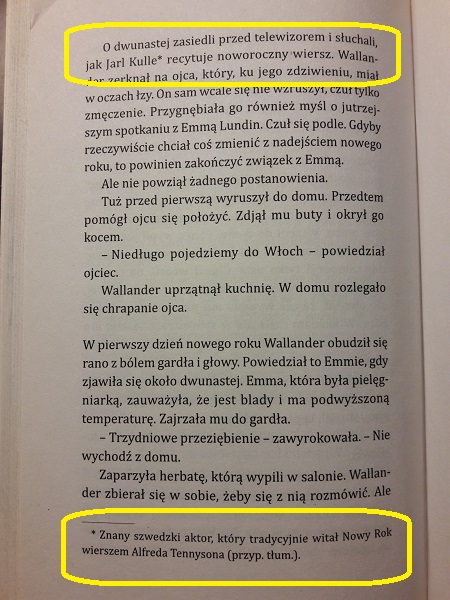
Zaczął się Nowy Rok. Wallander i jego ojciec zasiedli przed telewizorem i słuchali, jak Jarl Kulle recytuje noworoczny wiersz.*

Tłumaczka, Irena Kowadło-Przedmojska, dodaje w tym miejscu przypis:

A więc znany aktor tradycyjnie wita Nowy Rok w Szwecji wierszem Alfreda Tennysona.

Nie mogę nie pójść tym tropem. Zostawiam więc Wallandera, który wraca do domu, a rano budzi się z bólem gardła i głowy…


“Ring Out, Wild Bells” is a poem by Alfred, Lord Tennyson. Published in 1850, the year he was appointed Poet Laureate, it forms part of In Memoriam, Tennyson’s elegy to Arthur Henry Hallam, his sister’s fiancé who died at the age of twenty-two.

According to a story widely held in Waltham Abbey, and repeated on many websites, the ‘wild bells’ in question were the bells of the Abbey Church. According to the local story, Tennyson was staying at High Beach in the vicinity and heard the bells being rung on New Year’s Eve.

It is an accepted English custom to ring English Full circle bells to ring out the old year and ring in the new year over midnight on New Year’s Eve. Sometimes the bells are rung half-muffled for the death of the old year, then the muffles are removed to ring without muffling to mark the birth of the new year. In some versions of the story it was a particularly stormy night and the bells were being swung by the wind rather than by ringers, but this is highly unlikely given the method of ringing English full circle bells, which requires a considerable swinging arc before the clappers will strike the bell.

Ring out, wild bells, to the wild sky,
The flying cloud, the frosty light:
The year is dying in the night;
Ring out, wild bells, and let him die.
XXX
Ring out the old, ring in the new,
Ring, happy bells, across the snow:
The year is going, let him go;
Ring out the false, ring in the true.
XXX
Ring out the grief that saps the mind
For those that here we see no more;
Ring out the feud of rich and poor,
Ring in redress to all mankind.
XXX
Ring out a slowly dying cause,
And ancient forms of party strife;
Ring in the nobler modes of life,
With sweeter manners, purer laws
XXX
Ring out the want, the care, the sin,
The faithless coldness of the times;
Ring out, ring out my mournful rhymes
But ring the fuller minstrel in.
XXX
Ring out false pride in place and blood,
The civic slander and the spite;
Ring in the love of truth and right,
Ring in the common love of good.
XXX
Ring out old shapes of foul disease;
Ring out the narrowing lust of gold;
Ring out the thousand wars of old,
Ring in the thousand years of peace.
XXX
Ring in the valiant man and free,
The larger heart, the kindlier hand;
Ring out the darkness of the land,
Ring in the Christ that is to be.

A translation into Swedish by Edvard Fredin called ‘Nyårsklockan’ – ‘The New Year’s Bell’ – is recited just before the stroke of midnight at the annual New Year’s Eve festivities at Skansen in Stockholm, capital of Sweden. This tradition began in 1897 when the young Swedish actor Anders de Wahl was asked to recite the poem. De Wahl then performed the poem annually until his death in 1956. Since 1977 the Swedish national public TV broadcaster, SVT, has aired the event live, and the first to read the poem on television was the actor Georg Rydeberg. The show turned out to be a major success, and watching it on New Year’s Eve quickly became a nationwide tradition. Rydeberg recited the poem until his death in 1983. After that many famous Swedish actors and/or singers have recited the poem.

  • Georg Rydeberg 1977 – 1982
  • Jarl Kulle 1983 – 1996
  • Margaretha Krook 1997 – 2000
  • Jan Malmsjö 2001 – 2013
  • Loa Falkman –  2014
  • Malena Ernman – 2015
  • Pernilla August – 2016
  • Krister Henriksson – 2017

It should be noted that the Swedish translation differs significantly from the English original. Inspired by the Swedish tradition, auto manufacturer Volvo used the poem in a 2016 New Year’s Eve advertisement (TU).

Ciąg dalszy jutro / Follow us tomorrow

Worldwide Reading for Freedom of the Press and in Memory of Jamal Khashoggi

Dear Friends! Please read it tomorrow!

Dear Madam or Sir,

Below please find our call for a Worldwide Reading on December 10, 2018, signed, among others, by Nobel laureates Elfriede Jelinek, Herta Müller, Wole Soyinka, Mario Vargas Llosa, as well as Manal al-Sharif, Margarete Atwood, Bernard Henri Levy, Roberto Saviano, Eva Menasse, David Van Reybrouck and the President of PEN International, Jennifer Clement. The list of over 100 authors who support the call can be found below.

With kind regards,

Ulrich Schreiber
Festival Director
international literature festival berlin

Sehr geehrte Damen und Herren,

unten stehend finden Sie unseren Aufruf für eine weltweite Lesung am 10.12.2018, den u. a. die Literaturnobelpreisträger*innen Elfriede Jelinek, Herta Müller, Wole Soyinka, Mario Vargas Llosa sowie Manal al-Sharif, Margarete Atwood, Bernard Henri Levy, Roberto Saviano, Eva Menasse, David Van Reybrouck und die Präsidentin von PEN International, Jennifer Clement, unterzeichnet haben. Die Liste der über 100 Autor*innen, die den Aufruf unterstützen, finden Sie unten.

Mit freundlichen Grüßen

Ulrich Schreiber
Festivaldirektor
internationales literaturfestival berlin

Worldwide Reading for Freedom of the Press and in Memory of Jamal Khashoggi on the 70th Anniversary of the Declaration of Human Rights, December 10, 2018

On December 10, 1948, 70 years ago, the Universal Declaration of Human Rights was announced by the United Nations General Assembly at the Palais de Chaillot in Paris. On this anniversary, the international literature festival berlin (ilb) calls upon individuals, institutions, universities, schools, and media who value freedom of the press and human rights to organize and participate in a worldwide reading in memory of the murdered Saudi journalist Jamal Khashoggi.

The last time Khashoggi was seen alive was when he entered the Saudi consulate in Istanbul on October 2. After nearly three weeks of silence, Saudi Arabia admitted that he died there during a fight with Saudi officials. However, the evidence – such as the deployment of a fifteen-member team of security officers including a forensic scientist – indicates that the murder of Khashoggi was planned well in advance or, at the very least, accepted. The involvement of the highest levels of the Saudi Arabian government, including the crown prince, Mohammed bin Salman, is very likely, since such an action against a prominent critic of the regime would hardly be undertaken without the approval of the royal family. Until now, Saudi Arabia has not offered any clues about the location of Khashoggi’s body. The initiators of the worldwide reading demand the complete and transparent truth about the events that transpired. The responsible parties must be held accountable.

In the last text written by the 59-year-old (he would have celebrated his sixtieth birthday on October 13, 2018) Saudi journalist, which the Washington Post published two weeks after his disappearance, Khashoggi emphatically calls for freedom of expression in the Arab world. His firm stance has now cost the journalist his life.

This murder is the climax of a series of oft-unsolved murders of male and female journalists in recent years, as seen by recent cases in Mexico, Bulgaria, Malta, and Slovakia. Freedom of the press and freedom of expression, the indispensability of which Khashoggi emphasized with regard to the Arab world, is under threat everywhere, including in Europe. Consequently, journalists and political dissidents, even those in exile, are no longer safe, as this case blatantly shows. Jamal Khashoggi is simply the most prominent victim thus far. Many murders against journalists do not even reach the attention of the world public. We also remember that in Turkey, too, freedom of the press is extremely restricted. Over 150 journalists and authors are imprisoned, with some serving lifelong sentences.

At the same time, this incident has already led to serious consequences for international politics and the global economy. Numerous leading managers and economic policy makers will no longer participate in the large Future Investment Initiative scheduled to take place in Riyadh at the end of October. Therefore, this incident clearly shows that the protection of freedom of the press and freedom of expression and the fight against the murder of journalists and extrajudicial state killings are not about some kind of unrealistic idealism in terms of human rights, but rather that we are all affected by these crimes – culturally, politically, and economically.

If this incident, the most stunning murder of a journalist in recent years, does not lead to consequences – what then? Who will be the next murdered journalist, activist, or dissident, and in which country? Even after the partial confession by the Saudis, this incident may not be swept under the rug. Remembering Khashoggi on the anniversary of the Declaration of Human Rights is intended to make this emphatically clear.

With all this in mind, on December 10, we call upon you to participate in the worldwide reading of texts by Jamal Khashoggi and – depending on the specific national context – other murdered, missing, and imprisoned journalists. Please send information about the reading in your location to worldwidereading@literaturfestival.com so that we may publicize the events on our websites  http://www.worldwide-reading.com and  www.literaturfestival.com.

Ulrich Schreiber
Festival Director, international literature festival berlin

Our film “What Matters”, which presents a reading of the 30 articles of human rights with Vivienne Westwood, Nina Hoss, Can Dündar, Patti Smith, Simon Rattle, Ai Weiwei, Elfriede Jelinek, David Grossman, and others, is now available online with subtitles in 9 languages (Arabic, Chinese, English, French, Russian, Hindi, Turkish, Spanish and German) – we especially recommend screening the film in schools, universities, and cultural institutions:
http://literaturfestival.com/festival-en/projekte-en/what-matters-en?set_language=en

For the reading, we recommend texts by Khashoggi, such as these from the Washington Post:
https://www.washingtonpost.com/opinions/global-opinions/jamal-khashoggi-what-the-arab-world-needs-most-is-free-expression/2018/10/17/adfc8c44-d21d-11e8-8c22-fa2ef74bd6d6_story.html?utm_term=.f4a73f975eeb
Arabic:
http://blogs.aljazeera.net/blogs/2018/10/18/جمال-خاشقجي-أمس-ما-يحتاجه-العالم-العربي-هو-حرية-التعبير

See also Khassogis speech in Aril, this year:
https://www.nytimes.com/2018/10/22/opinion/khashoggi-mbs-arab-democracy.html

خاشقجي
في الذكرى السبعين للإعلان العالمي لحقوق الإنسان بتاريخ 10 ديسمبر 2018

في العاشر من ديسمبر عام 1948 صدر الإعلان العالمي لحقوق الإنسان من الجمعية العامة للأمم المتحدة في باريس. بهذه المناسبة يدعو مهرجان الأدب الدولي في برلين كل من تهمّهم حرية الصحافة وحقوق الإنسان من أفراد ومؤسسات وجامعات ومدارس ووسائل إعلام لتنظيم قراءات عالمية أو المشاركة فيها في ذكرى الصحفي السعودي المقتول جمال خاشقجي.
شوهد الأخير حياً للمرة الأخيرة في 2 أكتوبر، عندما دخل القنصلية السعودية في اسطنبول. وقد اعترفت السعودية بعد ثلاثة أسابيع من اختفائه أن خاشقجي مات من جراء “اشتباك” حصل بينه وبين موظفين سعوديين. إلا أن الأدلة، منها إرسال طاقم أمني سعودي الى القنصلية في ذات النهار، بينهم طبيب شرعي، تشير إلى أن اغتيال خاشقجي كان مخططاً له أو مقبولاً على الأقل لدى القيادة السعودية، مع العلم أن تورُّط أعلى المسؤولين في السعودية في الجريمة، بما في ذلك ولي العهد محمد بن سلمان، أمر وارد جداً. كما أن السعودية لم تشر بأية عبارة إلى مكان وجود جثة المقتول. يطالب المبادرون للقراءة العالمية بالكشف الكامل والشفاف عن حيثيات هذه الجريمة وبمحاسبة المسؤولين عنها.
لقد طالب جمال خاشقجي الذي كان سيدخل الـ60 سنة من عمره في 13 أكتوبر 2018 في مقاله الأخير في صحيفة واشنطن بوست، والتي نشرتها الصحيفة بعد أسبوعين من اختفائه، بضرورة حرية الرأي في العالم العربي، ودفع ثمن هذا الموقف حياته.
قتل جمال خاشقجي هو الأخير في سلسلة اغتيالات بحق صحفيين وصحفيات في الآونة الأخيرة، منها جرائم حدثت في المكسيك وبلغاريا ومالطا وسلوفاكيا، ولم يُكشف عن جميع حيثياتها. مما يوضح أن حرية الرأي والصحافة التي طالب بها خاشقجي للعالم العربي مهددة في كل مكان، وأيضاً في أوروبا، وأن أي شخص معارض ليس في أمان، حتى لو تواجد في المنفى. قضية جمال خاشقجي قضية بارزة، إلا أن الكثير من حالات القتل ضد الصحفيين لا تصل أخبارها إلى عناوين الصحف العالمية. يضاً في أوروبا

انعكست هذه القضية على السياسة والتجارة الدولية، فالكثير من رؤساء الشركات والسياسيين الاقتصاديين ألغوا مشاركتهم في مؤتمر استثماري كبير في الرياض في نهاية شهر أكتوبر، مما يُثبت أن حماية حرية الصحافة والرأي ومقاومة قتل الصحفيين على أيدي الدول ليست مجرد مثالية ساذجة، بل أنها قضية تهمّنا جميعاً من الناحية الثقافية والسياسية والاقتصادية.
أما إذا كانت قضية خاشقجي بصفتها أفدح حالة اغتيال بحق صحفي في السنوات الأخيرة لا تؤدي الى عواقب، فمن سيكون مصيره نفس مصير جمال خاشقجي من الصحفيين والناشطين والمعارضين، وفي أية دولة؟  حماية الصحفيين والناشطين تعني حماية الجميع. لا يجوز أن يُستر على هذه القضية حتى بعد شبه الاعتراف الذي جاءت به السعودية. نود أن نشير إلى ذلك بإلحاح بمناسبة ذكرى الإعلان العالمي لحقوق الإنسان، عندما نذكّر بمصير جمال خاشقجي في الوقت نفسه.
كما نذكّر أيضاً بأن حرية الصحافة مقيدة الى حد بعيد في تركيا أيضاً، حيث يقبع في سجونها أكثر من 150 صحفياً وكاتباً، وقد صدرت بحق بعضهم أحكام تصل إلى السجن مدى الحياة.
على هذه الخلفية ندعو للمشاركة في القراءات العالمية لنصوص جمال خاشقجي في العاشر من ديسمبر، أو قراءة نصوص غيره من الصحفيين المقتولين أو المختفين أو المسجونين، بحسب سياق كل بلد. مع الرجاء أن ترسلوا لنا معلومات عن هذه الفعاليات في أماكنكم إلى العنوان worldwidereading@literaturfestival.com ، حتى نشير إليها في صفحاتنا الالكترونية www.worldwide-reading.com و www.literaturfestival.com.

أولريش شرايبر
رئيس مهرجان الأدب الدولي في برلين

فيلمنا بعنوان “What Matters” والذي يحتوي على قراءة بنود حقوق الإنسان الثلاثين بمشاركة العديد من الفنانين والممثلين والصحفيين العالميين متوفر على الانترنت بترجمات مكتوبة بتسع لغات (عربي، صيني، إنجليزي، فرنسي، روسي، هندي، إسباني، ألماني). ننصح بعرض الفيلم خاصةً في المدارس والجامعات والمراحكز الثقافية:
http://literaturfestival.com/festival-en/projekte-en/what-matters-en?set_language=en

كما ننصح بقراءة النصوص التالية لجمال خاشقجي علناً:
https://www.washingtonpost.com/opinions/global-opinions/jamal-khashoggi-what-the-arab-world-needs-most-is-free-expression/2018/10/17/adfc8c44-d21d-11e8-8c22-fa2ef74bd6d6_story.html?utm_term=.f4a73f975eeb

See also Khassogis speech in Aril, this year:
https://www.nytimes.com/2018/10/22/opinion/khashoggi-mbs-arab-democracy.html
http://blogs.aljazeera.net/blogs/2018/10/18/جمال-خاشقجي-أمس-ما-يحتاجه-العالم-العربي-هو-حرية-التعبير

Weltweite Lesung für Pressefreiheit und in Erinnerung an Jamal Khashoggi am 70. Jahrestag der Erklärung der Menschenrechte, am 10. Dezember 2018

Am 10. Dezember 1948, vor 70 Jahren, wurde die Allgemeine Erklärung der Menschenrechte von der Generalversammlung der Vereinten Nationen im Palais de Chaillot in Paris verkündet. Anlässlich dieses Jahrestages ruft das internationale literaturfestival berlin (ilb) Menschen, Institutionen, Universitäten, Schulen und Medien, denen Pressefreiheit und Menschenrechte wichtig sind, zur Organisation und Teilnahme an einer weltweiten Lesung in Gedenken an den getöteten saudischen Journalisten Jamal Khashoggi auf.Zum letzten Mal wurde Khashoggi lebend gesehen, als er am 2. Oktober das saudische Generalkonsulat in Istanbul betrat. Nach fast dreiwöchigem Schweigen haben die saudischen Machthaber eingeräumt, dass er dort während eines Streits mit Beamten ums Leben gekommen ist. Die Indizien, etwa die Entsendung eines fünfzehnköpfigen Teams von Sicherheitsbeamten inklusive eines Forensikers, deuten jedoch darauf hin, dass die Ermordung Khashoggis von langer Hand geplant oder zumindest billigend in Kauf genommen wurde. Die Verwicklung höchster Regierungsstellen bis hin zum Kronprinzen Mohammed bin Salman in Saudi-Arabien ist sehr wahrscheinlich, da eine solche Aktion gegen einen prominenten Regimekritiker wohl kaum ohne die Billigung des Königshauses hätte durchgeführt werden können. Über den Verbleib von Khashoggis Leichnam ist Saudi-Arabien bis jetzt jeden Hinweis schuldig geblieben. Die Initiatoren der Weltweiten Lesung fordern die vollständige und transparente Aufklärung des Falls. Die Verantwortlichen müssen zur Rechenschaft gezogen werden.Im letzten Text, den der 59 Jahre alt gewordene (am 13.10.2018 hätte er seinen sechzigsten Geburtstag gefeiert) saudische Journalist geschrieben hat und den die Washington Post zwei Wochen nach seinem Verschwinden publiziert hat, fordert Khashoggi mit großem Nachdruck die Meinungsfreiheit in der arabischen Welt ein. Für seine klare Haltung hat der Journalist nun mit seinem Leben bezahlt.Dieser Fall ist der Höhepunkt einer Reihe von oftmals unaufgeklärten Morden an Journalistinnen und Journalisten in den letzten Jahren, wie die jüngsten Beispiele in Mexiko, Bulgarien, Malta und der Slowakei gezeigt haben. Die Presse- und Meinungsfreiheit, deren Unerlässlichkeit Khashoggi mit Blick auf die arabische Welt betont hat, ist überall bedroht, auch mitten in Europa. Folglich sind Journalistinnen, Journalisten und politische Oppositionelle selbst im Exil längst nicht mehr geschützt, wie dieser Fall auf eklatante Weise zeigt. Jamal Khashoggi ist nur das bislang prominenteste Opfer. Viele Journalistenmorde rücken gar nicht mehr ins Bewusstsein der Weltöffentlichkeit. Wir erinnern daran, dass auch in der Türkei die Pressefreiheit extrem eingeschränkt ist. Über 150 Journalisten und Autoren sind inhaftiert, einige erhielten lebenslange Haftstrafen.Zugleich hat dieser Fall bereits jetzt schwerwiegende Folgen für die internationale Politik und Wirtschaft. Zahlreiche führende Manager und Wirtschaftspolitiker werden nicht an der großen, Ende Oktober geplanten Future Investment Initiative in Riad teilnehmen. Der Fall zeigt damit exemplarisch, dass es sich bei dem Schutz von Presse- und Meinungsfreiheit, beim Kampf gegen Journalistenmorde und extralegale Tötungen staatlicherseits nicht um einen weltfremden menschenrechtlichen Idealismus handelt, sondern dass wir alle von diesen Verbrechen betroffen sind – kulturell, politisch, wirtschaftlich.

Wenn der Fall, als der spektakulärste von allen Journalistenmorden der letzten Jahre, nicht zu Konsequenzen führt – was dann? Wer wird der nächste ermordete Journalist, Aktivist, Oppositionelle sein, und in welchem Land? Der Schutz von Journalisten und Aktivisten ist der Schutz aller Menschen. Der Fall darf auch nach dem Teilgeständnis der Saudis nicht unter den Tisch gekehrt werden. Die Erinnerung an Khashoggi anlässlich des Jahrestages der Deklaration der Menschenrechte soll dies mit Nachdruck deutlich machen.

Vor diesem Hintergrund rufen wir am 10. Dezember zur Teilnahme an der Weltweiten Lesung von Texten Jamal Khashoggis und – je nach länderspezifischem Kontext – anderer ermordeter, verschwundener und inhaftierter Journalisten auf. Bitte senden Sie Informationen über die Lesung an Ihrem Ort an worldwidereading@literaturfestival.com, damit wir die Veranstaltungen auf unseren Websites www.literaturfestival.com und www.worldwide-reading.com  kommunizieren können.

Ulrich Schreiber
Festivaldirektor, internationales literaturfestival berlin

Unser Film „What Matters“ ist nun mit Untertiteln in neun Sprachen (Arabisch, Chinesisch, Englisch, Französisch, Russisch, Türkisch, Hindi, Spanisch und Deutsch) online verfügbar – wir empfehlen die Präsentation vor allem in Schulen, Universitäten und kulturellen Einrichtungen: http://literaturfestival.com/festival-en/projekte-en/what-matters-en?set_language=en

Wir empfehlen zur Lesung Texte Khashoggis, wie diesen aus der Washington Post:
https://www.washingtonpost.com/opinions/global-opinions/jamal-khashoggi-what-the-arab-world-needs-most-is-free-expression/2018/10/17/adfc8c44-d21d-11e8-8c22-fa2ef74bd6d6_story.html?utm_term=.f4a73f975eeb
Arabisch:
http://blogs.aljazeera.net/blogs/2018/10/18/جمال-خاشقجي-أمس-ما-يحتاجه-العالم-العربي-هو-حرية-التعبير

Eine Rede Khassoggis vom April diesen Jahres:  https://www.nytimes.com/2018/10/22/opinion/khashoggi-mbs-arab-democracy.html

Sowie:
https://www.washingtonpost.com/opinions/global-opinions/jamal-khashoggi-chose-to-tell-the-truth-its-part-of-the-reason-hes-beloved/2018/10/07/4847f1d6-ca70-11e8-a3e6-44daa3d35ede_story.html?utm_term=.b0474b26edb5

Porträt von Khashoggi aus der NZZ: https://www.nzz.ch/international/khashoggi-ein-saudi-der-nicht-schweigen-konnte-ld.1428431

Signers:

Héctor Abad, Colombia
Basma Abdel Aziz, Egypt
Anna Aguilar-Amat, Spain
Manal al-Sharif, Saudi Arabia
Scott Anderson, USA
Kerri Arsenault, USA
Vladimir Arsenijević, Serbia
Margaret Atwood, Canada
Hanan Awwad, Palestine
Zsófia Bán, Hungary
Doreen Baingana, Uganda
Maria Cecilia Barbetta, Argentina/ Germany
Priya Basil, UK/ Germany
Zoë Beck, Germany
Charles Bernstein, USA
Manfred Bissinger, Germany
Hans Christoph Buch, Germany
Brian Castro, Australia
Evans Chan, China/ USA
Bernice Chauly, Malaysia
Amir Hassan Cheheltan, Iran
Christos Chryssopoulos, Greece
Jennifer Clement, Mexico/ USA
Bora Ćosić, Serbia/ Germany
Mark Z. Danielewski, USA
Emmanuel Delloye, France
Migmar Dhakyel, Germany
Ariel Dorfman,  Chile
Reimer Eilers, Germany
Hannele Eskola, Finland
Stella Gaitano, South Sudan
V.V. (Sugi) Ganeshananthan, Sri Lanka/ USA
Paul Gilroy, UK
Namita Gokhale, India
Elvira M. Gross, Austria
Christian Grote, Germany
Miriam Haidle, Germany
Milton Hatoum, Brazil
Alban Nikolai Herbst, Germany
Iman Humaydan, Lebanon
Elfriede Jelinek, Austria
Pierre Joris, Luxembourg/ USA
Christoph Jürgensen, Germany
Archil Kikodze, Georgia
Vjačeslav G. Kuprijanov, Russia
Andrei Kurkov, Ukraine
Stan Lafleur, Germany
Louis Jensen, Denmark
Christoph Leisten, Germany
Bernard Henri Lévy, France
Joris Lieve, Belgium
Mario Vargas Llosa, Peru/ Spain
Jonas Lüscher, Germany/ Switzerland
Nikola Madzirov, Republic of Macedonia
Sindiwe Magona, Southafrica
Vasyl Makhno, Ukraine
Zakes Mda, South Africa
Claus Martin, Germany
March for Science e.V.
Lorenzo Marsili, Italy
John Mateer, Southafrica/ Australia
Eva Menasse, Austria/ Germany
Maaza Mengiste, Ethiopia/ USA
Amanda Michalopoulou, Greece
Fanny Moreno, Colombia
Davide Morosinotto, Italy
Ibrahim Nasrallah, Jordan
Ralf Nestmeyer, Germany
Norman Ohler, Germany
Laksmi Pamuntjak, Indonesia
Elisabeth Plessen, Germany
Francine Prose, USA
Laura Restrepo, Colombia
David Van Reybrouck, Netherlands
Daniel Roeder, Germany
Meg Rosoff, USA/ UK
Jaroslav Rudis, Czech Republic
Alberto Ruy-Sanchez, Mexico
Philippe Sands, UK
Sapphire, USA
Allen Say, Japan/ USA
Roberto Saviano, Italy   Wolfram Schrettl, Germany
Gereon Sievernich, Germany
Eduardo Sguiglia, Argentina
Samuel Shimon, Iraq/ UK
Tajima Shinji, Japan
Ostap Slyvynsky, Ukraine
Maria Sommer, Germany
Wole Soyinka, Nigeria
Gerhard Stadelmaier, Germany
Heino Stöver, Germany
Rick Stroud, UK
Murat Suner, Turkey/ Germany
George Szirtes, UK
Janne Teller, Denmark
Stefan Thome, Germany
Imre Török, Hungary/ Germany
Mario Vargas Llosa, Peru/ Spain
Joachim Walther, Germany
Dima Wannous, Syria
Steve Wasserman, USA
Peter Wawerzinek, Germany
Stefan Weidner, Germany
Suse Weisse, Germany
Levin Westermann, Switzerland
Herbert Wiesner, Germany
Viktor Yerofeyev, Russia
Abraham Zere, Eritrea
Jenni Zylka, Germany

A very (un)important question

Ewa Maria Slaska

HOW!?

One month ago I was in Washington. I visited Capitol and Capitol Library, Sculpture Garden with a Silver Tree, Vietnam Memorial, Holocaust Museum and Smithsonian Institut. Only in Capitol somebody checked my identity. It means: if somebody shall really want to know I was there he will be able to check it  using Capitols archives. I suppose than that imaginary “someone” will be ably to find my mail-adresse, birthday, number of my slips and information how many grandchildren I have. OK, I do not mind. If I want to see the place where the world is governed I have to accept I am being controlled. But only then.

Now… I am already some weeks back in Europa. Since then I get mails from Smithsonian. Like that one, from 25th of November. A Subject line: a power of knowledge.

Indeed.

Dear Friend,

This year, Smithsonian scientists built a tool that will touch the sun without melting. Smithsonian curators assisted FBI agents in identifying a stolen pair of Ruby Slippers from the The Wizard of Oz. And Smithsonian educators developed a new, freely available science curriculum that can be used by teachers all around the world.

That’s the power of knowledge. And the power of the Smithsonian. Thanks to you.

The year’s not over yet. To keep this momentum going, we’re looking for 150 new Friends of the Smithsonian members by the end of November. And because you’re such a devoted Smithsonian supporter, we’re offering you a Fall Member Drive discounted rate of just $60 – a savings of $15!

Your Member Card

When you become a Friends of the Smithsonian member, you’ll receive your very own Smithsonian membership card. This card is your gateway to exciting discounts, but it means much more than that. It’s a symbol of your belief in the power of knowledge. It shows that you’re committed to helping Smithsonian scientists, researchers, curators and educators make the world a better place.

And here at the Smithsonian, we want to reward you for that commitment. Become a member today and receive:

  • A subscription to Smithsonian magazine;
  • 20% discount in Smithsonian Museum Stores
  • 10% discount at selected Smithsonian dining facilities
  • A beautiful Smithsonian annual engagement calendar with full-color images of exceptional art and artifacts.
  • …and more!
JOIN NOW »

P.S. – Ready to take the next step in your quest for knowledge with a Friends of the Smithsonian membership? Join today and receive your special Fall Member Drive discounted rate – $15 off our standard membership rate!

Well, no, thank you, dear Smithsonian. I am totally excited of an extraordinary history of you and of your founder, but no, thank you, I do not want membership, even offered the cheaper one… I do not want anything but a very (un)important answer to my question:

GUYS! How did you get my mailadress? How did you know I was there? HOW!? I did not ask google, I did not search in Internet, I just was there. And you know it. HOW and WHY?

Is it geotracking?

Does my smartphone spy on me? Does ist listen to what I am saying? (I was excited of history of James Smithson and of your institution, so I told it anybody who wanted or did not want listen to me)

Or is Smithsonian itself making spionage job on its visitors?

PS. Cleaning the spam file I discovered also a mail from Peets Coffee, a small  and informell coffee shop. They also have my  adress. Somebody else?


Katarzyna Kozyra. Again in Berlin

today heute dziś

Lindenstr. 35, 10969 Berlin
open Tue to Sat, from 11am to 6pm

Katarzyna Kozyra, A Dream of Linnaeus’ Daughter, 2018

We are happy to invite you for the opening of our new exhibition:

Katarzyna Kozyra | A Dream of Linnaeus’ Daughter

Friday, 23 November 2018, from 6 to 9 pm (the artist will be present)
The exhibition will run between 24 November, 2018 and 16 February, 2019.

“Biology and evolutionary theory over the past two centuries have simultaneously produced modern organisms as objects of knowledge and reduced the line between humans and animals…”
The quote from the now classic A Cyborg Manifesto (1985) by biologist and feminist Donna Haraway can easily become the motto of Katarzyna Kozyra’s upcoming exhibition at ŻAK | BRANICKA Gallery.

The show features two photographic series presented alongside the artist’s latest video work, from which the exhibition title originates. A Dream of Linnaeus’ Daughter was shot in Uppsala, in the gardens of Carl Linnaeus, famous Swedish botanist living in the 18th century who invented the classification system of organisms and the theory of sexual reproduction of plants, whose nomenclature derived from human sexual anatomy sparked universal outrage at the time. In her work, Kozyra acts as Elisabeth Christina von Linné, one of Linnaeus’ five daughters, an exceptionally talented figure forgotten by history, who could never take up studies, but still followed the steps of her father and became a botanist. In Kozyra’s interpretation, Elisabeth conducts a choir singing Ludwig van Beethoven’s famous Ode to Joy but… with the voices of such animals as a dog, donkey, cow, horse, goat and monkey. The creatures moo and squeal the anthem of the European Union while standing on typical pallets that symbolise Noah’s Ark. What an irony of fate: in Kozyra’s piece the daughter of the founder of an organism classification system based on difference builds a new world order that levels all differences, deeming all creatures equal.

The problematic of Kozyra’s work sits in the philosophical tradition of Donna Haraway, mentioned at the beginning, who describes a new society of the future that sees the blurring of borders between the sexes, species (humans and animals), biology and technology (organism and machine), between the physical and the non-physical. In a similar vein, from the beginning of her career Kozyra’s works have explored the boundaries between being a man and a woman, life and death, youth and old age, between the possible and the impossible. The latest projects that liken humans to animals – and vice versa: animals to humans – result therefore from the artist’s prior investigations. In a video and a photographic series created at the Schwarzenberg Palace in Vienna, Kozyra plays the role of Lou Salomé – an intellectual and a femme fatal, friend of Friedrich Nietzsche, Sigmund Freud and Reiner Maria Rilke. In Kozyra’s interpretation, Nietzsche and Rilke are subjected to training as two dogs led on a leash by Salomé, again played by Kozyra, who walks them through the palace halls and takes them out to the gardens. The series Lou Salomé was created in 2005, but has never been displayed publicly in its entirety.

Kozyra follows Haraway’s path in proposing a new symbiosis between humans and animals. She approaches this topic from the perspective of radical feminism, as did Haraway, whose last manifesto The Companion Species Manifesto: Dogs, People, and Significant Otherness, devoted to human-canine relations, openly states that writing about dogs is for her a form of feminist theory. Also for Kozyra the notions of Culture and Nature are not necessarily a binary opposition. In photographs from the series Homo Quadrupeds (2018) naked men are led on a leash by burqa-clad women who tame their instincts. This is a reference to the legend of unicorn, in which only a virgin could tame the wild animal. While the women meet during the walk, the dogs sniff each other and seek to dominate. It is no longer only a matter of freeing women from male domination, as in the performance Aus der Mappe der Hündigkeit (From the Portfolio of Doggishness, 1968) by VALIE EXPORT and Peter Weibel, in which Weibel obediently waddled at the artist’s side. Kozyra expands the feminist approach with a political aspect: the dogs in her work, played by Arabs and Americans, are aggressive and ready to jump down each other’s throats any minute. Kozyra might therefore have more in common with Oleg Kulik, who attacks the establishment in his performances as a dog (literally!), but also dreams of a non-anthropocentric, ecological society and fights for democracy.

Kozyra expanded the borders of humanity to include other species already in her earliest works, such as the Polaroid series Karaski in Beef (1992) comprising images of a beautiful young nude male lying amid a halved carcass of beef. For a fuller picture, let us also evoke her diploma piece Pyramid of Animals (1993), inspired by the fairytale Town Musicians of Bremen by the Brothers Grimm, which consisted of stuffed animals: horse, dog, cat and rooster, accompanied by a horse slaughter film footage. At the time of its making, the piece stirred up an unprecedented scandal in the media, which turned it into the most famous artwork of the last quarter of the century and a symbol of critical art. Notably, Kozyra was creating that piece by herself, balancing on the border between life and death while struggling with cancer.

Insofar as her early works called for human morality with regard to animals, Kozyra now shows that the human being is an animal species, or in other words, a sociological chimera – doomed to co-exist with other creatures – which Haraway may have had on her mind while writing her Cyborg Manifesto. In order to survive, like every other species, they must therefore adapt to external condition: create a new society.


PS po polsku i po części żartobliwie:
O Linneuszu było już TU, a przez chwilę również TU (cierpliwości) i TU.

Wedding dress in a Country Club

After so many days ouf mourning, let us come back to the life…

Ewa Maria Slaska

Over the years I read many American books which mentioned privileged life in various country clubs. Club members enjoying playing golf, tennis, swimming pools, club house, social activities. Some of those country clubs charge initiation fee ranging from few thousand dollars to couple of hundred thousand. Monthly fees are usually high, plus members have to spend certain amount on dining at the club’s restaurants. But even having money doesn’t open you the door to the club if you are  not a proper person. And what it means: proper? In every book the answer was different.

So, as I said it already, I read a lot about country clubs, playing golf or tennis, dancing, dining and enjoying life. This expensive life style is often object of envy; public and affordable golf courses do not provide the same luxurious activities.

For three weeks I felt privileged to live in a Ramsey Golf and Country Club, observing and participating in daily activities, fascinated by golfer’s playing  next to our garden, amazing wild life like chipmunks, squirrels, deers, colorful birds.

One Sunday we were strolling through an empty club and all of sudden we saw the wedding gown photographed in different areas of the club.

It was Jewish wedding. We saw the basket full of snowy white yarmulka’s and a chuppah erected by one of the lakes. The grooms family name is Korczak; it is  embroidered into bride’s dress hanger: Mrs Korczak.

The color of the wedding is light and dark purple; very elegant.

The dress was modern, not at all traditional, as it should be. But also no modern fancies in a style of Meghan, what is now the number 1 of wedding trends:

Over-the-top embellishments appear to be a thing of the past, thanks to designers opting for a heightened sense of restraint and minimalism (read: thanks to Meghan Markle). Finally, clean styles the minimalist, uptown sophisticate, and even the effortless bohemian would gravitate towards can be found without an ounce of lace, beading, or appliqué. The simplest of designs can be the most challenging to create–there’s little place to hide when neither appliqué nor embroidery can conceal a design flaw–and your wedding is the time to invest in a design that’s all about the fine details.

Oh oh, as the Minions would say. Remember the elaborate wedding dress worn by so many generations from The Marrying of Chani Kaufman, a novel of Eve Harris? Dress covering not only arms but also the hands, with no cleavage, decorated all over with rich silver embroidery. The Marrying… is a book about a life of Hasidim in modern London. But it must be all over the world like that, everywhere where the traditional Jews are living. Also in New York. For example Menashe a movie of Joshua Weinsteins. Did you see it? 

Set within the New York Hasidic community in Borough Park, Brooklyn, Menashe follows a kind but hapless grocery store clerk trying to maintain custody of his son Rieven after his wife, Lea, passes away. Since they live in a tradition-bound culture that requires a mother present in every home, Rieven is supposed to be adopted by the boy’s strict, married uncle, but Menashe’s Rabbi decides to grant him one week to spend with Rieven prior to Lea’s memorial. Their time together creates an emotional moment of father/son bonding as well as offers Menashe a final chance to prove to his skeptical community that he can be a capable parent.

Shot in secret entirely within the Hasidic community depicted in the film, and one of the only movies to be performed in Yiddish in nearly 70 years, Menashe is a warm, life-affirming look at the universal bonds between father and son that also sheds unusual light on a notoriously private community. Based largely on the real life of its Hasidic star Menashe Lustig, the film is a strikingly authentic and deeply moving portrait of family, love, connection, and community.

Menashe should marry. He does not want. He is still bond to Lea. But he will. The marriage is inescapably waiting just behind the horizon of the movie’s end.

Also in Fading Gigolo of John Turturro (with Woody Allen!) a Hasidic wedding is inevitably. With a dress like that pictured below, like in Marrying…?

Compare it with the dress in “our” country club!

The couple who was getting married at the club was very modern…

The next married copule I meet in the… Grand Central Station in NY. They were Chinese.

They stood quite a long time not moving at all. And than they went out and on the other side of the street.

Good luck to all of you!

***

In Berlin we have an exposition

Hochzeitsträume (wedding dreams)

28.09.2018 – 28.07.2019
Museum Europäischer Kulturen

Reblog 18 Things That Every Polish American Will Understand

Monika Marzec

If you’re 100% Polish you know these are all true

Growing up as a Polish American there are some things that are just so true because we have all experienced them. By not being totally American and not being totally Polish, we get the best of both worlds. From Polish school to Jan Pawel II, these are just some of the identifiers that we grew up with.

https://www.powr.com/video/top-10-scary-polish-urban-legends-3741941

1. Saturdays are for Polish school

Whether you want to go or not isn’t up to you. This made Friday night sleepovers nonexistent for basically your whole childhood and preteenhood. Forget doing anything fun on Fridays because you ALWAYS had to wake up early and finish doing last week’s homework.

2. Your friends never understood your parents’ accent

All your non Polish friends are guilty of the smile and nod when being asked anything by your parents.

3. Every summer you went to Poland to visit your family

Nothing like flying LOT airlines the day after school ends to see your family. Every year you meet a new aunt or uncle or family friend you never met before (where do they seem to spawn from?!). Everyone is always excited to see you because you’re coming from America.

4. You know your mushrooms

If you’ve spent a summer in Poland, chances are you went mushroom picking. You always had that uncle that would tell you that muchomory are poisonous, so just take a picture but do not touch.

5. Babcia taught you how to make pierogi

Babcia is always cooking but teaching you to make pierogi is a sacred rite of passage because even though you live in America, you cannot forget you are Polish. After a few hours, you have enough pierogi to feed a small army and dinner to last the next few days.

6. Communism

Somehow this is a topic that always comes up during family dinners… or when you want something and get a lecture how your parents didn’t have anything during communism.

7. You know your Disco Polo

You do not know how people still listen to this but whenever it comes on you sing all the words to it.

8. Babcia will keep feeding you because you are never full in her eyes

9. You have your American friends and then you have your Polish friends

Not everyone in your school is Polish so naturally you have your American friends that just do not get your Polish parents or why you have to go to Polish school. Regardless, having two groups of friends is awesome because some there are some things that your American friends will just never get if they’re not Polish.

10. Krowki are life and you always have a secret stash of them somewhere

11. Everyone has a picture of pope John Paul II in their house

Are you even Polish if you do not have a picture of the Polish pope in your house?

12. Whenever someone mentions Poland in school or public you immediately begin to pay attention

“Yes I’m Polish”

13. Translating things from Polish to English is sometimes challenging

Sometimes Polish words do not translate to English the same way. For example, why is stuffed cabbage called pigeon? Why is a chocolate dipped marshmallow called bird’s milk? We have so many questions…

14. Just because your Polish everyone assumes you’re a raging alcoholic

I mean, they are not entirely wrong because vodka almost sounds the same as the Polish word for water. Coincidence? I think not.

15. Just like Saturdays are for Polish school, Sundays are for church

As a Polish American youth, you do not have the luxury of sleeping in on weekends because you either have Polish school or church. And God forbid you are late to either, wstyd.

16. Everyone has the same leather kapcie

Image: KAPCIE GÓRALSKIE SKÓRZANE DAMSKIE LACZKI SKÓRA 38 7304975839 ..

goo.gl

You do not know where they come from or how they make a size for everyone, but you always have to wear them because if you walk barefoot on the floor, you will get pneumonia.

17. You speak Polish whenever you’re in public but want to talk about someone

Whether you’re at Home Goods with mama and you see someone you used to know and start gossiping about them, or you’re with your Polish friends and you’re talking about your crush who just happened to walk in, Polish comes in handy.

18. Your mom is always cleaning

You are not allowed to be in the room she just cleaned because she literally vacuumed everything including the cat and the picture frames. The living room is for show, not for living!!!!

Regardless of everything, you would not change being Polish for anything.


Source

What I like in America?

Ewa Maria Slaska

Iwonka (Foto somebody)

Rich (Foto Iwonka)

Manhattan seen from Brooklyn (Foto Iwonka)

and from the Atlantic Ocean (Foto Iwonka)

Perkins Memory Drive (with Manhattan skyline)

“Our” Golf and Country Club (Fotos Iwonka)

Cardinals (Foto Iwonka in a winter!)

Golf course (View from the living room. Foto Iwonka)

Fireplace inside the living room.

Israeli Couscous

“Our” train to NY and back (Foto Iwonka)

New World Trade Center Train Station (designed by Santiago Calatrava)

“Clean Cranberry Snax” with Chia- or Pumpkin seeds

Cute Halloween cakes