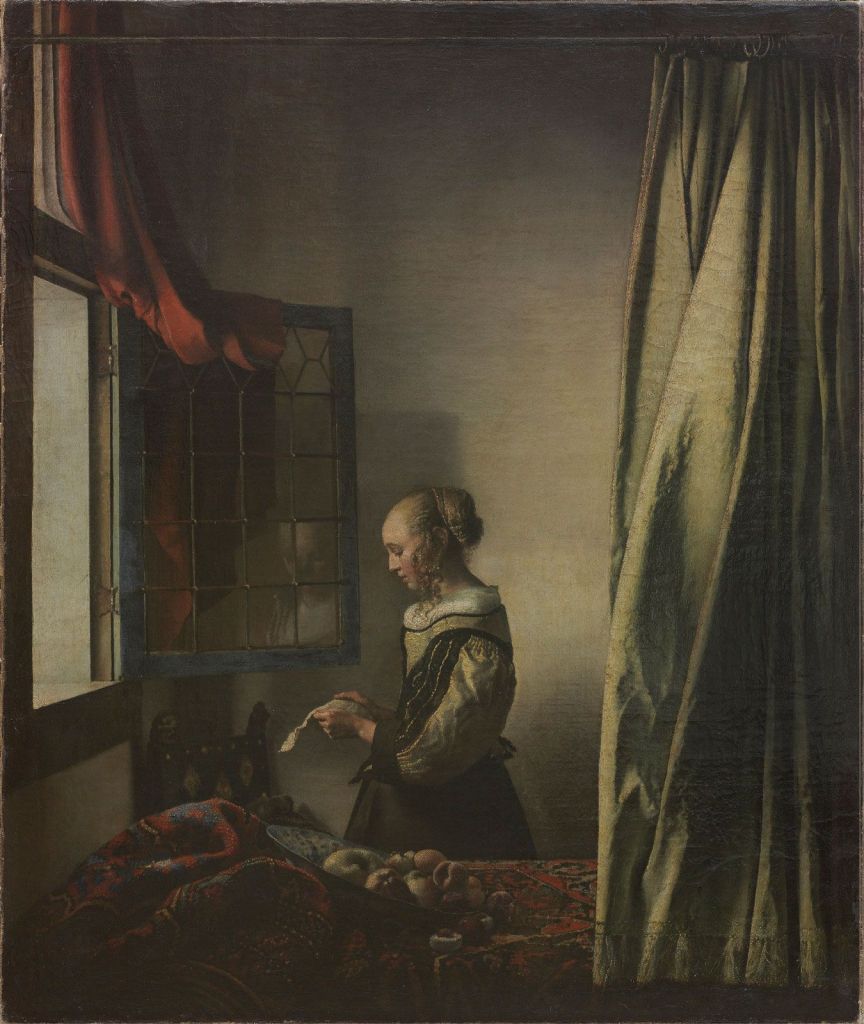
Art lovers get ready to be struck by Cupid’s arrow, as the first image of the completed restoration of Johannes Vermeer’s Girl Reading a Letter at an Open Window (around 1657-59) has been released today by Dresden’s Gemäldegalerie Alte Meister, fully revealing a hidden image of Cupid. The change to the composition in one of Vermeer’s most famous paintings is so great that the German museum is dubbing it a “new” Vermeer in publicity materials.
The painting has been in the museum’s collection for more than 250 years and the hidden Cupid had been known about since an x-ray in 1979 and infrared reflectography in 2009. It had been assumed that the artist himself had altered the composition by covering over the painting of Cupid.
But when a major restoration project began in May 2017, conservators discovered that the paint on the wall in the background of the painting, covering the naked Cupid, had in fact been added by another person. When layers of varnish from the 19th century began to be removed from the painting, the conservators discovered that the “solubility properties” of the paint in the central section of the wall were different to those elsewhere in the painting.
Following further investigations, including tests in an archaeometry laboratory, it was discovered that layers of binding agent and a layer of dirt existed between the image of Cupid and the overpainting. The conservators concluded that several decades would have passed between the completion of one layer and the addition of the next and therefore concluded that Vermeer could not have painted over the Cupid himself.
When the discovery was announced to the public in 2019, the senior conservator Uta Neidhardt said that it was “the most sensational experience of my career”. She added: “It makes it a different painting.”
The layer of overpaint was meticulously removed using a scalpel under a microscope, revealing the startlingly altered composition. The painting will go on show next month for the first time since the restoration as the star piece in a major exhibition titled Johannes Vermeer: On Reflection(10 September-2 January 2022) at the Gemäldegalerie in Dresden. The exhibition will include ten Vermeer paintings in total, making it one of the most significant shows on the Dutch Old Master in recent years (there are only around 35 extent Vermeer paintings).
Among the standout loans in the show are The Geographer (1669) from the Städel Museum in Frankfurt; View of Houses in Delft/The Little Street (around 1658) from the Rijksmuseum in Amsterdam; and A Young Woman standing at a Virginal (around 1670-72) from the National Gallery in London, which has a similar painting of Cupid in the background.
Bitte beachten Sie die aktuellen Covid-19 Regelungen.
FHXB Friedrichshain-Kreuzberg Museum Adalbertstr. 95a 10999 Berlin fhxb-museum.de
In selbstverwalteten Initiativen drücken wir unsere Wünsche und Hoffnungen auf eine Stadt für alle aus. Fünf selbstorganisierte Projekte blicken zurück auf ihre bewegte, manchmal auch noch sehr junge, Geschichte, auf interne Konflikte und die gesellschaftlichen Kämpfe, in denen sie sich positionieren. Mit “Dann machen wir’s halt selbst” fragen wir in Form einer Ausstellung, wie in dieser ökonomisch unter Druck geratenen Stadt selbstorganisierte Räume politische Möglichkeiten offenhalten.
Projektgruppe “Dann machen wir’s halt selbst”: Heike Böziger, Barbara Bohl, Anke Peterssen, Hermann Schlegel, Andy Wolff, Christine Ziegler Kuratiert von: Inga Zimprich Websitegestaltung: Judith Fehlau Ausmalbilder von: Burcu Türker Ausstellungsdesign: Inga Zimprich
“Dann machen wir’s halt selbst” wird unterstützt von Stiftung Menschenwürde und Arbeitswelt, Senatsverwaltung für Kultur und Europa Berlin, Bezirk Friedrichshain-Kreuzberg.
****
We’ll do it ourselves, then
– 40 years of self-organised spaces in Berlin
With: Casa Kuà, HeileHaus, Kinderbauernhof am Mauerplatz, Regenbogenfabrik, Schokofabrik
FHXB Friedrichshain-Kreuzberg Museum Adalbertstr. 95a 10999 Berlin fhxb-museum.de
In taking part in self-organised projects, we express our wishes and our hopes for a city belonging to all. Here five self-managed projects look back on their eventful, sometimes still very young, histories, on internal conflicts, and on the social struggles in which they position themselves. With “We’ll do it ourselves, then” we ask, in the form of an exhibition, how self-organised spaces keep political possibilities alive in a city under huge economic pressure.
*****
Zróbmy to zatem sami
– 40 lat samorządnych przestrzeni w Berlinie
Pięć projektów: Casa Kuà, HeileHaus, Kinderbauernhof am Mauerplatz, Regenbogenfabrik, Schokofabrik
Otwarcie: 26 sierpnia o godzinie 19 Czas ekspozycji: 27 sierpnia – 12 grudnia 2021 Godziny zwiedzania: Wt – Czw, 12 – 18 / Pią – Nie, 10 – 20
Prosimy o przestrzeganie aktualnie obowiązujących przepisów Covid-19.
FHXB Friedrichshain-Kreuzberg Museum Adalbertstr. 95a 10999 Berlin fhxb-museum.de
Biorąc udział w samorządnych projektach, dawaliśmy wyraz naszym potrzebom i nadziejom, że nasze miasto należy do wszystkich. Pięć takich samozarządzających się projektów ocenia swoją pełną wydarzeń historię, niekiedy całkiem niedawną, w której pomiędzy konfliktem wewnątrz grupy, a walką o realizację celów społecznych, kształtuje się ich osobowość. Poprzez wystawę “Zróbmy to zatem sami” próbujemy zastanowić się nad pytaniem, jak samorządne zarządzanie przestrzenią może wspierać politykę komunalną w mieście w czasach silnych nacisków ekonomicznych.
Konrad found him and called him Don Quijote. His name is Reza, he is an Irani and lives in USA. He planned to walk thousand miles on the water from Miami to Bermuda. Walking on the water, like Jesus. Sometimes I think that this both figures are the same. Jesus Don Quixote. They stopped Reza’s adventure already two times, but I belive, it is not the end of the story. Just observe.
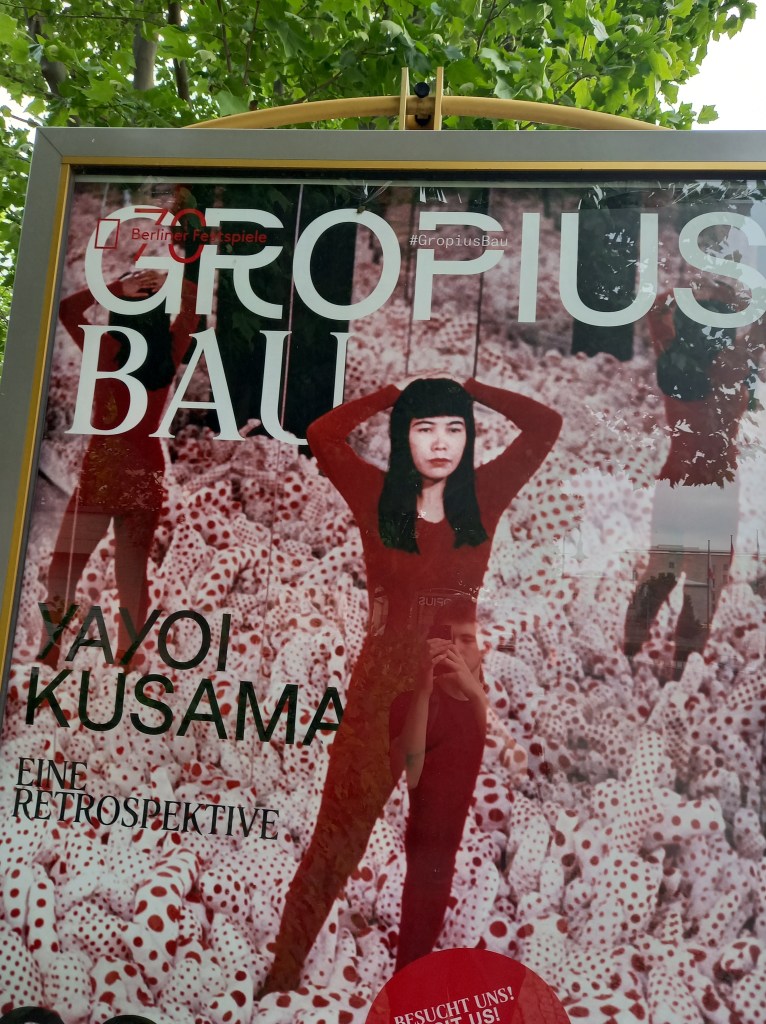
There is allmost no chance to get the ticket, but try. Just try. Try HERE.
It is fantastic. She get you in her crazy world and you remember that journey forever.
Below you see, what she made especially for her exhibition in Gropius House in Berlin.
All fotos made by Konrad.
The exhibition itself is the retrospective of all her famous or less famous works, starting with her drawings from the school time. You had never a possibility to see all these works together.
If you do not get the ticket, just enjoy these fotos.
The international literature festival berlin [ilb] calls on individuals, schools, universities, cultural institutions and media to participate in a Worldwide Reading for the Dead of the Corona Pandemic on September 5, 2021. The reading is intended to commemorate those who died in the pandemic. For more than a year, the world has been in the grip of the pandemic. Nearly three million people worldwide have died from Covid-19. Not a day goes by when we are not confronted with statistics and curves on current deaths and illnesses. Yet, it often remains abstract numbers.
The individual person and the individual stories behind them are hardly present in the public perception. Illness, death and grief have become largely invisible due to precautionary measures. Many people die alone, behind closed doors, and are buried in small circles. In many cases, there is no way for relatives and friends to say goodbye – and if they do, it is at a distance or in a digital setting.
Literature has the potential to give expression to this situation, to counter isolation at least through reception. It finds narratives away from the everyday images of horror, tells of loss from different perspectives, and helps to make the incomprehensible tangible, the intangible comprehensible. Readings can take place anywhere, including privately in a small circle, in a school, in a cultural institution or on the radio. People who would like to participate with a reading on September 5, 2021 are asked to send us the following information: Organizers, venue, time, participating actors, event language, link to your website if applicable.
The ilb has published first texts for the reading on the website, further are following soon in various languages. All readings will be announced there and on social media.
Weltweite Lesung für die Toten der Pandemie am 5. September 2021
Aufruf
Das internationale literaturfestival berlin [ilb] ruft Einzelpersonen, Schulen, Universitäten, Kultureinrichtungen und Medien dazu auf, sich am 5. September 2021 an einer Weltweiten Lesung für die Toten der Pandemie Corona zu beteiligen. Mit der Lesung soll an die Toten der Pandemie erinnert werden.
Seit mehr als einem Jahr wird die Welt von der Pandemie heimgesucht. Fast drei Millionen Menschen sind weltweit an Covid-19 gestorben. Kein Tag vergeht, an dem wir nicht mit Statistiken und Kurven über aktuelle Todesfälle und Krankheiten konfrontiert werden. Doch oft bleiben es abstrakte Zahlen. Der einzelne Mensch und die individuellen Geschichten dahinter sind in der öffentlichen Wahrnehmung kaum präsent. Krankheit, Tod und Trauer sind durch Vorsichtsmaßnahmen weitgehend unsichtbar geworden. Viele Menschen sterben allein, hinter verschlossenen Türen, und werden im kleinen Kreis beerdigt. In vielen Fällen gibt es für Angehörige und Freunde keine Möglichkeit, sich zu verabschieden – und wenn doch, dann aus der Ferne oder in einem digitalen Umfeld.
Literatur hat das Potenzial, dieser Situation Ausdruck zu verleihen, der Isolation zumindest durch Rezeption entgegenzuwirken. Sie findet Erzählungen abseits der alltäglichen Schreckensbilder, erzählt vom Verlust aus verschiedenen Perspektiven und hilft, das Unfassbare greifbar zu machen.
Lesungen können überall stattfinden, auch privat im kleinen Kreis, in einer Schule, in einer Kultureinrichtung oder im Radio. Menschen und Institutionen, die sich mit einer Lesung am 5. September 2021 beteiligen möchten, werden gebeten, uns folgende Informationen zukommen zu lassen: Organisator*innen, Ort, Zeit, teilnehmende Akteure, Veranstaltungssprache, ggf. Link zu Ihrer Website.
Das ilb hat erste Texte für die Lesung auf der Website veröffentlicht, weitere folgen bald in verschiedenen Sprachen. Die Lesungen werden dort und in den sozialen Medien angekündigt.
Kein Rondo heute, was es geben wird, wird aber kürzer sein.
Ich muss jedoch auf meinen letzten Artikel noch mal eingehen. Diejenigen, die ihn gelesen haben, werden zweifellos bemerkt haben, dass er ein kleines Theaterstück beinhaltete. Mit Elon Musk in der Hauptrolle und Kryptowährungsfans als (da)Nebendarsteller. Ich gehe irgendwie davon aus, dass Musk den Artikel nicht gelesen hat. Wer bin ich schon? Ein armer Komponist, der sich irgendwie nicht nur für Musik interessiert. Ich habe vor drei Wochen auch geschrieben, dass die ganze „Bitcoin und andere Coins“ Geschichte nicht so lala super ganz ökologisch ist.
Und Trallala, oder Hopsasa, kurz danach plagten Elon Musk Umweltbedenken, und Tesla auf einmal alle Zahlungen mit dem Bitcoin stoppte. Was auch bedeutet hat, dass der Aktienkurs von Bitcoin deutlich nach unten sank. Dass Tesla soviel Geld im letzten Quartal verdient hat, liegt nicht daran, dass seine Firma sehr viele E-Autos verkauft hat. Fast ein Viertel des Gewinns hat seinen Ursprung ganz woanders. Haben Sie richtig geraten von wohin? Sehr einfach, es waren die Spekulationen mit Kryptowährungen auf der Börse.
Also, ich komme irgendwie nicht umhin, das komische Gefühl zu haben, dass Elon Musk versucht meine kleine theatralische Spielerei (von vorher) gewissermaßen zu vertiefen, bzw. zu erweitern. Desto mehr, dass kurz nach der Trennung, seitens Tesla, von Bitcoin, hat Musk andere Kryptowährung hochgepriesen, den Dogecoin, der, nebenbemerkt, ursprünglich als eine Parodie auf Bitcoin von seinen Schöpfern (Billy Markus und Jackson Palmer) konzipiert wurde.
Also kann ich ganz sicher wiederum auch nicht sein, vielleicht hat er doch mein Artikel gelesen. Verdammt…
Beziehungsweise, hätte ich soviel Geld und Einfluss auf die Börse via Twitter, hätte ich auch wahrscheinlich auf irgendwelche Coins gesetzt. Ich verkaufe und twittere etwas, der Kurs fällt, ich kaufe und twittere was anders, der Kurs steigt, ich lasse es in schleife laufen – eine finanzielle Perpetuum Mobile, genial, oder?
Trotzdem, ich werde nicht unbedingt auf Mars fliegen. Obwohl ich Star Wars mag, letztendlich bin ich mit den Filmen aufgewachsen, die romantische Vorstellung, dass man von einem Planeten auf Anderen irgendwie fliegt, und alles Butter, überzeugt mich nicht ganz. In Wirklichkeit, jeder Planet hat doch andere Masse, andere Gravitationskraft, andere eigene Achsendrehung, andere Zeit seiner Sonne Umdrehung. Da kann es schon sein, dass man sich ganz anders fühlt, kann auch sein, dass es sich um ein Unwohlsein handeln könnte. Um die kosmische Strahlung nicht zu erwähnen. Neben bemerkt, ist sie noch 2,5-mal grösser als auf die ISS. Auf der Erde wir sind davon ziemlich gut geschützt, wegen des globalen Magnetfeldes, welches unser Planet besitzt, Mars hat sowas nicht.
Ob Elon Musk hat wiederum ein Sinn für Humor, ist mir unbekannt. Sein Kumpel, Jeff Bezos, jedoch hat ihn sicher, nach seinem charmanten Lächeln (beide treten, d.h. Jeff und sein Lächeln, auch in Nebenrollen in meinem Theaterstückchen auf) zu beurteilen. Er hat sich neulich eine Mega-Yacht für mehr als 500 Millionen Dollar gekauft. Funny, nicht wahr?
Übrigens, das Geschäft boomt, nur im ersten Quartal dieses Jahres wurden 222 Luxusyachten weltweit verkauft. Ein Jahr davor waren es vergleichsweise 106, 2019 nur 96. Was für Zeiten…
Aber letztendlich haben wir Pandemie, also die größte Weltkrise seit sehr, sehr langer Zeit. Für Manche, für Manche aber nicht. In letztem Jahr ist der Welt-Klub der Milliardäre kräftig gewachsen, um 660 Glücklichen (insgesamt sind jetzt 2755 Superreichen weltweit vorhanden). Das Vermögen dieser Bürger hat sich auch von 8 bis auf 13,1 Billionen Dollar aufgestockt, laut Forbes Magazine. Eine Krise? Welche Krise? Jeffs Lächeln ist berechtigt, und dabei so zauberhaft…
Außerdem sagen doch die Politiker immer: „we must grow“, oder nicht? Kein Wunder, dass Manche es ernst nehmen.
Wenn wir dann wieder bei der Politik landen, werde ich ein bisschen Regional bleiben. Falls man die Bertelsmann Stiftung dem Glauben schenken darf, es sieht so aus, dass die allgemeine Wechselstimmung deutscher Bürger/innen sich in Rekordhöhen befindet. Die aktuellen Trends ihres Demokratiemonitors sagen, dass über 60 % der Leute sich einen Wechsel der Bundesregierung wünschen, nur jede/r achte der Befragten denkt, dass es nicht gut wäre.
Es wundert mich nicht, nach 12 Jahre GroKo, wo die Kompromisse sich eher als Barrikaden auf der Weiterkommenstr. gestapelt haben, da kann man sich schon was anderes wünschen. Nach wie vor, denke ich, dass es die Grünen sein werden könnten, die diesen Wunsch der Leute nach etwas Neuen verkörpern.
Egal wer der Wahl gewinnt, die Aufgaben werden enorm sein, für jede Regierung. Vielleicht begreift die Welt der Politik endlich, dass wir tatsächlich in der Umbruchzeit leben. Nicht nur wegen Klima-Probleme, was natürlich als Priorität zu betrachten ist. Hauptsächlich jedoch, des Digitalen und Hochtechnologischen Zeitalters wegen, welches immensen Einfluss auf alles hat und dabei immer schneller wird, aber auch vielleicht uns retten kann. Die NASA hat auf Mars vor kurzem Kohlendioxid in Sauerstoff umgewandelt, was sie schon sicher auf unserem Planeten auch schon mal ausprobiert hat. Was daraus sich lesen liest; die Technologie ist da, sicher noch nicht so weit, aber…
Na ja, in Deutschland, mit dem Schulsystem (ich befürchte, Universitäten inklusiv), welches eher vor Gestern ist, wäre es schwierig, den Nachwuchs für NASA zu beschaffen, aber wer weiß?
Zeit für Wechsel, viel- und weitsichtlich, eigentlich die höchste Zeit.
Wie unsere Welt aussehen kann, falls wir nichts ändern werden, kann man in einem Buch lesen, den ich gerade als Lektüre habe. Es ist ein Thriller, über den ich noch vielleicht ein extra Artikel schreiben werde. Mit sehr starken Forecast–Elementen. Keine schöne Zukunft. Zur Beruhigung, das Geschehen geschieht im Jahre 2030, eher unwahrscheinlich, ich werde es auf Jahr 2050 schätzten…
Nun sollte es kurz Heute sein, also am Ende, ein kleines Zitat aus dem Terminator, einenFilm mit Arnold Schwarzenegger (der neulich, auf Grund der „Cancel Culture“, seinen Namen auf Arnold Dunkeldunkelhäutige ändern musste): „ich komme wieder“.
Geriatric Clinic of Doctor Klaus von Strohsack, Black Forest, Germany
A young reporter of NYT hear that in a famous Geriatric Clinic of Doctor Klaus von Strohsack, Black Forest, Germany, live more then one over hundred years and sexually active men. She takes the plane and fly to Europe to make a good story. At the place, wonderful, old castle in the mountains, she meet a group of old men they work or walk in pretty, full of flowers and fruit trees, garden. She go to the man looking very old and ask: – Hello, can you say me how old you are? – I’m 103 years old, my child – Great! And can I ask you something very private? – No matter, try… – How long you are sexually active? – 99 – Wow! Congratulations! And what is a secret of so successfully way of life? – I try all the time gymnastics and drank only yoghurt. – Thank you very much!, she leave the old man and go to the next – Hello, can you say me how old you are? – I’m 105 years old, drank yoghurt and try gymnastic.… – And can I… – 100! – Marvellous!, she shakes the micro and went to the next one – I’m 98, active till 96, gymnastic and yoghurt – Very good!, she says and turns to the one, which looks much older, than the others and ask – And how long stay you active, dear mister? – I’m into. – Amazing! And what is your secret? – All the time beer. – ???!!! And… how old are you, great master? – 36.
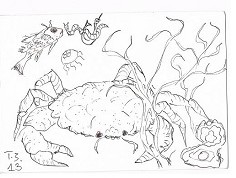
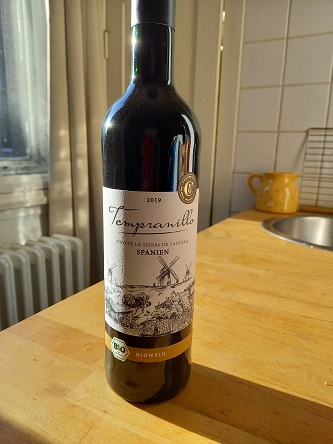
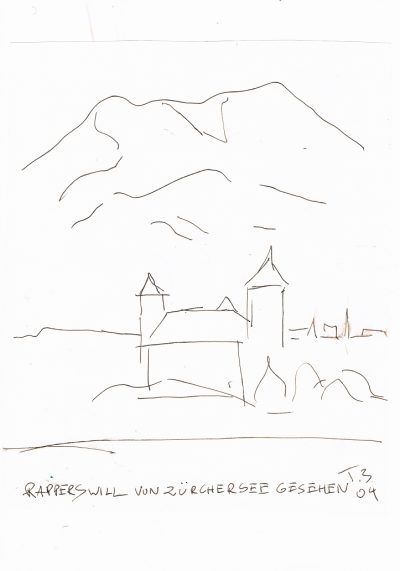
Ten rysunek, dzieło Autora, został podpisany Haus Abo-Moen. A te na końcu wpisu: Krab i Rapperswill.
Sałatka wodnika
1 miska młodych wodorostów 1 bukiecik drobno pokrojonego koperku do tego 4 dorodne pomidory, pokroić w dzwonka 2 cukinie pokrojone w plastry, które przysmażyć na patelni z oliwą, tymiankiem, gałązką rozmarynu i szałwią i odstawić na moment w ciepłe miejsce (przy ognisku – w popiele) do miski wrzucić pomidory, posiekany koperek i sos: 2 ząbki czosnku rozdusić i wymieszać z 4 łyżkami oliwy dodać 2 łyżki stołowe ostrej musztardy i wymieszać 1 cytryna (sok) cukier, sól do smaku
wszystkim ostrożnie wstrząsnąć i posypać przysmażoną cukinią
podawać najlepiej z prażonym nad ogniem pumperniklem tudzież dobrze zmrożonym aquavitem i pinot noir najlepiej z alzacji
smacznego!
a na deser krokusy i przebiśniegi w sosie poziomkowym (asti spumante, sambucca i espresso)
PS. zamiast wodorostów można użyc queller (solirody) https://de.wikipedia.org/wiki/Queller (w Anglii i Holandii do nabycia w supermarketach, właśnie zaczął się sezon)
*** Autor sam mnie sprowokował do wtrącania mu się we wpis, bo przysłał mi kartkę z wiatrakiem. Dodaję więc dwa inne wiatraki znalezione w Berlinie oraz niebieską kartkę (z Dulcyneą?), którą przysłały Joanna i Tania, nasze blogowe autorki-podróżniczki. I informuję, że w mojej ulubionej książce kucharsko-literackiej Yummy booksmówi się o pewnym (nieznanym mi zresztą) bohaterze literackim (Sprzysiężenie osłów Johna Kennedy’ego Toola), że był skrzyżowaniem szalonego Olivera Hardy, Don Kichota i Tomasza z Akwinu. I opychał się donatami.
Between going and staying the day wavers, in love with its own transparency. The circular afternoon is now a bay where the world in stillness rocks. All is visible and all elusive, all is near and can’t be touched. Paper, book, pencil, glass, rest in the shade of their names. Time throbbing in my temples repeats the same unchanging syllable of blood. The light turns the indifferent wall into a ghostly theater of reflections. I find myself in the middle of an eye, watching myself in its blank stare. The moment scatters. Motionless, I stay and go: I am a pause.
by Octavio Paz (translated by Eliot Weinberger)
Masha Pryven used that poem instead of a description of a photographs series by the group exhibition “One Swallow Does Not Make a Summer”, which was on display October 22-25, 2020 at the GlogauAir Gallery, Berlin. That series was titled “Between going and staying” and was about the ephemeral distance between now and then, about the melancholic nature of time and remembrance of things past. All photos were shot in 2020 in Brittany (Bretagne), where the author visited places one find in the book by Marcel Proust In Search of Lost Time.
Ewa Maria Slaska, administrator:
You can buy the pictures. Just write a comment and don’t forget to write your mail. I have that one with an armchair. It is an authentic Proust’s armchair in a house of Aunt Leonie in Combray (Illier)
Till 23rd of Mai you can visit an Antiquariat in Immanuelkirchstraße 6, 10405 Berlin, for an exhibition with another photos by Masha
But flying doesn’t let the traces on the surface of the world. Walking does.
Mostly she is alone, there are no words and no real traces. Just space.
long duration performance 12 h, 2018
(…) it was 12-hour walk around Berlin during which, thanks tu the connection to Google Maps and an application for drawing a route, I enter the word FORCE in the City map. My path is defined by the order of the letters. No mapping out the route contributed to any inadvertent breaking of laws and arrest by the police(force) and consequently, the necessity to choose another path, which could be observed in the letter F.
When walking, I followed the principle of “keep walking”. I hat twelve envelopes prepared with a link to the performance and the phrase “keep walking” written on each, which I would hand out on the hour, every hour, on random to different people, without any additional explanation.
performance, experience, action in public area exlusive ecological art, 2017
Felicja meaning “happy”. Here is one of that has not finished up in the broth (in Poland, the obligatory dish served on Sunday’s lunch) was what we manifested during our Sunday walks, that we took in Old Town, in Kraków. The price for saving her life was an adaptation to new conditions. Fela took up residence in one of Cracow tenements houses on Lea Street with myself. MT, Lumiér’s cat and several plants including two ficuses benjamins. In the kitchen by the balcony, there was a wooden chicken coop arranged for her.
Walking with Felicja and the experience of sharing a living space with her aroused a lot of emotions. McDonald’s environs aroused the most critical underbelly point. Our walks turned to be devastating.
Japan loves cats. A quick glance at anything related to Japanese pop culture will show you this: Hello Kitty. Cat cafes. Wearable electronic cat ears that respond to your emotional state. Massively popular comics like What’s Michael? and A Man and His Cat. The popular tourist destination Gotokuji, a temple in the Setagaya ward of Tokyo that claims to be the original home of the ubiquitous Maneki Neko, the “Lucky Cat.” The famous cat shrine Nyan Nyan Ji in Kyoto that has an actual cat monk with several kitty acolytes.
Cats are everywhere in Japan. While it is easy to see they are well-loved, Japan also fears cats. The country has a long, often terrifying history of folklore involving monstrous supernatural cats. Japan’s magic catlore is wide and deep—range from the fanciful, magical shapeshifters (bakeneko) to the horrendous demonic corpse-eaters (kasha). That’s where I come in.
Edo period Bakeneko (Wikimedia)
I began researching Japan’s catlore while working on the comic book Wayward from Image comics. Written by Canadian Jim Zub with art by Japan-based American penciler Steve Cummings and American colorist Tamra Bonvillain, Wayward was a classic story of shifting societal beliefs that tackled the age-old question of whether man creates gods or gods create man. It pitted Japan’s folkloric yokai against rising young powers that would supplant them. One of our main characters was Ayane, a magical cat girl of the type known as a neko musume. Ayane was built of cats who come together in a mystical merger to create a living cat avatar.
As a Japan consultant, my job on Wayward was to create supplemental articles to complement the stories. This meant I researched and wrote about things as varied as Japan’s police system, the fierce demons called oni, and the fires that ravaged Tokyo between 1600 and 1868. And, of course, magic cats. I researched Japan’s catlore to incorporate in Ayane’s character. Normally, my work was one-and-done: As soon as I finished with one topic, I moved onto the next. But cats, well… I guess you could say they sunk their claws into me—and they haven’t let go yet.
Sawaki Sushi Nekomata (Wikimedia)
Studying folklore means following trails as far as you can go with the understanding that you’ll never reach your destination. The further back you peel the layers of time, the mistier things become. You leave what you can prove and enter that nebulous realm of “best guess.”
Take the fact that cats exist in Japan at all. No one knows exactly when and how they got there. The “best guess” is that they traveled down the silk road from Egypt to China and Korea, and then across the water. They came either as ratters guarding precious Buddhist sutras written on vellum, or as expensive gifts traded between emperors to curry favor. Most likely both of these things happened at different times.
Bakenko prostitutes (Wikimedia)
But for our first confirmed record of a cat in Japan—where we can confidently set a stake in the timeline and say “Yes! This is unquestionably a cat!”—we must turn the dusty pages of an ancient diary.
On March 11, 889 CE, 17-year-old Emperor Uda wrote:
On the 6th Day of the 2nd Month of the First Year of the Kampo era. Taking a moment of my free time, I wish to express my joy of the cat. It arrived by boat as a gift to the late Emperor, received from the hands of Minamoto no Kuwashi.
The color of the fur is peerless. None could find the words to describe it, although one said it was reminiscent of the deepest ink. It has an air about it, similar to Kanno. Its length is 5 sun, and its height is 6 sun. I affixed a bow about its neck, but it did not remain for long.
In rebellion, it narrows its eyes and extends its needles. It shows its back.
When it lies down, it curls in a circle like a coin. You cannot see its feet. It’s as if it were circular Bi disk. When it stands, its cry expresses profound loneliness, like a black dragon floating above the clouds.
By nature, it likes to stalk birds. It lowers its head and works its tail. It can extend its spine to raise its height by at least 2 sun. Its color allows it to disappear at night. I am convinced it is superior to all other cats.
Bakeneko party (Public Domain)
As you can see, be they emperor or peasant, cat owners have changed little over the millennia. I will tell anyone who will listen that my cat (the monstrous beauty of a Maine coon called Shere Khan with whom I coexist in constant balance between pure love and open warfare) is superior to all other cats.
While cats were initially traded as priceless objects in Japan, unlike gold or gems or rare silks, these treasures were capable of doing something other valuables could not—multiplying. Cats made more cats. Over the centuries, cats bred and spread until by the 12th century they were common all over the island.
That was when they began to transform.
Toriyama Sekein Kasha (Public Domain)
Japan has long held a folk belief that when things live too long, they manifest magical powers. There are many old stories explaining why this is true of foxes, tanuki, snakes, and even chairs. However, cats seem to be somewhat unique in the myriad powers they can manifest—and their multitude of forms. Perhaps this is because they are not indigenous to Japan. Whereas Japanese society evolved alongside foxes and tanukis, cats possess that aura of coming from outside the known world. Combine that with cats’ natural mysterious nature, their ability to stretch to seemingly unnatural proportions, how they can walk without a sound, and their glowing eyes that change shape in the night, and it’s the perfect recipe for a magical animal.
The first known appearance of a supernatural cat in Japan arrived in the 12th century. According to reports, a massive, man-eating, two-tailed cat dubbed the nekomata stalked the woods of what is now the Nara prefecture. The former capital of Japan, Nara was surrounded by mountains and forests. Hunters and woodsman regularly entered these forests around the city for trade. They knew the common dangers; but this brute monster was far beyond what they expected to encounter. According to local newspapers of the time, several died in the jaws of the nekomata. Massive and powerful, they were more like two-tailed tigers than the pampered pets of Emperor Uda. In fact, the nekomata may have actually been a tiger. There’s speculation today that the nekomata legends sprang from an escaped tiger brought over from China, possibly as part of a menagerie, or it was some other animal ravaged by rabies.
Maneki neko (Wikimedia)
With the close of the 12th century, stories of the nekomata and supernatural felines went quiet for several centuries. Then came the arrival of the Edo period, when Japan’s magical cat population truly exploded.
Beginning around 1600, the country experienced a flowering of art and culture. Kabuki theater. Sushi. Ukiyoe wood block artists. Geisha. The first printing presses in Japan. All of these Edo period phenomena led to a flourishing industry of reading material for all classes—in many ways, a forerunner of manga. And as writers and artists soon found out, the country was hungry for tales of magic and Japanese monsters called yokai. Any work of art or theatrical play tinged with supernatural elements became a sure-fire hit.
In this golden age, a new species of supernatural cat appeared—the shape-changing bakeneko. As Japan urbanized, cat and human populations grew together. Now, cats were everywhere; not only as house pets and ratters but as roving strays feasting off the scraps from the new inventions of street sushi and ramen stands. And with them stories followed of cats able to transform into human shape. Japanese houses were mostly lit by fish oil lamps. Cats love to lap the oil, and at night, in the glowing lamplight, they cast huge shadows on the walls, seemingly morphing into massive creatures standing on their hind legs as they stretched. According to lore, cats who lived preternaturally long evolved into these bakeneko, killed their owners and took their place.
Not all bakeneko were lethal, however. Around 1781, rumors began to spread that some of the courtesans of the walled pleasure districts in the capital city of Edo were not human at all, but rather transformed bakeneko. The idea that passing through the doors of the Yoshiwara meant a dalliance with the supernatural held a delicious thrill to it. Eventually, these stories expanded beyond the courtesans to encompass an entire hidden cat world, including kabuki actors, artists, comedians, and other demimonde. When these cats left their homes at night, they donned kimonos, pulled out sake and shamisen, and basically held wild parties before slinking back home at dawn.
These stories proved irresistible to artists who produced illustrations featuring a wild world of cats dancing and drinking late into the evening hours. The cats were depicted as anthropomorphic human-cat hybrids (although the bakeneko were capable of shapeshifting into fully human forms, too). They smoked pipes. Played dice. And got up to all kinds of trouble that every hard-working farmer wished they could indulge in. Artists also created works replicating cat versions of popular celebrities from the world of the pleasure quarters.
While bakeneko are the most numerous and popular of Japan’s magical cat population—and certainly the most artistically appealing—magical cats also lurked in darker corners.
Take the kasha, a demon from hell that feasts on corpses. Like the nekomata and bakeneko, the kasha were once normal house cats. But, as the story goes, the scent of dead bodies filled them with such an overwhelming desire to feast that they transformed into flaming devils. With their necromantic powers they were said to be able to manipulate corpses like puppets, making them rise up and dance. The kasha story still remains part of the culture in terms of funeral services. In Japan, it is customary after the death of a loved one to hold a wake where the body is brought home and the family gather. To this day, cats are put out of the room where the wake is held.
Some cat creatures, like the neko musume, were thought to be cat-human hybrids. They were said to be born from a cat’s curse on makers of the traditional instrument called the shamisen, which use drums stretched from the hides of cats. A shamisen maker who got too greedy might be cursed with a neko musume daughter as revenge. Instead of a beloved human daughter, they would find themselves with a cat in human form who was incapable of human speech, ate rats, and scratched their claws.
Perhaps the most persistent of the Edo period supernatural cats is the maneki neko, known in English by the sobriquet “Lucky Cat.” While truly a creature of commerce, this ubiquitous waving feline has folkloric origins—two of them, in fact. Gotokuji temple tells of a fortuitous cat that saved a samurai lord from a lightning strike during a terrible storm. The lord gave his patronage to the temple, which still exists today and happily sells thousands of replica cats to eager tourists. The other origin is of a poor old woman whose cat came to her in a dream and told her to sculpt a cat out of clay to sell at market. The woman marketed both her cat and her story, selling more and more cat statues until she retired rich and happy. These same cat statues are still sold worldwide today as the Maneki Neko. Obviously, both origin stories can’t be true, but that doesn’t stop the sales from rolling in. It’s not unusual at all to trace back a folkloric story and to find someone trying to make a buck on the other end. As the earlier artists discovered with their bakeneko prints, cats have always been good for sales.
Bakeneko kabuki actors (Public Domain)
The more you dig into Japan’s catlore the more you’ll find, from the gotoko neko, an old nekomata that mysteriously stokes fires at night or turns the heaters up in households in order to stay warm, to the cat islands of Tashirojima where cats outnumber people by more than five to one, to the endangered yamapikaryaa, said to survive only on the remote Iriomote islands. Most of these are born from the Edo period, however many are expanded folklore and real-world locations. Japan’s catlore continues to spread and I have no doubt that new supernatural forms are being born even now.
For me, Japan’s catlore has been nothing short of catnip. The more I learned the more I wanted to know. After I finished my Wayward research, I kept diving deeper and deeper until I had piles of translated folk stories and historical texts on Japan’s cats. I had no plans to do anything with it; it was a personal obsession. Finally, though, my publisher noticed, and said, Hey, I think we know what your next book is going to be about. Thus Kaibyō: The Supernatural Cats of Japan was born, a book I never intended to write, and yet to this day, remains the most popular thing I’ve ever written. Even after it published in 2017, I knew my journey into Japan’s catlore was hardly finished; I don’t think it ever will be.