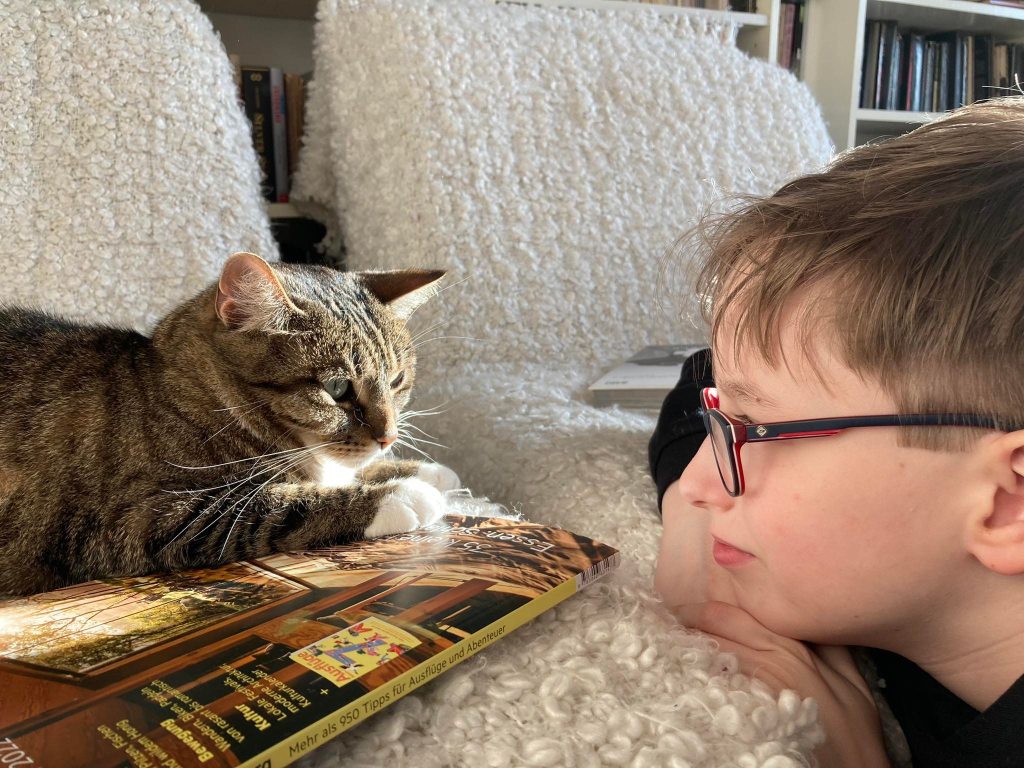
How to write for the next generations?

Reblogs

Rumaan Alam/December 23, 2019

Rupi Kaur Is the Writer of the Decade

The young Canadian poet understands better than most of her contemporaries how future generations will read.

BALJIT SINGH, COURTESY ANDREWS MCMEEL.


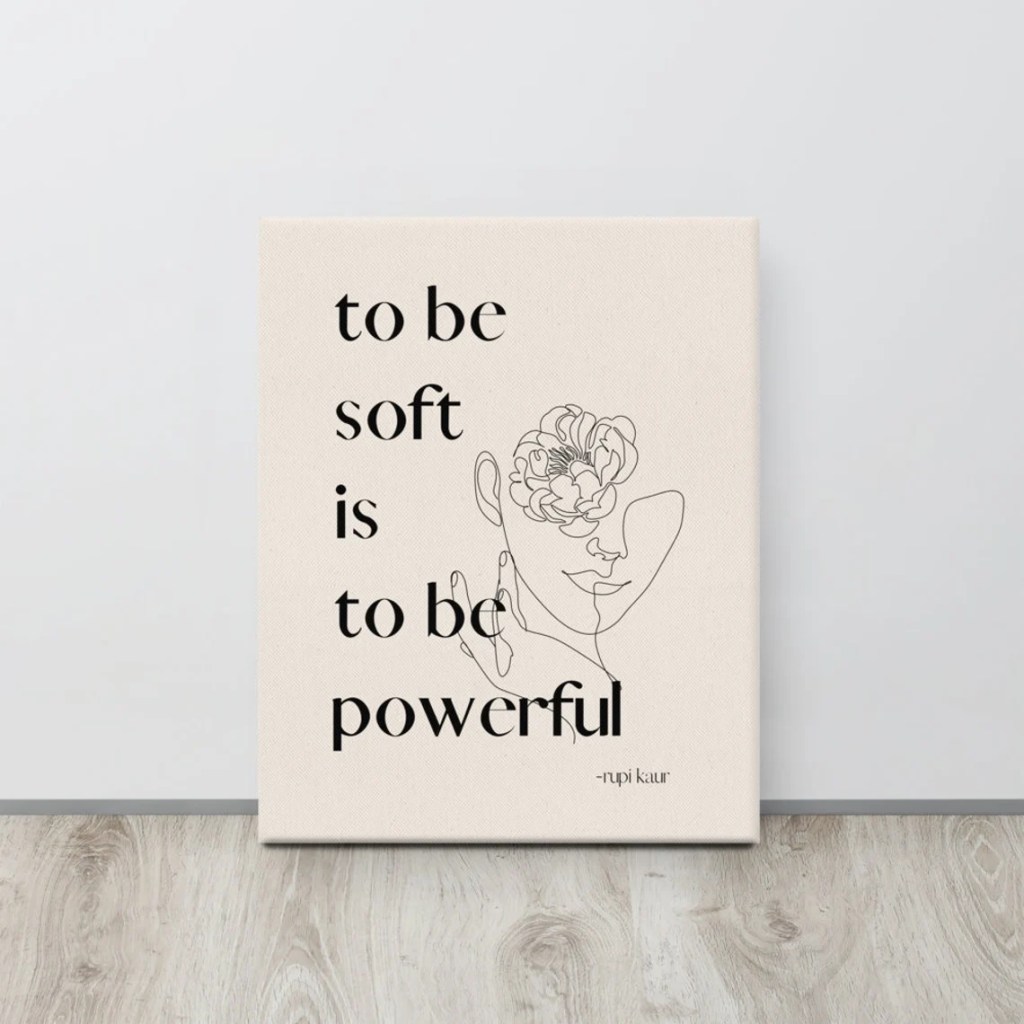
Rupi Kaur has published two books: 2015’s Milk and Honey, 2017’s The Sun and Her Flowers. Her epigrammatic verse is spare, the offspring of classical aphorism (if you’re feeling generous) and the language of self-help. The poems have a confessional, earnest manner; disarmingly full of feeling, they can be easy to dismiss. Nevertheless, Rupi Kaur, a Canadian poet who is not yet 30 years old, is the writer of the decade.

Kaur’s writing is not itself to my taste. She writes, in “the breaking”:

did you think i was a city
big enough for a weekend getaway
i am the town surrounding it
the one you’ve never heard of
but always pass through

Beyond the affectation of the lowercase letters, I find the metaphor impenetrable—the speaker is … a suburb? Further, I’m not an especial fan of the line drawings (they look like outsider art) that often accompany her poetry.

But Kaur’s achievement as an artist is the extent to which her work embodies, formally, the technology that defines contemporary life: smartphones and the internet. (Perhaps you could say the same of the novels now considered classics that were originally published serially in newspapers.) I’d argue that many of the writers currently being discussed as the most significant of the last decade write in direct opposition to the pervasive influence of the internet. Karl Ove Knausgaard, Rachel Cusk, and Ben Lerner (to name but three of our best) are interested in the single analog consciousness as a filter through which to see the world. If you think their experiment is the most important of the last 10 years, you’re probably (sorry) old.

The next generation of readers and writers views reality through a screen. Kaur, born in 1992, was 15 when the iPhone debuted. The majority of her readers have never known adulthood without that gizmo’s mitigating influence. On Instagram, Kaur doesn’t just share selfies and drawings; she publishes. Kaur’s books have sold more than 3.5 million copies, an incredible number for any poet but the more remarkable when you consider that surely some percentage of her readership has never owned one of those books.

Popularity does not generally correlate to artistic significance, but Kaur’s is an unusual case. That her work crumbles under traditional critical scrutiny is not really the point. There are readers who will forever think of Kaur as the first poet they loved. Even if they outgrow her—as is inevitable: I can no longer bear Salinger or Kerouac or Auster or many of the writers I adored as a younger reader—the lines in Milk and Honey will be a common text for the fortysomethings of 2035.

This is a different matter from a shared pop culture touchstone, such as Top 40 songs or sitcoms. The mantle of poet accords Kaur a kind of legitimacy, as it always has; you could write about her work for your college application essay. Readers who know about poetry might think Kaur’s work is dumb; those for whom Kaur is their first exposure to the medium think it profound. It doesn’t matter if you believe that title of poet belongs only to the likes of Wallace Stevens or Gwendolyn Brooks. Kaur has seized it for herself.

And she deserves it. Kaur cannily understands the contradiction that we want technology—in this case, a very powerful computer—to connect us to real people. She uses her verse, her drawings, her photographs, to give us persona, which is the next-best thing, and also an age-old poetic technique. It is easy for some readers (snobs like me) to dismiss Kaur’s self-representation as posture, or performance. I think this reflects a mostly generational divide. But can’t you imagine a younger Anne Sexton taking a selfie, or Elizabeth Bishop sharing a snapshot of the sea?

Kaur’s verse is compact in part because she’s thinking within the parameters of a smartphone screen, which is not that radical when you consider that many poetic forms are about artificial constraint. Think of hers as an Oulipian project. I also feel she’s onto something: The canonical poetry most likely to endure the next century is the one that can fit comfortably within the glowing window we spend so much of our time gazing into.
Technology has already trained us to read differently, which in turn has started to change the literature. The Crying Book, a recent nonfiction work by Heather Christle (also a poet), is organized into perfect swipe-size snippets of text. It doesn’t cohere as an argument so much as it overwhelms (maybe, alas, bores), like the internet’s infinite scroll. You can lament the death of the transitional sentence if you like; I’d say you should expect much more work like this.

A couple of decades ago, a handful of the avant-garde wanted a prose that assumed the shape—synaptic, irregular—of hypertext. That work remains mostly experimental (which is to say, a niche concern). Kaur’s poetry does something similar, but the experiment was a success. I was forced to read Robert Frost as a schoolboy and understood poetry to be metaphoric musing; Kaur’s young readers want to engage with her work, and will expect a poetry of brevity and brute feeling. They might enjoy Frost, but they’d also like an Instagram of those woods on a snowy evening. And Kaur (and her descendants) will deliver.

Kaur has used her own tools—her phone, her body and face (it doesn’t hurt that Kaur is strikingly beautiful), her sketches—to dismantle the master’s house: Many American readers consider a young woman of color our most prominent poet. Even if I think they’re wrong, it’s hard not to be thrilled by this fact.

A decade is an arbitrary thing, but the one now ending gave us remarkable writing. The artistry and sustained off-line attentions of Knausgaard, Cusk, and Lerner; the intimate multivolume epics of Elena Ferrante and the curiously under-discussed Jane Smiley; more singular and lovely novels than I could ever list here. Those are a matter of the past. I don’t know if we’ll be reading Rupi Kaur a decade or two hence, but I suspect we’ll be reading as she taught us to.

___________________________

Rumaan Alam @Rumaan

Rumaan Alam is a contributing editor at The New Republic. His latest novel is Leave the World Behind.

***

***

Comments (in Polish) KK

To dziwne. Dowiedziałem się o jej istnieniu dzisiaj, ale sławna zaczęła być już (albo dopiero) trzy lata temu. To może jakaś prekursorka pop-poezji?
Z jednej strony aż nieprzyjemnie przegląda mi się jej Instagrama, gdzie umieszcza wiersze, z drugiej – jest muzyka pop, są blockbustery o superbohaterach, to czemu ma nie być pop-poezji?
Ludzie w komentarzach piszą, że ją uwielbiają, że dotyka ich serce – miło to brzmi.
Może do tych ludzi zwykła poezja by nie trafiła?
Ktoś inny pisze
że to w ogóle nie poezja
tylko zwykłe, twitterowe przemyślenia poucinane na wersy
Jeszcze ktoś inny, że ludzie tak ją lubią, bo jej przekaz każdy jest w stanie zrozumieć, a wiersze wciąż kojarzą się z wyrafinowaniem, więc teraz każdy może poczuć lepiej, myśląc że rozumiejąc jej poezję, rozumie coś wyrafinowanego.
Widzę coś ładnego w jej wierszach. Mają często znany przekaz, i dość prostą formę, ale są zgrabnie ułożone.
Ale jednak mi się nie podobają.
New Robinson (optimistic Don Quixote)

Martyne Trempe Sortir de l’illusion (12 April 2022)

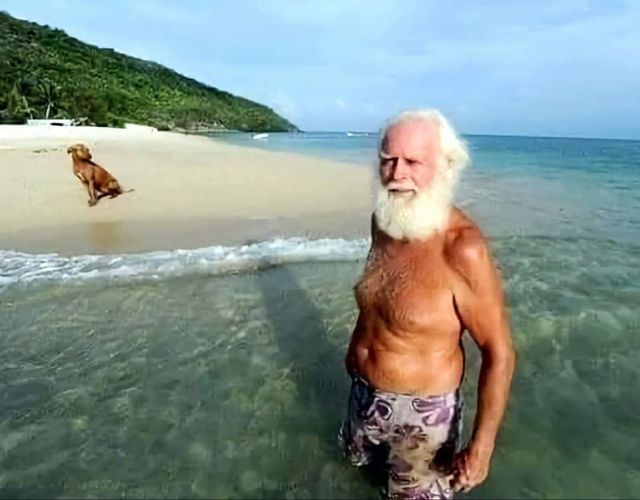
For $13,000, Englishman Brendon Grimshaw bought a small uninhabited island in Seychelles and settled there forever. When he was less than forty, he quit his editor-in-chief and started a new life. At that time, no human had set foot on the island for 50 years.

Brendon found a companion among the indigenous. His name was René Lafortin. With René, Brendon has started equipping his new home.

While René often didn’t come to the island, Brandon lived there for decades, never leaving her.

For 39 years, Grimshaw and Lafortin planted 16,000 trees with their own hands and built nearly five kilometers of trails. In 2007, René Lafortin passed away and Brandon was alone on the island.

He was 81 years old.

His island attracted 2,000 new bird species and introduced over a hundred giant turtles, which in the rest of the world (including Seychelles) were already on the verge of extinction.

Thanks to Grimshaw’s efforts, the once-a-desert island now houses two thirds of the Seychelles fauna. An abandoned land has turned into a true paradise.

A few years ago, the Prince of Saudi Arabia offered Brandon Grimshaw $50 million for the island, but Robinson refused. “I don’t want the island to become a rich’s favorite resort.” This better be a national park that everyone can enjoy.

And he managed to make the island actually declared a national park in 2008.

Article: https://thekidshouldseethis.com/…/brendon-grimshaw…

Governor of Barataria

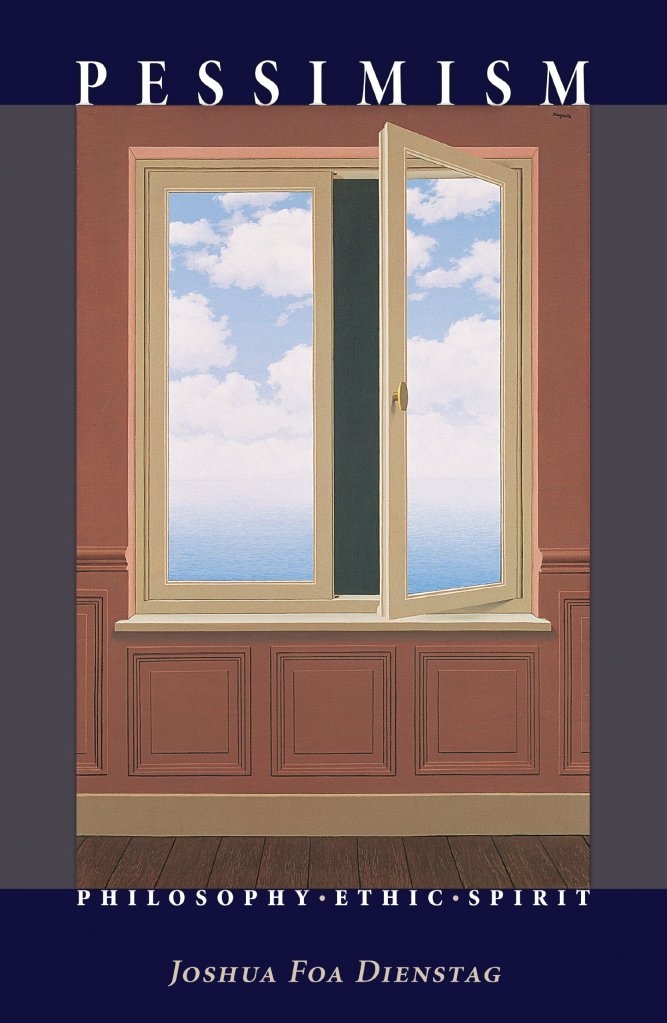
The Telescope is a 1963 oil on canvas painting by René Magritte.
The painting depicts a window through which a partly clouded blue sky can be seen. However, the right side of the window is partially open, revealing a black background where the viewer would expect to see a continuation of the clouds and sky – there could hardly be a better symbol of pessimism.

Ewa Maria Slaska

What I really like in Don Quixote, is, as all my attentive readers know, the story of how Sancho Panza, a simple, unlearned peasant, becomes governor and turns out to be a good and just ruler. Throughout all their journey together, the lord and his squire kept talking about how it would be when Sancho Panza’s faithful services were rewarded with the governorship of some island. The Duke’s mischievous joke makes the fiction come true. Sancho is appointed governor. For the next two chapters, Don Quixote instructs him on what to do to perform his duties well. Interestingly, the pessimistic Don Quixote, a fantast detached from reality, turns out to be a good, practical and pragmatic teacher. Sancho Panza’s reign ends with the lost war and his voluntary decision to resign as governor.

The author analysing this in his book on pessimism writes, that what we learn from it is not how to bring order and justice to the world in any permanent way, but that the attempt to do so is worthwhile. It is what should always count: our efforts are never in vain, they are always worthwhile.

(…) The episode of Sancho’s governorship suggests that he got from being with Don Quixote a surprisingly useful political education. When he takes up his post as governor of Barataria and is confronted with liars and tricksters, Sancho sees through them. When legal cases are brought before him, he is a shrewd judge of the motives and wiles of others. Several of these cases involve, essentially, two lowlifes who accuse one another of having cheated them. Sancho always finds a way to punish both while doing justice to both. The townspeople, who both present and observe these cases, have not been let in on the Duke’s joke and come to have great admiration for Sancho: “In a word, he made so many good rules that to this day they are preserved there, and are called “The ordinances of the great governor Sancho Panza”. Since, up to this point, the reader has been told repeatedly of Sancho’s intellectual shortcomings, this is a remarkable transformation. On Sancho’s part, while he first sought a governorship in order to get rich, he later has cause to boast that “without a cent I came into this government, and without a cent I go out of it”. Once his common sense has been unburdened of greed and ambitions, it is more than adequate to the task at hand. The justice that Quixote is repeatedly unable to effect by force, Sancho brings about through a sensible administration inspired by Quixote’s ideals and Sancho’s embrace of his own humble background. One of Sancho’s “advisers” (planted by the Duke to observe and report on what are expected to be hilarious blunders), is amazed at what he has seen and reports, “Every day we see something new in this world; jokes become realities, and the jokers find the tables turned on them”. But the lesson is not just that the Duke’s mildly sadistic plan has backfired. Quixote’s quest for justice, which everyone considers mad and impossible, has shown itself to bear fruit indirectly and in the most unlikely of places. In Don Quixote, quixotism is a joke; in Sancho, it becomes real.

Why is Sancho more successful than Quixote? Perhaps because he knows himself better than Quixote. Quixote claims to continue the personality of the Nine Worthies, but Sancho knows himself only as Sancho, Quixote’s squire. Without Quixote’s example, he would, perhaps, never have been able to see the value of this. While at the start, Sancho wanted nothing else than to be a governor, by the time he actually takes on the role, he has changed. The Duke suggests that he pick out a new wardrobe when assuming office, but he replies, “Let them dress me as they like. However I’m dressed I’ll be Sancho Panza”. Sancho reassures Quixote that the position will not distort him by saying, “I’d rather go to heaven as Sancho than to hell as a governor.” And this draws a rare compliment out of Quixote: “For those last words you uttered alone, I consider you deserve to be governor of a thousand islands”. In learning from Quixote, Sancho has not become another Quixote, but the first and only Sancho Panza. Following a knight with delusions of grandeur, Sancho has lost his own delusions and become who he is. What success he has in politics stems from this. Sancho’s policies are not, perhaps, what we might expect from a pessimist, but the entire episode may perhaps be taken to indicate that the best governor is one with a pessimistic education. Having dismantled his extravagant plans for the future, Sancho is better at seeing each case that comes before him for what it is. In knowing himself, he also knows what justice is. But the success that Sancho meets with is limited, in more ways than one. First of all, there is the inability of Sancho’s state to withstand a violent attack staged by the Duke who put him in power. More importantly, despite Sancho’s fitness to govern, he finds the process itself agonizing. An “advisor” concerned with his health refuses to let him eat anything and this symbolizes the lack of reward involved in governing: “I am dying of discouragement, because when I thought I was coming to this government to get hot food and cold drinks, and take my ease between holland sheets on feather beds, I find I have come to do penance as if I was a hermit”. Sancho has forsworn the acceptance of bribes or any such similar material rewards, so his post is no more rewarding financially than nutritionally. It might be expected, though, that his successful government might give him some feeling of satisfaction. It does not. Sancho, in coming to know himself, learns that the task of government is more than he can bear, nor does Cervantes suggest that another would find it any easier. Sancho leaves his governorship even more hastily than he accepted it. Finally, Cervantes warns us, in his usual comic fashion, not to become too enamored of Sancho’s new-found “wisdom.” When Quixote remarks on his improvement, Sancho replies, “It must be that some of your worship’s discretion sticks to me. Land that, of itself, is barren and dry, will yield good fruit if you fertilize it and till it. What I mean is that your worship’s conversation is the fertilizer that has fallen on the barren soil of my dry wit, and the time I have spent in your service and company has been the tillage”. This way of putting things sets them in proper perspective. Though Sancho has improved, he has not improved much. At best, he repeats garbled versions of old maxims whose meaning he only half-understands. In imitating Quixote, he has unlearned a few of his worst habits and acquired some better ones. If Sancho is successful at governing, it is as much because an honest half-wit is already a great improvement on the greedy, corrupt, and conniving men who ordinarily hold such posts. Quixote had suggested to Sancho that knowing who he is would be enough for him to govern, and, as Cervantes lets the events unfold, this turns out to be the case. At some level, the joke, which appeared to become real, remains a joke-what more, Cervantes seems to say, could one expect from a chaotic world such as this one? But this attitude too is perfectly consonant with a pessimistic perspective. What we learn from Sancho’s government is not how to bring order and justice to the world in any permanent way, but that the attempt to do so is worthwhile.

Pessimism of Don Quixote

Ewa Maria Slaska

Do not worry, only this part is in Polish, further follows English text

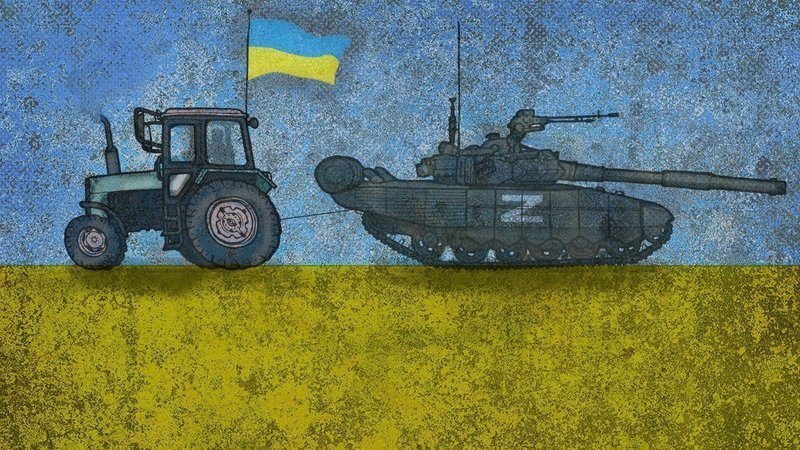
Thanks an Arkadiusz Łuba for sending me that picture 🙂

I. Wstęp z niemieckiej prasy codziennej

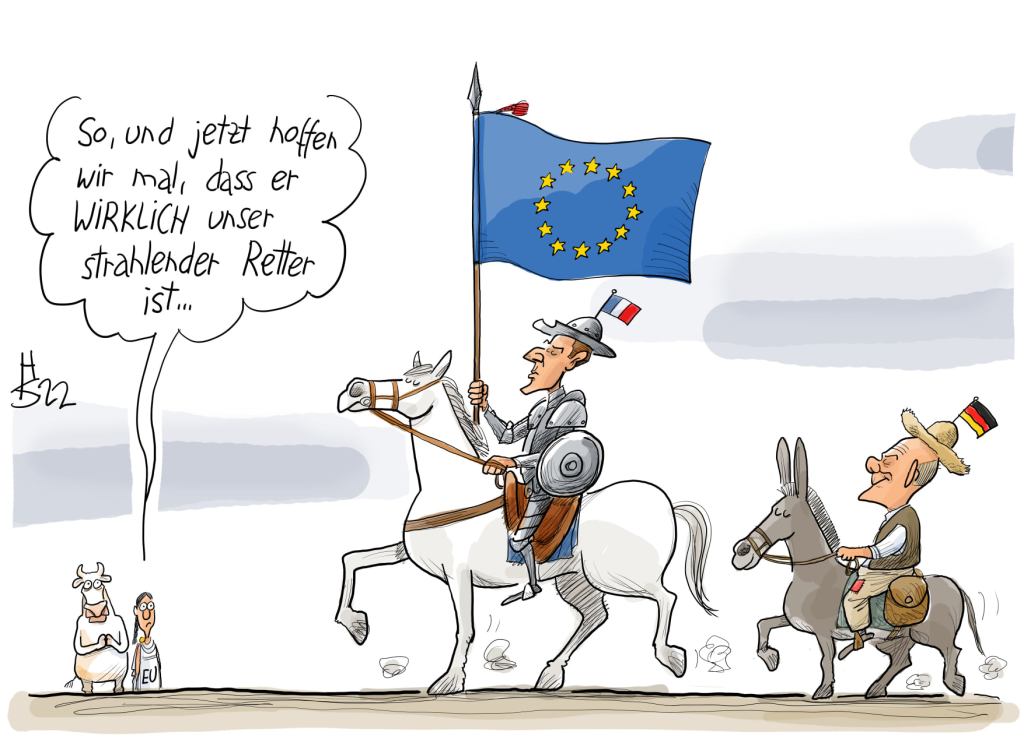
Ach, miejmy nadzieję, że on naprawdę okaże się naszym promiennym zbawcą

Trudno wyrokować. Na pewno po odejściu Angeli Merkel Emmanuel Macron wybija się na przywódcę Europy, podczas gdy niemieckiemu kanclerzowi przypada zaledwie rola giermka-brzuchacza. O dalszych analogiach między dzisiejszą sytuacją Europy a życiorysem Rycerza o Smętnym Obliczu pisze Arek Łuba na swoim blogu o komiksach: TU. Ciekawe wydaje się oczywiście, że jak po dwóch miesiącach wojny biedny zapatrzony we własny brzuch giermek wreszcie podniósł oczy, ujrzał mroczne obrazy wojny i postanowił sam chwycić za miecz, natychmiast zleciały się zewsząd niemieckie intelektualne dziewczątka i chłopięta, przerażone do głębin jestestwa myślą o tym, że będzie brzydko, be i prosząc Sanczę Brzuchacza by natychmiast zrezygnował ze wspierania walki i powrócił do roli przygłupa. List intelektualistów niemieckich TU (jest nawet, niestety moja ulubiona pisarka, Juli Zeh). Najstraszniejsze w tym liście (nazwijmy go) pierwszym była teza, że jeżeli naród ukraiński będzie nadal cierpiał, to będzie to jego własna wina, bo broni się przed agresorem! To zdanie jest hańbą europejskiej myśli pacyfistycznej, a ludzie którzy uznali, że ofiara jest winna tego, że cierpi, są po prostu ch… I niech już tam sobie idą.

Na szczęście, zanim przyszedł czas na opublikowanie tego posta, pojawił się drugi list otwarty, w którym paru naprawdę porządnych intelektualistów wsparło Sancho Pansę w jego decyzji, żeby jednak stanąć po stronie sprawiedliwości.

Uwaga, po kliknięciu na tego linka znajdzie się też link, gdzie się można podpisać pod tym “drugim listem”, razem Danielem Kehlmannem, Maximem Billerem, Herthą Müller, Olgą i Vladimirem Kaminerami, ze mną i innymi porządnymi ludźmi.

Koniec części polskiej

II. Optimistic intermezzo

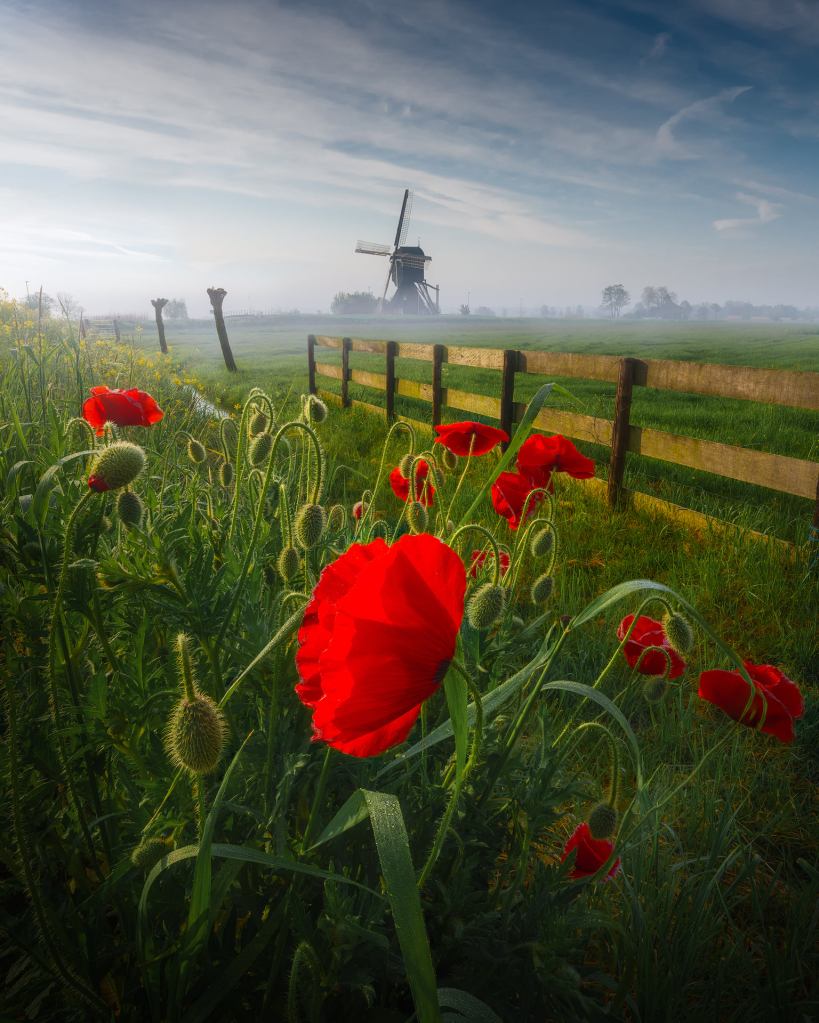
Albert Dros Photography

I have photographed many windmills over the years, but never one with poppies. Last week, after driving home I put my navigation ‘avoid motorways’. It’s a way for me to discover new places on the countryside, and this windmill was waiting for me. Just a few poppies were enough to make this photo.

René Magritte, The Telescope,1963, oil on canvas

III. About optimism of pessimists

Chapter Six
CERVANTES AS EDUCATOR
DON QUIXOTE AND THE PRACTICE
OF PESSIMISM

Don Quixote … is an allegory of the life of every man who,
unlike others, will not be careful merely for his own personal
welfare, but pursues an objective, ideal end that has taken
possession of his thinking and willing; and then, of course,
in this world he looks queer and odd.
-ARTHUR SCHOPENHAUER

Today we read Don Quixote with a bitter taste in our
mouths, almost with a feeling of torment, and would thus
seem very strange and incomprehensible to its author
and his contemporaries: they read it with the clearest
conscience in the world as the most cheerful of books,
they laughed themselves almost to death over it.
-FRIEDRICH NIETZSCHE

Prehistory

Different pessimists have read Don Quixote in different ways (…). But the uniform praise of this novel by the pessimists should cause us to wonder at the source of the commonplace understanding of its protagonist as an enemy of pessimism. Though the reader may reflexively think of Don Quixote as an inveterate optimist, charging at windmills and the like, I would suggest that this has more to do with the popularity of the musical Man of La Mancha than with Cervantes’s actual text. Whatever merits this lachrymose bit of theater may possess, fidelity to the spirit of Don Quixote is not actually one of them. If anything, Man of La Mancha resembles the heavy-handed, Wagnerian operatic romanticism that Nietzsche so feared being associated with.
Though I am not concerned here with cultural analysis, the reworking that Don Quixote receives in Man of La Mancha is an interesting example of the kind of imperialism of optimism that has succeeded in making pessimism invisible today. As Nietzsche reminds us, however, Cervantes’s book was received by its first readers as a bright comedy and was, indeed, internationally successful on that basis.

Practice of pessimism

If Quixote hopes, at first, to right wrongs with a wave of his noble sword, the sad truth about the world eventually destroys that expectation, both in him and in the reader. But if the narratives of chivalry that Cervantes mocks have been a dubious education for Quixote, that is not at all the case for Quixote’s own narrative of chivalry, which is an education for Sancho Panza and, through him, for the rest of us. And, as certain episodes in the novel suggest (particularly those in which Sancho is called upon to govern), it is even a useful political education. For Sancho, the unlettered peasant, to the surprise of everyone, governs wisely when given the opportunity. The justice that the insane Quixote is unable to effect with the sword, Sancho brings about through a sane and brave administration inspired by Quixote’s example. Sancho’s success is limited (indeed, ultimately it is destroyed), but it is (temporarily) genuine. For a time, Sancho organizes a small portion of the universe under something like a decent political regime. And all the characters in the novel, except Quixote, find this astounding.
Cervantes (…) characterizes the universe he created as a pessimistic vision and (…) his book aims at a goal that pessimists would recognize (and have recognized) – a mode of action that acknowledges the insuperable barriers that time-bound existence throws up against justice and happiness, but which does not respond to this situation with resignation. Don Quixote represents what I am terming a “practice of pessimism,” a mode of conduct and action founded on an absence of expectation and hope.

More tomorrow

Chmury w głowie

Teresa Rudolf

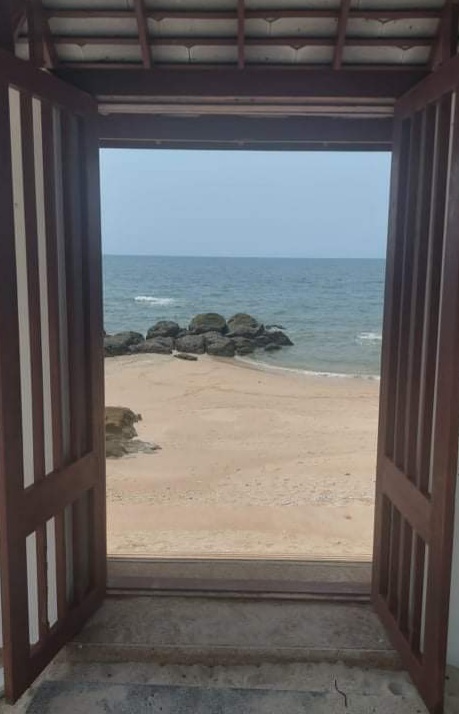
Okno marzeń

 A ona miala takie, 
tylko swoje własne,
dziwne okno marzeń...

co otwierało się 
codziennie rano,
na całkiem coś innego...

Wdychała ten swieży
zapach swych fantazji,
z kolorytem nieba...

I nie było nigdy końca
tym pięknym podróżom,
na leniwych chmurach,

na śpiewnych falach morza, 
na zieleni wilgotnej ogrodów,
i na  skrzydłach ptaków.

Bała się tylko jednego:

by nie otworzyć go 
kiedyś niespodzianie...
...na bezbrzeżną pustkę.
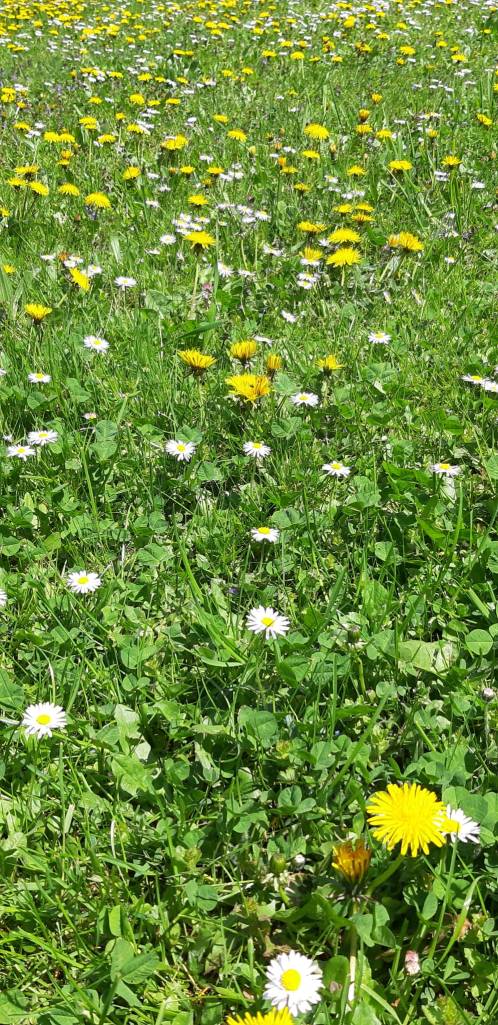
Łąka 

Poczuła ciche
ciepło w duszy,
czułość niebywałą.

Ujrzała znów 
w sobie tę znaną,
jak ze snów łąkę.

Taka ona niby
normalna, a jakby
wyszyta cierpliwie,

zielenią soczystą
nadziei na wiosnę,
kwiatów słonecznością.

I nagle poczuła ten
skurcz bolesny myśli,
lęk przed burzą,

groźnie miotającą 
błyskawicami 
wojną, tuż obok..

...ale też 
i przed 
słowem, 
co straszy,
i zabija.

Ein anderer offener Brief an den Kanzler

Waffenlieferung an die Ukraine

Alice Schwarzer und andere wurden für ihren Brief an Olaf Scholz heftig kritisiert. Mehrere Prominente schreiben dem Kanzler nun ebenfalls – mit einem ganz anderen Appell. Intellektuelle um den Publizisten Ralf Fücks plädieren für die kontinuierliche Lieferung von Waffen an die Ukraine – nachdem eine Gruppe um Alice Schwarzer davor gewarnt hatte.

Anm. der. Administratorin: Wie gut es einem tut, dass es nicht nur Alice Schwarzer und Julie Zeh gibt, sondern auch Herta Müller und Maxim Biller, Olga und Vladimir Kaminer oder Daniel Kehlmann.

Dieser Artikel stammt aus der ZEIT Nr. 19/2022. Hier können Sie die gesamte Ausgabe lesen.

Den offenen Brief an Bundeskanzler Scholz unterzeichneten unter anderem auch die Schriftsteller Maxim Biller und Herta Müller sowie der Publizist Ralf Fücks.
© Hannes Jung für ZEIT ONLINE; Sean Gallup/​Getty Images; IPON/​imago images

Sehr geehrter Herr Bundeskanzler,

auf der Maikundgebung in Düsseldorf haben Sie gegen Pfiffe und Protestrufe Ihren Willen bekräftigt, die Ukraine auch mit Waffenlieferungen zu unterstützen, damit sie sich erfolgreich verteidigen kann. Wir möchten Ihnen auf diesem Weg Beifall für diese klaren Worte zollen und Sie ermutigen, die Entschließung des Bundestags für Waffenlieferungen an die Ukraine rasch in die Tat umzusetzen.

Angesichts der Konzentration russischer Truppen im Osten und Süden der Ukraine, der fortgesetzten Bombardierung der Zivilbevölkerung, der systematischen Zerstörung der Infrastruktur, der humanitären Notlage mit mehr als zehn Millionen Flüchtlingen und der wirtschaftlichen Zerrüttung der Ukraine infolge des Krieges zählt jeder Tag. Es bedarf keiner besonderen Militärexpertise, um zu erkennen, dass der Unterschied zwischen “defensiven” und “offensiven” Rüstungsgütern keine Frage des Materials ist: In den Händen der Angegriffenen sind auch Panzer und Haubitzen Defensivwaffen, weil sie der Selbstverteidigung dienen.

Wer einen Verhandlungsfrieden will, der nicht auf die Unterwerfung der Ukraine unter die russischen Forderungen hinausläuft, muss ihre Verteidigungsfähigkeit stärken und die Kriegsfähigkeit Russlands maximal schwächen. Das erfordert die kontinuierliche Lieferung von Waffen und Munition, um die militärischen Kräfteverhältnisse zugunsten der Ukraine zu wenden. Und es erfordert die Ausweitung ökonomischer Sanktionen auf den russischen Energiesektor als finanzielle Lebensader des Putin-Regimes.

Es liegt im Interesse Deutschlands, einen Erfolg des russischen Angriffskriegs zu verhindern. Wer die europäische Friedensordnung angreift, das Völkerrecht mit Füßen tritt und massive Kriegsverbrechen begeht, darf nicht als Sieger vom Feld gehen. Putins erklärtes Ziel war und ist die Vernichtung der nationalen Eigenständigkeit der Ukraine. Im ersten Anlauf ist dieser Versuch aufgrund des entschlossenen Widerstands und der Opferbereitschaft der ukrainischen Gesellschaft gescheitert. Auch das jetzt ausgerufene Ziel eines erweiterten russischen Machtbereichs von Charkiw bis Odessa kann nicht hingenommen werden.

Die gewaltsame Verschiebung von Grenzen legt die Axt an die europäische Friedensordnung, an deren Grundlegung Ihre Partei großen Anteil hatte. Sie beruht auf Gewaltverzicht, der gleichen Souveränität aller Staaten und der Anerkennung der Menschenrechte als Grundlage für friedliche Koexistenz und Zusammenarbeit in Europa. Es widerspricht deshalb nicht der Ostpolitik Willy Brandts, die Ukraine heute auch mit Waffen zu unterstützen, um diese Prinzipien zu verteidigen.

Russlands Angriff auf die Ukraine ist zugleich ein Angriff auf die europäische Sicherheit. Die Forderungen des Kremls für eine Neuordnung Europas, die im Vorfeld der Invasion formuliert wurden, sprechen eine klare Sprache. Wenn Putins bewaffneter Revisionismus in der Ukraine Erfolg hat, wächst die Gefahr, dass der nächste Krieg auf dem Territorium der Nato stattfindet. Und wenn eine Atommacht damit durchkommt, ein Land anzugreifen, das seine Atomwaffen gegen internationale Sicherheitsgarantien abgegeben hat, ist das ein schwerer Schlag gegen die Nichtweiterverbreitung von Atomwaffen.

Was die russische Führung fürchtet, ist nicht die fiktive Bedrohung durch die Nato. Vielmehr fürchtet sie den demokratischen Aufbruch in ihrer Nachbarschaft. Deshalb der Schulterschluss mit Lukaschenko, deshalb der wütende Versuch, den Weg der Ukraine Richtung Demokratie und Europa mit aller Gewalt zu unterbinden. Kein anderes Land musste einen höheren Preis bezahlen, um Teil des demokratischen Europas werden zu können. Die Ukraine verdient deshalb eine verbindliche Beitrittsperspektive zur Europäischen Union.

Die Drohung mit dem Atomkrieg ist Teil der psychologischen Kriegführung Russlands. Dennoch nehmen wir sie nicht auf die leichte Schulter. Jeder Krieg birgt das Risiko einer Eskalation zum Äußersten. Die Gefahr eines Nuklearkrieges ist aber nicht durch Konzessionen an den Kreml zu bannen, die ihn zu weiteren militärischen Abenteuern ermutigen. Würde der Westen von der Lieferung konventioneller Waffen an die Ukraine zurückscheuen und sich damit den russischen Drohungen beugen, würde das den Kreml zu weiteren Aggressionen ermutigen. Der Gefahr einer atomaren Eskalation muss durch glaubwürdige Abschreckung begegnet werden. Das erfordert Entschlossenheit und Geschlossenheit Europas und des Westens statt deutscher Sonderwege.

Es gibt gute Gründe, eine direkte militärische Konfrontation mit Russland zu vermeiden. Das kann und darf aber nicht bedeuten, dass die Verteidigung der Unabhängigkeit und Freiheit der Ukraine nicht unsere Sache sei. Sie ist auch ein Prüfstein, wie ernst es uns mit dem deutschen “Nie wieder” ist. Die deutsche Geschichte gebietet alle Anstrengungen, erneute Vertreibungs- und Vernichtungskriege zu verhindern. Das gilt erst recht gegenüber einem Land, in dem Wehrmacht und SS mit aller Brutalität gewütet haben.

Heute kämpft die Ukraine auch für unsere Sicherheit und die Grundwerte des freien Europas. Deshalb dürfen wir, darf Europa die Ukraine nicht fallen lassen.

Wer diesen offenen Brief unterzeichnen möchte, kann das via change.org tun: http://www.change.org/KanzlerfuerUkraine

________________

Erste Unterzeichner unten – als ich es gestern um 15 Uhr unterzeichnet habe, war ich circa 6000. Bei dem Unterzeichnen sieht man die ganze Liste und auch die Zahl der schon geleisteten Unterschrifte.

Stephan Anpalagan
Gerhart Baum
Marieluise Beck
Maxim Biller
Marianne Birthler
Wigald Boning
Prof. Tanja Börzel
Hans Christoph Buch
Mathias Döpfner
Prof. Sabine Döring
Thomas Enders
Fritz Felgentreu
Michel Friedman
Ralf Fücks
Marjana Gaponenko
Eren Güvercin
Rebecca Harms
Wolfgang Ischinger
Olga Kaminer
Wladimir Kaminer
Dmitrij Kapitelman
Daniel Kehlmann
Thomas Kleine-Brockhoff
Gerald Knaus
Gerd Koenen
Ilko-Sascha Kowalczuk
Remko Leemhuis
Sabine Leutheusser-Schnarrenberger
Igor Levit
Sascha Lobo
Wolf Lotter
Ahmad Mansour
Marko Martin
Jagoda Marinić
Prof. Carlo Masala
Markus Meckel
Eva Menasse
Herta Müller
Prof. Armin Nassehi
Ronya Othmann
Ruprecht Polenz
Gerd Poppe
Antje Rávik Strubel
Prof. Hedwig Richter
Prof. Thomas Risse
Prof. Gwendolyn Sasse
Prof. Karl Schlögel
Peter Schneider
Linn Selle
Constanze Stelzenmüller
Funda Tekin
Sebastian Turner
Helene von Bismarck
Marie von den Benken
Marina Weisband
Deniz Yücel
Prof. Michael Zürn

ViSdP: Ralf Fücks, Zentrum Liberale Moderne, Reinhardtstr. 15, 10117 Berlin

Pesymizm Don Kichota

Ewa Maria Slaska

… czyli kolejny wpis o pożytkach czytania wszystkiego, co w ręce wpadnie

I. Prolegomena do wstępu

Konstanty Ildefons Gałczyński, Śmierć Andersena VI*

Nie żyjesz. Czyżbyś był już tylko śladem na bibule?
Czy naprawdę umarłeś Christianie?
Ja myślę, że nawet strzelać trzeba czule.
(MELANCHOLIJNA PORO, OCZU OCZAROWANIE…)
Bo te liście odfruwające bokiem…
bo dzień wczorajszy to żebrak…
więc… Tak likwidował epokę
niejaki Miguel Cervantes de Saavedra.

Przepisane z książki K.I.Gałczyński, Wybór poezji, Biblioteka Narodowa, Ossolineum 1974, s. 203; przepisane w Światowym Dniu Książki 2022 roku, czyli w rocznicę śmierci Szekspira i Cervantesa. Obaj umarli tego samego dnia – 23 kwietnia 1616 roku.

Tak likwidował epokę, napisał Gałczyński. I tak oczywiście było. Szekspir doprowadził literaturę renesansową na najwyższe wyżyny, ale Cervantes zmiótł to, co było i rozpoczął czas czytania powieści, a to nas do dzisiaj trzyma w kleszczach. Jeśli naprawdę wiemy coś o świecie i ludziach, to dlatego, że czytamy powieści. Czytamy. My czytamy. My kobiety. Bo co najmniej od XIX wieku uważa się, że powieści czytają przede wszystkim kobiety (oczywiście są wyjątki!). Mężczyźni wiedzą coś o świecie z traktatów i rozpraw, kobiety z powieści. Śmiem twierdzić, że wiemy lepiej, już chociażby dlatego że powieść, żebyśmy ją czytały, musi nas przekonać, musimy uwierzyć w jej sens, a ten dostajemy wraz prawdą o tym, jakie jest całe życie.
W traktatach jest teza, antyteza, synteza, w powieści kobieta, mężczyzna, dziecko, służąca, babcia i stary stajenny.
Tak, przez wiele stuleci to mężczyźni pisali dla nas powieści, ale musieli znać psychologię i wiedzieć, co czują kobiety. Jeśli nie potrafiliby nas przekonać, że Izabela Łęcka jest zimną wyrachowaną dziwką, Effie Briest miała odwagę kochać i zapłaciła za miłość wysoką cenę, a Emma Bovary zmarniała w pustce mieszczańskiej egzystencji, to byśmy nie czytały kolejnych powieści tych autorów. Takie to proste. W XIX wieku mężczyźni, żeby się utrzymać przy życiu jako pisarze, musieli pisać dla kobiet.

II. Intermezzo

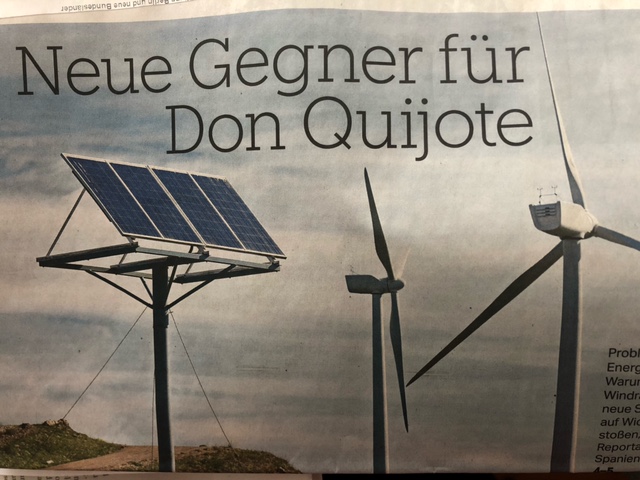
Z codziennej prasy niemieckiej. Nowi przeciwnicy Don Kichota.

Zdjęcie z Tageszeitung 22.02.22 (Pedro Sala/Imago)

Problemy z energią odnawialną. Nie tylko Hiszpanie nie chcą ani wiatraków ani baterii słonecznych.
I nie tylko oni walczą. Obejrzyjmy kataloński film Alcarràs Carli Simon, nagrodzony złotym niedźwiedziem na tegorocznym Berlinale (przy okazji – był to pierwszy film kataloński, który otrzymał tak prestiżową nagrodę). To co na filmie wydaje się opowieścią o rozpadzie jednej rodziny, naprawdę jest częścią wielkiego problemu, z jakim się borykamy – kryzysu klimatycznego.

III. Wstęp do pesymizmu

Główna teza autora brzmi: Europejczyk jest z samej swej natury pesymistą, a jego podstawowe przekonanie głosi, że życie jest cierpieniem. Zgodnie z tym poglądem Europejczyk, nawet jeśli tworzy utopie na temat idealnych państw czy rządów, tak naprawdę wcale w nie nie wierzy. Można nawet powiedzieć coś więcej i gorzej na ten temat – tak naprawdę Europejczyka pesymistę poznać po tym, że traktuje pesymizm jako swoją sprawę osobistą, a systemy społeczne wcale go nie obchodzą, bo przecież i tak wiadomo, że będą nieudane.

Skądinąd wiadomo.

W życiu codziennym zachowujemy się jednak trochę inaczej i właściwie odwrotnie do tego, co przypisał nam filozof. W życiu codziennym bowiem często bywamy optymistami i czasem wystarczy nam do tego kwitnące drzewo wiśni, lekka bryza, niebieskie niebo i trochę słońca. Natomiast w sprawach wielkich i wyższych na pewno jesteśmy pesymistami. W każdym razie my, Europejczycy z Europy Wschodniej. Możliwe, że na przełomie wieków XX i XXI nauka i polityka usiłowały nam wmówić, że teraz już wszystko będzie jak najlepiej na tym najlepszym ze światów, że nie ma już Historii i wszyscy będziemy na zawsze szczęśliwi, a wojny to sprawa, która przeminęła i będą zajmowały już tylko dyplomatów. Zachód bardzo chciał w to uwierzyć ale my, Europejczycy z Europy Wschodniej, nie daliśmy się nabrać. Widzieliśmy jak świat prawie bez rozlewu krwi strząsa z siebie okowy komunizmu, ale widzieliśmy też wojnę w Zatoce Perskiej, krwawy rozpad Jugosławii, ludobójstwo na placu Wiecznego Pokoju w Pekinie, narodziny islamskiego terroryzmu, upadek Arabskiej Wiosny Ludów, zdewastowanie Syrii, zbombardowanie miasta Grozny, krwawą rzeź na ukraińskim Majdanie i zajęcie Krymu. Dobrze wiedzieliśmy więc, że wszędzie naokoło czai się zło, a to, że my żyjemy w pokoju, jest jakimś cudem.

Cudem, który właśnie się skończył.

Dlatego wiedzieliśmy, że tylko durnie z Zachodu likwidują radio Wolna Europa, bo myślą, że nigdy już nie będzie potrzebne i tylko durnie z Zachodu dobrowolnie ładują łeb w pętlę “pipeliny”, dostarczającej przez Polskę i drugiej – przez Bałtyk tani gaz z Rosji Sowieckiej. Nawet nie przyszło nam do głowy, żeby tak nie mówić i żeby brać poważnie deklaracje, że Związek Radziecki upadł, bo wiedzieliśmy, że to tylko zmiana definicji i może lekka kosmetyka zachowań politycznych, ale Związek Sowiecki nie upadł, tak jak nie upadł carat, i że to wszystko to tylko inne nazwy.

Z czasem dowiedzieliśmy się, że ci z Zachodu to wcale nie durnie, którzy nie widzą niebezpieczeństwa, tylko całkowicie obojętni oligarchowie, których nie obchodzi, jakie koszty zapłaci w przyszłości świat za to, w jaki sposób oni się teraz bogacą.

I teraz właśnie za to płacimy, żyjąc w sześciu kryzysach na raz. Mamy kryzys klimatyczny, kryzys uchodźczy, kryzys finansowy, pandemię, kryzys demokracji i wojnę.

IV. Don Kichot jako nauczyciel-pesymista (czyli o praktyce bycia pesymistą)

Hmmm, kochani, okazało się, że ten wpis jest już bardzo długi… Obiecuję więc, ciąg dalszy nastąpi, ale na dziś wystarczy… Do poczytania za tydzień.

________

* umarł 4 sierpnia 1875

Mucha, czyli martwa natura z rękawicą

Ewa Maria Slaska

Moi kochani, postanowiłam, że przestanę się pastwić nad Kierkegaardem i już mu odpuszczę tę muchę, nad którą bezkarnie pozwalał się znęcać znudzonym chłopcom w szkole. Ale żebyście wiedzieli, że nadal kręcę się wokół tematu, jak wyglądał świat przed czasami internetu i jak dalece nasze pokolenie (“starych”) nie jest w stanie zrozumieć się z pokoleniem młodych, młodszych i najmłodszych (pokolenie “Z” – choć chyba powinni sobie zmienić oznaczenie, skoro od kilku tygodni litera Z oznacza zwolenników Putina – ciekawe, czy już zmienili?), usunęłam filozofa z nadtytułu i zostawiłam tylko “Muchę”. Teraz już tylko wtajemniczeni będą rozumieli, o co chodzi.

Mucha jest ważna. Znalazłam taki fragment u Canettiego w jego książce Über die Dichter (Hanser 2004, s. 28):

Welcher Dichter hat nicht zu seiner Fliege gesprochen?
Wen erkenne ich nicht an seiner Fliege?
Wer hält sich nicht eine Fliege, die für ihn trippelt?
*

Spacer po najgłębszej angielskiej prowincji

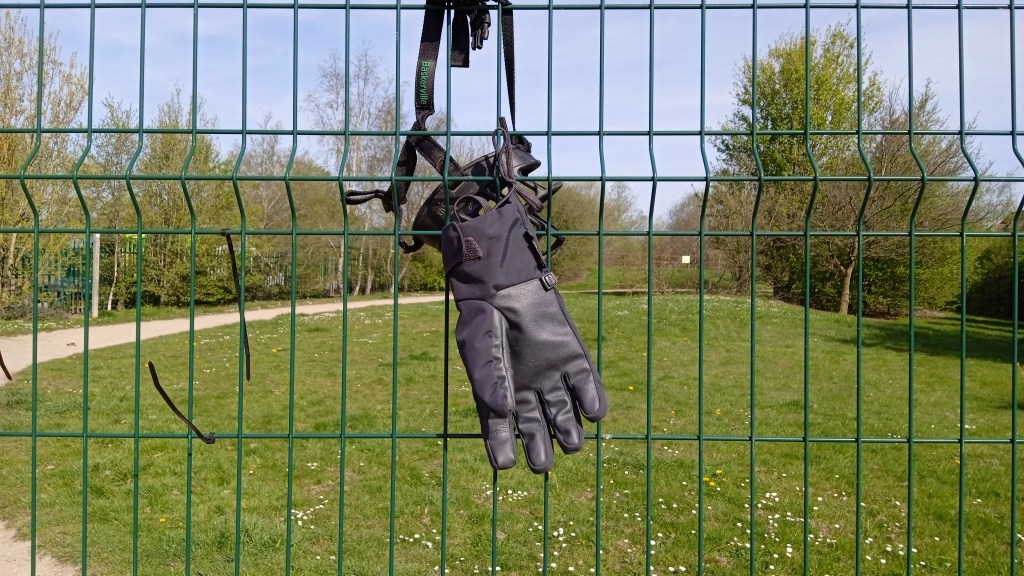
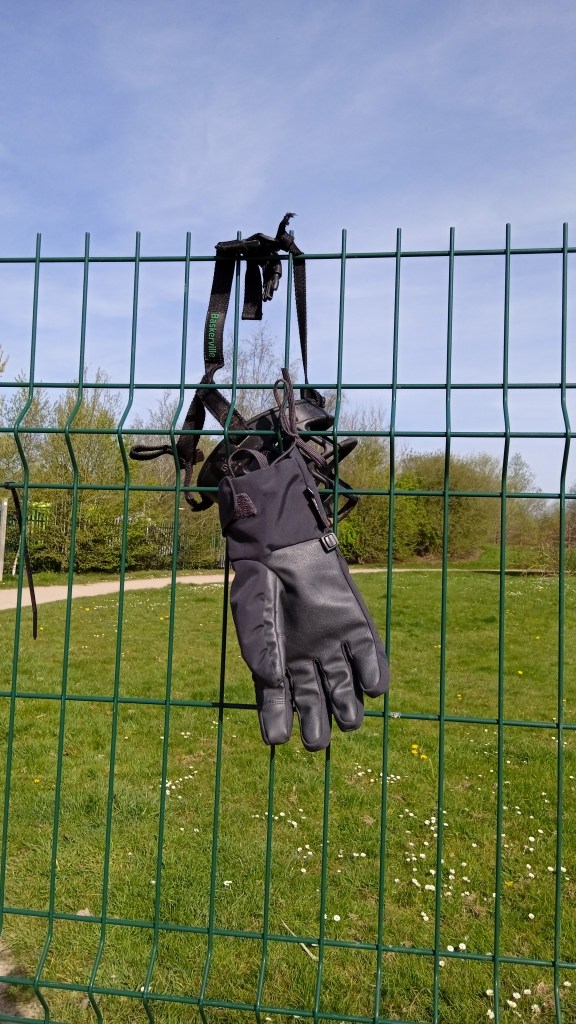
Idę na spacer po angielskim przedmieściu. Muszę podkreślić, że po angielskim, bo chyba ani w Niemczech, ani w Polsce taki przypadkowy spacer nie zaprowadził by mnie na pole golfowe. A tam na płocie taka czarna kompozycja.

Z tyłu za rękawicą jest jeszcze rodzaj uzdy czy kagańca, ale jakoś nie udało mi się tego sfotografować. Taśma, na której wisi ów kaganiec, ma napis Baskerville, więc może to wszystko wcale nie są atrybuty pola golfowego, tylko wybiegu dla psów. Dużych, czarnych, złych? Nie wiem, nie ma nikogo. Nikt nie gra w golfa, nikt nie wyprowadza psa. Jest wcześnie rano.

– Martwa natura, mówię, pokazując po powrocie to zdjęcie. Pierwsza martwa natura w historii sztuki.
– A czy martwa natura to nie jest obraz przedstawiający kwiaty i owoce?
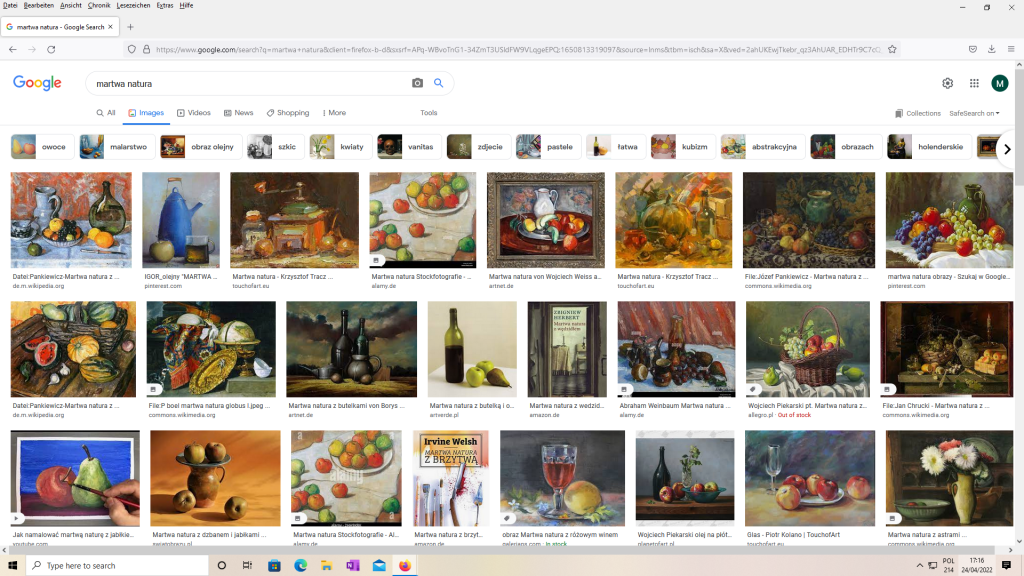
Milknę, bo nie wiem, co powiedzieć. Co to jest martwa natura? Myślałam, że wiem, ale co to jest dzisiaj martwa natura?

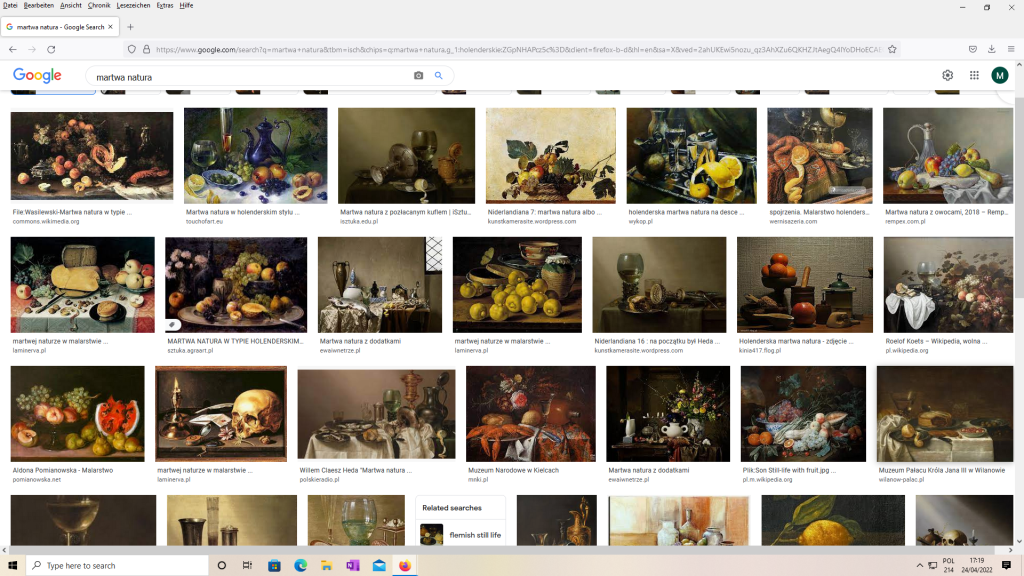
Piszę w internecie “martwa natura” i zaiste, pojawiają się przede wszystkim kwiaty i owoce. Miły, kolorowy świat, nadający się do powieszenia w salonie. Dziś skromniejszy, na miarę naszych czasów, w Holandii (na obrazku poniżej) w XVII wieku bogatszy, ale przekazujący to samo uczucie – tak jest, tak ma być w szczęśliwym domu.

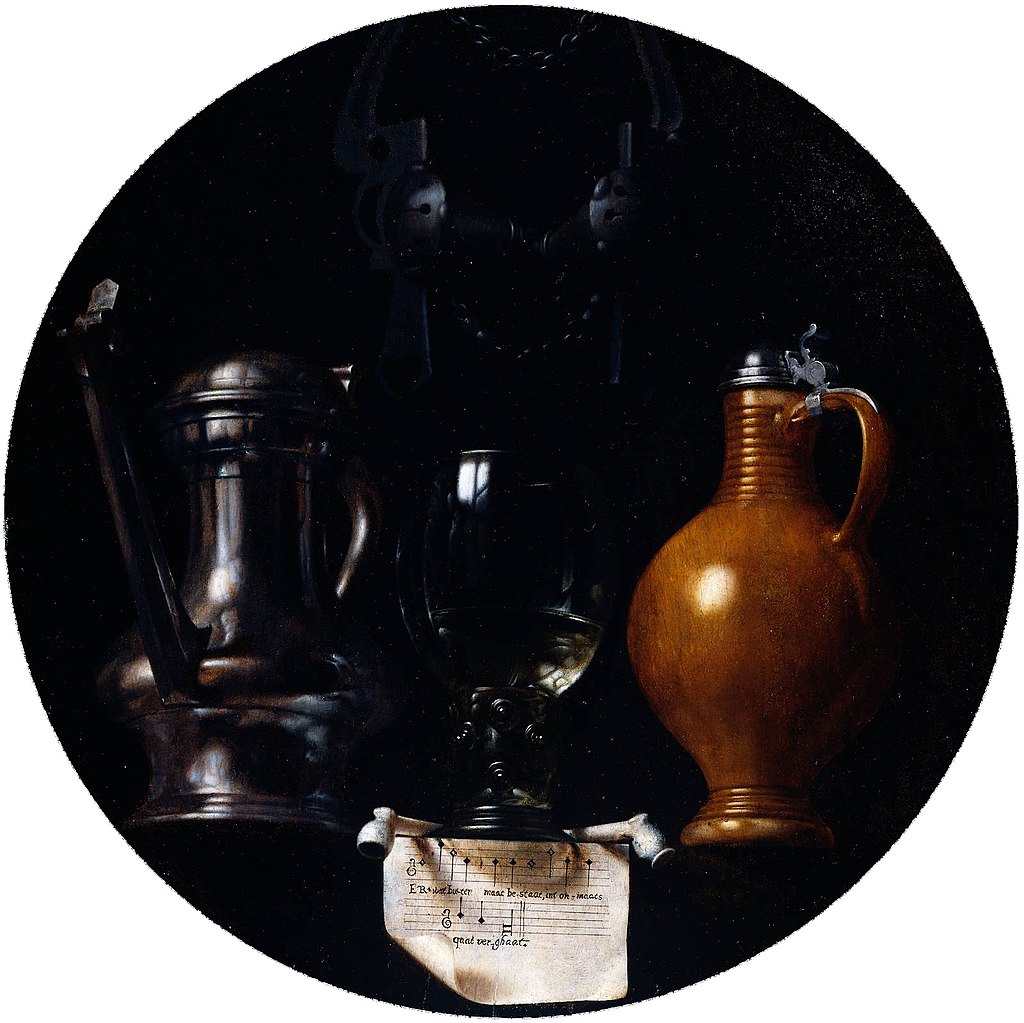
Owszem, na górnej ilustracji pojawia się Martwa natura z wędzidłem Herberta, ale na okładce są drzwi do domu, klucz, szczotka. Na dolnej z kolei jest czaszka, ale i koło niej jest kwiat, zresztą czaszka już chyba tak nie straszy jak kiedyś.

Zaczynam rozumieć pytanie, czarna rękawica i uzda na płocie to nie martwa natura. Wniosek jest jasny. Nie znam się.

Nie będę się upierać. W żadnej rozmowie w realu już się przy niczym nie upieram. Dopiero tu, blogu mój kochany, mogę jeszcze spróbować przypomnieć sobie i innym, co kiedyś znaczyła martwa natura.

Nie będę tu uprawiała profesorowania z zakresu historii sztuki. Każdy może sobie przeczytać wpis na Wikipedii, żeby zobaczyć, iż martwa natura (stil life, natura morta, Stilleben) wcale nie musiała służyć radosnemu upiększaniu szczęśliwego domu i mogła być alegorią, przestrogą, nauką, inwentaryzacją. Najsłynniejsze martwe natury, te pełne dorodnych kwiatów i owoców, potrafiły być, mimo to, przypomnieniem, że wszystko w życiu to marność (obrazy typu Vanitas) i że nie ciesz się człowieku, bo i tak umrzesz (obrazy typu Memento mori). Jak się przyjrzeć tym obrazom pełnym obfitości i bogactwa, można zauważyć, że niektóre kwiaty zwiędły, niektóre owoce nadgniły, chodzą po nich mrówki i gąsienice, latają muchy i ważki. Nic w życiu nie jest na zawsze, wszystko przeminie, wszystko przepadnie i zniszczeje.
Ale są też po prostu inne martwe natury, które przedstawiają coś innego, niż kwiaty i owoce.

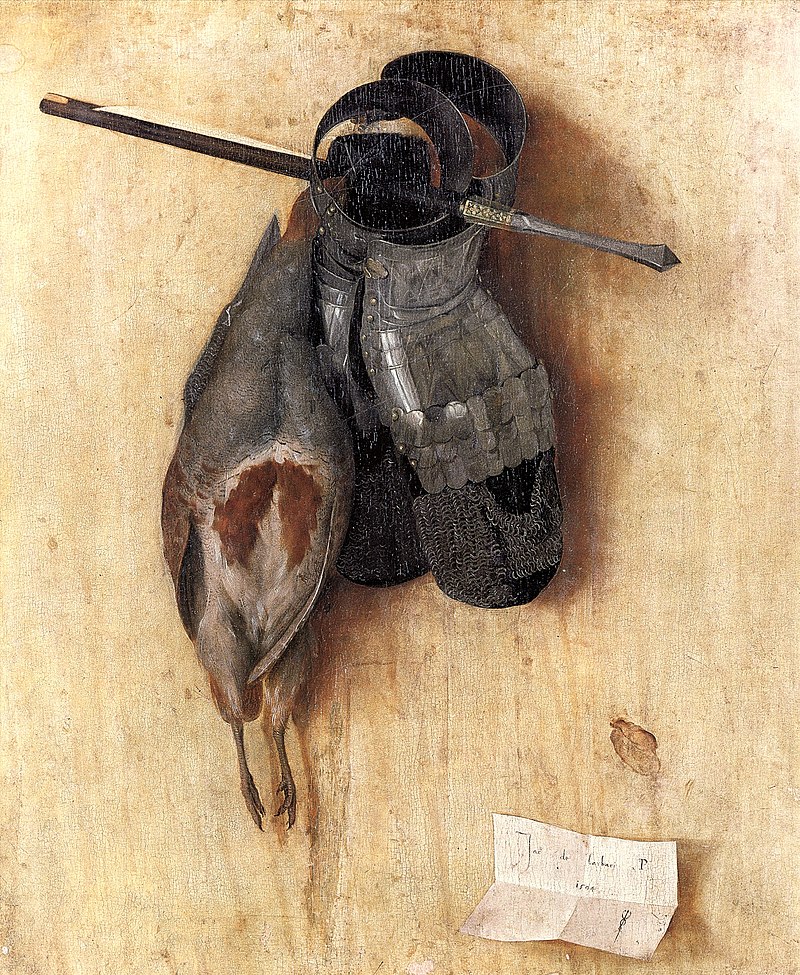
Zacznę od tego, co było moim pierwszym skojarzeniem. Martwa natura z kuropatwą i żelaznymi rękawicami, pierwsza samodzielna martwa natura na świecie, bo były już wcześniej takie, które na przykład na jakimś portrecie zostały ustawione na stole, czy kredensie i często przedstawiały atrybuty portretowanej osoby: globus – astronoma, waga – kupca, pędzel i paleta – malarza. Jacopo der Barbari. Rok 1504.

***

Tytułowa martwa natura z książki Herberta, Martwa natura z wędzidłem, jest o ponad sto lat późniejsza (1614). Jej autorem był holenderski malarz Johannes van der Beeck, zwany Torrentiusem. Zarówno wędzidło, jak i znajdująca się na obrazie kartka z nutami utworu zwanego Temperance (Umiarkowanie) skłoniły historyków sztuki do uznania obrazu za Alegorię wstrzemięźliwości. Ale rzecz wcale nie jest taka pewna, bo mogło być zupełnie przeciwnie – w zapisie nut jest błąd, który wskazuje na przynależność artysty do różokrzyżowców i może sugerować, iż Torrentius, heretyk, bluźnierca, rozpustnik i awanturnik, malując pozornie obraz sławiący słynną holenderską powściągliwość, naprawdę sobie z niej zakpił.

Dodam jeszcze, że losy obrazu są nieznane. W XVII wieku należał do Karola I Stuarta, ale po śmierci króla obraz zniknął. Został odnaleziony w roku 1913 w mieście Enschede w Holandii, gdzie używany był jako wieko do beczki z rodzynkami. Od roku 1918 znajduje się w zbiorach Rijksmuseum w Amsterdamie.

***

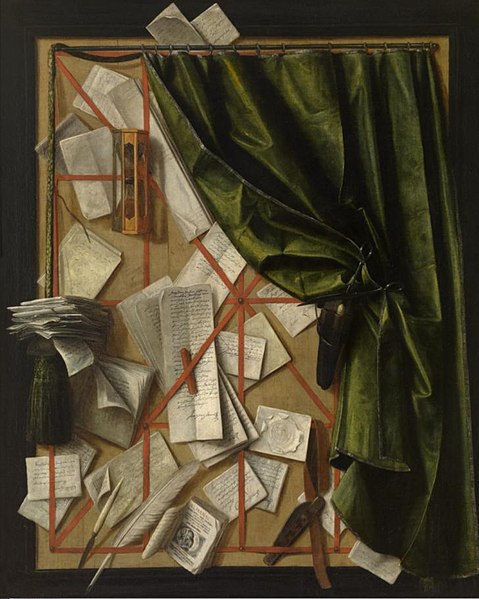
Cornelis Norbertus Gysbrechts, malarz flamandzki (1660–1683) namalował ten świetny obraz zapewne około roku 1664. Gysbrechts był mistrzem takich właśnie martwych natur, które historycy sztuki nazywają bez większej inwencji Tablica na listy z… Ta jest z brzytwą i klepsydrą, ale może być z nożem, pędzlem i paletą, ważną deklaracją polityczną, narzędziami balwierskimi lub kieszonkowymi skrzypcami. Pełna inwentaryzacja martwych natur Gysbrechta, z których żadna nie jest tylko bukietem kwiatów lub paterą z owocami, znajduje się TU; zalicza się je do kategorii Trompe l’Oeil, czyli złudzenie optyczne.

***

Trwa wojna Putina przeciw Ukrainie. Jeszcze w miejscu, gdzie żyjemy, niebo jest niebieskie, a na zielonej murawie kwitną niewinne stokrotki. Ale trawę otacza płot, a czarne rękawice za chwilę mogą się nam zacisnąć na szyi, tak jak od wielu tygodni dławią Ukrainę.
Ewa Maria Slaska, Martwa natura z kagańcem i rękawicą do poskramiania psów, 2022.

*
Jakiż poeta nie rozmawiał ze swoją muchą?
Kogóż to nie rozpoznam po jego musze?
Któż nie trzyma muchy, by za niego dreptała?

Koty na smutek historii

…bo co jeszcze możemy zrobić?

Ewa Maria Slaska

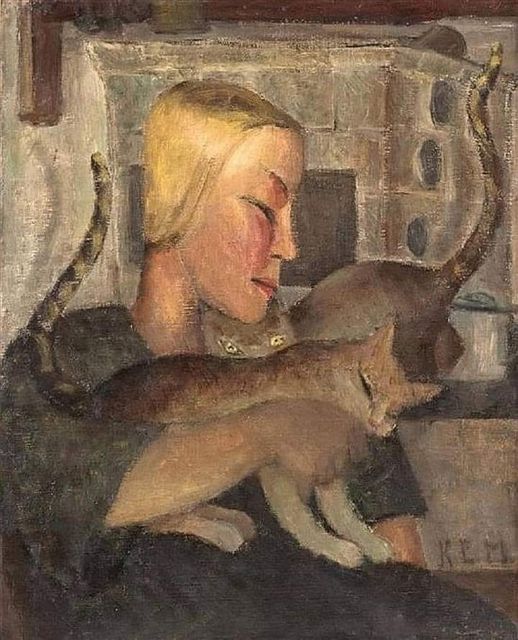
Ponieważ wszyscy wiedzą, że lubię koty, wciąż mi ktoś przysyła jakiegoś nowego kota. Co lepsze – Facebook robi to sam z siebie. Trzy powyższe ilustracje właśnie on mi podsunął.

Po te poniższe sama z siebie udałam się na internetowe pola, wychodząc z założenia, że napiszę tu o tym, co się pojawi jako pierwsze. Pojawił się barok, a wraz z nim nieznane motywy, nieznany malarz i nieznana malarka.

Słowacki artysta Jakub Bogdani specjalizował się w malowaniu martwej natury i ptaków. Ze swojej rodzinnej miejscowości Eperjes (dziś Prešov na Słowacji) podróżował po całej Europie, począwszy od Amsterdamu po Londyn, gdzie się ożenił i mieszkał już do końca życia. W jego obrazie Kot pośród kogutów z lat 1706-1710 widać wpływ XVII-wiecznego holenderskiego malarstwa rodzajowego. Obraz powstał na zamówienie admirała George’a Churchilla, jednego z angielskich patronów artysty.

Zauważmy, że są też świnki morskie.

Dwa obrazy barokowe, które reprodukuję poniżej, bardzo zresztą podobne do siebie, namalowała Clara Peeters, malarka flamandzka. Nigdy o niej nie słyszałam. Peeters wybrała typowy motyw barokowych martwych natur holenderskich – kot zakradający się do jedzenia.


Urodziła się około roku 1587, zmarła po roku 1636.
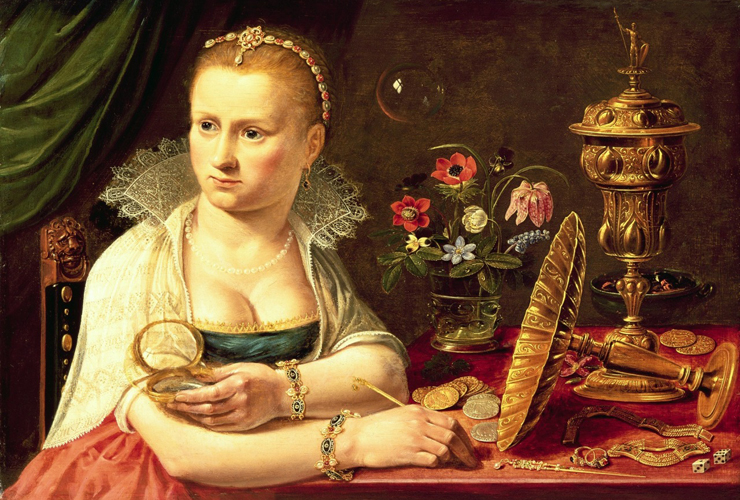
Wiemy o niej stosunkowo niewiele. Została ochrzczona w Antwerpii w roku 1594, tu też wyszła za mąż, w stosunkowo późnym wieku, miała bowiem 45 lat. Wcześnie zaczęła malować, najstarszy jej obraz pochodzi z 1607 roku, czyli miała wtedy 13 lat. Malowała przede wszystkim niewielkie obrazki przedstawiające jedzenie i napoje. Malowała już tak dojrzale, że niewątpliwie musiała pobierać nauki u jakiegoś mistrza malarskiego. Możliwe, że jej nauczycielem był Osias Beert, znany antwerpski autor martwych natur. W kilka lat później malarka dodała do swych obrazów luksusowe przedmioty – złote puchary i monety, egzotyczne kwiaty. Tak też, w otoczeniu luksusowych przedmiotów i kwiatów, sportretował ją nieznany malarz antwerpski. Na portrecie jest bardzo poważna, ale trzeba chyba powiedzieć, że życie ma dość szczęśliwe.

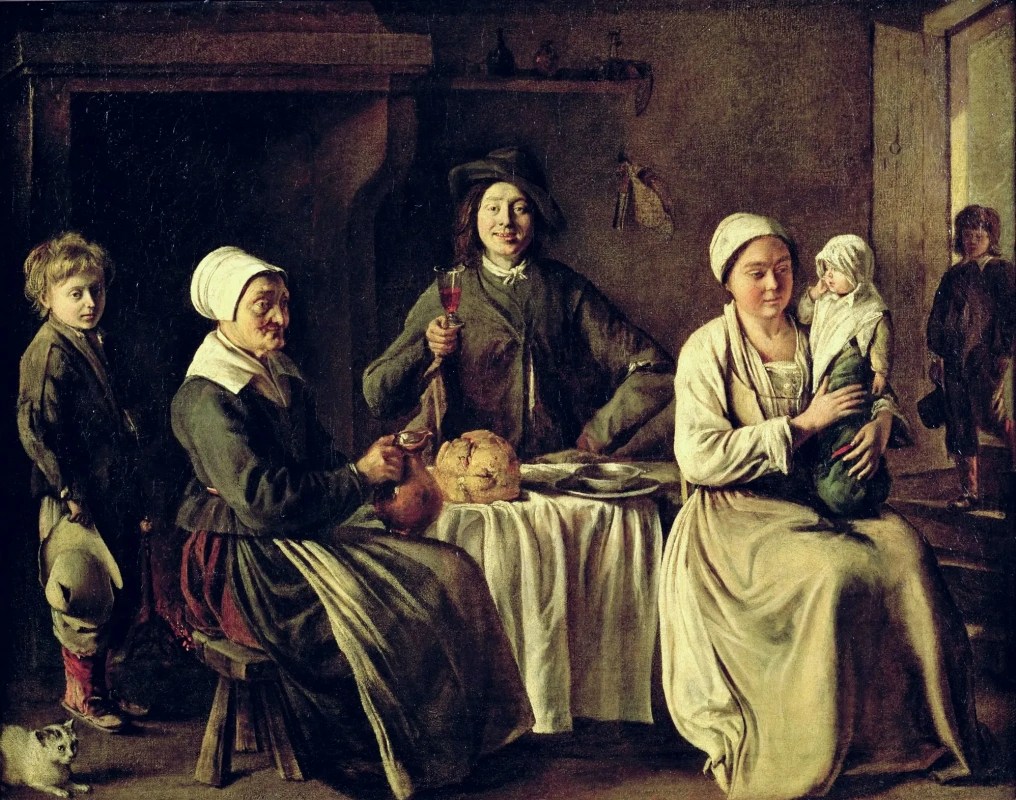
Poniżej obraz Louisa Le Nain z roku 1642 – ma przedstawiać szczęśliwą rodzinę. W pierwszym odruchu widz reaguje zdumieniem, bo ciemna tonacja obrazu kłóci się z tytułem. Jednak baczniejszy ogląd pozwala stwierdzić, że tak, to jest portret szczęśliwej rodziny. Mama, tata, troje dzieci i babcia wyglądają na bardzo zadowolonych z życia. Kot jak to kot. Syty, tłusty, zadowolony.

Myślałam, że przygotowuję wpis o kotach, ale nie, to wpis o życiu szczęśliwym. Bo tak nam się przecież kojarzy kot. Kot, symbol domu, przyjaciel, który “niczemu nie służy”, tylko byciu domowym przyjacielem.

Wojna Putina przeciw Ukrainie spowodowała, że dotarły do nas setki tysięcy uchodźców, kobiet, dzieci i… kotów. Przejmujący symbol tego, że skończyło się szczęśliwe życie. My, szczęśliwcy, póki co wciąż je jeszcze mamy. I daj Boże…