Wpis noworoczny dla wszystkich, specjalnie jednak dla Agnieszki, Doroty, Kingi, Tomka, Adama i wszystkich innych, którzy nie lubią moich małosłownych odpowiedzi na maile, choć nie zawsze dali temu wyraz. Musi być ich jednak mnoga rzesza, bo ostatnio bez przerwy ktoś zgryźliwie komentuje, że “się rozpisałam”… Podczas gdy ja odpowiadając w biegu na ich maile pisałam do nich O! albo Super! Albo Dziękuję, OK…
Ale te krótkie odpowiedzi, tak pomocne w biegu przez płotki i obowiązki, są jednak czymś więcej, są nawet dwoma “czymsiami”. Po pierwsze nie lubię pisania do znajomych, bo wolę, lubię i cenię przede wszystkim rozmowę z drugim człowiekiem. Dlatego też często jest tak, że jak ktoś wylał w mailu rwącą rzekę swych aktualnych problemów życiowych, moja jedyna odpowiedź będzie brzmiała, w czwartek na śniadanie? albo zadzwoń w niedzielę albo przyjedź do Berlina to pogadamy…
Jestem człowiekiem potwornie zajętym, ale zawsze znajdę dla Was czas, jak przyjdziecie czy przyjedziecie ze mną porozmawiać, a jak będziecie chorzy albo niedołężni, to ja przyjdę do Was porozmawiać. A nawet przyjadę. I na pewno możecie do mnie zatelefonować choćby w środku nocy, jeżeli musicie pogadać…
Ale proszę proszę proszę dajcie mi święty spokój z długim odpisywaniem na maile i czaty. Jeśli OK starcza za odpowiedź, to proszę niech Wam to moje OK starczy. Bardzo Was lubię i znajdę dla Was czas nawet w biegu i nawet w żmucie tysiąca obowiązków, który mnie oplątał. Znajdę czas, ale nie chce mi się szukać ręki, która napisze maile, ubierające OK w długie zdania.
To pierwszy powód. Ale jest jeszcze tak, że ja lubię lakoniczność.
Nauczyła mnie jej Mama. Dla tych, którzy ją znali brzmi to może dziwnie, bo zachowała się w pamięci wszystkich jako ktoś, kto dużo mówi, ale zapewniam, że jedno drugiemu nie przeczy. Bo lakoniczność to nie brak słów w ogóle, lecz usuwanie słów niepotrzebnych. Opór przed nadmiarem.
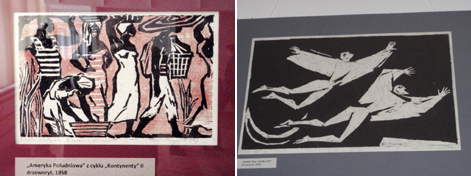
Była graficzką i to ten kunszt ją uczył oszczędności wyrazu.
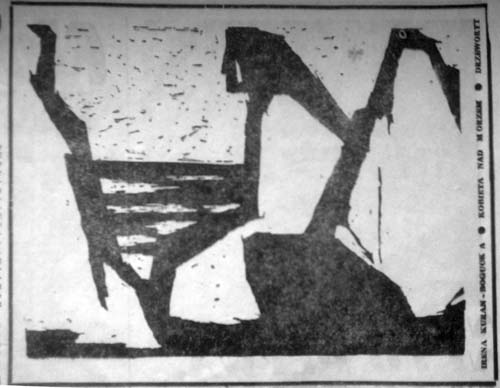
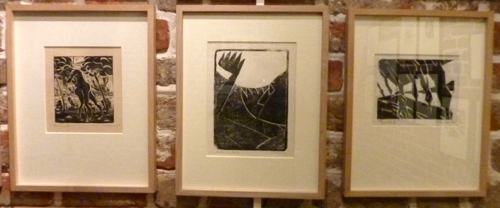
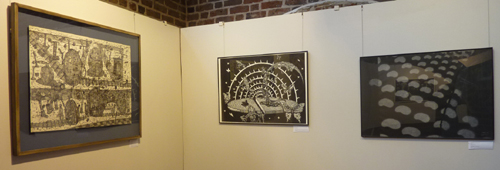
Irena Kuran-Bogucka, Ameryka Południowa, drzeworyt 1958 / Dedal i Ikar, drzeworyt 1963 / Poniżej – Kobiety nad morzem, drzeworyt 1962
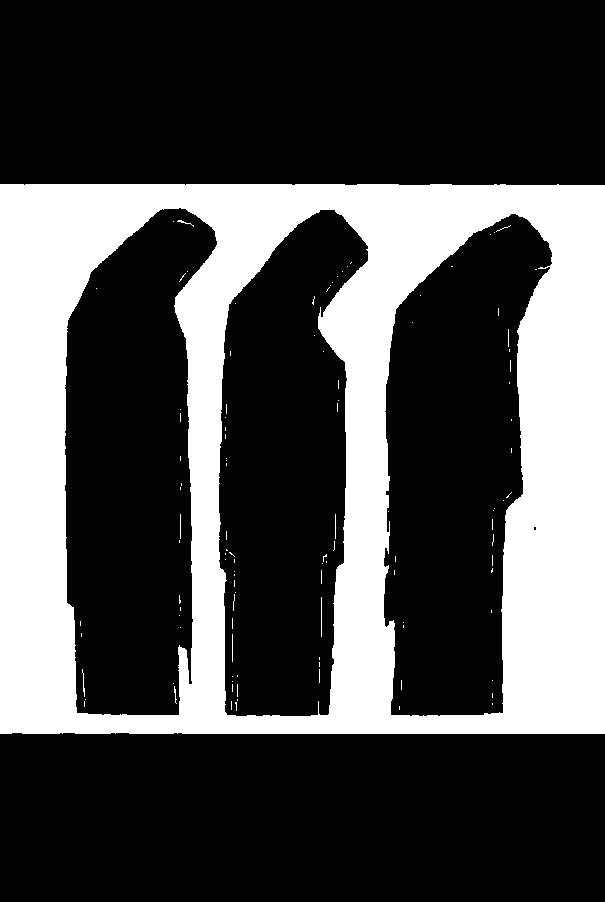
Z roku na rok jej grafiki stawały się coraz oszczędniejsze, coraz mniej linii było jej potrzeba do opisania sytuacji. Madonna Nomadów to już tylko kilka kresek, więcej pojawia się w tle niż ich Mama użyła do zarysowania kobiety i dziecka.
A metopy barbarzyńskie już w ogóle obywają się bez kreski.
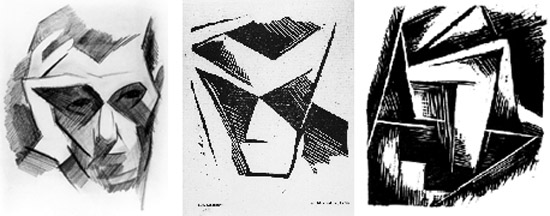
To oczywiście znany proces. Tak z realistycznego wizerunku rodziła się abstrakcja, bez której sztuka nowoczesna nigdy by się nie pojawiła jako nowa epoka i przełom w historii.
Nasza Lidia Głuchowska, niestrudzona badaczka awangardy w sztuce, pokazuje w jednej ze swych książek, jak Stanisław Kubicki, wychodząc od realizmu dochodzi do tego, co krytycy w latach dwudziestych, wciąż jeszcze nieobeznani z tym, co nowe, złośliwie nazywali trzy kuby Kubickiego.
Stanisław Kubicki, Trzy autoportrety, 1918 -1920
To samo oczywiście w nowoczesnym świecie odbywało się ze słowami. Już w barokowym wielosłowiu pojawiają się powściągliwe statementy. Haiku tylko uporządkowało ten trend.
Jak się zwadzimy — jagody są trądem,
Usta czeluścią, płeć blejwasem bladem,
Ząb szkapią kością, włosy pajęczyną,
Czoło maglownią, a oczy perzyną.
To w końcu XVII wiek w Polsce. A co dopiero Matsuo Basho, wiek ten sam, ale w Japonii.
Chimaki musubu katate ni hasamu hitaigami
Owijając ryżowe knedle liśćmi bambusa
Jedną ręką dotyka
Włosów nad czołem.
Tłumaczyła Teresa Kowalska.
Przez następne stulecia posuniemy się przecież w oszczędności znacznie dalej. Już dawno pojawia się taka “skrócona” angielska koperta zwana SASE (Self Addressed Stamped Envelope), wzór wszystkich maili, smsów, twittera, dla mfG, lol & fytk.
Zgodnie z tym obowiązującym trendem, ja – mentalnie z całą pewnością członkini Tajnego Stowarzyszenia Jawnych Przeciwników Barokizowania Budowli Gotyckich – próbując sprostać obowiązkom grzeczności korespondencyjnej – słynne zapomniane thank you letters – przeciwstawiając się jednocześnie obezwładniającej polskiej normie nie odpowiadania na maile, w poczuciu zatem, że… no więc częstokroć, żeby dać… ach tam… I wtedy pojawia się to moje
O! lub Super!
I uwierzcie mi, ja naprawdę tak myślę. Myślę, że O! i myślę, że super!
O, jak super, że mnie zrozumieliście i już nie będziecie się na mnie złościć…
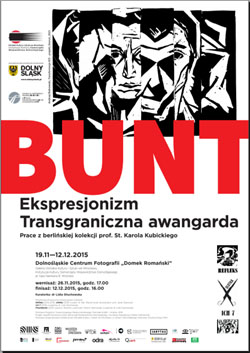
Today we present the preview (teaser) of the film Bunt. Re-Vision. 100 Years of Bunt/ Revolt, which shows the entire tour of the donated art exhibition Bunt – Expressionism – Transborder avant garde. Works from the Berlin collection of prof. St. Karol Kubicki (2015) from Berlin via the Nationalmuseum Poznań, Regionalmuseum Leon Wyczółkowski in Bydgoszcz, Kraszewski Museum Dresden and the Lower Silesian Center of Photography “Roman House” [Dolnośląskie Centrum Fotografii „Domek Romański”] in Wrocław.
The exhibition finale will take place on Saturday 12 December 2015 at 16.00 in the Lower Silesian Center of Photography “Roman House” [Dolnośląskie Centrum Fotografii „Domek Romański”]. The event will be a combination of the premiere of the documentary-artistic film Bunt. Re-Vision and the presentation of a book concurrent to the exhibition written by the exhibition’s curator Dr. Lidia Głuchowska.
Dziś prezentujemy wglądówkę (teaser) filmu Bunt – Re-Wizja. 100 lat Buntu, ukazującego wszystkie stacje międzynarodowego tournée wystawy donacyjnej Bunt – Ekspresjonizm – Transgraniczna awangarda. Prace z berlińskiej kolekcji prof. St. Karola Kubickiego, która wyruszyła z Berlina do Muzeum Narodowego w Poznaniu, Muzeum Okręgowego im. Leona Wyczółkowskiego w Bydgoszczy i Dolnośląskiego Centrum Fotografii „Domek Romański” we Wrocławiu
Finisaż w sobotę, 12.12.2015 o godz. 16.00 w Dolnośląskim Centrum Fotografii „Domek Romański”, połączony będzie z premierą filmu dokumentacyjno-artystycznego Bunt – Re-Wizja,a także prezentacją towarzyszącej jej książki autorstwa kuratorki, dr Lidii Głuchowskiej.
Heute zeigen wir die Vorschau (Teaser) des Films Bunt – Re-Vision. 100 Jahre von Bunt / Revolte über alle Stationen der internationalen Ausstellungstour Bunt – Expressionismus – Grenzübergreifende Avantgarde. Werke aus der Berliner Sammlung von Prof. St. Karol Kubicki. Die Kunstwerke aus Berlin sind die Werke im Nattionalmuseum Poznań, Leon-Wyczółkowski-Bezirksmuseum in Bydgoszcz, Kraszewski-Museum in Dresden sowie Bezirksmuseum im Niederschlesischen Zentrum für Fotografie „Domek Romański” [Romanisches Haus] präsentiert worden.
Bei der Finissage am Samstag, den 12. Dezember 2015 um 16.00 im Niederschlesischen Zentrum für Fotografie „Domek Romański” [Romanisches Haus], wird die Erstpräsentation des dokumentarisch-künstlerischen Films Bunt – Re-Vision sowie eine Präsentation der Begleitpublikation, ein Buch der Kuratorin Dr. Lidia Głuchowska, stattfinden.
We invite you to the first presentation at the finissage Zapraszamy na premierę na finisażu Wir laden Sie herzlich zur Erstpräsentation auf der Finissage ein
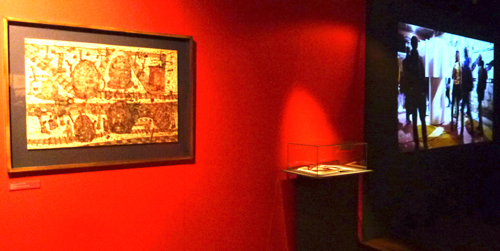
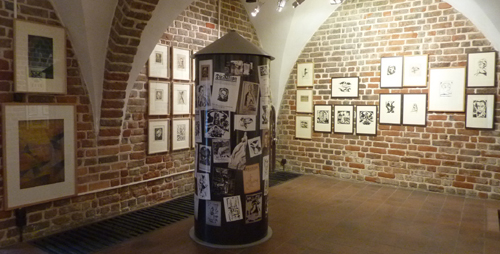
The initial shots of the film were presented in the Regional Museum Leon Wyczółkowski in Bydgoszcz in so called “Cinema”, one of the three parts of the arrangement of the exhibition, next to the “Street” and the “Café”, inspired by the atmosphere of the artistic centres of the 1920s. Next to the “Cinema” is to be seen the presentation of the artistic book Refleks / Relfex (2014) and the drawing by Jacek Szewczyk Alley without work (1999), part of the presentation Ich 7 / The 7 of them (They 7)
Początkowe sceny filmu zaprezentowane zostały w Muzeum Okręgowym im. Leona Wyczółkowskiego w Bydgoszczy, w części ekspozycji zatytułowanej „Kino“, która – podobnie jak pozostałe części aranżacji, czyli „Ulica“ i „Kawiarnia“ – zainspirowane były atmosferą centrów artystycznych dwudziestolecia międzywojennego.
Obok „Kina” widoczna prezentacja książki artystycznej Refleks (2015) oraz rysunek Jacka Szewczyka Aleja bez pracy (1999), część prezentacji Ich 7.
Die Anfangsszenen des Filmes wurden präsentiert im Leon- Wyczółkowski-Bezirksmuseum in Bydgoszcz im so genanten „Kino“, einem der drei Teile des Ausstellungsarrangements, welcher, neben der „Straße“ und dem „Café“, an die Aura der künstlerischen Zentren der 1920er inspiriert wurden. Neben dem Kino – die Präsentation des Kunstbuchs entstanden im Rahmen des Projekts Refleks / Reflex sowie die Zeichnung von Jacek Szewczyk Allee der Arbeitslosen (1999), Teil der Kunstpräsentation Ich 7 / Sie 7.
BUNT – RE-Vision. 100 Years of Bunt / Revolt artistic-documentary film Concept: Lidia Głuchowska, An Kraśko Technical production: An Kraśko Text: Lidia Głuchowska
At the exhibition closing event in Wrocław the film’s final version will be screened including 8 episodes:
1/ Acceptance of the donation from prof. Kubicki in Berlin-Hufeisensiedlung and transport to the National Museum in Poznań, 16 March 2015.
2/ Exhibition opening in the National Museum in Poznań, 19 April 2015.
3/ The long Museum Night and curator-guided exhibition viewing in the National Museum in Poznań, 16 May 2015.
4/ Opening of the premiere showing of the project Flyer, squat Od-Zysk, 16 May 2015. Handing over a gift by Polish contemporary artists and a letter of intent – thanking for the donation by prof. Kubicki from Germany, to the hands of the curator dr. Lidia Głuchowska.
5/ Presentation of the gift by Polish contemporary artists to prof. Kubicki in Berlin-Hufeisensiedlung.
6/Exhibition opening and conference in the Leon Wyczółkowski District Museum in Bydgoszcz.
7/ Press conference, exhibition opening and the exhibition in Kraszewski-Museum Dresden; handing over of a miniature of the installation by Karolina Ludwiczak and Marcin Stachowiak and the order of the Leon Wyczółkowski District Museum in Bydgoszcz to prof. St. Karol Kubicki in Berlin by the artists and the Museum’s director prof. dr. hab. Ryszard F. Woźniak.
8/ Vernissage at the Gallery of the Culture and Art Centre OKiS, Lower Silesian Centre for Photography “Domek Romański” in Wrocław.
There were also two other films presented during the exhibition –Refleks [Reflex] and Ulotka [Flyer] by Marek Glinkowski (sound: Radosław Włodarski, 2015)
Authors of the works presented in the movie:
Krzysztof Balcerowiak, Andrzej Bobrowski, Magdalena Czerniawska, Zuzanna Dyrda, Stefan Ficner, Agata Gertchen, Marek Glinkowski, Mariusz Gorzelak, Paweł Frąckiewicz, Jarosław Janas, Aleksandra Janik, Dorota Jonkajtis, Anna Kodź, Wojciech Kołacz, Katarzyna Krawczyk, Marta Kubiak, Maciej Kurak, Maryna Mazur, Agnieszka Mori, Christopher Nowicki, Grzegorz Nowicki, Mirosław Pawłowski, Max Skorwider, Jacek Szewczyk, Piotr Szurek, Michał Tatarkiewicz, Anna Trojanowska, Przemysław Tyszkiewicz, Małgorzata ET BER Warlikowska, Radosław Włodarski.
In Dresden Kraszewski Museum the movie was presented already during the press conference and the opening, in one of the exhibition rooms. It allowed the visitors to imagine the parallellity of the different moments of the exhibition tour – the signing of the donation contract in Berlin by Professor Kubicki, the vernissage of the first station of the exhibition in Nationalmuseum in Poznan and the vernissage of the Ulotka / Flyer project in squat Od-Zysk as well as the presentation at the second station of the exhibition in Bydgoszcz.
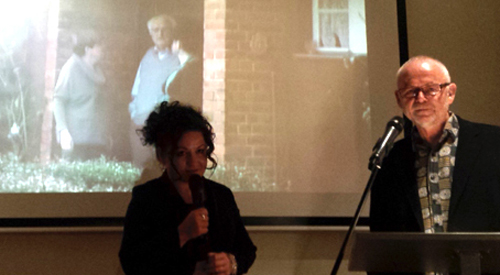
At the photo-exhibition curator, Lidia Głuchowska and exhibition coordinator, Bronislaw Kowalewski at the vernissage in Dresden.
In the background – the movie: Prof. St. Karol Kubicki, his wife – Petra, as well as the curator, Lidia Głuchowska, after the forwarding the artpieces from his Berlin collection to the Nationalmuseum in Poznań and the regional Museum Leon Wyczółkowski Museum in Bydgoszcz.
W Muzeum im Józefa Ignacego Kraszewskiego w Dreźnie film prezentowany był w jednej z sal wystawowych i to już w trakcie konferencji prasowej i wernisażu, co wśród zwiedzających budzić mogło wrażenie paralelności różnych momentów tournée wystawy donacyjnej – począwszy od podpisania umowy donacyjnej przez prof. Kubickiego w Berlinie, otwarcia pierwszej odsłony w Muzeum Narodowym w Poznaniu oraz premiery projektu Ulotka na sqacie Od-Zysk, a także pokazu podczas na drugiej stacji wystawy – w Bydgoszczy.
Na zdjęciu – kuratorka, dr Lidia Głuchowska i kordynator wystawy, Bronisław Kowalewski podczas wernisażu w Dreźnie. W tle- film: prof. St. Karol Kubicki, jego żona Petra oraz kuratorka, Lidia Głuchowska, po przekazaniu daru dla Muzeum Narodowego w Poznaniu i Muzeum Okręgowego im. Leona Wyczółkowskiego w Bydgoszczy.
Im Kraszewski Museum Dresden wurde der Film in einem der Ausstellungsräume bereits während der Pressekonferenz und der Ausstellungseröffnung gezeigt. Dies könnte bei den Besuchern den Eindruck von der Parallelität unterschiedlicher Momente der Ausstellungstour erweckten – der Unterzeichnung des Schenkungsvertrags durch Prof. Kubicki in Berlin, der Eröffnung der Erstausstellung im Nationalmuseum Poznan und der Vernissage des Projekts Ulotka / Flyer im Squat Od-Zysk sowie der Schau in der zweiten Ausstellungsstation in Bydgoszcz.
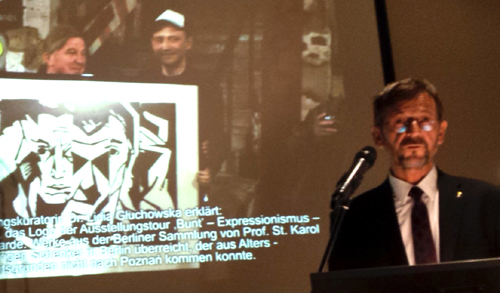
Director of the Regional Museum Leon Wyczółkowski in Bydgoszcz, prof. Michał Woźniak during the opening in Dresden. In the background – the movie: presentation of the Logo of the touring exhibityion by Andrzej Bobrowski and Radosław Włodarski at the vernissage of the Ulotka / Flyer project in squat Od- Zysk in Poznań.
Dyrektor Muzeum Okręgowego im. Leona Wyczółkowskiego w Bydgoszczy, prof. dr Michał Woźniak podczas wystąpienia na wernisażu w Dreźnie. W tle – film: Andrzej Bobrowski i Przemysław Włodarski prezentują logo wystawy donacyjnej na wernisażu projektu Ulotka na squacie Od-Zysk w Poznaniu.
Direktor des Leon-Wyczółkowski-Bezirksmuseums in Bydgoszcz, Prof. Ryszard F. Woźniak während der Eröffnungsrede in Dresden. Im Hinterngrund der Film: Andrzej Bobrowski und Przemysław Włodarski present ieren das Logo der Ausstellungstour auf der Vernissage des Projekts Ulotka / Flyer in the squat Od-Zysk in Poznań.
BUNT – RE-Wizja. 100 lat Buntu Film dokumentacyjno-artystyczny
Koncepcja: Lidia Głuchowska, An Kraśko
Realizacja techniczna: An Kraśko
Tekst: Lidia Głuchowska
Premierowy pokaz całego filmu na finisażu odsłony wrocławskiej obejmuje 8 epizodów:
1/ Przejęcie donacji prof. Kubickiego w Berlinie-Hufeisensiedlung i transport do Muzeum Narodowego w Poznaniu, 16.03.2015.
2/ Wernisaż w Muzeum Narodowym w Poznaniu, 19.04.2015.
3/ Długa Noc Muzeów i oprowadzanie kuratorskie po Muzeum Narodowym w Poznaniu, 16.05.2015.
4/ Wernisaż premierowej odsłony projektu „Ulotka”, squat Od-Zysk, 16.05.2015.
Przekazanie daru polskich artystów współczesnych i listu intencyjnego – podziekowania za donację z Niemiec dla prof. Kubickiego na ręce kuratorki, dr Lidii Głuchowskiej.
5/ Wręczenie daru polskich artystów współczesnych prof. Kubickiemu w Berlinie-Hufeisensiedlung.
6/ Wernisaż i konferencja naukowa w Muzeum Okręgowym im. Leona Wyczółkowskiego w Bydgoszczy.
7/ Konferencja prasowa, wernisaż i wystawa w Muzeum Józefa Ignacego Kraszewskiego w Dreźnie oraz przekazanie miniatury instalacji Przenikanie Karoliny Ludwiczak i Marcina Stachowiaka oraz medalu Muzeum Okręgowego im. Leona Wyczółkowskiego prof. St. Karolowi Kubickiemu w Berlinie przez artystów i dyrektora muzeum, prof. dra. hab. Ryszarda F. Woźniaka
8/ Wernisaż we Wrocławiu.
Na wystawie prezentowane były jeszcze dwa filmy artystyczne autorstwa Marka Glinkowskiego (dźwięk: Radosław Włodarski, 2015) – Ulotka i Refleks
Prezentowano w nich prace graficzne nastepujących artystów:
Krzysztof Balcerowiak, Andrzej Bobrowski, Magdalena Czerniawska, Zuzanna Dyrda, Stefan Ficner, Agata Gertchen, Marek Glinkowski, Mariusz Gorzelak, Paweł Frąckiewicz, Jarosław Janas, Aleksandra Janik, Dorota Jonkajtis, Anna Kodź, Wojciech Kołacz, Katarzyna Krawczyk, Marta Kubiak, Maciej Kurak, Maryna Mazur, Agnieszka Mori, Christopher Nowicki, Grzegorz Nowicki, Mirosław Pawłowski, Max Skorwider, Jacek Szewczyk, Piotr Szurek, Michał Tatarkiewicz, Anna Trojanowska, Przemysław Tyszkiewicz, Małgorzata ET BER Warlikowska, Radosław Włodarski.
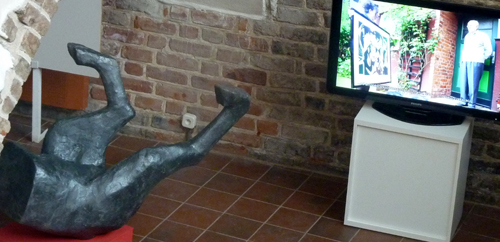
During the display in the Lower Silesian Photography Centre „Domek Romański“ the movie was to bee seen already from the street, through the windows. It invited the passengers to come in and to see the whole exhibition. In the movie is to be seen the moment of forwarding of the gratitude presents of the Poznań contemporary artists to Prof. St. Karol Kubicki in Berlin.
Next to the screen is to be seen the sculpture by Małgorzata Kopczyńska Cerberus (c. 2013), part of the artistic presentation Ich 7 / The 7 of Them.
Podczas wystawy w Dolnośląskim Centrum Fotografii Domek Romański film było widać już przez okna, z ulicy. Zapraszał on przechodniów do wejścia do środka i zapoznania się z całą ekspozycją.
W filmie udokumentowano m.in. moment przekazania daru współczesnych artystów z Poznania prof. St. Karolowi Kubickiemu w Berlinie.
Obok monitora – rzeźba Małgorzaty Kopczyńskiej Cerber (ok. 2013), część prezentacji artystycznej Ich 7.
Während der Ausstellung im Niederschlesischen Zentrum für Fotografie, „Domen Romański” der Film war zu sehen schon aus der Straße, durch die Fenster. Das lud die Passanten ein, damit sie reinkommen, um die gesamte Ausstellung anzusehen. In dem Film ist u.a. der Moment der Übergabe des Ausstellungslogos – des Dankbarkeitsausdrucks der Gegenwartskünstler aus Poznań to Prof. St. Karol Kubicki in Berlin.
Neben dem Bildschirm- Plastik von Małgorzata Kopczyńska Cerberus (ca. 2013), Teil der Kunstpräsentation Ich 7 / Sie 7.
BUNT– RE-Vision. 100 Jahre Bunt / Revolte Künstlerisch-dokumentarischer Film
Konzeption: Lidia Głuchowska, An Kraśko Technische Umsetzung: An Kraśko Text: Lidia Głuchowska
Die Erstaufführung des gesamten Films während der Finissage der Schau in Wrocław umfasst 8 Episode:
1/ Übernahme der Schenkung von Prof. Kubicki in der Hufeisensiedlung/Berlin und Transport in das Nationalmuseum Poznań, 16.03.2015.
2/ Vernissage im Nationalmuseum Poznań, 19.04.2015.
3/ Lange Nacht der Museen und kuratorische Führung im Nationalmuseum Poznań, 16.05.2015.
4/ Vernissage der Erstpräsentation des Projekts Ulotka [Flyer], im Squat Od:Zysk, 16.05.2015.
Übergabe des Geschenks und Dankschreibens von den zeitgenössischen Künstlern aus Poznań für Herrn Prof. Kubicki an die Kuratorin Dr. Lidia Głuchowska.
5/ Aushändigung des Geschenks an Herrn Prof. Kubicki in Berlin.
6/ Vernissage und wissenschaftliche Konferenz im Leon-Wyczółkowski-Bezirksmuseum in Bydgoszcz.
7/ Vernissage und Ausstellung im Kraszewski-Museum Dresden. Anschließend Übergabe einer Miniatur der Installation Przenikanie [In-Einander-Greifen] von Karolina Ludwiczak und Marcin Stachowiak sowie der Medaille des Leon-Wyczółkowski-Bezirksmuseums in Bydgoszcz an Prof. St. Karol Kubicki in Berlin durch die Künstler und den Museumsdirektor Prof. Dr. Ryszard F. Woźniak.
8/ Vernissage in der Galerie des Kultur- und Kunstzentrums in Wrocław, dem Niederschlesischen Zentrum für Fotografie „Domek Romański“.
In der Ausstellung wurden ferner zwei weitere Filme:Refleks [Reflex] and Ulotka [Flyer] von Marek Glinkowski ((Klang: Radosław Włodarski, 2015) gezeigt, in denen Werke folgender Grafikkünstler präsentiert wurden: Krzysztof Balcerowiak, Andrzej Bobrowski, Magdalena Czerniawska, Zuzanna Dyrda, Stefan Ficner, Agata Gertchen, Marek Glinkowski, Mariusz Gorzelak, Paweł Frąckiewicz, Jarosław Janas, Aleksandra Janik, Dorota Jonkajtis, Anna Kodź, Wojciech Kołacz, Katarzyna Krawczyk, Marta Kubiak, Maciej Kurak, Maryna Mazur, Agnieszka Mori, Christopher Nowicki, Grzegorz Nowicki, Mirosław Pawłowski, Max Skorwider, Jacek Szewczyk, Piotr Szurek, Michał Tatarkiewicz, Anna Trojanowska, Przemysław Tyszkiewicz, Małgorzata ET BER Warlikowska, Radosław Włodarski.
Here is An Kraśko, responsible for the technical production and the artistic shape of the movie.
Oto An Kraśko odpowiedzialna za techniczną realizację i artystyczny kształt filmu.
Das ist An Kraśko, verantwortlich für die künstlerische Umsetzung und die künstlerische Gestalt dieses Films.
Foto: Mariola Nehrebecka
At the screen part of the glas instalation Interference-Re-Integration/ Przenikanie /In-Einander-Greifen by Karolina Ludwiczak & Marcin Stachowiak
The international touring exhibition Bunt – Expressionism – Transborder Avant-Garde. Works from the Berlin Collection of Prof. Stanisław Karol Kubicki is coming in two days an end. The exhibition finale will be a combination of the premiere of the documentary-artistic film Bunt. Re-Vision and the presentation of a book concurrent to the exhibition written by the exhibition’s curator Dr. Lidia Głuchowska. The exhibition finale: Saturday, 12 December 2015 at 16.00 in the Lower Silesian Center of Photography “Roman House” in Wrocław.
*** Za dwa dni dobiega końca międzynarodowe tournée wystawy donacyjnej Bunt – Ekspresjonizm – Transgraniczna awangarda. Prace z berlińskiej kolekcji prof. St. Karola Kubickiego.
Finisaż połączony będzie z premierą filmu dokumentacyjno-artystycznego Bunt – Re-Wizja, a także prezentacją towarzyszącej jej książki autorstwa kuratorki, dr Lidii Głuchowskiej. Finisaż: sobotę, 12.12.2015, godz. 16.00 w Dolnośląskim Centrum Fotografii „Domek Romański” we Wrocławiu
***
In zwei Tagen erreicht die internationale Ausstellungstour Bunt – Expressionismus – Grenzübergreifende Avantgarde. Werke aus der Berliner Sammlung von Prof. St. Karol Kubicki ihr Ende. Bei der Finissage wird die Erstpräsentation des dokumentarisch-künstlerischen Films Bunt – Re-Vision sowie eine Präsentation der Begleitpublikation, eines Buches der Kuratorin Dr. Lidia Głuchowska, stattfinden. Finissage: Samstag, den 12. Dezember 2015 um 16.00 Uhr, Niederschlesisches Zentrum für Fotografie „Domek Romański” in Wrocław
Stanisław Kubicki who had roots in Poland and Germany not only created poetry in two languages but also expressed himself in two artistic media – visual arts and literature. He was equally engaged in popularizing aesthetic innovation as he was in the socio-political changes of his time, proving his patriotism and fascination with the avant-garde utopia of the new community. In her search for the essence of this trans-border phenomenon, Lidia Głuchowska, in her book provides an insight into the crucial chapter of the history of Polish culture, German studies on Polish literature and art history, by referring to the achievements of such renowned researchers of expressionism as Paul Raabe, Eberhard Roters and Heinrich Kunstmann.
Prof. UAM dr hab. Brigitta Helbig-Mischewski, Polish-German Research Institute at Collegium Pollonicum in Słubice (Adam Mickiewicz University in Poznań, Europa-Universität Viadrina in Frankfurt on Oder)
By focusing on Kubicki’s romantic Polish patriotism and simultaneously on his avant-garde internationalism, Lidia Głuchowska, uses comparative – art historical and philological – methodology and provides an incisive approach and enlightening results. Her sensitivity to the pregnant relationship between the author’s own German and Polish versions of the same poems and their role in both transmedial artistic and political activities enables Głuchowska to analyze productively the differences and parallels between Kubicki’s German and Polish verses. By embracing this original method – from which the title of “in transitu” derives – she is able to penetrate the deepest meanings of the writer’s intentions. The result of the author’s heroic endeavor is to restore the fullness to Stanisław Kubicki’s life in art and to show that the dilemma of his national or supranational self-awareness was typical of many artists of the ‘new states’ in Central Eastern Europe after WW1.
Steven Mansbach, Professor of the History of Twentieth-century Art University of Maryland, USA
Stanisław Kubicki – the author of manifestos and posters of the Poznań group Bunt (1918 – 1922) – initiated the group’s contacts with the international avant-garde in Berlin. For a long time now he’s been valued as the author of expressionist and cubo-constructivist drawings and paintings which were created with extraordinary formal discipline. It turns out however that in the culminating phase of his achievements he also wrote interesting program poems and did so in Polish and German at the same time. Only a comparative analysis of the two areas of Kubicki’s creative activities facilitates a full unveiling of its originality. That is the subject of an insightful monograph by Lidia Głuchowska who thanks to her competency in literary studies and art history, critically researches many archival sources unknown up till now and also documents the artist’s active participation in the Polish resistance movement and the circumstances of his tragic death at the hands of Gestapo.
Prof. dr hab. Waldemar Okoń, The Institute of Art History, University of Wrocław
Repro p. / s. / S. 3, 342-343
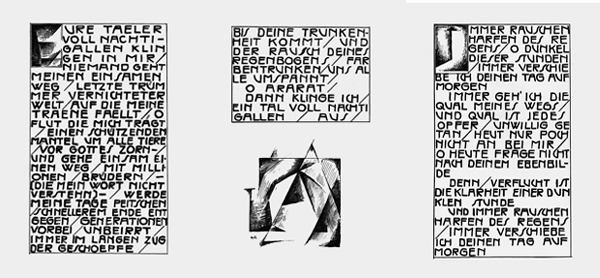
The book Stanisław Kubicki – In transitu – The poet translates himself is not only a solid publication in terms of content but a widely commented and beautiful edition containing program manifestos and expressionist poetry in two languages by the radical leader of the Bunt group Stanisław Kubicki. The works created between 1918 and 1921 reflect the dilemmas of many representatives of the classic avant-garde not only in Poland but also in the other “new countries” of Central Eastern Europe.
Part of them were printed in that stormy period as a kind of artistic intervention to the sudden socio-political changes of the end of the first world war and at the beginning of the new, post-war order. At that time they were simultaneously published in Poland and in Germany in Zdrój magazine, Die Aktion, Der Weg and Die Bücherkiste and in the almanac Faded Dawn of the Epoch. Fighting for the New Art 1917 – 1921 [Zagasły brzask epoki. W walce o nową sztukę 1917–1921], however the majority of them were found only recently and they were reconstructed as a bilingual collection by the author of that publication.
The poetic-program works of Kubicki in the book are a worldwide curiosity: the artist wrote them originally in two languages breaking the particularity of the literary message and thus created a peculiar manifesto of avant-garde internationalism.
Repro p. / s. / S. 9, 281, 165
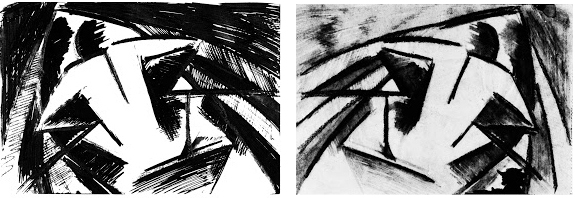
The versed expressionist manifestos by Kubicki correspond to his drawings that he created simultaneously and paintings similar in themes and universal in expression due to the international – by its nature – artistic language. Together they are a representative example of the explosive synergy of word and image, intensifying the program message in magazines and ethereal printed materials of the avant-garde.
The frame for the poems is a monographic commentary on the interdisciplinary oeuvre by Kubicki which is polemical in comparison with the traditional and stereotypical opinion of his achievements. The book’s introduction defines his poetry and artistic and political activity as an expression of ambivalent self-awareness – in transitu –that is a typical avant-garde multiple identity, stretched between the belief in a trans-national utopia of the new man, the new community and romantic patriotism.
That romantic patriotism was expressed in the unparalleled sacrifice of Kubicki. As the National Army’s courier to the embassies of neutral countries in Berlin he died at the hands of Gestapo.
Repro p. / s. / S. 106, 107, 223
The presentation of the artistic and literary oeuvre included in the five essays goes beyond the revision of Kubicki’s place in the national and universal history of literature and art. It is also an insightful, stylistic and subject-matter-oriented interpretation of the aesthetic artifacts because it unveils the little known behind-the-scenes activity of Kubicki and his colleagues from Bunt in international artistic circles.
The author provides a critical contextualization of the myth and reality of revolution in Kubicki’s works, there’s therefore an echo of his alleged participation in the Spartacus uprising in Germany which the author describes by referring to the theory of the grotesque. Moreover, by delving into the archival source materials the author documents Kubicki’s involvement in the Polish resistance during the second world war. The Preface by Peter Mantis enables understanding the relationships between the artistic (auto)creation of Kubicki and his tragic biography.
The publication concludes with an annex pertaining to the drawings by the Bunt group from the heritage left by the artist and his wife – poet, painter and graphic artist Margarete Kubicka – donated to the National Museum in Poznań and the Leon Wyczółkowski District Museum in Bydgoszcz as well as the exhibition to honor this generous gift.
Repro p. / s. / S. 379, 24, 25
The bookStanisław Kubicki – In transitu – The poet translates himselfcaptivates with its elaborate artwork by the frequently awarded designer Monika Aleksandrowicz. Most of all, she managed to excellently elicit the innovativeness of Kubicki’s art works, their unique discipline and their internal rhythm. Many of the over seventy black and white reproductions are shown here for the first time
Repro p. / s. / S. 62, 63
Lidia Głuchowska, Stanisław Kubicki – In transitu – Poeta tłumaczy sam siebie / Ein Poet übersetztsichselbst; Przedmowa / Vorwort [Foreword]: Peter Mantis, transl.: Dorota Cygan, Lidia Głuchowska, Arkadiusz Jurewicz, Michael Zgodzay; Style editors: Margit Jäkel, Elżbieta Łubowicz; Ośrodek Kultury i Sztuki we Wrocławiu, Wrocław 2015, pp. 1-480, ISBN: 978-83-62290-97-0.
Noch bis zum Sonntag, den 6. Dezember sind in der Berliner Hufeisensiedlung, entworfen vom bekannten Avantgardearchitekten, Bruno Taut, Bilder von Margarete Kubicka (1891-1984) zu sehen.
Die Hinterglasmalerei Weltenwanderer (1923) im expressionistisch-theosophischen Geist gehört dazu.
Die Finissage
dieser sorgfältig vorbereiteten Schau
findet am 6. Dezember, um 15.00 Uhr
im Hufeisen-Café
Fritz-Reuter-Allee 44, 12-359 Berlin
statt
Lidia Głuchowska
Margarete Kubicka. Ihr Beitrag zur Herausbildung und Entwicklung der Gruppe Bunt (1917-1922), einer deutsch-polnischen Künstlervereinigung der Avantgarde
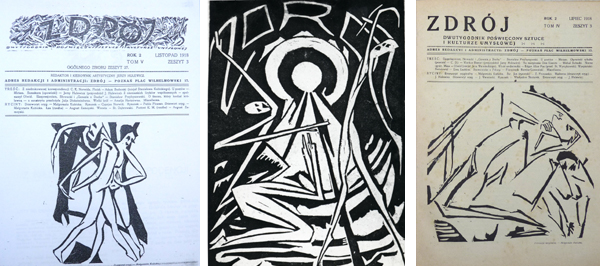
Sie war Ehefrau des polnischen Malers und Graphikers, Stanisław Kubick und die einzige Frau und die einzige Deutsche unter den Mitbegründern der Posener Gruppe „Bunt“ (Revolte), deren Hauptforum die Kunstzeitschrift Zdrój (Quelle) bildete.
Im März 1918 erschien in diesem Periodikum das Programmheft der Vereinigung, deren zweisprachige Name, sowohl auf Deutsch und Polnisch sinnbildhaft für ihr expressionistisches Programm steht.
Margarete Kubicka hat das einzige im Linolschnitt festgehaltene Dokument der Diskussionen im Zentrum des Posener Expressionismus, dem Gut von Jerzy Hulewicz in Koscianki bei Września/Wresen geschaffen, auf dem sie Mittels kubo-futuristischer Bildsprache den Gedankenaustausch von Stanisław Kubicki, Jerzy Hulewicz, seiner Ehefrau und sich selbst darstellte.
Margarete Kubicka, Bei Hulewicz, Linolschnitt , 1917, Zdrój Febr, 1918, II, Nr. 4
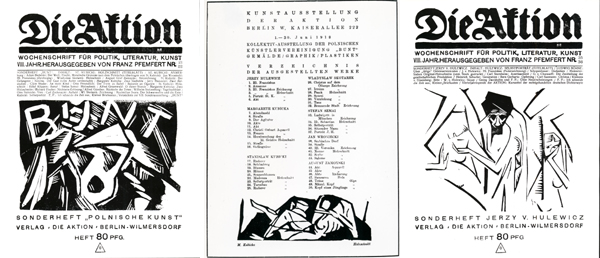
Kubicka sorgte dafür, dass die Gruppe Kontakte zu internationalen Avantgardekreisen Berlins um die Zeitschrift Die Aktion knüpfte. Sie war auch hauptverantwortlich für die Organisation ihrer kollektiven Ausstellung in den Redaktionsräumen von Die Aktion im Juni 1918. Anlässlich davon erschien eine Sondernummer dieser Zeitschrift. Es folgten weitere Publikationen und Ausstellungen.
Ankündigung der Bunt-Ausstellung in den Redaktionsräumen von Die Aktion mit dem Linolschnitt von Margarete Kubicka Opfer
Sie hat auch das internationale Profil der Zeitschrift Zdrój und ihre grafische Gestaltung in Anlehnung an die der Berliner Periodika Die Aktion und Der Sturm, geprägt, da sie Covers der Einzelhefte vom Juli und November 1918 und vom Gesamtband VI entworfen hat.
Stilistisch und kompositorisch souverän, beeinflusste ihr Werk das Schaffen ihrer Kollegen, Jerzy Hulewicz und Władysław Skotarek.
In der historischer Perspektive war es auch ihr Verdienst, dass sie die nach den vier „Bunt“-Ausstellungen in Berlin gebliebenen Werke ihrer Künstlerkollegen während des Zweiten Weltkriegs beschützte und für die Nachwelt rettete.
Diese bilden den Kern der Ausstellung Bunt –Expressionismus – Grenzübergreifende Avantgarde. Werkle aus der Berliner Sammlung von Prof. St. Karol Kubicki, deren letzte Schau in Wrocław (ehemals Breslau) parallel zur Ausstellung von Kubicka eröffnet wurde und noch bis zum 12. Dezember 2015 zu sehen ist.
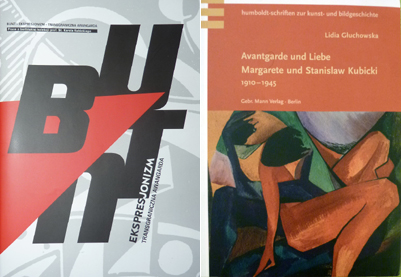
Lidia Głuchowska, Avantgarde und Liebe. Margarete und Stanislaw Kubicki 1910-1945, Berlin 2007
Lidia Głuchowska (Hg,): Bunt – Ekspresjonizm – Transgraniczna awangarda. Prace z berlińskiej kolekcji prof. St. Karola Kubickiego / Bunt – Expressionismus – Grenzübergreifende Avantgarde. Werke aus der Berliner Sammlung von Prof. St. Karol Kubicki, Poznań: Muzeum Narodowe, 2015
sowie
in den Begleitheften zur Ausstellung im Hufeinsen-Café,
herausgegeben von der Anwohnerinitiative „Hufeisern gegen Rechts“
Auszüge aus dem Referat von der Autorin gehalten am 29. November 2015 im Café in der Hufeisensiedlung
Weihnachtliche Holzschnitzkunst aus Polen in Magdeburg
Über 20 polnische Holzschnitzer zeigen derzeit ihre sinnenfrohen wie tiefsinnigen Kunstwerke, viele davon Unikate, in der Stadt am Elbestrom. Große Namen sind darunter, von Stanisław Apriasz, Adam und Eugeniusz Zegadło, Magdalena und Andrzej Wojtczak, über Józef Szypuła, Jan Mika, Stanisław Hołda bis zu Wojciech Oleksy und anderen. Das ist eine kleine Sensation.
Ohne den Magdeburger Sammler und Liebhaber naiver Kunst Hans Gieraths hätte ganz sicher keiner der Künstler und kaum eines der Stücke je den Weg nach Magdeburg gefunden.
Der Passion des pensionierten Theologen und seiner Ehefrau Edeltraud ist es zu danken, dass ihr beider jahrzehntelange Sammelleidenschaft aus Magdeburg ein Mekka polnischer naiver Schnitz- und Malkunst im Osten der Republik gemacht hat. Aus über Jahrzehnte gewachsenen Freundschaften sind inzwischen viele und vielbeachtete Ausstellungen entstanden.
Schnitzen ist in Polen ein jahrhundertealtes und immer noch sehr lebendiges Kunsthandwerk. In vielen Dörfern zwischen den Beskiden und den Bieszczady trifft man auf Holzschnitzer. Weit über tausend Menschen sollen es noch sein. Die Berufskünstler sind vor allem im Verband der Volkskünstler organisiert. Die Laienkünstler aber leben überwiegend in abgelegenen Dörfern.
Was dort entsteht, ist selten ein Serienprodukt, sondern oft noch unverwechselbarer Individualstil. Naive Kunst eben, entstanden und verstanden als Kunst des Einzelnen und Ausdruck unkomplizierter, vereinfachter Darstellung. Der Künstler öffnet uns auf der Suche nach dem unverdorbenen Ursprünglichen sein Herz und seine Seele.
Wer darauf neugierig ist, wird im Allee-Center Magdeburg bis zum 24.12.2015 viele Entdeckungen machen können. Die dort gezeigten Kunstwerke sprechen mit uns. Ihre Botschaften lassen sich entschlüsseln: Mit dem Strom – gegen den Strom; Hoffnung und Zuversicht; Flucht und Zuflucht. Das, was uns nicht nur in der dunklen Jahreszeit, sondern über’s Jahr hinaus bewegen sollte.
Übrigens lässt sich ab 3.Dezember Stanisław Apriasz aus Grybów beim Schnitzen im Allee-Center über die Schulter schauen. Eine seiner Besonderheiten: Alle Skulpturen sind aus einem Stück Holz geschnitzt.
***
Das Magdeburger Allee-Center liegt an der Hauptverkehrsachse Ernst-Reuter-Allee/Breiter Weg. Das Allee-Center ist sowohl mit dem Auto als auch mit öffentlichen Verkehrsmitteln gut zu erreichen. Von Haupt- bzw. Busbahnhof sind es zu Fuß knapp 10 Minuten.
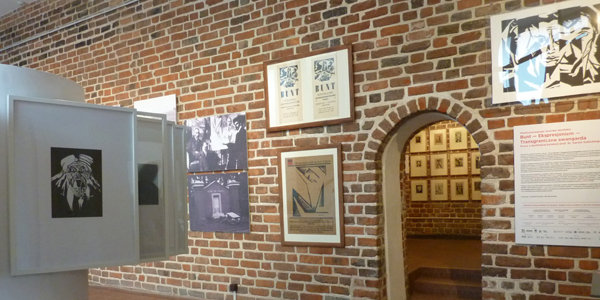
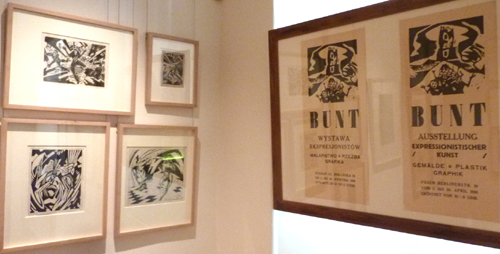
Arrangement with the posters of the first “Bunt” exhibition in Poznań in 1918 and the last one, in Berlin, 1922
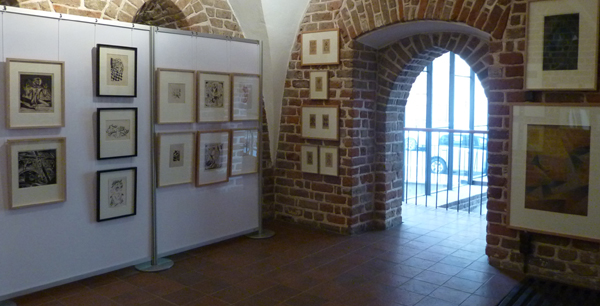
The Wrocław edition of the exhibition Bunt – Expressionism – Transborder Avant-Garde.Artpieces from the Berlin Collection of Prof. Stanisław Karol Kubicki is a closing event of the touring display of donated art which includes exhibitions in essential pre-war centers of expressionism and the development of graphic arts. So far it has been shown in Poznań, Bydgoszcz and Dresden. It was organized to honour the donation received by the Leon Wyczółkowski Regional Museum in Bydgoszcz and the National Museum in Poznań from Professor Stanisław Karol Kubicki, son of the Polish-German avant-garde artists Margarete and Stanisław Kubicki.
About these tourning exhibition we already have written here, here, here, here, here and at many other places – just look in the index or searching.
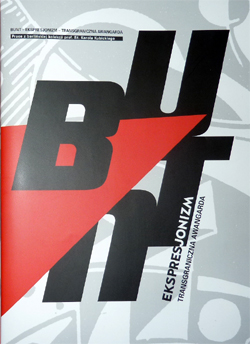
The exhibition finale on 12 December 2015 will be connected with the aid of four bilingual publications accompanying the exhibition, among them the book by the curator, Lidia Głuchowska, Stanisław Kubicki – in transitu. Poeta tłumaczy sam siebie / Ein Poet überestzt sich selbst, and the premiere screening of a documentary-artistic film Bunt – Re-visions showing the entire tournée.
Exhibition ”Bunt” – Expressionism – Transborder Avant-garde: prints of the group “Bunt”
The core of the exhibition consists of prints, drawings and pastels created by members of the artistic association from Poznań known as Bunt (“Revolt”), focused around the Poznań magazine Zdrój (1917-1922).
Margarete and Stanisław Kubicki, the co-founders of the group, began its cooperation with Polish and foreign galleries as well as such magazines as Die Aktion and Der Sturm from Berlin. The exhibit also includes works by other members of the group: Jerzy Hulewicz, Władysław Skotarek, Stefan Szmaj, Jan Jerzy Wroniecki and Jan Panieński. Proceeding the donation, the prints and drawings had remained abroad since the “Bunt” exhibitions in Berlin (1918-1922).
Linocuts by Stefan Szmaj
In Wroclaw it should be especially mentioned, that the first expressionist linocuts of the “Bunt” circle, among them The Tower of Babel from the poster of its first exhibition, were created by Stanisław Kubicki in Schömberg/ Chełmsko Śląskie, Silesia.
The Silesian linocuts by Stanisław Kubicki, among them The Tower of Babel
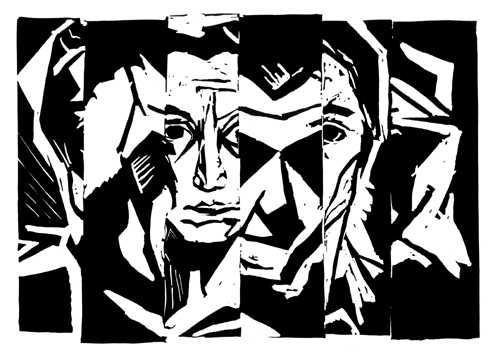
Logo of the exhibition is the linocut by Andrzej Bobrowski Transformation M/S. Just as the artists of the “Bunt” never create a group portrait, Margaret and Stanisław Kubicki never did a portrait of themselves as a couple.
The linocut by Andrzej Bobrowski Transformation M/S [Transformation M(argarete)/ S(tanisław)] refers to the self-portrait of Margarete Kubicka from 1917 and the Self-portrait IV of her husband which was not preserved but is only known from the publications of Zdrój and Die Aktion magazines in 1918. This contemporary work of graphic art of a hybrid and panoramic composition in a form that refers to the banner is a reflection on the creative and personal relationship of the Kubickis. It is also a reflection on the passing of time and the details of artistic biographies receding in group memory, but also on group identity and the lack of integrity of an artifact in the epoch of its technical reproduction.
Part of the presentation Flyer: print by Małgorzata EtBER Warlikowska and the installation Interference – Re-Integration by Karolina Ludwiczak and Marcin Stachowiak
The exhibition of these works created towards the end of World War I and shortly after is accompanied by the contemporary artistic projects: Refleks [Reflex, 2014-2015], Ulotka [Flyer] and Ich 7 [They 7, 2015], inspired by the art and ideology of “Bunt” and created by contemporary graphic artists from Poznań and Wrocław and a sculptor, Małgorzata Kopczyńska. The latter’s participation is a symbolic allusion to August Zamoyski, who was also a sculptor and a member of the Expressionist group from Poznań. In addition to works on paper, sculptures and documentary photography, the exhibition includes artistic films and a monumental glass installation Przenikanie [Interference – Re-Integration, 2015].
The contemporary artistic presentations demonstrate the stylistic and ideological influence of “Bunt” on the works of present-day artists, especially to its idea of critical art, and constitute a symbolic artistic response to the donation of works from Germany. Expressionist inspirations are particularly evident in the social involvement of the installations; the artworks unmask rigid conventions, instances of provincialism and xenophobia, combat the idealization of reality and the reinforcement of socio-political hypocrisy by the media as well as the limitations imposed on citizens by institutions.
The distribution of art through public media, a practice to which Reflex and Flyer also refer, was one of the typical modes of expression used by “Bunt” and other artists of the pre-war European avant-garde. The primary media used at that time were art books and political leaflets with informative and propaganda content. Distributed at rallies, they reinforced the message of artistic manifestos and supported the ideas of social and political emancipation.
The installation Przenikanie makes one understand the paradox related to the technique used to create it. The artifact made by Ludwiczak and Stachowiak is an example of a peculiar interdisciplinary game – the work they created is partly fine art and not a print on a flat screen. That way they also refer to the relief nature of linocut slabs out of which the Kubickis printed their images of themselves.
Presentation They 7: Prints by Jacek Szewczyk, Przemysław Tyszkiewicz and Agata Gertchen
The presentation They 7 concerns works of a larger format, programmatically and technologically inspired by “Bunt” traditions, executed by an informal group of seven artists. The works demonstrate the timelessness of avant-garde ideas and aesthetics as well as their potential for reinterpretation. The name of the project (containing the word ich, meaning “they” in Polish and “I” in German) echoes the bilingual name of “Bunt” (“Revolt”, “rebellion” in Polish, “colourful” in German), which reflected the supranational nature of Expressionist ideology.
Presentation They 7 corresponding with the architecture and life of Wroclaw. From left to the right: prints by Andrzej Bobrowski, Przemysław Tyszkiewicz and Agata Gertchen.
The scale of the objects of the presentation They 7 similar to the installation Przenikanie. Significantly larger than the ones from the time of the classic avant-garde, is supposed to epitomise for the viewers a change of status and the recipient paradigm. In the times of “Bunt”, graphic art was reproduced in magazines which were the main media of international artistic exchange. Today the art, which is often exhibited in large formats, has gained autonomy and dominated the contemporary iconosphere.
Presentation They 7 corresponding with the architecture and life of Wroclaw. From left to the right: prints by Piotr Szurek and Przemysław Tyszkiewicz
The artists of “Bunt” in their operations considered both the national and transnational perspective, constructing our network of artistic contacts from amongst all the Polish artistic groups of that time.
There are not many documents of the international cooperation between the members of the group and other artistic associations, even though the pages of Zdrój [Source] magazine, co-created by “Bunt” artists, are proof of their relationships with creative communities not only in Germany, which is widely known, but also in France, Belgium, Italy, Russia, the Czech Republic, Iceland and even India.
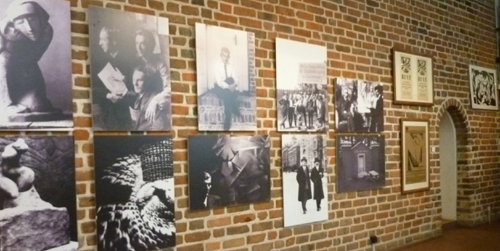
The impressive impact of the inter-partition and international exhibitions and publishing initiatives of these artists were also documented in their personal correspondence and some photos.
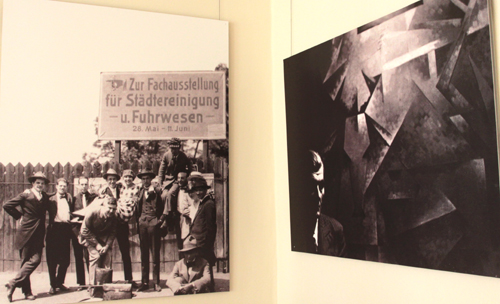
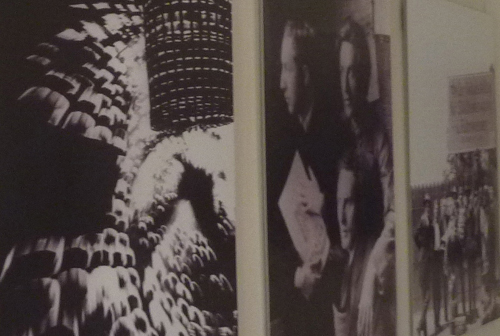
The photographic re-creation of one of the Expressionist linocuts printed in Zdrój (and Die Aktion), the Self-portrait of Stanisław Kubicki from 1918 shot by Berlin ex-Dadaist Raoul Hausmann, shows an expert use of light and shadow. Although Hausmann went on to inspire the camera masters of his time, none of them documented his meetings with Kazimierz Malewicz, the theoretician of Suprematism. The a bis z magazine is the only evidence of their discussions on the internal contradictions in proletarian art. A memento mori of the fascist period is formed from the photographs proving the existence of works condemned to erasure from official artistic life and the collective memory as part of the campaign to banish “degenerate art”. These include photographs documenting such avant-garde works as the sculptures Female torso by Otto Krischer or Mother and child by Pola Lindenfeld, destroyed by the SA and SS during searches conducted in the Berlin home of Margarete and Stanisław Kubicki.
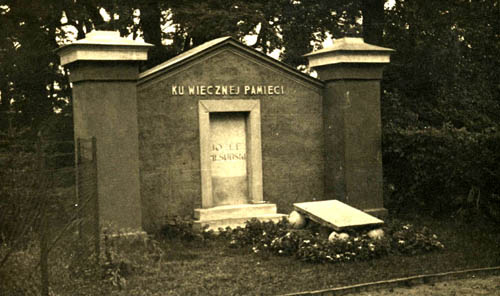
Stanisław Kubicki, “In memoriam” (1935–1939) statue of Józef Piłsudski and the legionaries from the “Kobylepole group” who died in 1919–1920. The monument was located in the park of the palace of Count Stanisław Mycielski in Kobylepole, destroyed in the 1940s., postcard from the 1930s
Other photographs call back from oblivion the forgotten Eternal Remembrance memorial to Józef Piłsudski and his legions, erected in the suburbs of Poznań. It was the only commissioned work of Stanisław Kubicki showing classicist influences and a testament to the widespread cult of Marshal Piłsudski in 1934 in the face of the growing power of Soviet and fascist totalitarianism, but also the fascination of the Zdrój artistic community with the idea of Polish unification in the spirit of the Jagiellonian union, a concept dating back to the days of World War I.
The photographs provide a commentary on the history of transborder contacts and the patriotic fascinations of “Bunt” members. Despite their lack of objectivity and poor state of preservation, they clearly demonstrate the artists’ ambivalent attitude, fluctuating between approval of the “new Polish state” and enthusiasm for the utopian avant-garde idea of a “new international community”.
Installation Interference – Re-Integration by Karolina Ludwiczak and Marcin Stachowiak and the part of the presentation Flyer. To be seen are prints and drawings by Zuzanna Dyrda and Jacek Szewczyk
***
Initiator/curator of the tour: Lidia Głuchowska Financial support: Foundation for Polish-German Cooperation XXXXXXXXXXXXXXISamorząd Województwa Dolnośląskiego
Patronage: International Print Triennial Society in XXXXXXXXXXXXXX Kraków XXXXXXXXXXXXXXiWilly Brandt Center for German and XXXXXXXXXXXXXXiEuropean Studies at the University of xxxxxxxxxxxxxxxxxiWrocław
Showings of the exhibition:
National Museum in Poznań – 19.04-31.05.2015
Leon Wyczółkowski Regional Museum in Bydgoszcz – 25.06-23.08.2015
Kraszewski Museum (Museen der Stadt Dresden) in Dresden – 4.09-8.11.2015
“Roman House” Lower Silesian Photography Centre in Wrocław – 19.11-12.12.2015
Organizers:
Centre for Culture and Art in Wrocław, as part iof the Lower Silesian Art Festival
National Museum in Poznań
Leon Wyczółkowski Regional Museum in Bydgoszcz
Kraszewski Museum (Museen der Stadt Dresden) in Dresden
Reflex and Flyer curator: Maciej Kurak Flyer coordinator in Wrocław: Jacek Szewczyk, Małgorzata ET BER Warlikowska
They 7 (graphic art and sculpture)curator: Lidia Głuchowska
Installation Interference – Re-Integration: Karolina Ludwiczak and Marcin Stachowiak
Artistic-documentary film: Lidia Głuchowska, Anna Kraśko
Tour logo: Andrzej Bobrowski, Transformation M/S – project, linocut, 2015
Partners:
University of Arts in Poznań, Faculty of Graphic Arts and Visual Communications
Academy of Art and Design in Wrocław, Faculty of Graphic and Art of Media
University of Zielona Góra, Faculty of Arts, Institute of Visual Arts
Wroclaw Good Books Fair
“Roman House” Lower Silesian Photography Centre in Wroclaw
Rarytas Foundation, Poznań
”Zachęta“, Greater Poland Society for the Encouragement of the Fine Arts
Były czasy, że Lidia Głuchowska miała czas i donosiła na przykład o wystawianiu kanap na trawniki, o ciastkach z Krzykiem Muncha lub o zupie z opieniek, ale ostatnio to już nic, tylko ta sztuka. Dziś grafika, ten gatunek sztuki, który wywołuje u mnie poczucie niespełnionej tęsknoty. Moja mama, Irena Kuran-Bogucka, była graficzką, wyrastałam więc w świecie pełnym takich słów jak “drzeworyt” i “linoryt”, rzadziej “zupa” i “drugie danie”, a nigdy “konfitura” czy “sernik”. Jako dziecko mogłam być z takiej sytuacji niezadowolona, jako dorosła kobieta, kiedy sama zrobię i zupę, i konfiturę, tęsknię za grafiką, za akwatintą, akwafortą, sztychem, suchą igłą...
Lidia Głuchowska
Graficzna Retrospektywa w Zielonej Górze
Jeszcze do końca roku w Zielonej Górze zobaczyć można zorganizowaną w ramach programu towarzyszącego Międzynarodowemu Triennale Grafiki w Krakowie wystawę Retrospektywa Zakładu Grafiki Instytutu Sztuk Wizualnych Uniwersytetu Zielonogórskiego. Prezentuje ona dokonania 17 grafików dawniej i dziś związanych z tym ośrodkiem.
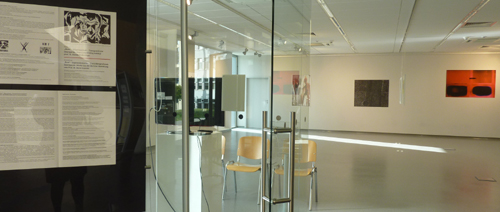
Plakat zapowiadający pokaz filmu dokumentacyjno-artystycznego Bunt – Re-wizja i widok na wnętrze ekspozycji Retrospektywa. Na pierwszym planie prace Andrzeja Bobrowskiego i Katarzyny Dziuby.
Ekspozycji towarzyszy pokaz filmu dokumentacyjno-arystycznego Bunt – Re-wizja Lidii Głuchowskiej i Anny Kraśko na temat międzynarodowego tournée wystawy donacyjnej Bunt – Ekspresjonizm – Transgraniczna awangarda. Prace z berlińskiej kolekcji prof. St. Karola Kubickiego w Poznaniu, Bydgoszczy, Dreźnie i Wrocławiu, także włączonego do Triennale Grafiki.
Galeria Biblioteki Uniwersyteckiej, Zielona Góra, wernisaż w dniu 23.10.2015
Wśród wystawionych prac, w aranżacji korespondującej z pejzażem i architekturą za oknem Galerii Biblioteki Uniwersyteckiej, znalazła się m.in. praca Studium PO. XIV (1980–1983, autooffset), którą pozostawił po sobie Wielki Nieobecny – nestor zielonogórskiego (choć nie tylko) środowiska grafików – Jan Berdyszak, artysta, który z równą maestrią wypowiadał się o rysunku, malarstwie, grafice, fotografii, rzeźbie i szeroko rozumianej instalacji czy scenografii.
Z jego holistycznym pojmowaniem grafiki korespondują twórczość i refleksja teoretyczna Andrzeja Bobrowskiego, który, zwłaszcza w ostatnich swych pracach, koncentruje się nie tylko na aplikowaniu na płaszczyznę symbolicznych form, lecz i w równym stopniu na zacieraniu, zakrywaniu ich, zdzieraniu warstw farby i papieru, redukcji materialnej warstwy dzieła, obnażaniu śladów uczuć. Proces ten ma, jak można sądzić, charakter puryfikacyjny, katarktyczny.
Jan Berdyszak, Studium PO. XIV, 1980-1983 (autooffset)
Andrzeja Bobrowskiego absorbuje tło postrzegane jako horror vacui. Odwracając relacje obwiązujące w sformalizowanym systemie dystrybucji grafiki, czyni on rozróżnienie między chronioną jak sacrum matrycą a odbitką, którą można w eksperymentalny sposób opracowywać, kształtując w sposób równie strukturalny jak wyjściową płytę, aż do okaleczenia powierzchi, przebicia się przez nią na zewnątrz, do rzeczywistości – poza płaszczyznę estetycznego artefaktu.
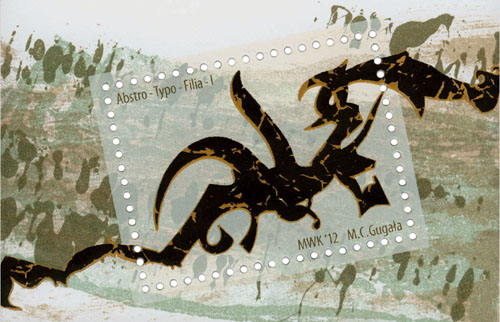
Także inni artyści omawianego kręgu w swych pracach koncentrują się na odkrywaniu konwencjonalności znaczeń. Pismo i graficzny zapis słów są przedmiotem studiów Radosława Czarkowskiego i Mirosława Gugały, którzy analizując i eksponując formę graficznego zapisu określonych pojęć, jednocześnie wskazują na nieoczekiwane sensy – ukryte za tym, co w komunikacie najbardziej oczywiste. Semantycznie istotna jest przy tym skala objektów. Dla Radosława Czarkowskiego jego aktualne prace, układające się w cykl, odnoszący się do do takich pojęć jak Jesus, Wiedzieć – Widzieć, Gastarbeiter, Learn, Love – Hope – Pain, są logiczną konsekwencją wcześniejszych realizacji w różnych mediach – rysunku czy malarstwie. Przyznaje jednak, że kreują one odmienną sytuację odbiorczą. Aktualnie tworzone murale wykluczają bowiem subtelność kameralnego przekazu, jak można uzyskać przy zastosowaniu tradycyjnych technik graficznych. Także Mirosław Gugała na wielu poziomach, nie tylko w liternictwie, lecz i w układach gwiazd, dostrzega graficzne konstelacje, skłaniające do interpretacji własnej roli w kosmosie i otaczającym systemie komunikacyjnym.
Na pierwszym planie druki cyfrowe Pawła Andrzejewskiego i Radosława Czarkowskiego, na drugim – akwaforty Maryny Mazur i linoryt Witolda Michorzewskiego
Abstro – Typo – Filia – I, 2012 (litografia, serigrafia, perforacja)
Retrospektywa Zakładu Grafiki ukazuje obok siebie prace bardzo różnorodne. Są tu zarówno pełne humoru i celnej obserwacji prace w technikach eksperymentalnych Wojciecha Müllera, jak i twórczość plakatowa Witolda Michorzewskiego – nowoczesna i staroświecka zarazem, bo z jednej strony awangardowo kwestionująca kanon estetyczny, a z drugiej wprzęgnięta w służbę (pozytywistycznej) reformy rzeczywistości.
Trudno też szukać analogii między onirycznymi i emanującymi aurą groteski dziełami Tadeusza Jackowskiego a antropocentrycznym, tworzonym na zasadzie fragmentaryzacji wizerunkiem dłoni autorstwa Izabelli Gustowskiej, już poprzez sugestywnie czerwone tło ewokującym ciepło i sensualizm.
Prace graficzne Izabelli Gustowskiej i Wojciecha Müllera
Barwa jest siłą i głównym środkiem wyrazu realizowanego przez Katarzynę Dziubę od 2012 roku cyklu Processing, w którym konstytutywną rolę odgrywa jednak i światło, istotne już w jej wcześniejszych pracach, wykonanych w technikach litografii i algrafii. W tych wielkoformatowych drukach pigmentowych uporczywie powtarza się motyw przenikających się pulsarów, ich nieregularnego rytmu i kontynuacyjności – niedawno jeszcze utrzymanych w optymistycznych i harmonijnych, neonowych barwach, teraz atakujących dramatycznym kontrastem czerwieni, czerni i bieli. Jak Katarzyna Dziuba porzuciła swe dawniej preferowane techniki dla druku cyfrowego, tak i Grzegorz Nowicki „zdradził” dla niego i dla offsetu bardziej kameralną serigrafię. Nowicki zderza monochromatyczne rejestracje pejzażu i „górskie krajobrazy” przypadkowych struktur pomiętego papieru z geometrycznymi formami, znakami z innego całkiem supra-porządku.
Wklęsłodruk Tadeusza Jackowskiego i druk cyfrowy Grzegorza Nowickiego
Znakowość świadomie destylowana z fotograficznych obrazów jest też cechą prac dwóch grafików odwołujących się do ikonosfery socrealizmu – Stefana Ficnera i Pawła Andrzejewskiego. Obaj traktują ją z nieukrywaną nostalgią, ukazując ją jednak z odmienną intencją. W litograficznym cyklu Hołobutów (2015) Ficner podejmuje grę z kodem wizualnym stosowanym przez polityczną propagandę. Andrzejewski, sięgając po tę samą technikę i po druk cyfrowy, od lat tworzy hommage dla ikony PRLu – poczciwej syrenki, wydobywając z powierzchni papieru niemal haptyczny urok rdzy socrealizmu, w nowszych pracach kreując jednak uniwersalne symbole niemal na miarę pittura metafisica.
Stefan Ficner, Hołobutów V, 2015 (litografia, cynkografia)
(część tej pracy była jedną z ulotek, eksponowaną na prezentacji towarzyszącej wystawie „Bunt” – Ekspresjonizm – Transgraniczna awangarda w Poznaniu, Bydgoszczy, Dreźnie i Wrocławiu)
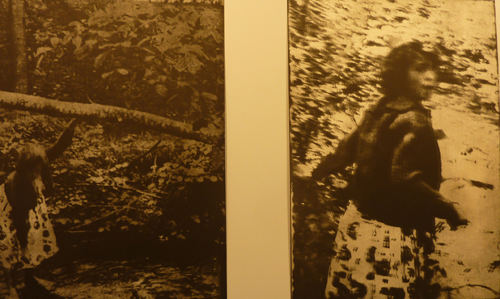
Podobna nostalgia, zaklęta w wyblakłych fotografiach, emanuje także z cyklu Garda Maryny Mazur (akwatinta 2015). Niepokojąca narracja i migotliwie poetycka aura tych druków uwodzą tak bardzo, że trudno uwierzyć, iż ich powstanie poprzedzał mozół pokonywania ograniczeń tworzywa.
Dwa wklęsłodruki Maryny Mazur z serii Garda, 2014 (akwatinta)
Do żmudnego manualnego procesu w swych rysunkach tuszem sięga także Piotr Czech. Zaangażowanie emocjonalne w kreowanie „osobnego świata” – uniwersum tajemniczych szufladek i labiryntu drobiazgowości, skoncentrowanego na niewielkiej powierzchni, to mniej znana strona jego dokonań, gdyż w swej codziennej praktyce twórczej czy dydaktycznej docenia i wykorzystuje raczej walory miksowania tradycyjnych technik z cyfrowymi, co służy profesjonalizacji grafiki projektowej, którą się zajmuje.
Rysunki tuszem Piotra Czecha z lat 2010-2014
Wizytówka stylu Tadeusza Piskorskiego to syntetyczne komunikaty wizualne zawarte w nagradzanych wielokrotnie w kraju i za granicą plakatach, takich jak prezentowany na wystawie zabawny Oktoberfest. Z kolei próbą kunsztu Jacka Papli są publikacje oficyny Wydawniczej Uniwersytetu Zielonogórskiego, wśród których klarowna i wyrazista okładka książki Jazz w kulturze polskiej poświadcza także współpracę muzyków i plastyków Wydziału Artystycznego.
Projekt okładki – Jacek Papla i plakat Tadeusza Piskorskiego
O sile prac jednego z najbardziej wiernych swej technice i tematowi twórców – Piotra Szurka – stanowi misterna precyzja. Ograniczenie formalne i stałość inspiracji są dla niego wyzwaniem i drogą ku perfekcji. Tym, co zadziwia u twórcy od lat uporczywie studiującego własną fizjonomię, jest nagłe antyklasyczne rozdwojenie wizerunku i dysonans – płaski pas czerni ze śladami kropel (krwi? łez?) rozdzielający lustrzane odbicia niezliczone już razy uwiecznianej twarzy – tej samej, lecz nie takiej samej.
Aż się prosi, żeby zobaczyć w tej pracy metaforę środowiska artystycznego, które reprezentuje – widziane przed dekadą i dziś.
Piotr Szurek, Autoportret, 2015 (akwatinta, sucha igła)
Graficzna retrospektywa roku 2015 w Zielonej Górze nie jest zamknięciem, lecz raczej znakiem (auto) refleksji jej twórców in statu nascendi. Trwały symbol ich dorobku to z pewnością Artoteka Biblioteki Sztuki, od 2001 roku, tworzona przede wszystkim przez doktor Janinę Wallis. Interesującym dokumentem są też katalogi wystaw zbiorowych Zakładu Grafiki, istotny znak dokonań artysty-edytora, Jacka Papli.
***
Wystawa Retrospektywa Zakładu Grafiki Instytutu Sztuk Wizualnych Uniwersytetu Zielonogórskiego w ramach programu towarzyszącego Międzynarodowemu Triennale Grafiki w Krakowie. Galeria Biblioteki Uniwersytetu Zielonogórskiego
Zdjęcia pierwsze i ostatnie: Zaproszenie na wystawę Retrospektywa Zakładu Grafiki Instytutu Sztuk Wizualnych Uniwersytetu Zielonogórskiego, projekt: Jacek Papla, motyw tytułowy: Nina Stefaniak
Am Sonntag, den 15. November wird in der Berliner Hufeisensiedlung, erbaut 1926 vom avantgardistischen Architekten, Bruno Taut, eine Werkschau der Berliner Künstlerin, Margarete Kubicka eröffnet. Wenn sie auch häufig als Expressionistin bezeichnet wird, da sie der polnischen Gruppe Bunt (Revolte) angehörte, trägt ihr frühes grafisches Werk eher kubo-futuristische Züge. Ihre Stärke, neben dem Linolschnitt, waren die leuchtenden Aquarellen, die sie gerne in die Serien gesammelt hat und die of eine Art Geschichte erzählen.
Einige ihrer Werke gehören der Berlinischen Galerie, darunter die Folge, Drei Sprünge des Wan Lung zum gleichnamigen Roman von Alfred Döblin.
Begleitend zur Ausstellung finden Sonderveranstaltungen statt, darunter ein Interview mit dem Sohn der Künstlerin, Mitbegründer der Freien Universität, St. Karol Kubicki sowie zwei kunstgeschichtlichen Vorträge.
Im Namen der Organisatoren, denen wir zu diesen Initiative auch gratulieren, laden wir Sie herzlich ein.
Mehr über das Leben und Werk der Künstlerin in:
Lidia Głuchowska, Avantgarde und Liebe. Margarete und Stanislaw Kubicki 1910-1945, Berlin 2007.
Margarete Kubicka, Hommage à Kubicki: Stanislaw Kubicki, der Agitator, 1924, Aquarell, Privatbesitz
Margarete Kubicka, Neukölln: Bau der U-Bahn-Überführung 3, Linolschnitt, 1928, Privatbesitz
Für die Reproduktionsgenehmigung danken wir Herrn Prof. St. Karol Kubicki
Bunt, internationaler Expressionismus und die avantgardistische „Neue Welt“ – Finissage und Buchpräsentation im Kraszewski-Museum, Dresden
Sonntag, 8. November um 15.00 Uhr
Nur noch wenige Tage ist im Kraszewski-Museum, Dresden die Ausstellung Bunt – Expressionismus – Grenzübergreifende Avantgarde. Werke aus der Berliner Sammlung von prof. St. Karol Kubicki zu sehen.
Ab dem 26. November wird sie noch in Wrocław gezeigt.
Anlässlich der Finissage findet im Kraszewski-Museum, Dresden Vortrag und Führung von Dr. Lidia Głuchowska sowie die Präsentation der Begleitpublikation zur Ausstellung
Auch wenn Expressionismus zumeist als eine „deutsche“ Stilrichtung bezeichnet wird, war der Radius seiner Wirkung durchaus viel breiter. Im Grunde entfaltete er sich international mit jeweils spezifischen lokalen Ausprägungen, häufig folkloristisch gefärbt, und verlieh der Idee der „neuen Staaten“ Ausdruck, die nach dem Ersten Weltkrieg entstanden war.
Kuratorin der Ausstellung und Autorin vor der Dokumentation der internationalen Vernetzung der Gruppe Bunt, Kraszewski-Museum, Dresden.
Foto: Mariola Nehrebecka
Das expressionistische Universum erstreckte sich von Skandinavien bis zum Balkan. Sein wichtigstes Zentrum in Polen wurde Poznań/Posen, wo die literarisch-künstlerische Gruppe Bunt (Revolte) und die Zeitschrift Zdrój (Quelle – 1917-1922) entstanden sind.
Der Sohn ihrer zweier Mitbegründer, eines deutsch-polnischen Künstlerpaares, Margarete und Stanisław Kubicki, hat sich entschieden, Werke der Posener Künstlervereinigung die nach ihren Berliner Ausstellungen in den Jahren 1918-1922 in der Sammlung seinen Eltern verblieben sind, den polnischen Museen zu vermachen. Dies war der Anlass, eine Wanderausstellung, auf der sie alle zu sehen sind, zu organisieren.
Die Gruppe Bunt, die Teil der transnationalen Kunstbewegung wurde, verkündete in ihren parallel auf Deutsch und Polnisch verfassten Manifesten die Utopie der avantgardistischen, grenzenlosen „Neuen Welt“. Die Fotodokumentation zur ihrer internationalen Zusammenarbeit der ist leider nur fragmentarisch erhalten. Aus ihrer Zeitschrift Zdrój und aus ihrem Briefwechsel ist jedoch bekannt, dass Kontakte mit Künstlerkreisen nicht nur in Deutschland gepflegt wurden, sondern auch in Frankreich, Belgien, Italien, Russland, Tschechien, Island und sogar Indien. Somit werden Initiativen der Künstlervereinigung von eindrucksvoller Reichweite bestätigt, die auch alle drei damaligen Teilungsgebiete Polens miteinbezogen. Diese wird ebenfalls durch die Publikationen in solchen expressionistischen Kunstzeitschriften wie Die Aktion, Der Sturm, Der Weg oder Die Bücherkiste bestätigt.
Plakate der ersten Ausstellung der Gruppe Bunt (Revolte) in Poznań/Posen 1918 sowie expressionistische Linolschnitte von Władysław Skotarek , darunter Schrei und Panik, inspiriert vom Schrei Edvard Munchs
Die Bunt-Mitglieder verewigten nicht einmal ihre erste Ausstellung, die als strategischer succès du scandale gilt und deren Aura den Veranstaltungen der Zürcher Dadaisten und Modernisten in Paris gleichen sollte. Das einzige Foto, welches das Zentrum ihrer Tätigkeit dokumentiert – den Gutshof des Verlegers der Zeitschrift Zdrój Jerzy Hulewicz in Kościanki – zeigt diesen nur in Begleitung ihrer ersten informellen Herausgebers, Stanisław Przybyszewski, der seinerzeit in Berlin als der „geniale Pole“ bezeichnet wurde. Dieser hat allerdings in Berlin 1894 die erste Monographie über den Urexpressionisten Edvard Munch und somit auch die erste Theorie des Expressionismus verfasst.
Stanisław Przybyszewski und Jerzy Hulewicz vor dem Porträt Przybyszewskis aus der Hand von Jerzy Hulewicz. Kościanki, Wielkopolska [Großpolen].
Aus: Stanisław Przybyszewski, Listy, Hg. v. Stanisław Helsztyński, Bd. 2., Warszawa/Gdańsk 1938.
Ein groteskes Anti-Gruppenbildnis ist wiederum das Foto von den Separatisten des Kongresses Internationale Union fortschrittlicher Künstler in Düsseldorf im Jahr 1922, an dem Margarete und Stanisław Kubicki teilnahmen. Hier ist der spiritus rector des radikalen Flügels der Künstlervereinigung Bunt unter den wichtigsten Vertretern der internationalen Avantgarde zu sehen.
Dem Ex-Dadaisten Raoul Hausmann gelang es wiederum mithilfe von Licht-Schaffen-Effekten das expressionistische Linolschnittbildnis von Kubicki nachzuahmen.
Links: Separatisten des Kongresses der Union Fortschrittlicher Internationaler Künstler, Düsseldorf, 1922 Stanisław Kubicki (sitzend), Franz W. Seiwert, Hannah Höch, El Lissitzky, Otto Freundlich, Ruggero Vasari, N.N., Nelly van Doesburg, Cornelis van Eesteren, Hans Richter, Theo van Doesburg, Raoul Hausmann, Werner Graeff.
Foto: Retina, aus: Central European Avant-Gardes: Exchange and Transformation, 1910-1930, Hg. Timothy O. Benson, Cambridge 2002, S. 35
Rechts: Raoul Hausmann, Korb mit Lampe, 1930, Fotografie, Privatsammlung von Prof. St. Karol Kubicki, Berlin. Foto: Mariola Nehrebecka
Ein im Privatarchiv Kubickis erhaltenes Foto der Gruppenmitglieder von Jung Jiddisch aus Łódź bestätigt die Einbindung von Bunt in das multikulturelle künstlerische Leben Polens nach dem ersten Weltkrieg. Suggestiv wirken auch die Porträts einiger Künstler beider Vereinigungen aus der Serie Menschen des 20. Jahrhunderts von August Sander, gestaltet in der Konvention der Neuen Sachlichkeit. Von Hausmann wurde Kubicki nicht nur porträtiert. Zusammen mit ihm realisierte er auch Fotoexperimente, deren Dokumente zwei in seinem Atelier entstandene und in seinem Nachlass erhaltene Aufnahmen, mit dynamisch und abstrakt wirkenden Formen bilden.
Rechts: Marek Szwarc, Moses Broderson und Jankiel Adler präsentieren das zweite Heft ihrer Zeitschrift Jung Idysz (Jung Jiddisch) 1919, Nr. 2–3. / Links: Raoul Hausmann, Korb mit Lampe, 1930. Foto: Lidia Głuchowska
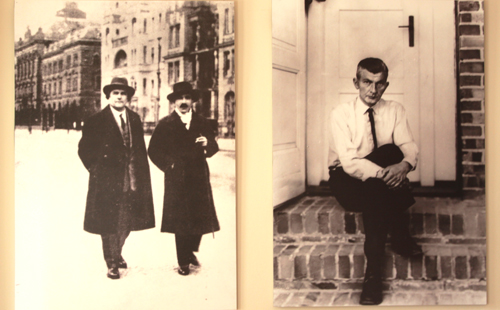
1926 in Berlin führte Kubicki in Berlin Gespräche mit dem polnischstämmigen Vertreter der russischen Avantgarde, Kasimir Malewich. Diese desillusionierten ihn endgültig zur Idee der „proletarischen Kunst“, was in seinen Beiträten in der Kölner Kunstzeitschrift a bis z zum Ausdruck kam. Diese wurde von der Gruppe progressiver Künstler herausgegeben, mit der die Kubickis zwischen 1923 und 1933 zusammen ihre Werke ausstellten. 1929 wurde Kubicki auf Empfehlung ihres Wortführers, Franz Wilhelm Seiwert, vom Hoffotografen der Progressiven, August Sander, in der Berliner Hufeisensiedlung auf einen für dessen Serie Menschen des 20. Jahrhunderts bestimmten Porträt verewigt.
Links: Kasimir Malewitsch und Tadeusz Peiper in Berlin, Frühling 1927, Fotografie gesendet als Postkarte an Jalu Kurek in Krakau, aus: Andrzej Turowski, Malewicz w Warszawie, Kraków 2002, S. 212. /Rechts: August Sander, Der Maler (Stanislaw Kubicki), 1929, Privatsammlung von Prof. St. Karol Kubicki, Berlin. Foto: Mariola Nehrebecka
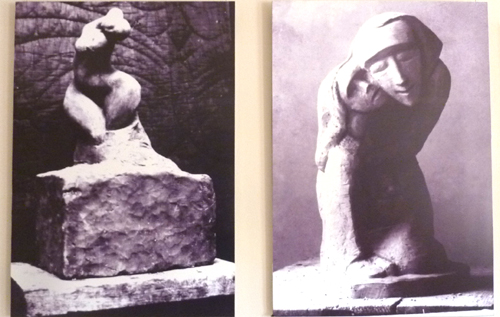
Wie ein Memento Mori an die nationalsozialistische Ära und an die Verbannung der sg. ‚entarteten Kunst’ aus dem offiziellen Kunstleben wirken Fotografien von Skulpturen Weiblicher Torso von Otto Krischer sowie Mutter und Kind von Pola Lindenfeld, welche von SA und SS während der Durchsuchungen im Berliner Haus der Kubickis zerstört wurden.
Otto Krischer, Weiblicher Torso, ca. 1919 (links) und Pola Lindenfeld, Mutter und Kind, Gips, ca. 1922 (rechts).
Fotografie der Plastiken aus der Privatsammlung Kubicki die von den Nazis im Rahmen der Aktion ‚entartete Kunst’ vernichtet wurden. Foto: Lidia Głuchowska
Das nur noch von einer alten Postkarte bekannte Denkmal Zum ewigen Andenken an Józef Piłsudski, das einzige klassizistische Werk im Œuvre von Kubicki, bezeugt nicht nur den Kult um den polnischen Staatsanführer angesichts der wachsenden Stärke des sowjetischen und nationalsozialistischen Totalitarismus, sondern erinnert auch die Affinität der Bunt-Künstler zur Idee der Vereinigung Polens im Geiste seiner Politik während des Ersten Weltkrieges. Es veranschaulicht auch die Ambivalenz ihrer Selbstidentifizierung, die zwischen romantischer Begeisterung für den 1918 entstandenen polnischen ‚neuen Staat’ einerseits und avantgardistischer Utopie der internationalen ‚Neuen Gemeinschaft’ andererseits schwankte.
Stanisław Kubicki, Denkmal Zum ewigen Andenken (1935–1939) an Józef Piłsudski und seine Legionäre aus der Gemeinde Kobylepole, die in den Jahren 1919–1920 gefallen sind. Park des Palastes vom Grafen Stanisław Mycielski in Kobylepole. Denkmal vernichtet in den 1940ern.
Kubicki war nicht nur ein bildender Künstler, dessen Werke eine besondere geometrische Stringenz aufweisen, sondern auch ein Kunsttheoretiker und Dichter. 1918-1921, am Ende des Ersten Weltkriegs und in den Folgejahren verfasste er seine expressionistischen, manifestartige Poemen zugleich auf deutsch und polnisch, womit er seinen Beitrag zum avantgardistischen Internationalismus geleistet hat. Mit dem Ausbruch des zweiten Weltkriegs schloss er sich der der polnischen Widerstandsbewegung an und wurde 1942 von der Gestapo ermordet, womit er die Wahrheit seiner eigenen Aussage „Nicht unsere Werke sind wichtig, sondern das Leben“ bestätigt hat.
Wenn nicht anders beschrieben, stellen Fotos in diesem Beitrag Fragmente des Arrangements der Ausstellung Bunt – Expressionismus – Grenzübergreifende Avantgarde im Kraszewski-Museum, Dresden
Mehr zum Thema in: Lidia Głuchowska (Hg.): Bunt – Ekspresjonizm –Transgraniczna awangarda / Bunt – Expressionismus – Grenzübergreifende Avantgarde, Poznań: Muzeum Narodowe, 2015


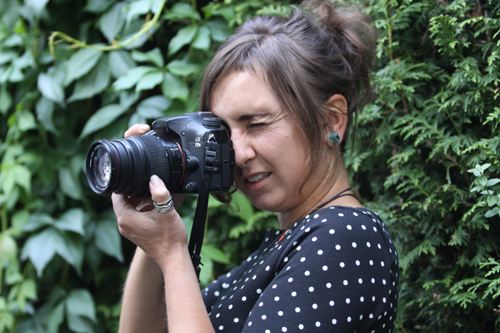
 The international touring exhibition Bunt – Expressionism – Transborder Avant-Garde. Works from the Berlin Collection of Prof. Stanisław Karol Kubicki is coming in two days an end.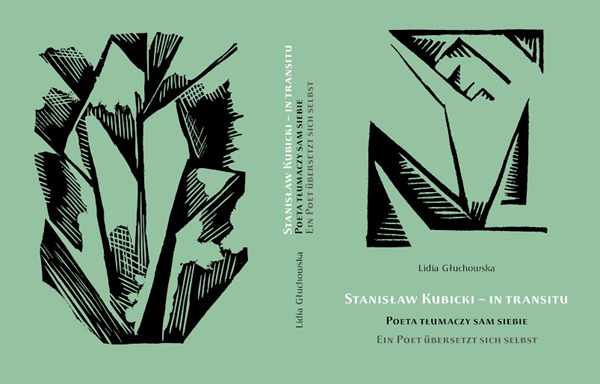



 Mehr über das Leben und Werk der Künstlerin in:

 Der Passion des pensionierten Theologen und seiner Ehefrau Edeltraud ist es zu danken, dass ihr beider jahrzehntelange Sammelleidenschaft aus Magdeburg ein Mekka polnischer naiver Schnitz- und Malkunst im Osten der Republik gemacht hat. Aus über Jahrzehnte gewachsenen Freundschaften sind inzwischen viele und vielbeachtete Ausstellungen entstanden.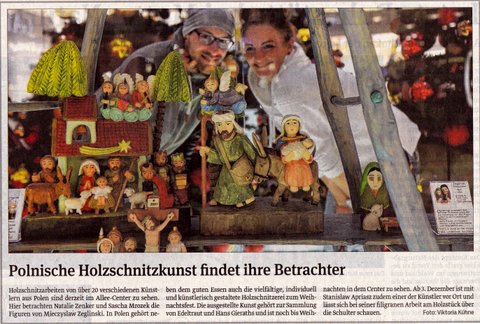
 Das Magdeburger Allee-Center
 Dr Lidia Głuchowska

 The linocut by Andrzej Bobrowski Transformation M/S [Transformation M(argarete)/ S(tanisław)] refers to the self-portrait of Margarete Kubicka from 1917 and the Self-portrait IV of her husband which was not preserved but is only known from the publications of Zdrój and Die Aktion magazines in 1918. This contemporary work of graphic art of a hybrid and panoramic composition in a form that refers to the banner is a reflection on the creative and personal relationship of the Kubickis. It is also a reflection on the passing of time and the details of artistic biographies receding in group memory, but also on group identity and the lack of integrity of an artifact in the epoch of its technical reproduction.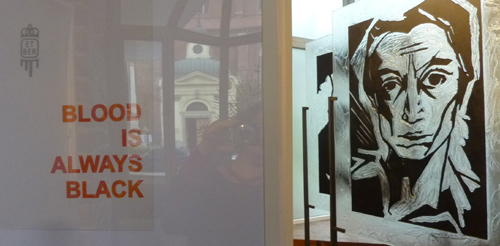




 Plakat zapowiadający pokaz filmu dokumentacyjno-artystycznego Bunt – Re-wizja i widok na wnętrze ekspozycji Retrospektywa. Na pierwszym planie prace Andrzeja Bobrowskiego i Katarzyny Dziuby.
 Galeria Biblioteki Uniwersyteckiej, Zielona Góra, wernisaż w dniu 23.10.2015
 Jan Berdyszak, Studium PO. XIV, 1980-1983 (autooffset)

 Wklęsłodruk Tadeusza Jackowskiego i druk cyfrowy Grzegorza Nowickiego
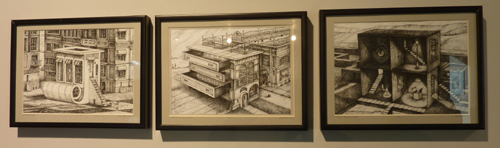 Rysunki tuszem Piotra Czecha z lat 2010-2014

 Piotr Szurek, Autoportret, 2015 (akwatinta, sucha igła)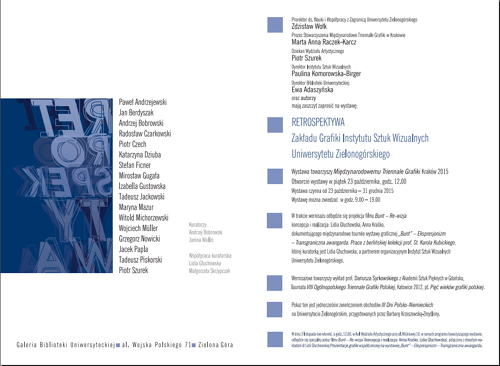




 Ewa Maria and Friends