because it is really worth of reblogging. Just so!
Dr Lidia Głuchowska
Yiddishland and the utopie of Avant-Garde
 (…) …„Yiddishland“, the patria of the new, secular Yiddish culture of the Central East European Diaspora. To its inhabitants or rather residents belonged pro-Russian Litvaks, sympathising with socialism and rooted in the misnagda tradition; pro-Austrian Galitsianers influenced by Haskala and open to assimilation; and Hasidic pious Polakes, loyal to the pre-partioned Poland. This population was subject to migration and urbanisation processes, which additionally differentiated it. The cultural revival of the “Yiddishland” depicts in an especially evident way the problem of the deterriorisation of the international avant-garde.The interdisciplinary and transborder Yiddish avant-garde was active mainly in the former “Ansiedlungsrayon” of the Russian Empire, which means in Poland, Ukraine and Belarus, but also in other parts of Central Europe – like in Latvia, Romania or Germany – and in the United States. Its representatives emphasised ties with the Yiddish language and culture – common among the inhabitants of these areas, so called Yiddishism. This movement was considered to be a conception opposite to the Haskala renaissance, the revival of Hebrew and Zionism, aiming at founding an independent Jewish state and based on the restitution of Hebrew as an official literary language.
The following essay presents the structure of Yiddish avant-garde within the universal network of international avant-garde consisting of such components as art groups, magazines exhibitions, cafés, cabaret and theatre, and communicating with its own lingua franca. (…)
The avant-garde network has been often compared with the Diaspora. A paradigmatic avant-garde artist was cosmopolitan, multilingual and mobile – acting in the transborder cultural space and the distribution radius of the avant-garde manifestos extending from Scandinavia to the Balkans, and from Paris to Moscow. Against this background, Central Eastern Europe, which could be geographically identified with the area of the utopian “Yiddishland“, was more specifically “a region of constant migration, immigration and emigration, of people arriving, departing and moving around”. “Nomadic modernism” was another essential phenomenon of artistic internationalism in this period. (…)
 … it has to be pointed out, that while, in general, in looking for the realisation of the utopia of a borderless “new world”, most of the émigrés were outsiders acting as insiders, the members of the Yiddish avant-garde were always outsiders, acting in foreign national or international contexts.
According to the political limitations, for example after a period of the flourishing of the avant-garde tendencies in the Soviet Union, several Jewish artists felt pushed to emigration. As a consequence of less or more convenient political or economical conditions the process of the deterriorisation considered not only actors of the cultural process themselves, but also their works. A number of art journals also appeared initially at one, then at another place, sometimes abroad (…) or been published in the German Metropolis parallel in Yiddish and Hebrew and was addressed to the different competing fractions of the Jewish national-artistic movement, divided between the Yiddishists and Zionists. Lissitzky, Berlewi or Marc Chagall – who in opposition to his two colleagues did not explicitly support the idea of Yiddishism – were active in different countries and published their manifestoes in various languages.
The fact of a great relevance is that in a way, the Yiddish avant-garde was a Diaspora in a double sense. It participated in an avant-garde network on two levels. On an international level its members cooperated locally with Russian, Polish, Romanian or German groups in the singular national “household” countries and their representatives abroad. Simultaneously, on the national level they had several other local and cross-border contacts and were involved in the artistic life of their Yiddish-speaking communities. (…)
Some characteristics of the international avant-garde as a utopian borderless “new world” seem to fit to the Yiddish avant-garde in a particular way. The “Yiddishland” as a political utopia generated several images of the cultural transfer associated with its maps as a whole. (…) Such maps gave a glimpse of a major myth for a whole generation of artists, their collaborative project, a dream like imago mundi. Attempts in creating the artistic topography, sometimes in a comprehensive global way, sometimes on a smaller scale, were also the Panslavism, the zenitist aim of the Balkanisation of Europe or – much less researched idea of Yiddishism concerning the bigger part of Central-Eastern Europe. (…)
 The echo of these historical maps or symbols of the cultural transfer are the schemes of the network, which correspond with the current historiographical concepts (…). While the first one seems to symbolize the stable construction of the right angled lines, the other one, through the usage of the diagonals, suggest the dynamic of the exchange-processes, a motion. (They are) not identical; this means on the one side that the Yiddish network has got partly other exchange centres, and, on the other side it also evaluated in the time. After the limitations of the artistic autonomy in the Soviet Union, the Yiddish avant-garde network became smaller and shifted to the West… (…)
In the past two decades, the avant-garde have been examined as an intellectual and spiritual alliance, as a model of a “new community” pursuing a “new world”, consisting of the interconnected locations of cosmopolitan artistic life in Central Europe such as Bucharest, Budapest, Łódź, Prague and Zagreb, with links to Amsterdam, Berlin, Dessau, Moscow, Paris, Vienna and many other cities in other parts of Europe and the world. In this way the newer narratives contribute to overcoming the previous dualistic approach to the European avant-garde, which divided the artistic map of the continent between Western “centres” and Eastern “peripheries”. The old canon has meanwhile been replaced by a more sophisticated approach, in which the geographical centre of the continent is no longer perceived as its periphery. In opposition to that the visualisations of the network of the Yiddish avant-garde, with its centres in Minsk, Kiev, Kharkov, Riga, Odessa, Saint-Petersburg, Odessa, Moscow, Vilna, Łódź and Warsaw, as well as in Berlin, Paris and New York, are of a much younger datum and the discussion on it in the more general, supranational context is still a desideratum of new cultural historiography.
Apart of the comparison of the imaginative maps of the avant-garde and Yiddish avant-garde universe, also a closer glance at another self-advertising strategy of the(se) movement(s), shows both interesting similarities and differences. One of their major media promoting the universal spirit of art were the little magazines, which all together contributed to a “worldwide network of periodicals”. (…)
Warsaw thereby acquired the status of a European centre for Yiddish literature, with Paris and Berlin serving as its satellites. (…) However, what has to be pointed out is that, even if Yiddish as a language was represented here, the magazine popularised not the idea of Yiddishism, but the opposite one – Zionism. (…)
Paradoxically, both in the case of the international avant-garde and the Yiddish one as its very specific case, their cartography, manifestos and the network of magazines presented a new sphere of the transborder artistic exchange, which can be seen as the anticipation of a future perfect, of modernisation projects characterised by new forms, frequently with an emphasis on ethics rather than aesthetics. In both cases they refer to a utopian community, neglecting the political reality of the period.
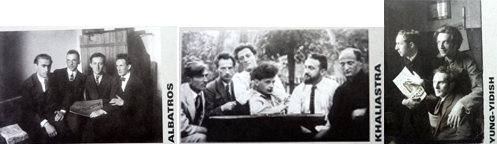
Almanac Yung-Yidish – Songs in word and image (…)
One of its innovative qualities was the breaking the rules of the Jewish tradition, such as the biblical ban on images. The typical avant-garde integration of word and image, (…) the domination of the forbidden image over the word was a kind of redefinition of a cultural code and its extension into the zone of taboo. (…) The three issues of Yung-Yidish were published on packing paper between February and December 1919 with a print-run of 350 to 500 copies. (…) Like most avant-garde periodicals, it was an ephemeral publication, even if it grew more interesting and bigger with each new issue. (…) Despite the advanced plans, the 4th issue, dedicated to the biblical Ruth, never came out because of financial reasons. (…)
The Yung-Yidish magazine, representing the main ideas of Yiddish avant-garde, set out its programme in two manifestos. The first, unsigned, in the periodical’s first issue, rebelled against the chaos and materialistic character of the present, and defended the eternal values of God, beauty, and truth. Yung-Yidish artists defined themselves as realists in a mystical faith, admiring art and both Jewish languages: the young one – Yiddish – and the ancient one – Hebrew – the language of the prophets. In the manifesto of the second issue, Broderzon stressed the ties of the Yiddish avant-garde with the millennium tradition of universal culture. Invoking the Bible, including the Psalms and “The Song of Songs”, and thus the tradition of Judaism, he once again pointed to the metaphysical concept of art. Adler too, in the same issue, evoked the Chasidic tradition in his “Prayer”. (…)
Historiography of the avant-garde, written by representatives themselves or by specialised scholars since World War II, often assumes that at the end of the first decade of the twentieth century an internationalist inclination superseded nationalist tendencies which had typified the nineteenth century, when art and architecture were instrumentalised as true manifestations of nationhood. In Central Eastern Europe the internationalist avant-garde conception of a “new world” had to compete with the predominance of conceptions of national modernisation and the idea of a national responsibility of the arts in the “new states”. (…) Internationalism, multiculturalism and multilingualism though not desired in the official life, belonged to the reality of art and present life. (…)
 One of the consequences of this process, intensified by the multilingualism and multiculturalism on a personal level, was the cultural syncretism both in the form and content of artistic production. Among others, this syncretism is apparent in a non-confessional religiousness which combined Christianity or Jewish religious conceptions, via theosophy, with Buddhism and other Eastern religions. (…) there was an explicit demand for a plurality of styles (…) and it was Futurism that played the key role in “new art”. (…)
The problem of the national awakening (…) concerns, however, not only the real existing “new” national states in Central Eastern Europe, but also (re)constructing the national consciousness and culture of the “Yiddishland” being in general the “underground structure” of the really existing political organisms in the interwar period, the same way as the literature of the Yiddish avant-garde was an exterritorial one, which but did not have any foundation in any specific national country.
Yiddish, which since the 1908 conference in Czernowitz was recognised as the language of Jewish culture on a par with Hebrew, was here the prime token of identity. In contrast to it, other languages like German, Russian and Polish, were the means of communication of assimilated Jews, whereas Hebrew, the language of religion, was unknown to the general Jewish population and was removed from its Central and Eastern European roots. The style of the poetry of the Yiddish avant-garde is characteristic of the entire literature of a community that survived the atrocities of World War I and a history of pogroms and revolutions. It expressed less the beauty than the horror. Its poetics bear the imprint of Yiddish Expressionism. (…)
In this context one has to maintain a paradoxical fact: not only as a literary but also as a communicative medium Yiddish often has to be constituted/restituted among the members of the Yiddishist movement. (…) And – which is not a well known fact – they mostly communicated in the languages of the “household” states (…). On the other hand, the Yiddish poets, like e.g. Peretz Markish, creatively used the polysemiotic senses of the Slavic languages, even in their programmatic manifestoes.
Yiddish as a language of the Diaspora which before World War II appealed to readers in most parts of Central Eastern Europe (…) …transgressed political borders, but at the same time had a national function. Because of that, with time however some of the representatives of the Yiddish avant-garde (…) looking for broader recognition decided to use mainly other languages and in a way lost this part of their identity, at least as a means of artistic expression. (…)
 In Central Eastern Europe the tensions between the universal and the particular, the international and national, were stronger than elsewhere on the continent. The modernisation impulse from the respective political centres in the single new states contributed to hybrid results privileging local materials, ornaments and themes. Artists tried (…) to transform foreign artistic patterns, creating local idioms of the international avant-garde code (…). Sometimes these permutations and hybridisations of Central European art are perceived as a consequence of the Jewish influence, with the affinity to richness and orientalism. Sometimes, however, both the whole (Central) Eastern European art and the new secular Jewish one being one of the main aims of the Yiddish avant-garde, has been associated with the hybrid components and the biomorphic metaphor of a world in statu nascendi (…)
In a special way, the avant-garde interest in new universal signs in the visual arts and design also resulted in a standardised typography. Innumerable examples which can be found in books, little magazines or posters, including collages or photomontages and especially exotic and impressive when printed in Cyrillic or Hebrew letters, established “a sort of international hieroglyph”. And often – only this one component of the Jewish identity, the language being, next to the culture and religion – Judaism a proof of “Jewishness”. In its written form it was used not only as and artistic medium, but also as a symbol of identity (…)
Efforts to create a universal style and an avant-garde corporate identity were crowned with an International Art Collection in Łódź in 1931, the first presentation of contemporary art to be permanently exhibited in a state museum in Europe. (…)
Jankel Adler in his article (1920) about expressionism which at that the time was still generally identified with the whole of progressive art stressed out its links with the sacral sphere: “We are the children of the 20th century. […] Stuffy air was our first breath. Our first walk are accompanied by the thousand fold by a choir of ringing trams, the staccato of horse-cabs, whimpering freight trains, speeding automobiles and a choir and noisy passages with criss-cross the streets with a thousand diagonals […] Art of the 20th century, the art of expressionism was born at that longing [after the God LG] and became the seventh day of the working week.”
Two years later his colleague Berlewi already after his return from Germany became a follower of the “new form” and meant: “I had to give up purely Yiddish problems completely and then I devoted myself to cubists and the constructivist’s experiments. Currently my task is to create something European”. (…)
 To the general components of the avant-garde paradigm belongs the performative character of its manifests and manifestations. Regarding the Yiddish avant-garde, the most authentic and most long lasting emanations of its identity was, next to the programmatic texts and new secular visual art, the theatre, reflecting the every day life experience of the Yiddish population. In its carnival-like art (…) it appeared as especially attractive to a wide audience in Central Europe. In this sense, being even a mirror and mimicry of life and the part of life itself, it can be considered as the most and thus effective, performative manifesto of the Yiddish avant-garde.
Due to the hostility of orthodox religious communities it was formed relatively late, in 1876 in Jassy (Romania). The name of its founder, Graham Goldfaden, inspired the description of the whole genre, inspired by such folk songs and the traditions like the Purim-spiel of Biblical motifs. Between 1878 and 1905 the Tsar had forbidden the staging of performances in Yiddish, but Goldfaden’s theatre still used this “Jargon”. It was partly disregarded also among Jewish intellectuals, opting for the revival of Hebrew or the assimilation, concerning it as shund (garbage). (…) As an alternative to it several other theatre groups were grounded (…) (also) small artistic theatres and cabarets…(…), performances (…).
If internationalism is generally considered a conditio sine qua non of the avant-garde, the national question can be perceived as the contrasting intertext, as a negative point of reference for an international avant-garde ideology, or at least as a set of ideas which had to be addressed. The artists of the Yiddish avant-garde gathered e.g. around such magazines as Yung-Yidish or Yung-Vilne (…) deserve special attention. They were major platforms of Yiddishism, (…) unlike the rest of the Jewish artists who were often assimilated (…). They represented a second generation of new Jewish culture. Whereas the first one tried to create a European opening for Yiddish culture, the second, on the contrary, strove to introduce “the Jewish world” into European culture. As such, the Yiddish avant-garde operated “in-between”, addressing the issue of “the other” in a more poignant way than the rest of the avant-garde, provoking a deconstruction of the official conception of the “new state” as an ethnic and cultural monad, which they considered to be merely a political construct. As “universal others”, they were predestined to become spokespeople for an ‘inter-national’ avant-garde. The motivation for their stylistic choices was, however, not underpinned by a universal aesthetic based in an “escape from history”, but rather by a symbolic discourse of the marginalised in relation to the relevant national cultural context and historiography.(…)
 Their common work and the three issues of Yung-Yidish over the previous two decades are treasured by a handful of libraries in the world as an imposing body of work by the Yiddish avant-garde, arriving at its dire epilogue in the Nazi Entartete Kunst (Degenerate Art) exhibition of 1937 and the Holocaust. (…)
Because of its national aims and structures, but possibly also a missing recognition from the outside, it can be, on the one hand perceived as a hermetic or maybe separate/isolated network, parallel to a universal one and not its subdivision. On the other hand, its exterritorial character and numerous transborder links predestined it to be even a model of the international network as its pars pro toto.
In opposition to the predominant meanings it was not isolated from the local context of the “household” countries. In contrary, following the own national aims, it also looked for the universal perspectives and acceptance in Central Eastern European “new states”, which in opposition to the “Yiddishland” became real political organisms. (…)
For the Yiddish avant-garde attempts of the transmission of their own heritage and ideological proposals were a difficult compromise. Often the transfer from the different “householders’” cultures appeared as dominant and the transmission turned out into cultural transgression. (…)
In fact, in a great scale, after the revolution in the Soviet Union the Yiddish avant-garde network became smaller and its idea of an independent national modern culture failed. It was misused by the propaganda and became “an art for the masses”. According to the Lissitzky’s conception it was the third stage of the transgression. The fourth one was represented by the stylistic turn of the Yiddish avant-garde, e.g. by his own pangeometry. (…)
Not only the idea of Jewish art, but also – in particular, the message transferred in the name of the prominent group of the Yiddish avant-garde – Jung Vilne – were perceived as oxymorons. The last one, created in the old centre of Jewish culture – the Jerusalem of the North ceased to exist much later than the other groups of the Yiddish avant-garde movement – in the Nazi time (…)
Arie Ben-Menachem created an album of photomontages Ghetto. Terra Incognita (…) Its title seems to define the status of the “Yiddishland” and its new secular art, as well as its little reception in the international avant-garde studies.
All the mentioned examples of the contradictory attitude towards the perspectives of the proper milieu for the development of their own identity stand on the one side for the tendency to transgress and as a consequence a compromise of partly assimilation and acculturation in the foreign context, and on the other side – for a strong opposition against it. In this sense the history of the Yiddish avant-garde is a document of both – plurality of Judaism on the one side and of the – (pre)modern liquid identity of Jewish artists in general – on the other one.

Yiddishland Image captions:
Pola Lindenfeld with her sister Eugenia, Photo, courtesy S. Karol Kubicki, Berlin
Teresa Żarnower, c. 1920, Photo from: Andrzej Turowski, Budowniczowie swiata, Cracow 2000.
Other photos:
Nathalie Hazan-Brunet and Ada Ackerman (eds.): Futur antérieur: L’avant-garde et le livre yiddish (1914–1939), Paris 2009.
& Wikipedia Commons, http://www.ecoledeparis.org, http://www.infocenter.co, http://www.e-teatr.pl, http://www.rp.pl, US Holocaust Memorial Museum, http://www.museumoffamilyhistory.com, http://www.jewishgen.org
Full text version with footnotes published in: Lidia Głuchowska, From Transfer to Transgression. Yiddish Avant-Garde – a Network within the Universal Network of the International Movement or a Complementary One? In: Harri Veivo (ed.): Transferts, appriopriations et fonctions de l’avant-garde dans l’Europe intermédiataire et du Nord [Cahiers de la nouvelle Europe, hors serie], Paris 2012, pp. 143-168.
http://www.fabula.org/actualites/harri-veivo-sous-la-dir-de-transferts-appropriations-et-fonctions-de-l-avant-garde-dans-l_52704.php
Also to read: about „Jidyszland” in Polish press



 Good luck to all of you!



 Somehow this is a topic that always comes up during family dinners… or when you want something and get a lecture how your parents didn’t have anything during communism.

 Not everyone in your school is Polish so naturally you have your American friends that just do not get your Polish parents or why you have to go to Polish school. Regardless, having two groups of friends is awesome because some there are some things that your American friends will just never get if they’re not Polish.











 Monika Marzec








 Ewa Maria and Friends