
Ewa Maria Slaska
I was invited to America by my friend. Thank you Iwona! It is great to be with you here!
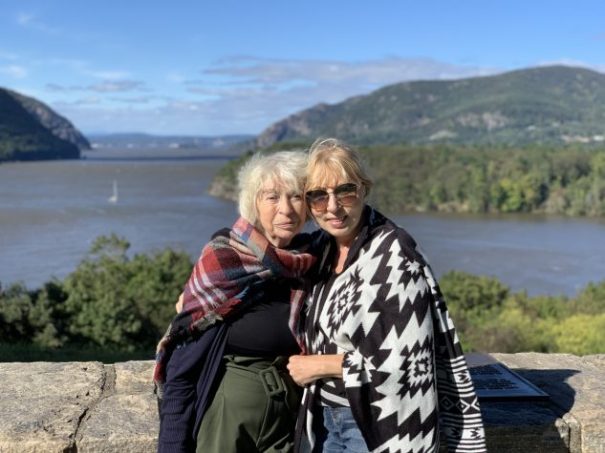
It is already my third day in America.
Yesterday I was told that today we will visit West Point.
Do you know what West Point is? Oh, I said, something military.
I visited USA 27 years ago so I was aware that Kosciuszko was involved in the revolutionary war here.
I asked my friends “do Americans know that he was Polish?; they pronounce his name as Kosciusko?” I was assured that Americans know that he was a Pole but I still had doubts.
Shortly after we were in the United States Military Academy, also called West Point. Originally established as a fort, it is a national landmark full of historic monuments and buildings. Kosciuszko, military architect designed and managed construction of the West Point’s fortification. He even build tranquil Kosciusko Garden, overlooking stunning Hudson River, where he would retreat to relax and contemplate. Soon we approached his monument. I was proud to see how prominent Kosciuszko’s role was in Polish and American history.
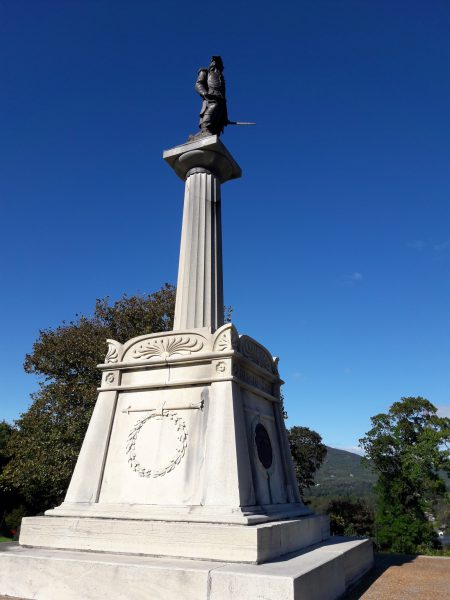
Do you recognize him? Tadeusz Kościuszko!
From Wikipedia:
He was born 1746, died October 15, 1817. He was Polish-Lithuanian military engineer, statesman, and military leader who became a national hero in Poland, Lithuania, Belarus, and the United States. He fought in the Polish-Lithuanian Commonwealth’s struggles against Russia and Prussia, and on the U.S. side in the American Revolutionary War. He studied in Warsaw and Paris, then 1776 moved to America, where he took part in the American Revolutionary War as a colonel in the Continental Army. An accomplished military architect, he designed and oversaw the construction of state-of-the-art fortifications, including those at West Point, New York. In 1783, in recognition of his services, the Continental Congress promoted him to brigadier general. Upon returning to Poland in 1784, Kościuszko was commissioned as a major general in the Polish-Lithuanian Commonwealth Army in 1789. After the Polish–Russian War of 1792 resulted in the Second Partition of Poland, he organized an uprising against Russia in March 1794 (Powstanie Kościuszkowskie), serving as its Naczelnik (commander-in-chief). Russian forces captured him at the Battle of Maciejowice in October 1794. The defeat of the Kościuszko Uprising led to Poland’s Third Partition in 1795, which ended the Polish–Lithuanian Commonwealth’s independent existence for 123 years. In 1796, following the death of Tsaritsa Catherine the Great, Kościuszko was pardoned by her successor, Tsar Paul I, and he emigrated to the United States. A close friend of Thomas Jefferson’s, with whom he shared ideals of human rights, Kościuszko wrote a will in 1798 dedicating his U.S. assets to the education and freedom of U.S. slaves. He eventually returned to Europe and lived in Switzerland until his death in 1817. The execution of his will later proved difficult, and the funds were never used for the purpose he had intended.
***
My friends live in Ramsey, New Jersey, one of many bedroom communities close to New York City; 45 minutes by car or train. Ramsey is located five minutes from the Appalachian Mountains. On our way to West Point we drove through Seven Lakes – as name implies group of seven large and few small, picturesque lakes. Via curvy and steep Perkins Memorial Drive we reached the top of the Bear Mountain. It is breathtaking view of the Hudson Valley, Catskill Mountains.
It is sunny autumn day. We are surrounded by huge green forests. Some trees are already covered in a fall foliage, the whole landscape is shiny and golden.
We plan to visit this area in 2 weeks, hoping that Appalachian Trial and Bear Mountain will be covered with vivid fall colors. We are stopping every now and then so I can take pictures. Once, far away behind river, lakes, forests and hills we see again skyline of New York City. I was thrilled that day.


 Ewa Maria and Friends
Super rewelacyjny to jest jest blog według mnie. Wszedłem na niego przypadkowo z google.